Proceedings of Recent Advances in Natural Language Processing, pages 446–451,
A Statistical Machine Translation Model with Forest-to-Tree Algorithm
for Semantic Parsing
Zhihua Liao
College of Teacher Education Center for Faculty Development
Hunan Normal University Changsha, China
Yan Xie English Department Foreign Studies College Hunan Normal University
Changsha, China
Abstract
In this paper, we propose a novel super-vised model for parsing natural language sentences into their formal semantic rep-resentations. This model treats sentence-to-λ-logical expression conversion within the framework of the statistical machine translation with forest-to-tree algorithm. To make this work, we transform the λ -logical expression structure into a form suitable for the mechanics of statistical machine translation and useful for model-ing. We show that our model is able to yield new state-of-the-art results on both standard datasets with simple features.
1 Introduction
Semantic parsers convert natural language (NL)
sentences to logical forms(LFs) through a mean-ing representation language (MRL). Recent re-search has focused on learning such parsers di-rectly from corpora made up of sentences paired with logical meaning representations (Artzi and Zettlemoyer,2011, 2013;Liao and Zhang,2013;
Liao et al.,2015b,a;Lu et al., 2008;Lu and Ng,
2011; Krishnamurthy, 2016;Kwiatkowski et al.,
2010,2011;Zettlemoyer and Collins,2005,2007,
2009). And its goal is to learn a grammar that can map new, unseen sentences onto their correspond-ing meancorrespond-ings, or logical expressions.
While these algorithms usually work well on specific semantic formalisms, it is not clear how well they could be applied to a different se-mantic formalism. In this paper, we propose a novel supervised approach to learn semantic pars-ing task uspars-ing the framework of the statistical machine translation with forest-to-tree algorithm. This method integrates both lexical acquisition and surface realization in a single framework.
In-spired by the probabilistic forest-to-string gener-ation algorithm (Lu and Ng,2011) and the work of Wong and Mooney (2006;2007a; 2007b) and Wong (2007) that learn for semantic parsing with statistical machine translation, our semantic pars-ing framework consists of two main components. Firstly it contains a lexical acquisition component, which is based on phrase alignments between nat-ural language sentences and linearized semantic parses, given by an off-the-shelf phrase alignment model trained on a set of training examples. The extracted transformation rules form a synchronous context free grammar (SCFG), for which a prob-abilistic model is learned to resolve parse ambi-guity. The second component is to estimate the parameters of a probabilistic model. The paramet-ric models are based on maximum-entropy. The probabilistic model is trained on the same set of training examples in an unsupervised manner.
This paper is structured as follows. Section 2 describes how we build the framework of the sta-tistical machine translation with forest-to-tree al-gorithm to develop a semantic parser, and Section 3 discusses the decoder. Then Section 4 presents our experiments and reports the results. Finally, we make the conclusion in Section 5.
2 The Semantic Parsing Model
Now we present the algorithm for semantic pars-ing, which translates NL sentences into LFs us-ing a reduction-basedλ-SCFG. It is based on an extended version of a reduction-based SCFG (Lu and Ng,2011). Given a set of training sentences paired with their correct logical forms, the main learning task is to induce a set of reduction-based
λ-SCFG rules, which we call a lexicon, a proba-bilistic model for derivations. A lexicon defines the set of derivations that are possible, so the in-duction of probabilistic model first requires a
sepa-NL LF r:he, ti1
give me he, ti1 :λg.λf.λx.g(x)∧f(x)/he, ti1 /he, ti2
he, ti1 :λx.state(x)
the states
he, ti2 :λf.λg.λx.∃y.g(y)∧(f(x)y)/hehe, tii1 /he, ti2
he,he, tii1 :λy.λx.next to(x, y)
bordering
he, ti2 :λg.λf.λx.g(x)∧f(x)/he, ti1 /he, ti2
he, ti2 :λx.state(x)
states
he, ti1 :λy.λx.loc(y, x)/ e1
that e1 :miss r
the mississippi
runs through
Figure 2: One exampleλ−hybrid tree for the sentence “give me the states bordering states that the mis-sissippi runs through” together with its logical form “λx0.state(x0)∧∃x1.[loc(miss r, x1)∧state(x1)∧
next to(x1, x0)]”.
type 1: he,he, ti → hbordering,λy.λx.next to(x, y)i
he, ti → hhe, tih2 e, ti1, λg.λy.λx.g(x)∧f(x)/he, ti1 /he, tii2 type 2: he, ti → hstates that the mississippi runs through,λx.loc(miss r, x)∧state(x)i
he, ti → hthat the mississippi runs through,λx.loc(miss r, x)i
type 3: he, ti → hthe states borderinghe, ti1, λf.λx.state(x)∧ ∃y.[f(y)∧next to(y, x)]/he, tii1 he, ti → hstates thate1 runs through,λy.λx.loc(y, x)∧state(x)/ ei1
Table 1: Example synchronous rules that can be extracted from theλ−hybrid tree.
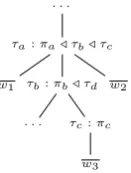
Tree fragment:
he, ti2 :λg.λf.λx.g(x)∧f(x)/he, ti1 /he, ti2
he, ti2 :λx.state(x)
states
he, ti1 :λy.λx.loc(y, x)/ e1
that e1 :· · · runs through Source: states thate2runs through
Target: (α−conversion)⇒λy.λx.loc(y, x)∧state(x)/ e1 (β−conversion)⇒λy0.λx.loc(y0, x)∧state(x)/ e1
(twoβ−conversion)⇒λy0.[λf.λx.loc(y0, x)∧f(x)/ λx.state(x)]/ e1
(substitution)λy0.[λg.λf.λx.g(x)∧f(x)/[λy.λx.loc(y, x)/ y0]/ λx.state(x)]/ e1 Rule: he, ti → hstates thate1 runs through,λy.λx.loc(y, x)∧state(x)/ ei1
as-(a) The Geo250 test set
system Rec. Pre. F1
λ-WASP 75.6 91.8 82.9
UBL 81.8 83.5 82.6
FUBL 83.7 83.7 83.7
SMTFOREST2STRING 85.0 88.5 86.8 (b) The Geo880 test set
system Rec. Pre. F1
ZC07 86.1 91.6 88.8
UBL 87.9 88.5 88.2
FUBL 88.6 88.6 88.6
SMTFOREST2STRING 89.6 91.8 90.7
Table 3: Performance of Exact Match between the different GeoQuery test sets.
system Rec. Pre. F1
ZC07 74.4 87.3 80.4
UBL 65.6 67.1 66.3
FUBL 81.9 82.1 82.0
SMTFOREST2STRING 84.2 90.3 87.3
Table 4: Performance of Exact Match on the ATIS development set.
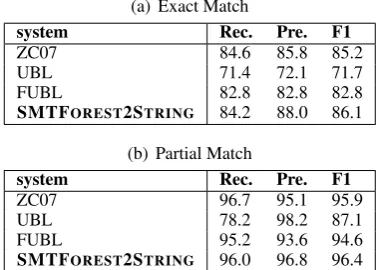
(a) Exact Match
system Rec. Pre. F1
ZC07 84.6 85.8 85.2
UBL 71.4 72.1 71.7
FUBL 82.8 82.8 82.8
SMTFOREST2STRING 84.2 88.0 86.1 (b) Partial Match
system Rec. Pre. F1
ZC07 96.7 95.1 95.9
UBL 78.2 98.2 87.1
FUBL 95.2 93.6 94.6
SMTFOREST2STRING 96.0 96.8 96.4
Table 5: Performance of Exact and Partial Matches on the ATIS test set.
split into a training set of 600 pairs and a test set of 280 ones. The Geo250 dataset is a subset of the Geo880, and is used 10-fold cross validation ex-periments with the same splits of this subset. The ATIS dataset is split into a 5000 example develop-ment set and a 450 example test set.
Initialization: For our algorithm learning, we use Och and Ney’s (2003;2004) GIZA++ implemen-tation of IBM Model 5 for training word alignment models. IBM Models 1-4 are used for initializing the model parameters during training.
Systems: We compare this performance to those recently-published and directly-comparable results. For GeoQuery, they include the ZC07 (Zettlemoyer and Collins, 2007), λ -WASP (Wong and Mooney, 2007b; Wong,
2007), UBL (Kwiatkowski et al., 2010) and FUBL (Kwiatkowski et al.,2011). For ATIS, we report results from ZC07, UBL and FUBL. Results: Tables 3-5 present all the results on the GeoQuery and ATIS domains. In all cases, our system achieves at state-of-the-art recall and pre-cision when compared to directly comparable sys-tems and it significantly outperforms ZC07, λ -WASP, UBL and FUBL. The major advantage of our algorithm over other three systems is that it does not require any prior knowledge of the NL syntax. Hence it is straightforward to apply this algorithm to other NL sentences for which train-ing data is available.
5 Conclusion
This paper presents a novel supervised method for semantic parsing which adopts the framework of the statistical machine translation with forest-to-tree algorithm. The experiments on both bench-mark datasets (i.e., GeoQuery and ATIS) show that our method achieves suitable performances.
Acknowledgments
References
Yoav Artzi and Luke Zettlemoyer. 2011. Bootstrapping semantic parsers from conversations. In the Con-ference on Empirical Methods in Natural Language
Processing (EMNLP).
Yoav Artzi and Luke Zettlemoyer. 2013. Weakly su-pervised learning of semantic parsers for mapping instructions to actions. Transactions of the Associa-tion for ComputaAssocia-tional Linguistics (TACL). Philipp Koehn, Franz Josef Och, and Daniel Marcu.
2003. Statistical phrase-based translation. In the Conference of the North American Chapter of the Association for Computational Linguistics (NAACL-HLT).
Jayant Krishnamurthy. 2016. Probabilistic models for learning a semantic parser lexicon. In the Confer-ence of the North American Chapter of the
Associa-tion for ComputaAssocia-tional Linguistics (NAACL-HLT).
Tom Kwiatkowski, Luke Zettlemoyer, Sharon Gold-water, and Mark Steedman. 2010. Inducing prob-abilistic ccg grammars from logical form with higher-order unification. Inthe Conference on Em-pirical Methods in Natural Language Processing
(EMNLP). Cambridge, MA.
Tom Kwiatkowski, Luke Zettlemoyer, Sharon Goldwa-ter, and Mark Steedman. 2011. Lexical generaliza-tion in ccg grammar inducgeneraliza-tion for semantic parsing.
Inthe Conference on Empirical Methods in Natural
Language Processing (EMNLP). Edinburgh, UK.
Zhihua Liao, Qixian Zeng, and Qiyun Wang. 2015a. Semantic parsing via`0-norm-based alignment. In
Recent Advances in Natural Language
Process-ing(RANLP). pages 355–361.
Zhihua Liao, Qixian Zeng, and Qiyun Wang. 2015b. A supervised semantic parsing with lexical extension and syntactic constraint. InRecent Advances in
Nat-ural Language Processing(RANLP). pages 362–370.
Zhihua Liao and Zili Zhang. 2013. Learning to map chinese sentences to logical forms. Inthe 7th Inter-national Conference on Knowledge Science,
Engi-neering and Management (KSEM). pages 463–472.
Wei Lu and Hwee Tou Ng. 2011. A probabilistic forest-to-string model for language generation from typed lambda calculus expressions. Inthe Confer-ence on Empirical Methods in Natural Language
Processing(EMNLP).
Wei Lu, Hwee Tou Ng, Wee Sun Lee, and Luke S. Zettlemoyer. 2008. A generative model for parsing natural language to meaning representations. Inthe Conference on Empirical Methods in Natural
Lan-guage Processing(EMNLP).
Franz Joseph Och and Hermann Ney. 2003. A sys-tematic comparison of various statistical alignment
Franz Joseph Och and Hermann Ney. 2004. The align-ment template approach to statistical machine trans-lation.Computational Linguistics30:417–449. Yuk Wah Wong. 2007. Learning for Semantic Parsing
and Natural Language Generation Using Statistical
Machine Translation Techniques. Ph.D. thesis,
De-partment of Computer Sciences, University of Texas at Austin, Austin, TX.
Yuk Wah Wong and Raymond J. Mooney. 2006. Learn-ing for semantic parsLearn-ing with statistical machine translation. In the Human Language Technology Conference of the North American Association for
Computational Linguistics (NAACL).
Yuk Wah Wong and Raymond J. Mooney. 2007a. Gen-eration by inverting a semantic parser that uses sta-tistical machine translation. In the Conference of the North American Chapter of the Association for
Computational Linguistics (NAACL-HLT-07).
Yuk Wah Wong and Raymond J. Mooney. 2007b. Learning synchronous grammars for semantic pars-ing with lambda calculus. Inthe Conference of the Association for Computational Linguistics (ACL). Luke S. Zettlemoyer and Michael Collins. 2005.
Learning to map sentences to logical form: Struc-tured classification with probabilistic categorial grammars. In the 21st Conference on Uncertainty in Artificial Intelligence (UAI). pages 658–666. Luke S. Zettlemoyer and Michael Collins. 2007.
On-line learning of relaxed ccg grammars for parsing to logical form. Inthe Conference on Empirical Meth-ods in Natural Language Processing and the Confer-ence on Computational Natural Language Learning
(EMNLP-CoNLL). pages 678–687.
Luke S. Zettlemoyer and Michael Collins. 2009. Learning context-dependent mappings from sen-tences to logical form. In Joint conference of the 47th Annual Meeting of the Association for Compu-tational Linguistics and the 4th International Joint Conference on Natural Language Processing of the Asian Federation of Natural Language Processing