Original Research Article.
178 |P a g e Int J Med Res Prof.2018 Jan; 4(1); 178-82. www.ijmrp.com
Evaluation of Knowledge and Awareness of Heart Disease Among
Adults Population in Tabuk-2017
Saleh Hammad Alhawiti
1*, Waleed Essam Saleh
1, Mohammed Faisal Albalawi
2,
Rayan Mohammed Aloufi
1, Abdulelah Faiz Alasmari
1,
Khalid Awd Albalawi
1, Meshal Saleh Alatawi
31Medical Intern, Faculty of Medicine, University of Tabuk, Tabuk, KSA. 2Medical Resident, King Salman Armed Forces Hospital, Tabuk, KSA.
3Third Year Medical Student, Faculty of Medicine, University of Tabuk, Tabuk, KSA.
ABSTRACT
Introduction: According to World Health Organization (WHO), heart disease especially coronary heart disease is the leading cause of death globally and one of the major health burdens worldwide. A report released by the Media and Health Awareness Information Center at the Ministry of Health (MOH) in Saudi Arabia, pointed out that, Cardiovascular diseases (CVD), including heart attacks and strokes, are the cause of 42 percent of the Kingdom's non-communicable diseases deaths in 2010. Vascular injury accumulates in adolescence, making it necessary for primary preventive measures to be taken from childhood. Therefore, there is increasing emphasis on preventing atherosclerosis by modifying risk factors, such as healthy diet, exercise and avoidance of smoking.
Methods: We have conducted a descriptive cross-sectional study in Tabuk city population, Saudi Arabia. The study was conducted during the period from May to September 2017. The participants were selected by random sampling. Sampling was stratified for the different geographical areas of the city. The total sample obtained was 379. All the pupils were approached to obtain the desired sample size. A self-administered questionnaire, previously validated, about heart disease knowledge and awareness filled by participants.
Results: In average, more than half of participants have good knowledge about diet, half of them were aware of the
knowledge about epidemiology of heart disease, and third of them have correct medical information of heart disease. (39.5%) of participants know that a person cannot tell whether or not if he/she has high blood pressure, and (47.2%) disagreed to that high blood pressure is defined as 110/80 (systolic/diastolic) or higher.
Conclusion: More attention needed on primary prevention programs that focus on diet, exercise, and the danger of heart disease and its risk factors should be emphasized.
Keywords: Heart Disease Knowledge, Risk Factors, Awareness, Diet.
*Correspondence to:
Saleh Hammad,
Medical Intern, Faculty of Medicine, University of Tabuk, Tabuk, KSA.
Article History:
Received: 03-10-2017, Revised: 23-12-2017, Accepted: 14-01-2018
Access this article online Website:
www.ijmrp.com
Quick Response code
DOI:
10.21276/ijmrp.2018.4.1.035
INTRODUCTION
Cardiovascular diseases (CVDs) are group of disorders of heart and blood vessels. According to WHO, heart disease especially coronary heart disease is the leading cause of death globally and one of the major health burdens worldwide.1 For over 80 years,
heart disease has been the leading cause of mortality for both men and women of all ages and all races in the United States. Coronary heart disease (CHD) is the most common type of heart disease, killing over 370,000 people annually in the United States.2 A report released by the Media and Health Awareness
Information Center at the Ministry of Health (MOH) in Saudi Arabia, pointed out that, Cardiovascular diseases, including heart attacks and strokes, are the cause of 42 percent of the Kingdom's non-communicable diseases deaths in 2010. The report further
noted that the number of patients with cardiac diseases in the primary health centers mounts to 167,499 people of both males and females. The report underscored that the heart attacks and strokes are usually acute events and are mainly caused by a blockage that prevents blood from flowing to the heart or brain. The most common reason for this is a build-up of fatty deposits on the inner walls of the blood vessels that supply the heart or brain.3
179 |P a g e Int J Med Res Prof.2018 Jan; 4(1); 178-82. www.ijmrp.com
integrated primary health care programmes for early detection and treatment of people with risk factors compared to people in high-income countries. People in low- and middle-high-income countries who suffer from CVDs have less access to effective and equitable health care services which respond to their needs. As a result, many people in low- and middle-income countries are detected late in the course of the disease and die younger from CVDs, often in their most productive years.1 Some people are at greater
risk of cardiovascular disease than others. Major factors linked to an increased risk of CVD are grouped into two categories, non-modifiable and non-modifiable risk factors. Non-non-modifiable risk factors are factors that are outside of a person's control and cannot be reduced or altered. They are: family history, age, sex. Modifiable risk factors can be reduced or prevented by lifestyle behaviors or by medical treatment. They are: cigarette smoking, excessive alcohol consumption, raised blood cholesterol levels, high blood pressure, high blood glucose, physical inactivity, poor diet, Overweight and Obesity.4 It is estimated that 23.3 million people
will die by 2030, because of cardiovascular disease. High blood pressure, high cholesterol level, high Blood glucose level, smoking, obesity and physical inactivity are conventional risk factors.5 Although cardiovascular disease occurs in the middle age
or later, risk factors (smoking, dietary factors…etc.) are
determined to great extent by behaviors learnt in childhood and continued to adulthood.6 In the industrialized world, physical
activity continues to decline while total caloric intake increases. The resulting epidemic of overweight and obesity may signal the start of the age of inactivity and obesity. Rates of type 2 diabetes mellitus, hypertension, and lipid abnormalities are on the rise, trends that are particularly evident in children. If these risk factor trends continue, age adjusted CVD mortality rates could increase in the coming years. Adherence to healthy nutritional and lifestyle recommendations can play an essential role in the prevention of CVD.7 In order to encourage people to adopt a cardio protective
lifestyle; little is known about knowledge of cardiovascular risk factors in general population. Knowledge is an essential step in developing a more cardio protective lifestyle.8 Socioeconomic
indicator “education” is a strong predictor of cardiovascular risk
factor knowledge. Higher knowledge is associated with higher education. Socioeconomic polarization could partly explain the fact that a low socioeconomic position has been associated with higher morbidity and mortality of chronic diseases.9
METHODS
We have conducted a descriptive cross-sectional study in Tabuk city population, Saudi Arabia. The study was conducted during the period from May to September 2017. The participants were selected by random sampling. Sampling was stratified for the different geographical areas of the city. The sample size was calculated based on the formula (n= Z1-α2 P(1-P)/d2), where n=
sample size = 384,10,11 Z= standard normal variate = 1.96 (at 5%
type I error, p= 0.05), P= expected proportion = 50%, and d= precision error = 5%. Additional 20 % was added to cover the missing data. The total sample obtained was 460. All the pupils were approached to obtain the desired sample size. 81 respondents were excluded because they were below 20 years old, and the final total sample were 379. A self-administered questionnaire, previously validated12, about heart disease
knowledge, filled by participants. A letter that explains the objectives of the study and asks for participants consent was sent with the questionnaire. The questionnaire requires information Knowledge of risk factors, symptoms, and epidemiology of heart disease. The questionnaire responses were analyzed using the Statistical Package for the Social Science (SPSS Inc. Chicago, IL, USA) version 23. Categorical variables were described by frequencies and percentages. Descriptive analysis involving Chi-square test was used to test significance of association between categorical variables. The level of significance was set at P< 0.05. The research was approved by the local Research Committee of the Faculty of Medicine, University of Tabuk.
RESULTS
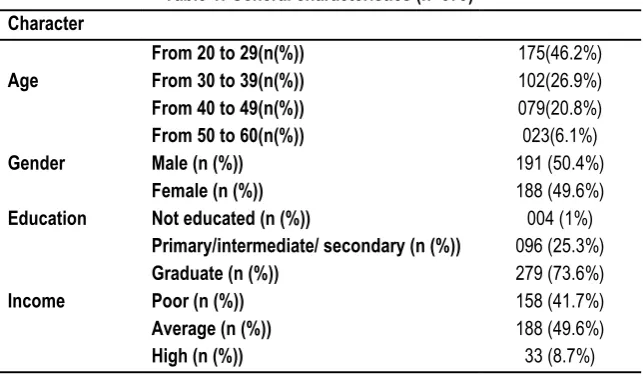
Table 1 shows general characteristics of the participants. Participants classified to four categories according to age: from 20 to 29 years old, from 30 to 39 years old, from 40 to 49 years old, and 50 years old or above. Male and female groups contributed to (50.4%) and (49.6%) respectively. The majority of participants were university graduates (73.6%), and about (25.3%) were secondary education or bellow. Table 2 shows frequency of dietary knowledge questions answered by the participants. (55.9%) of participants agreed that polyunsaturated fats are healthier for the heart than saturated fats, and (57.5%) disagreed that trans-fats are healthier for the heart than most other kinds of fats. (72.5%) agreed that dietary fibers lower blood cholesterol, and (24.3%) agreed that many vegetables are rich in cholesterol.
Table 1: General characteristics (n=379) Character
Age
From 20 to 29(n(%)) 175(46.2%)
From 30 to 39(n(%)) 102(26.9%)
From 40 to 49(n(%)) 079(20.8%)
From 50 to 60(n(%)) 023(6.1%)
Gender Male (n (%)) 191 (50.4%)
Female (n (%)) 188 (49.6%)
Education Not educated (n (%)) 004 (1%)
Primary/intermediate/ secondary (n (%)) 096 (25.3%)
Graduate (n (%)) 279 (73.6%)
Income Poor (n (%)) 158 (41.7%)
Average (n (%)) 188 (49.6%)
Table 2: Dietary knowledge regarding heart disease
Question Right answer Frequency %
Polyunsaturated fats are healthier for the heart than saturated fats. True 212 55.9%
Trans-fats are healthier for the heart than most other kinds of fats. False 218 57.5%
Most of the cholesterol in an egg is in the white part of the egg. False 180 47.5%
Dietary fiber lowers blood cholesterol. True 275 72.5%
Margarine with liquid safflower oil is healthier than margarine with hydrogenated soy oil.
True 133 35.1%
Many vegetables are high in cholesterol. False 287 75.7%
Table 3: Knowledge about epidemiology and prevalence of Heart disease
Question Right answer Frequency %
Women are less likely to get heart disease after menopause than before. False 186 49%
Heart disease is the leading cause of death in Saudi Arabia. False 244 64.4%
Most women are more likely to die from breast cancer than heart disease. False 106 28%
Heart disease is better defined as a short-term illness than a chronic, long-term illness.
False 250 65.9%
Table 4: Medical knowledge of Heart disease
Question Right answer Frequency %
Most people can tell whether or not they have high blood pressure. False 150 39.5%
The healthiest exercise for the heart involves rapid breathing for a sustained period of time.
True 122 32.2%
A healthy person's pulse should return to normal within 15 minutes after exercise.
True 170 44.8%
Cardiopulmonary resuscitation (CPR) helps to clear clogged blood vessels. False 87 22.9%
HDL refers to “good” cholesterol, and LDL refers to “bad” cholesterol. True 93 24.5%
Atrial defibrillation is a procedure where hardened arteries are opened to increase blood flow.
False 84 22.1%
High blood pressure is defined as 110/80 (systolic/diastolic) or higher. False 179 47.2%
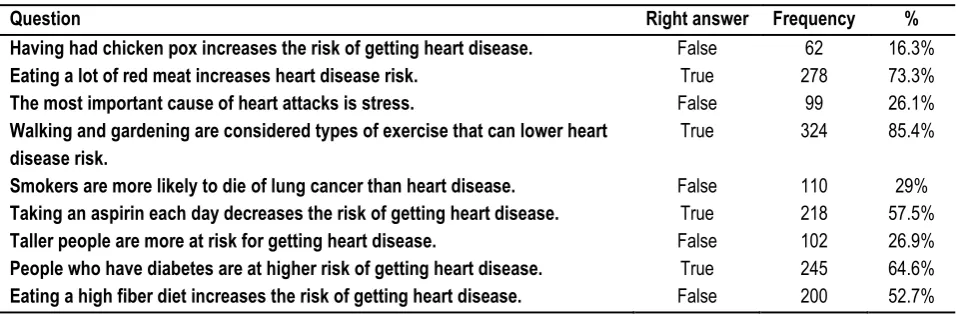
Table 5: Knowledge about risk factors of Heart disease
Question Right answer Frequency %
Having had chicken pox increases the risk of getting heart disease. False 62 16.3%
Eating a lot of red meat increases heart disease risk. True 278 73.3%
The most important cause of heart attacks is stress. False 99 26.1%
Walking and gardening are considered types of exercise that can lower heart disease risk.
True 324 85.4%
Smokers are more likely to die of lung cancer than heart disease. False 110 29%
Taking an aspirin each day decreases the risk of getting heart disease. True 218 57.5%
Taller people are more at risk for getting heart disease. False 102 26.9%
People who have diabetes are at higher risk of getting heart disease. True 245 64.6%
Eating a high fiber diet increases the risk of getting heart disease. False 200 52.7%
Table 3shows frequencyof knowledge regarding the prevalence and epidemiology of heart disease. (51%) of the participants think women are less likely to develop heart disease after menopause compared to pre-menopausal women, and the majority agreed that most women are less likely to die from breast cancer than heart disease. (34.1%) think that heart disease is better defined as a short-term illness than a chronic, long-term illness.
Table 4shows the medical knowledge of participants. (39.5%) of participants know that a person cannot tell whether or not if he/she has high blood pressure, and (47.2%) disagreed to that high blood
pressure is defined as 110/80 (systolic/diastolic) or higher. Only (24.5%) know that the High Density Lipoproteins (HDL) refers to
“good” cholesterol, and Low Density Lipoproteins (LDL) refers to “bad” cholesterol. (32.2%) agreed that the healthiest exercise for
the heart involves rapid breathing for a sustained period of time. Table 5 shows Knowledge about risk factors of Heart disease. (73.3%) agreed that eating a lot of red meat increases the risk of developing heart disease, and (47.3%) agreed that eating a high fiber diet increases the risk of developing heart disease. (73.9%)
181 |P a g e Int J Med Res Prof.2018 Jan; 4(1); 178-82. www.ijmrp.com
attacks is stress”. (57.5%) agreed that taking an aspirin each day
decreases the risk of getting heart disease, and (64.6%) agreed that if a person has diabetes mellitus, he\she is at increased risk for heart disease. (85.4%) of participants considered walking and gardening as types of exercise that can lower heart disease risk.
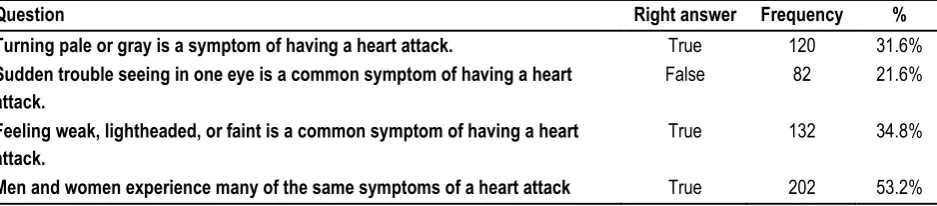
Table 6 shows Knowledge of participants about symptoms of Heart disease. (53.2%) considered that women and men experience the same symptoms of heart attack, and (65.2%) do
not know that “feeling weak, lightheaded, or faint are symptoms of having heart attack”.
Table 6: Knowledge about symptoms of Heart disease
Question Right answer Frequency %
Turning pale or gray is a symptom of having a heart attack. True 120 31.6%
Sudden trouble seeing in one eye is a common symptom of having a heart attack.
False 82 21.6%
Feeling weak, lightheaded, or faint is a common symptom of having a heart attack.
True 132 34.8%
Men and women experience many of the same symptoms of a heart attack True 202 53.2%
DISCUSSION
According to WHO, heart disease especially coronary heart disease is the leading cause of death globally and one of the major health burdens worldwide.1 To the best of our knowledge,
there is no much data and insufficient studies done regarding the knowledge and awareness of heart disease among public. The present study showed in average, more than half of participants have good knowledge about diet, half of them were aware of the knowledge about epidemiology of heart disease, and third of them have correct medical information of heart disease. (39.5%) of participants know that a person cannot tell whether or not if he\she has high blood pressure, and (47.2%) disagreed to that high blood pressure is defined as 110/80 (systolic/diastolic) or higher. Participants were aware about that Walking and gardening are considered types of exercise that can lower heart disease risk (85.4%). Lower findings reported in another study (65%).13 About
(73.3%) of participants agreed that diet with too much red meat will increase the risk for heart disease, and (64.6%) agreed that diabetes mellitus is a risk for heart disease. Another study reported higher results (85.8%) as unhealthy diet increases the risk for cardiovascular disease, and lower results (53.1%) as diabetes mellitus is a risk factor to cardiovascular disease.14 About
(74%) agreed that stress is the most important cause of heart attacks, another study reported stress as a risk factor for cardiovascular disease (62%).14 More than half of participants
know that taking an aspirin each day decreases the risk of getting heart disease. Most of participants were unaware of symptoms of heart disease. Third of participants know that feeling weak, lightheaded, or faint are symptoms of having a heart attack (34.8%), while another study reported quarter of participants know that feeling weak, lightheaded, or faint are symptoms of having a heart attack (25.4%).14 In conclusion, more attention needed in
primary prevention programs that focus on diet, exercise, and the danger of heart disease and should be emphasized. Lifestyle changes such as modifying dietary habits can benefit those who are at risk of developing heart disease. Knowledge of risk factors, symptoms, and epidemiology of heart disease are essential to prevent development of, and identify heart disease. The study emphasizes on the importance of educating the population about the various risk factors, symptoms of heart disease.
REFERENCES
1. World Health Organization (WHO) Cardiovascular diseases fact sheet, updated May 2017. Accessed on May 28, 2017.
Available on: http://www.who.int/mediacentre/factsheets/fs317/en/ 2. Centers for Disease Control and Prevention. Leading Causes of Death for 2013. Accessed on May 26, 2017. Available at: https://www.cdc.gov/nchs/data/nvsr/nvsr65/nvsr65_02.pdf. 3. Kingdom of Saudi Arabia. Ministry of Health Portal. Media center. Ministry News. Cardiovascular Diseases Cause 42% of Non-Communicable Diseases Deaths in the Kingdom. October 30 2013. Accessed on May 28, 2017. Available on: http://www.moh.gov.sa/en/ministry/mediacenter/news/pages/news -2013-10-30-002.aspx
4. Heart foundation of Australia: Risk factors for heart disease online resources [internet].2002 [updated 2004 Jul; cited 2010 Jun 3]. Accessed at June 2, 2017. Available from: http:// www.nevdgp.org.au/info/heartf/school/risk.htm.
5. Sania Nishtar. Prevention of coronary heart disease in South Asia. The Lancet.2002: September 28; Vol.360:1015–1018. 6. World Health Organization. Cardiovascular diseases: Risk factors starts in childhood and youth online cvd atlas [internet].2002 [updated 2004; cited 2010 Jun 3]. Available from http://www.who.int/cardiovascular_diseases/en/cvd_atlas_04_chil dhood_youth.pdf?ua=1 accessed at May 29, 2017.
7. Patrick Mullie, Peter Clarys. Association between cardiovascular disease risk factor knowledge and life style. Food and Nutrition Sciences. 2011; (2): 1048–153.
8. Louise. Potvin, Lucie. Richard and Alison C. Edwards. Knowledge of Cardiovascular Disease Risk Factors among the Canadian Population: Relationships with Indicators of Socioeconomic Status. Canadian Medical Association Journal. 2000:May 2;Vol.162(9 suppl):S5–S11.
9. Elizabeth B. Lynch, Kiang. Liu, Catarina I. Kiefe and Philip Greenland. Cardiovascular Disease Risk Factor Knowledge in Young Adults and 10-Year Change in Risk Factors: The Coronary Artery Risk Development in Young Adults (CAR-DIA) Study. American Journal of Epidemiology. 2006: October 12; Vol. 164 (No. 12): 1171–179.
11. Kingdom of Saudi Arabia.2012.census 2010. https://www.stats.gov.sa/sites/default/files/en-census2010-dtl-result_2_1.pdf . Accessed on May 29, 2017.
12. Bergman HE, Reeve BB, Moser RP, Scholl S, Klein WMP. Development of a Comprehensive Heart Disease Knowledge Questionnaire. Am J Health Educ. 2011 March ; 42(2): 74–87. 13. Alona D. Angosta, Kirsten E. Speck. Assessment of heart disease knowledge and risk factors among first-generation Filipino Americans residing in Southern Nevada: A cross-sectional survey. Clinical Nursing Studies, 2014, Vol. 2(2).123-132.
14. Abdelmoneim Awad. Hala Al-Nafisi. Public knowledge of cardiovascular disease and its risk factors in Kuwait: a cross-sectional survey. BMC Public Health. 2014 November 4. Available on http://www.biomedcentral.com/1471-2458/14/1131. Accessed at September 13 2017.
[
Source of Support: Nil. Conflict of Interest: None Declared.
Copyright: © the author(s) and publisher. IJMRP is an official publication ofIbn Sina Academy of Medieval Medicine & Sciences, registered in 2001 under Indian Trusts Act, 1882. This is an open access article distributed under the terms of the Creative Commons Attribution Non-commercial License, which permits unrestricted non-commercial use, distribution, and reproduction in any medium, provided the original work is properly cited.