Rule-Driven Object Tracking in Clutter and Partial
Occlusion with Model-Based Snakes
Gabriel Tsechpenakis
Center for Computational Biomedicine, Imaging and Modeling (CBIM), Division of Computer and Information Sciences, Rutgers University, NJ 08854, USA
Email:[email protected]
Konstantinos Rapantzikos
School of Electrical & Computer Engineering, National Technical University of Athens, Zografou, 15773 Athens, Greece Email:[email protected]
Nicolas Tsapatsoulis
School of Electrical & Computer Engineering, National Technical University of Athens, Zografou, 15773 Athens, Greece Email:[email protected]
Stefanos Kollias
School of Electrical & Computer Engineering, National Technical University of Athens, Zografou, 15773 Athens, Greece Email:[email protected]
Received 5 February 2003; Revised 26 September 2003
In the last few years it has been made clear to the research community that further improvements in classic approaches for solving low-level computer vision and image/video understanding tasks are difficult to obtain. New approaches started evolving, em-ploying knowledge-based processing, though transforming a priori knowledge to low-level models and rules are far from being straightforward. In this paper, we examine one of the most popular active contour models, snakes, and propose a snake model, modifying terms and introducing a model-based one that eliminates basic problems through the usage of prior shape knowledge in the model. A probabilistic rule-driven utilization of the proposed model follows, being able to handle (or cope with) objects of different shapes, contour complexities and motions; different environments, indoor and outdoor; cluttered sequences; and cases where background is complex (not smooth) and when moving objects get partially occluded. The proposed method has been tested in a variety of sequences and the experimental results verify its efficiency.
Keywords and phrases:model-based snakes, rule-driven tracking, object partial occlusion.
1. INTRODUCTION
In the last decade, snakes, a major category of active con-tours, have been given special attention in the fields of com-puter vision, image and video processing. They employ weak models, which deform in conformance with salient image features. The approaches proposed in the literature focus on either the highest accuracy of estimating moving silhouettes or the lowest computational complexity.
Active contours (snakes) were first introduced by Kass et al. [1]. A snake is actually a curve defined by energy terms, being able to deform itself in order to minimize its total ergy. This total energy consists of an “internal” term, that en-forces smoothness along the curve, and an “external” term,
that makes the curve move towards the desired object bound-aries. Many variations and extensions of snakes have been proposed and applied to certain applications [2,3]. However, the majority of them faces three main limitations. The first one is the quality of the initialization that is crucial for the convergence of the algorithm. The second one is the need for parameter tuning that may lead to loss of generality, and the third one is the sensitivity to noise, clutter, and occlusions.
models is a very interesting property that makes them appro-priate for capturing case-dependent constraints. Constrain-ing the active contour representation to follow a global shape prior while preserving local deformations has drawn the in-terest of the research community. Cootes et al. [13] intro-duced the term “active shape models” to compensate for the extension of classical snakes with global constraints. They described a technique which allows an initial rough guess for the best shape, orientation, scale, and position to be refined by comparing a hypothesized model instance with image data, and using differences between model and im-age to deform the shape. The results demonstrate that their method can deal with clutter and limited occlusion. An ef-ficient method towards the combination of low- and high-level information in a consistent probabilistic framework is proposed by Isard and Blake [14,15]. The result is highly robust tracking of agile motion in clutter that runs in near real time. The condensation algorithm they introduced is a fusion of the statistical factor sampling algorithm for static, non-Gaussian problems with a stochastic differential equa-tion model for object moequa-tion. Rouson and Paragios [16] proposed a two-stage approach using level-set representa-tions. During the first stage, a shape model is built directly on the level-set space using a collection of samples. This model allows shape variabilities that can be seen as an “un-certainty region” around the initial shape. Then, this model is used as a basis to introduce the shape prior in an energetic form.
In the proposed approach, we consider a knowledge-based view of active contour models, which is appropriate for handling object tracking in partial occlusion, as well as track-ing objects whose shape can be approximated by parameter-based models. We use shape priors and set them in a rather loose way to preserve the required deformations and intro-duce an uncertainty region around the contour to be ex-tracted, which is based on motion history. In order to cope with partial occlusion, we use a rule-driven approach and provide several results. The algorithm seems to provide effi -cient solutions in terms of both accuracy and computational complexity. Head tracking has been selected as a test-bed application of the integrated model, where head is approx-imated by shape priors derived from an ellipsoid. This ap-proach provides the constraint that the desired object is not strongly deformed in successive frames of video sequences, which is actually valid for most cases.
The paper is organized as follows. In Section 2we re-view the classic snake model and provide information on the adopted model-based approach.Section 3describes in detail the proposed tracking approach andSection 4provides the experimental results. Future research directions are given in Section 5.
2. SNAKE MODEL
In general, snakes concern model and image data analysis through the definition of a linear energy function and a set of regularization parameters. Their energy function consists
of two components, the internal or smoothness-driven one, which enforces smoothness along the snake, and the external or data-driven component, which depends on the image data according to a chosen criterion, forcing the snake towards the object boundaries. The goal is to minimize the total snake energy and this is achieved iteratively after considering an initial approximation of the object shape (prototype). Once such an appropriate initialization is specified, the snake can converge to the nearby energy minimum, using gradient de-scent techniques. According to that formulation, a snake is modeled as being able to deform elastically, but any defor-mation increases its internal energy causing a “restitution” force, which tries to bring it back to its original shape. At the same time, the snake is immersed in an energy field (created by the examined image), which causes a force acting on the snake. These two forces balance each other and the contour actively adjusts its shape and position until it reaches a local minimum of its total energy.
We consider a snakeCsnakedefined by a setV(s) ofN or-dered points (snaxels){Vi(s)|i=1, 2,. . .,N},
correspond-ing to the positions (xi(s),yi(s)) in the image plane (s is a
parameter denoting the normalized arc length in [0 1]. For simplicity, in the following the parameterswill be mentioned only when necessary). The total energy functionEsnakeis then defined by the weighted summation of the internal energy Eint, corresponding to the summation of the stretching and bending energies of the snake, and the external one which indicates how the snake evolves according to the features of the image:
ergies corresponding to the point Vi, and the procedure of
snake’s convergence to the object boundary is given by the solution of its total energy minimization:
Csnake=argmina1·Eint(V) +a2·Eext(V), (4)
wherea1anda2are the snake’s regularization parameters.
2.1. Internal energy
where (x,y) parameterize the curve asVi =[xi,yi] and the
first and second derivatives of (x,y) denote the velocity and the acceleration along the curve ( ˙x=dx/ds, ˙y=d y/ds) and (¨x=d2x/ds2, ¨y=d2y/ds2). Thus, the internal energy of the snake is defined as
eintVi
=CUsnakeVi+DVsnake
Vi
, (6)
where|·|denotes the magnitude of the corresponding quan-tities. In the discrete case, the value of the curvature at the kth point is calculated using the neighboring points to each side of it; the sign of the curvature is positive if the contour is locally convex, and negative if concave. Moreover, curvature distribution/function uniquely defines a propagating curve at different time instances although it is not affine invariant, and thus it is inappropriate in object recognition problems [18,20]. In the proposed snake model, the points constitut-ing a curve are not equally spaced and thus the distances be-tween successive points represent the local elasticity of the snake. Finally, it should be noted that curvature and point density terms are often used in the literature [1,19,21], and in the present work they are used both as smoothness and curves similarity criteria, as described in the following sec-tions. Figure 1illustrates the curvature (curve smoothness) and point density (elasticity) distributions of a given snake.
2.1.1. Prior model constraints
The inclusion of a global shape model biases the snake con-tour towards a target shape, allowing some selectivity over image features. In several applications, the general shape, and possibly the location and orientation of objects, is known, and this knowledge may be incorporated into the deformable adaptive contour in the form of initial conditions, data con-straints, constraints on the model shape parameters, or into the model fitting procedure. However, for efficient interpre-tation, it is essential to have a model that not only describes the size, shape, location, and orientation of the target object, but that also permits expected variations in these character-istics.
A number of researchers have incorporated knowledge of object shape into deformable models by using deformable shape templates. These models usually use global shape pa-rameters to embody a priori knowledge of expected shape and shape variation of the structures and have been used suc-cessfully for many applications of automatic image interpre-tation. An excellent example in computer vision is the work of Yuille et al. [22], who constructed deformable templates for detecting and describing features of faces, such as the eye. Staib and Duncan [23] used probability distributions on the parameters of the representation and biased the model to a particular overall shape while allowing for deformations. Boundary finding is formulated as an optimization problem using a maximum a posteriori objective function. A model-based snake that is directly applicable in image space as op-posed to parameter space is proop-posed in [24]. This method is simple and fast and therefore fits well to our intention to ex-tend the previous formulation with a model prior constraint. We mention here that our goal is to illustrate the increased
(a) 0.5
0
−0.5
−1
0 50 100 150 200 250 300 350 (b)
2 1.8 1.6 1.4 1.2 1 0.8 0.6 0.4 0.2
0 50 100 150 200 250 300 350 (c)
Figure1: Curvature and point density distributions of a given con-tour. (a) The snake is locked at car boundaries whereas the circled areas denote parts of the curve of high curvature and point density: (b) curvature distribution and (c) point density distribution.
robustness of the proposed method provided by the inclu-sion of shape information rather than incorporating a novel shape prior constraint representation.
Emodel(V(s)) as
whereλis parameterized, since it can vary with position, and (6) is reformulated as
As an example, a generalized ellipse represented by (9) is used as a model (modelellipse) here. Ellipse is a typical model for human faces and therefore is appropriate for head tracking, which is our test-bed application,
modelellipse
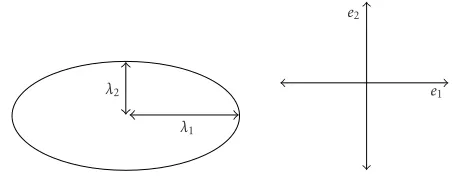
where aandb are the minor and major axes, respectively, andϑis the ellipsoid rotation. The model should take scal-ing, translation, and rotation under consideration. In order to meet the previous requirements, we base the minor and major axes and rotation calculation on a statistical represen-tation of an ellipsoid as the covariance matrixSderived from the distribution of the last recovered (previous frame) solu-tion points, principal directions e1ande2, respectively. The eigenvalues determine the shape of the ellipsoid, while the eigenvectors determine the orientation as shown inFigure 2.
2.2. External energy
The external energy term, in most approaches, for each point Vi, is defined as
of the image convolved with a Gaussian filter, of varianceσ at point (xi,yi) corresponding to the snaxelVi;g(Vi) is the
respective gradient direction; andn(Vi) is the normal vector
of the snake at the snaxelVi.
The common problems in snake models are the pres-ence of noise, background edges close to object boundaries, and edges in the interior of the desired object. These prob-lems flow from the definition of the external energy and the Laplacian-of-Gaussian (LoG) term∇Gσ∗I, especially in
λ2
λ1
e2
e1
Figure2: Proposed model constraining the obtained solutions to the application of the human head modeling and tracking.
cases where the initialization is not close enough to object boundaries. For that reason, snakes turn out to be efficient only in specific cases of images and video sequences. In the proposed model, another term is introduced instead, min-imizing the local variance of the image gradient and pre-serving the most important image regions. This is achieved through morphological operations leading to a modified im-age gradient. In particular, the expression|∇Gσ∗I(xi,yi)|is
replaced by a modified image gradientGmand the image data
criterion is strengthened through the square ofGm:
eextVi
To obtain the modified image gradient, we first presmooth the image with a nonlinear morphological filter, called alter-nating sequential filter (ASF) [25] and we extract the mor-phological image gradient. The ASF used in our model is based on morphological area opening (◦) and closing (•) operations with structure elements of increasing scale. The main advantage of such filters is that they preserve line-type image structures, which is impossible to be achieved with, for example, median filtering.Figure 3illustrates the perfor-mance of a frame’s presmoothing with the proposed ASF; it can be clearly seen that noise is eliminated and the most important edges are preserved. More details can be found at [26].Figure 4illustrates the differences between the two image data criteria |∇Gσ∗I(xi,yi)| and Gm, presented in
(11) and (12). It can be seen in Figures4band4cthat the proposed procedure clearly suppresses noise and retains the most important edges of the examined image, whereas Fig-ures4dand4eillustrate the difference between image gradi-ent and the proposed modified gradigradi-ent, computed along a randomly selected image line.
(a) (b)
Figure3: Frame presmoothing with the proposed ASF: (a)original frame and (b) filtered frame.
(a) (b) (c)
0.2 0.18 0.16 0.14 0.12 0.1 0.08 0.06 0.04 0.02 0
20 40 60 80 100 120
(d)
0.2 0.18 0.16 0.14 0.12 0.1 0.08 0.06 0.04 0.02 0
20 40 60 80 100 120
(e)
Figure4: Differences between the image data criteria using the image gradient and the proposed one. (a) Original image, (b) image gradient, (c) modified image gradient, (d) image gradient computed along a randomly chosen row shown in (a), and (e) modified image gradient computed along the same row.
3. THE PROPOSED TRACKING APPROACH
Object tracking actually concerns the separation of moving objects from background [28], which is done so far in two different ways: (a) the motion-based approaches that rely on grouping motion information over time and (b) the model-based approaches that impose high-level semantic represen-tation and knowledge. In these approaches, either geomet-rical properties or region-based features of the desired
ob-jects are extracted and utilized. Thus the methods proposed in the literature can be categorized in edge-based methods [14], which rely on the boundary information, and region-based ones [29], utilizing the information provided by the interior region of the tracked objects.
(a) (b)
Figure5: Qualitative comparison between (a) a representative example of external energy term using Gaussian filtering and (b) the proposed external energy term.
natural sequences, where background is usually complicated and the amount of noise or the external lighting changes are not known. The latter has been a motivation for many re-searchers, especially in the last years, to follow probabilis-tic approaches, for example, [30]. In addition, a more diffi-cult problem emerges in many sequences, the occlusion, that is, when moving objects get occluded successively as time passes. This requires some assumptions about the shape, re-gion, or motion of the tracked object in order to estimate its contour even in regions that are covered by other moving or static objects. In the following, we describe the proposed ap-proach, which aims to cope with the above mentioned prob-lems.
The proposed method consists of two main steps: the ex-traction of the “uncertainty regions” of each object in a se-quence, and the estimation of the mobile object contours. The term “uncertainty regions” is used to describe the re-gions in a frame, where moving contours are possible to be located, whereas the estimation of the contours consists of an energy minimization procedure based on the proposed snake energy terms, described in Section 2. More specifically, the contour of a moving object is estimated first in a few succes-sive frames of a sequence. This can be achieved with appro-priate parameter initialization utilizing the proposed snake model. Then, for the next frames, a force-based approach is being followed to minimize the total snake energy inside the respective uncertainty regions, which are extracted us-ing the displacement history of each point of the contour. The force-based approach is adopted as an alternative to di-rect energy minimization, while some rules are introduced to separate objects from background and to detect possible occlusions.
3.1. Uncertainty region estimation
The minimization procedure of snake’s total energy is actu-ally a problem of picking out the “correct” curve in the im-age, that is, the curve which corresponds to the object of in-terest among a set of candidate curves, given an initial esti-mate of the object’s contour. In this section, we propose a way to determine a region around the snake initialization,
for each frame of a video sequence, in which the correct curve is located. This idea is not new, as stochastic models have been lately proposed in the literature, mostly as shape prior knowledge [8], to define possible positions of the curve points around an initialization. In the same direction, we in-troduce here the term “uncertainty region,” which denotes that the minimization procedure (or the picking out of the correct curve) takes place inside that region, constraining the problem inside a narrow band around the snake initializa-tion. Such regions are extracted by exploiting the motion his-tory of the tracked contour (curve points’ displacements in previous time instances), extracting statistical measurements of the motion. The previously estimated contour is deformed according to the previously calculated point displacements (initialization for the next frame), and the standard devia-tion of each point’s mean modevia-tion is calculated; the uncer-tainty region around each point is then defined in terms of its corresponding standard deviation. The next step is to find the new position of each point of the curve, inside its corre-sponding uncertainty region, which corresponds to the min-imum of a criterion, which is defined by the snake’s energy terms described inSection 2.
We define the contour of an object, located in the Ith frame (I > 1), of a video sequence as a vector of complex numbers, that is,
C(I)=x(I)
i +j·y
(I)
i |i=1,. . .,N
=C((1)I),. . .,C (I) (N)
,
(13)
whereC((Ik))=xk(I)+j·yk(I)is the location of thekth point of the contour. We define the instant motion of thekth point of the object contour, computed in theIth frame, as
m(cI,k)=MF(I−1,I)
xk,yk
, (14)
where MF(I−1,I)(x
k,yk) is the motion vector of the pixel
(xk,yk) estimated with the use of a robust motion estimation
Based on the definition of the instant motion, we calcu-late the mean movement of the contourCup to frameIas
¯
is the corresponding mean movement of thekth point of the contour.
Similarly, the standard deviation of contour’s mean movement is defined as
¯
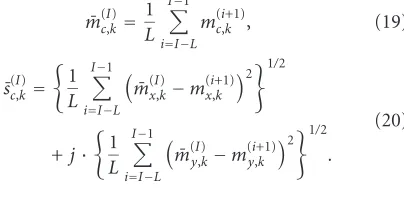
is the standard deviation ofkth point’s mean movement. In practice, (16) and (18) are computed based on the last Lframes so as to take into account only the recent history of contour’s movement, that is,
¯
The initial estimation of the object’s contour C(initI+1) in the frameI+ 1 is computed based on the contour’s current loca-tion and
(a) its mean motion when no abrupt movements are ex-pected to occur, that is,
C(initI+1)=C(I)+ ¯m(I)
c , (21)
or
(b) its instant motion when no knowledge about the mo-tion of the desired object is available, that is,
C(initI+1)=C(I)+m(cI+1), (22)
wherem(cI+1) = [MF(I,I+1)(xi,yi) | i = 1,. . .,N] =
[m((Ic+1),1),. . .,m (I+1) (c,N)].
The final solution, that is, the desired contour C(I+1) = [C((kI+1)) |k =1,. . .,N], is obtained by solving the following rameters w1 and w2 represent the weights with which the energy-based terms of (23) participate in the minimization procedure, whereasµ1andµ2control the model’s influence on the final solution; more about these weights is discussed inSection 3.3.
The set of all possible curvesR, defining the uncertainty region, emerges by oscillating the points of the curveC(initI+1)
according to the standard deviation of their mean move-ment, computed using (17) and (20). The Gaussian formu-lation for the point oscilformu-lations is mainly adopted to show that each point of the curve is likely to move in the same way (amplitude and direction) that it has been moving un-til the current frame. In this way, and for each contour point Vk, an uncertainty region is defined. IfC((kI))is the location of thekth point of the contour in frameI and this point was static during the previous Lframes, then ¯s(cI,k) = 0 and its uncertainty region shrinks to a single point whose location coincides with Cinit,((I+1)k). If point k was moving with invari-able velocity, then the standard deviation of its movement is again ¯s(cI,k) = 0 and the previous case holds regarding its
uncertainty region. On the other hand, if pointkwas oscil-lating in the previousLframes, the standard deviation of its movement is high and consequently its uncertainty region is large.Figure 6illustrates the proposed approach in steps, in the case of face tracking. Figures6aand6bpresent two suc-cessive frames of a face sequence and the respective contours. Figure 6cpresents the amplitude of the computed standard deviation (in pixels) of the contour mean motion, and based on this standard deviation, the uncertainty regions are then extracted (Figure 6d).
3.2. Force-based approach
The minimization of (23) is a procedure of high complexity: ifNis the number of points determining the examined curve
CandMis the number of all possible positions of each curve pointC(init,I+1)k inside the extracted uncertainty region,
assum-ing thatMis the same for all points, then the number of all possible curvesr∈Rgenerated by points’ oscillations isMN.
(a) (b) 8
6
4
2
0
0 50 100 150 200
(c) (d)
Figure 6: The proposed tracking approach in steps. (a), (b) Two successive frames of a face sequence and the respective contours. (c) Amplitude of the standard deviation of the contour mean motion leading to (d) the uncertainty regions of the curve.
approach (instead of using a dynamic programming algo-rithm) where the energy terms, participating in the snake energy function, are transformed into forces applied in each curve point so as to converge to the desired object bound-aries.
We consider the curveVdescribing the object’s contour. The object’s contour at frame Iis given byC(I)and its ini-tialization at frameI+ 1 is given byC(initI+1). Also lettbe the set of the tangential unit vectors andnthe set of the normal vectors of curveV, given by (28):
t=tk|k=1,. . .,N], (26)
n=nk|k=1,. . .,N], (27)
tk=
∇V|k
∇V|k, nk=
∇t|k
∇t|k. (28)
We define the following forces acting at each contour pointVk:
Fd
Vk
=DDV(I)
Vk
·tk
=DVC((Ik))−DVVk
·tk,
Fc
Vk
=DCU(I)
Vk
·nk
=CUC((Ik))−CUVk
·nk.
(29)
Fd = [Fd(Vk) | k = 1,. . .,N] represents the stretching
component that forces points to come closer or draw away from each other along the curve, and it is always tangential to it. Thus, if the distance between two curve pointsC((Ik))and
C((Ik)+1)is greater than the distance betweenVkandVk+1, then Fd(Vk)·tk > 0 andVk is forced to draw away fromVk+1; otherwise,Fd(Vk)·tk<0 andVkis forced to come closer to
Vk+1.
Fc = [Fc(Vk) | k = 1,. . .,N] represents the
deforma-tion of the curve along its normal direcdeforma-tion. The property of the curvature distribution to take low values, where the curve is relatively smooth, and high values, where the curve has strong variations, makes Fc force curve to the initial shape (the one in the previous frame) and not to a smoother form. Moreover, we exploit the curvature’s property to be positive where the curve is convex and negative where the curve is concave.Figure 7illustrates the directions ofFcandFdalong
a curve.
These forces represent the internal snake forces that de-form the curveV, initialized atC(initI+1), according to the shape of the contourC(I)in the previous frame. The constraint of such a deformation is actually the first term of (23), that is, the external energyEext, which is transformed into force as described in the following.
We definegm,k(p), given by (30), to be the modified
*
Figure7: Curvature-based and point density-based forcesFcand Fd, respectively, along the initialization of a curveVin the frame I+ 1.
belongs to the uncertainty regionUand (b) lies on the line segment that is defined by the normal direction of the curve
Vat pointVk,
The maximum of this function determines the most salient edge pixel in the line segment defined above and thus defines the direction of theexternalsnake force:
pk=arg max
where sgnkdenotes the sign/direction of the external force to be applied toVk.
Then, the external snake force for each pointVkis given
by
From the definition of the external energy term (12), it can be seen that it takes values close to zero in contour points corre-sponding to regions with high image gradient (G2
m(Vk)1)
and values close to unity in regions with relatively constant intensity (G2
m(Vk) 0). Thus, the term Fe = [Fe(k) |
k =1,. . .,N] is proportional toGm and forces the curve to
the salient edges inside the extracted uncertainty region. In the definition of this force, we exploit the advantage ofGm
against |∇Gσ∗I| to preserve the most important edges, as
shown before, and thus the problem of the existence of many local maxima in (31) is eliminated.
In the force-based approach, the examined curve V
marches towards the object’s boundaries in the next frame, I + 1, according to the forces applied to it. Thus, the
min-imization of (23) can be approximated by using the inter-nal and exterinter-nal snake forces defined above, in an iterative manner similar to the steepest descent approach [32], as it is summarized below. In particular, letV(ξ)be the estimated contour in theξiteration, then the following equations hold:
V(0)=C(I+1)
k ) are estimated
according to (29) and (33), respectively, andFmodel(V (ξ−1)
k )
is the regularization force, according to the specific model adopted, given by
It is clear from the above definition that Fmodel(Vk)
forces contour point Vk(ξ−1) towards the model point
model(Vk(ξ−1)(s)).
The final curveVcorresponding to the contourC(I+1)is obtained when one of the following criteria is satisfied.
(a) Fτ(V(ξ))< a·Fτ(V(ξ+1)), where
Parameter a is a positive constant in the range 0 < a < 1. When ais selected to be close to 1, C(I+1) is more likely to correspond to a local minimum solu-tion; lower values ofa increase the number of itera-tions and, therefore, the execution time. The statistical approach we follow to estimate the regions of uncer-tainty allows for the use ofaclose to 1.
(b) The maximum number of iterations is reached. In this case,
(a) (b)
100 200 300 400 500 600
300
100 200 300 400 500 600
20
100 200 300 400 500 600
(f)
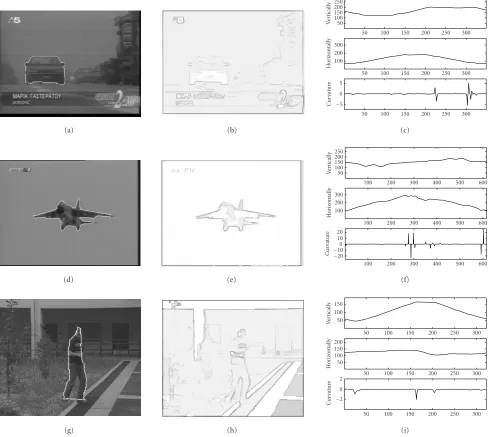
Figure8: Curvature and external energy terms: (a), (d), (g) different cases of curves and background complexity, (b), (e), (h) respective external energies visualization, and (c), (f), (i) respective curvature distributions.
3.3. Weights estimation
In (23) and (37), four energy and force terms, respectively, participate in the minimization procedure with different weights w1,w2,µ1, andµ2. The choice of appropriate val-ues for these weights is important for the method’s perfor-mance. The values should be set depending on the amount of the background complexity and the smoothness of the object silhouette. For sequences with relatively smooth background (without any significant edges close to object boundaries, or edges far from object boundaries), the curve’s external en-ergy/force term is used as a reliable criterion and thusw1is set to higher value. Moreover, if the contour of the tracked object is complicated (not smooth) or noisy, the elasticity
and smoothness energy/force terms are not reliable and thus w2is set to lower values.
In order to automatically estimate the value ofw2, it suf-fices to count the curvature and point density distributions’ zero crossings, which can give us the contour’s local smooth-ness/elasticity. To estimate the value ofw1, it suffices to cal-culate the mean values of the external energy at all pixels p inside the extracted uncertainty regionU(as verified by trial and error). Thus, smooth background inside the uncertainty region results in higher mean values andw1is set to a higher value, whereas low mean values correspond to cases of com-plex/noisy uncertainty regions (great number of edge pixels) andw1is set to a lower value.
moving objects of different contour complexities. Figures8a, 8d, and8grepresent the original images along with the mov-ing object contours. At the first sequence, the background is relatively smooth and the object (car) has an uncomplicated contour. In the case of the aircraft, the background is also smooth but the contour is quite complicated, whereas in the third case, the walking man’s contour is simple but the back-ground is very cluttered. The respective external energies vi-sualization is illustrated in Figures8b,8e, and8hwhere the background complexity can be clearly seen; the modified im-age gradient preserves the most salient edges and eliminates noise. Finally, in Figures8c,8f, and8i, the complexity of the respective object contours is presented in terms of the cur-vature. The first and the second subplots of each case illus-trate thexandycoordinate distributions along the curves, whereas the third subplot represents the curvature distribu-tion. As can be seen, the complexity of the contours is de-termined by the curvature variations, that is, the curvature’s zero crossings: if Zc,car,Zc,aircraft, and Zc,man are the num-bers of the respective zero crossings andNcar,Naircraft, and Nman are the number of points constituting the three con-tours, thenZc,car/Ncar 0.03,Zc,aircraft/Naircraft 0.08, and
Zc,man/Nman0.05.
The parametersµ1 andµ2 related to the internal snake force can be set according to the application under consider-ation. If strict prior model knowledge is available (e.g., med-ical applications), then the model can strongly influence the solution. On the contrary, if there is no high certainty re-garding the model prior, then the first term of the internal force should affect the solution more. This competitive rela-tion of the two internal force terms can be easily represented by allowing one of them to change according to the other in a functional manner (µ1= f(µ2)).
3.4. Rule-driven approach for complex background and partial occlusion cases
In order to separate background and object regions, espe-cially when the background in not homogeneous (smooth), as well as to cope with moving object’s partial occlusion that may occur, we introduce more constraints that pk in
(31) must obey, so that its estimation will be reasonable. The adopted motion estimation technique [31] ensures the distinction between moving background and foreground even in hard-to-detect cases (slightly different movements). Therefore, without loss of generality, we suppose that the background is static and possible occluding objects are also static. Let ¯m(cI,k)be the mean estimated motion of thekth
con-tour point at frameI, estimated through (16) or by any mo-tion estimamo-tion algorithm as shown inFigure 14, and letpl andpmbe the surrounding pixels ofpkon the line segment, along which the functiongm,k(p) is computed. Then,pkmust
fulfill the following two constraints/requirements:
(a) pkmust divide that line segment in two parts: an
im-miscibly moving and an imim-miscibly static one, that is,
upl
whereu(·) denotes the instant velocity.
Thus, taking the above constraints into consideration, we overcome cases such as (a) when the maximum is found in background: it is not a moving one and does not separate two immiscible (according to the motion) parts of the function gm, (b) when the maximum is found inside the moving
ob-ject region: although it is a moving one, it does not divide the functiongmin such two parts, (c) when occlusion occurs and
the maximum is on the occluding object boundary: the max-imum is not moving although it makes the regiongm
separa-tion, and (d) when occlusion occurs and the maximum is in the occluding object region: neither the maximum is moving nor it makes such a separation. In these cases, where these two constraints are not reached, we ignore the external force and evolve the curve according to its internal forces; in this way, we can obtain contours similar to the ones in the past frames. Figure 9illustrates the detection of occlusion with the use of the above-defined rules that the local maximum pk(shown as minimum), corresponding to a curve pointk, must obey. It has to be mentioned that treating large occlu-sions is limited by the capabilities of the estimated motion field.
4. EXPERIMENTAL RESULTS
The performance of the proposed approach is tested over a large number of natural sequences, where specific tracking problems emerge. The results presented in this section con-cern cases of different object shape complexities, different motions, noisy video sequences, complicated backgrounds, as well as partial occlusion. Finally, a specific application of the proposed method is shown, where the desired objects are human heads. It has to be mentioned that the contour initial-ization for the first frame in a sequence is done manually. The adopted time-window parameterL(number of past succes-sive frames) is set to 5 for all the sequences under considera-tion. Additionally, the motion at the very first frame of each sequence is supposed to be zero.
Figure 10illustrates the case of tracking an object with complicated contour (low smoothness) moving in front of a relatively smooth background. In such a case, weight w1 of (23) and (37) is significantly greater thanw2([w1,w2]= [10, 1]). In this case, the desired object (aircraft) is moving towards the shooting camera and even if the object is rigid, its projection on the image plane is deforming (its contour expands) along the time.
1 0.95 0.9 0.85 0.8 0.75 0.7
2 4 6 8 10 12 14 16 18
No occlusion detected
gm,k(p)
Moving minimum
Area 1: motion detected
Area 2: no motion detected
1 0.95 0.9 0.85 0.8 0.75 0.7
2 4 6 8 10 12 14 16 18 20 22 Occlusion detected
gm,k(p)
Static minimum
Area 1: motion detected
Area 2: no motion
detected
Figure9: Detection of occlusion using the two rules of (41), (42), and (43) for the local minimumpkof the function 1−gm,k(p).
(a) (b) (c)
Figure10: Example of tracking an aircraft approaching the airport: the case of complicated tracked contour with smooth background.
(a) (b) (c)
(d) (e) (f)
(a) (b) (c)
Figure12: Object tracking in strong existence of clutter. For each of the transitions (a), (b) and (b), (c), the estimated weights are [w1,w2]=
[1, 10], since the background is not smooth enough.
(a) (b) (c)
(d) (e) (f)
Figure 13: Example of a man walking in a cluttered sequence. The main source of inaccuracies is the weak edges of the human body (especially close to the head). We choose [w1,w2]=[1, 10] to reduce the effect of the background complexity.
desired object (car) is moving towards the camera and al-though it is rigid, its projection on the image plane is slowly deforming along time, as in the previous example. In this case, the sequence is more cluttered, although the car silhou-ette is smoother. The utilization of image presmoothing with the ASF and the modified image gradient, used for the exter-nal snake energy definition as described inSection 2, results in the estimation of such accurate contours.
Figure 12 illustrates the method’s performance in a strongly cluttered sequence, where the object is nonrigid and its motion projection is both rotational and translational rather than a simple translation or expansion/shrink. The low accuracy of the method in this case is mainly due to the
large uncertainty regions extracted. On the other hand, the object is well detected and localized in each frame of the se-quence, due to the snake’s external energy definition through the ASF prefiltering and the image modified gradient estima-tion.
(a1) (a2)
(b1) (b2)
(c1) (c2)
(d1) (d2)
(e1) (e2)
(f1) (f2)
(a1) (b1) (c1) (d1)
(a2) (b2) (c2) (d2)
(a3) (b3) (c3) (d3)
(a4) (b4) (c4) (d4)
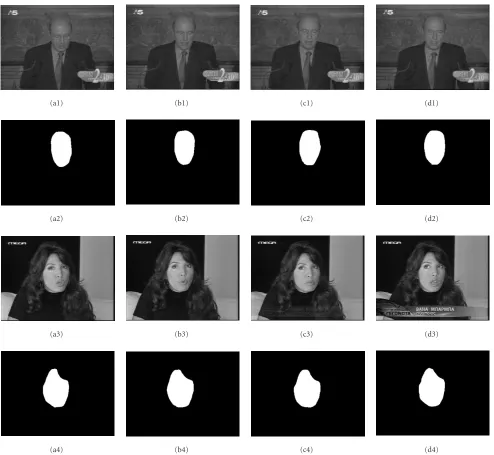
Figure15: Ground truth masks for selected frames of four TV sequences.
Figure 14illustrates a case of two moving objects, where, as time goes by, the one is getting partially occluded by a static obstacle, while the other is moving in the front of the obstacle. In Figures14a1,14b1,14c1,14d1,14e1, and14f1, the motion estimates are illustrated, showing that the noise is effectively eliminated on the boundaries between the static and moving regions even when the occlusion occurs, whereas the respective Figures14a2,14b2,14c2,14d2,14e2, and14f2 show that both objects’ contours are estimated with sufficient accuracy, due to the additional constraints (see (41), (42) and (43)) in which the maximum of (31) is imposed.
In order to demonstrate the efficiency of the proposed approach, we also evaluate the results of our technique
applied to head (face) extraction. Obtaining quantitative re-sults for such an application area is hard since no extensive ground truth databases are available today. Therefore, in or-der to quantitatively assess the improvement of our algo-rithm, achieved by the addition of the geometrical model, we generated ground truth masks for available sequences.
(a1) (b1) (c1) (d1)
(a2) (b2) (c2) (d2)
(a3) (b3) (c3) (d3)
(a4) (b4) (c4) (d4)
Figure16: Face tracking results of the proposed rule-based method without applying the model-based term: the final results (contours) are illustrated in bold curves, whereas the shape prior (ellipse), to be further applied (Figure 17), is shown in soft curves.
the tracking method with and without the geometrical model for head contour tracking. We present representative exam-ple frames from the TV clip collection and comment on the various difficulties introduced. Even though the head is a rigid object, its contour is being deformed on the image plane along the time, due to the projection of its motion. The head contours produced by the rule-driven model-based approach (Figure 17) are obtained using an ellipsoid as shape prior.
In order to get a visual grip of the way that an ellipsoid (Section 2.1.1) affects the contour deformation, we present the results in two ways: we superimpose (a) the ellipse model (soft) and the nonmodel-based contour (Figure 16), and (b)
(a1) (b1) (c1) (d1)
(a2) (b2) (c2) (d2)
(a3) (b3) (c3) (d3)
(a4) (b4) (c4) (d4)
Figure17: Face tracking results of the proposed method after applying the model-based (shape prior) term: the final contours are illustrated in bold curves, whereas the results obtained without the shape prior (Figure 16), are shown in soft curves.
regions of the head, as shown clearly in Figures17a1,17b1, 17c1, and 17d1; and 17a2,17b2,17c2, and17d2. The ac-tual head contour of Figures17a4,17b4,17c4, and17d4case is fairly different than the corresponding “perfect” ellipsoid (Figures17a4,17b4,17c4, and17d4case) since our ground truth generation is merely based on skin presence. However, the final model-based contour seems to be much closer to the shape of a head and therefore it can be treated as a better way to verify the presence of a human head in a sequence even in the case of partial occlusion (due to hair in the considered case).
Table1: Recall and precision values, comparing the ground truth results with the ones obtained using the proposed method with and without the shape prior model.
Frame Recall percentage Precision percentage Recall percentage Precision percentage
(no model) (no model) (model) (model)
a1 89.08 100.00 94.52 100.00
b1 87.01 100.00 100.00 97.44
c1 90.09 100.00 98.17 100.00
d1 90.09 100.00 98.17 100.00
a2 98.38 100.00 100.00 99.54
b2 98.63 100.00 95.14 100.00
c2 98.76 100.00 95.17 100.00
d2 100.00 96.68 100.00 99.52
a3 100.00 91.04 100.00 99.78
b3 100.00 94.18 95.55 100.00
c3 100.00 91.64 98.48 100.00
d3 100.00 91.26 99.62 100.00
a4 100.00 93.88 100.00 93.90
b4 100.00 97.29 100.00 91.60
c4 100.00 98.12 100.00 84.85
d4 100.00 97.09 100.00 97.83
Total 95.05 93.16 97.24 95.84
5. CONCLUSIONS AND FURTHER WORK
In this work, we have presented a probabilistic application of snakes for object tracking in clutter, partial occlusion, and complex backgrounds. Statistical measurements of the ob-ject contour motion history are extracted to obtain uncer-tainty regions, in which the estimated contours are to be lo-calized. In this way, we constrain the solution in a narrow band around the next frames snake initialization. Moreover, utilizing various tools from image morphology, we eliminate noise. This approach is extended to cope with complex back-ground and partial occlusion, introducing rule-based knowl-edge to separate objects from background and to detect oc-clusion. Finally, for specific applications where the desired object contours can be approximated by specific models, we use a shape prior knowledge in addition to the rule-driven approach so as to obtain more accurate contours. As indi-cated before, in this work our goal is to illustrate the in-creased robustness of the proposed method with the addition of a model rather than incorporating a novel prior constraint representation. Therefore, the future direction of our work is a more sophisticated representation and use of general-ized geometric-based models, which will permit the method to deal even more efficiently with occlusions and perform tracking under various conditions (e.g., static or mobile cam-era). In this sense, a possible extension can be the incor-poration of region-based tracking modules to the existing framework that will increase robustness. Additionally, cov-ering large occlusions cases would require extensions of the method, for example, using higher-level representation of the moving regions, which is a topic of future research. We are currently examining such issues using “semantics” and onto-logical knowledge techniques in the framework of [33].
REFERENCES
[1] M. Kass, A. Witkin, and D. Terzopoulos, “Snakes: active con-tour models,”International Journal of Computer Vision, vol. 1, no. 4, pp. 321–331, 1988.
[2] S. R. Gunn and M. S. Nixon, “A robust snake implementation: a dual active contour,” IEEE Trans. on Pattern Analysis and Machine Intelligence, vol. 19, no. 1, pp. 63–68, 1997.
[3] L. D. Cohen and I. Cohen, “Finite-element methods for active contour models and balloons for 2-d and 3-d images,” IEEE Trans. on Pattern Analysis and Machine Intelligence, vol. 15, no. 11, pp. 1131–1147, 1993.
[4] L. D. Cohen, “On active contour models and balloons,” Com-puter Vision, Graphics and Image Processing: Image Under-standing, vol. 53, no. 2, pp. 211–218, 1991.
[5] A.-R. Mansouri, T. Chomaud, and J. Konrad, “A compara-tive evaluation of algorithms for fast computation of level set PDEs with applications to motion segmentation,” inProc. of International Conference on Image Processing (ICIP ’01), vol. 3, pp. 636–639, Thessaloniki, Greece, October 2001.
[6] V. Caselles, R. Kimmel, G. Sapiro, and C. Sbert, “Minimal sur-faces: a geometric three dimensional segmentation approach,”
Numerische Mathematik, vol. 77, no. 4, pp. 423–425, 1997. [7] S. Osher and J. A. Sethian, “Fronts propagating with
curvature-dependent speed: algorithms based on Hamilton-Jacobi formulations,” Journal of Computational Physics, vol. 79, no. 1, pp. 12–49, 1988.
[8] N. Paragios and R. Deriche, “Geodesic active contours and level sets for the detection and tracking of moving objects,”
IEEE Transactions on Pattern Analysis and Machine Intelli-gence, vol. 22, no. 3, pp. 266–280, 2000.
[9] N. Paragios and R. Deriche, “A PDE-based level set approach for detection and tracking of moving objects,” inProc. 6th International Conference on Computer Vision (ICCV ’98), pp. 1139–1145, Bombay, India, January 1998.
[11] M. Daoudi, F. Ghorbel, A. Mokadem, O. Avaro, and H. San-son, “Shape distances for contour tracking and motion esti-mation,” Pattern Recognition, vol. 32, no. 7, pp. 1297–1306, 1999.
[12] C. Xu and J. L. Prince, “Snakes, shapes, and gradient vector flow,”IEEE Trans. Image Processing, vol. 7, no. 3, pp. 359–369, 1998.
[13] T. F. Cootes, C. J. Taylor, D. H. Cooper, and J. Graham, “Ac-tive shape models—their training and application,”Computer Vision and Image Understanding, vol. 61, no. 1, pp. 38–59, 1995.
[14] M. Israd and A. Blake, “Contour tracking by stochastic prop-agation of conditional density,” inProc. European Conf. on Computer Vision (ECCV ’96), vol. 1, pp. 343–356, Cambridge, UK, 1996.
[15] M. Israd and A. Blake, “ICONDENSATION: unifying low-level and high-low-level tracking in a stochastic framework,” in
Proc. 5th European Conf. Computer Vision, vol. 1 ofLecture Notes in Computer Science, pp. 893–908, 1998.
[16] S. Rousson and N. Paragios, “Shape priors for level set repre-sentations,” inEuropean Conference in Computer Vision, pp. 78–93, Copenhagen, Denmark, June 2002.
[17] P. Delagnes, J. Benois, and D. Barba, “Active contours ap-proach to object tracking in image sequences with complex background,” Pattern Recognition Letters, vol. 16, no. 2, pp. 171–178, 1995.
[18] H. H. S. Ip and D. Shen, “An affine-invariant active contour model (AI-Snake) for model-based segmentation,”Image and Vision Computing, vol. 16, no. 2, pp. 135–146, 1998.
[19] J. S. Park and J. H. Han, “Contour motion estimation from image sequences using curvature information,”Pattern Recog-nition Letters, vol. 31, no. 1, pp. 31–39, 1998.
[20] Y. Avrithis, Y. Xirouhakis, and S. Kollias, “Affine-invariant curve normalization for object shape representation, classi-fication and retrieval,” Machine Vision and Applications, vol. 13, no. 2, pp. 80–94, 2001.
[21] F. Mohanna and F. Mokhtarian, “Improved curvature esti-mation for accurate localization of active contours,” inProc. International Conference on Image Processing (ICIP ’01), vol. 2, pp. 781–784, Thessaloniki, Greece, October 2001.
[22] A. L. Yuille, P. W. Hallinan, and D. S. Cohen, “Feature ex-traction from faces using deformable templates,” Interna-tional Journal of Computer Vision, vol. 8, no. 2, pp. 133–144, 1992.
[23] L. H. Staib and J. S. Duncan, “Boundary finding with para-metrically deformable models,” IEEE Trans. on Pattern Anal-ysis and Machine Intelligence, vol. 14, no. 11, pp. 1061–1075, 1992.
[24] S. R. Gunn and M. S. Nixon, “A model based dual active con-tour,” inProc. British Machine Vision Conference, E. Hancock, Ed., pp. 305–314, York, UK, 1994.
[25] P. Maragos, “Noise suppression,” inThe Digital Signal Pro-cessing Handbook, V. K. Madisetti and D. B. Williams, Eds., pp. 20–26, CRC Press, Boca Raton, Fla, USA, 1998.
[26] G. Tsechpenakis, N. Tsapatsoulis, and S. Kollias, “Snake mod-ifications for object tracking in cluttered sequences: a prob-abilistic approach,” submitted to Image Communication, http://www.image.ntua.gr/∼gtsech/.
[27] C. L. Lam and S. Y. Yuen, “An unbiased active contour algo-rithm for object tracking,”Pattern Recognition Letters, vol. 19, no. 5-6, pp. 491–498, 1998.
[28] J. M. Odobez and P. Bouthemy, “Separation of moving re-gions from background in an image sequence acquired with a mobile camera,” inVideo Data Compression for Multimedia Computing, H. H. Li, S. Sun, and H. Derin, Eds., pp. 283–311, Kluwer Academic Publishers, Boston, Mass, USA, 1997.
[29] F. G. Meyer and P. Bouthemy, “Region based tracking using affine motion models in long image sequences,” Computer Vision, Graphics and Image Processing: Image Understanding, vol. 60, no. 2, pp. 119–140, 1994.
[30] N. Paragios and R. Deriche, “Geodesic active regions for mo-tion estimamo-tion and tracking,” inProc. 7th IEEE International Conference in Computer Vision (ICCV ’99), Kerkyra, Greece, September 1999.
[31] M. J. Black and P. Anandan, “The robust estimation of mul-tiple motions: parametric and piecewise-smooth flow fields,”
Computer Vision and Image Understanding, vol. 63, no. 1, pp. 75–104, 1996.
[32] S. Haykin, “The steepest descent method,” inNeural Net-works: A Comprehensive Foundation, pp. 124–126, Macmillan College Publishing Company, New York, NY, USA, 1994. [33] EU FP6 Network of Excellence, “Knowledge web,” 2003–2007.
Gabriel Tsechpenakiswas born in Athens, in 1975. He graduated from the School of Electrical and Computer Engineering, National Technical University of Athens (NTUA), in 1999, and obtained his Ph.D. degree in 2003 from the same university. His Ph.D. was carried out in the Image, Video and Multimedia Systems Laboratory of NTUA. His current research interests fo-cus on the fields of computer vision,
ma-chine learning, and human computer interaction. He is a Member of the Technical Chambers of Greece and the IEEE Signal Process-ing Society. He is currently a Postdoctoral Associate at the Center for Computational Biomedicine, Imaging and Modeling (CBIM) in Rutgers, The State University of New Jersey.
Konstantinos Rapantzikos received the Diploma and M.S. degree in electronics & computer engineering from the Technical University of Crete, Greece, in 2000 and 2002, respectively. He is currently working towards the Ph.D. degree in electrical en-gineering at the National Technical Univer-sity of Athens, Greece. His thesis will be on computational modeling of human vision. His interests also include biomedical image
processing and motion estimation in compressed/uncompressed video.
Nicolas Tsapatsouliswas born in Limassol, Cyprus, in 1969. He graduated from the De-partment of Electrical and Computer En-gineering, National Technical University of Athens in 1994 and received his Ph.D. de-gree in 2000 from the same university. His current research interests lie in the areas of human computer interaction, machine vi-sion, image and video processing, neural networks, and biomedical engineering. He
Stefanos Kollias was born in Athens in 1956. He obtained his Diploma from the National Technical University of Athens (NTUA) in 1979, his M.S. in communi-cation engineering in 1980 from the Uni-versity of Manchester, Institute of Science and Technology (UMIST), England, and his Ph.D. degree in signal processing from the Computer Science Division of NTUA. He is with the Electrical Engineering Department
![Figure 12: Object tracking in strong existence of clutter. For each of the transitions (a), (b) and (b), (c), the estimated weights are [w1,w2] =[1,10], since the background is not smooth enough.](https://thumb-us.123doks.com/thumbv2/123dok_us/897260.1108116/13.600.65.537.252.527/figure-object-tracking-existence-clutter-transitions-estimated-background.webp)