WORK AND FAMILY RECONCILIATION: ISSUES AND POLICY Ilona Tandzegolskiene, Vaida Butautaite
Vytautas Magnus University, K. Donelaicio str. 58, LT-44248, Kaunas, Lithuania
Abstract
This article focuses on the political, social and employment factors in Lithuania. Work and Family reconciliation policy has been promoted as a tool that different policy documents employ at any particular point in time. Social factors, like work and family reconciliation policies, in relation to gender equality were defined more in terms of level of labour market participation than anything else. In this article the differences and relationship between male and female at work and in the family and their impact on career among the employees based on employers’ attitudes are described. These three factors are analysed in relation to opportunities of reconciliation of work and family obligations for young families with small children.
Key words: work, young family, career, child-caring, reconciliation
1. EXTERNAL FACTORS INFLUENCING RECONCILIATION OF WORK AND FAMILY OBLIGATIONS IN A YOUNG FAMILY
The theoretical analysis of family and work reconciliation opportunities signified two groups of factors - external and internal. The present article covers opportunities of work and family reconciliation which are largely affected by external factors. The data received in the process of the narrative are presented. 15 young families from 32 to 35 years of age with children up to 12 years participated in the research. 15 The research is based on the analysis of the narratives (Søderberg 2006) i.e. the retold life episodes connected with children upbringing, maternity and parental leave, work and family reconciliation opportunities and changes in career. The analysis of external factors leads to distinguishing of three levels: political, social and institutional. The article presents the theoretical discussion of these levels and moves on to the presentation of the narrative data based on the paradigmatic analysis of the data (Virgilaite-Meckauskaite & Mazeikiene 2012) by distributing them into categories prepared in the process of the theoretical analysis.
Research aim – to distinguish external factors determining the opportunities of work and family reconciliation for young families.
Research question – What external factors create opportunities for young families to reconcile work and family obligations?
Research object - reconciliation of family obligations and work
Research methods – literature analysis and narrative analysis (qualitative research) where data are distinguished and grouped into categories according to theoretical insights. Research is funded by Research Council of Lithuania Agreement No. MIP-075/2014.
1.1.Changes at the political level
The attention to the issues of work and family life reconciliation developed gradually in the EU. The Treaty of the European Economic Community establishment of 1957 (Rome) spoke of the assurance of equal rights for men and women at work. Still Dromantiene (2008) points out that the attention was related to the status of women as employees. It has to be noted as well that there was no emphasis on working parents with children and their opportunities to reconcile family obligations and employment. A programme of social actions was adopted by the Council resolution of January 21, 1974. The Council resolution put forward the social action programme emphasizing the need in the implementation of means supporting reconciliation of family and work obligations, but no specific
means were offered. The European Council document of 1992 “Recommendation on Child-care” dealing with the creation of family-friendly environment is considered to be of utmost importance.
The European Commission Communique of 1989 (implemented in 1990) accentuated the significance of the family, its sensitivity to economic and social conditions for the first time. One of the most important questions under analysis is reconciliation of work and family life and sharing responsibilities. This document not only states the significance of suitable conditions for working or studying parents to be able to combine family obligations and occupation (studies), but also signifies the encouragement of working environment, structure and organisation adaptation to the needs of working parents, as well as equal distribution of family obligations. It is suggested that member states should create child- care services, be more flexible in organising vacation period for parents, adapt working environment, work structure and organisation to the needs of employees raising children and enhance equal distribution of parental obligations in the family.
1994 was announced the International family year by the United Nations. At that time the biggest attention was given to family resources and responsibility in the changing world. At the end of that year the EU Parliament produced a resolution expressing a provision on the development of family policy at the EU level and consideration of family interests in all EU decisions (Dromantiene 2008, p. 235).
The Lisbon strategy of 2000 aims at turning the EU into the most dynamic and economically developed zone in the world by the year 2010 and at securing the opportunity to combine work and family life considering it an important condition determining active participation in the labour market. The need in work and family life reconciliation policy at the European level was acknowledged in the European Commission Communique of 2007 on the encouragement of generation solidarity.1 The document states that with the society growing older the aim of this policy is to create opportunities to combine family obligations and work for men and women with family members in need of care.
In 2002 the EU directives on professional occupation confirm the necessity for reconciliation of work and family and emphasize the importance of strategies created by the EU member states that would be favourable for the family. The 2007 conclusions of the meeting of the European Council and member states’ governments expressing concern about demographic changes state the need to establish the Alliance for Families in order to exchange knowledge and experience in the formation and implementation of policy favourable for the family.
The Universal Declaration of Human Rights states that “a family is a natural and fundamental society group and it has a right to be protected by the society and the state” (Universal Declaration of Human Rights, art. 16). Accordingly, the 38th Article of the Constitution of the Lithuanian Republic indicates that “a family is at the basis of the state”. The International Covenant on Civil and Political Rights (Art. 23) points that “a family is a natural and fundamental cell of the society and it has a right to be protected by the society and the state”. These ideas emphasize family significance in the Lithuanian legal discourse. Thus the process of policy formation is defined as a social dimension covering policy, psychology and culture (Dunn 2006) and is connected with constant efforts to change the present situation when solving emerging problems (Parsons 2001).
The state concept of family policy (2008, p.2) states that a family is essential good, arising from the human nature and is based on a voluntary marital commitment between a man and a woman to devote their lives for creation of family relations, ensuring the welfare of family members, all generations and development of a healthy society, as well as vitality and creativity of the state. Lithuanian legislation does not give a unified family conception. The Civil Code of the Lithuanian Republic does not speak about a family, but indirect definitions could be found in a number of other legal acts. Reference to the Constitution and Civil Code provisions proves that there is no variety of family conception in the
1
Generation solidarity encouragement, the Commission communique to the European Parliament, the Council, the European Committee of economic and social affairs and the regional committee. KOM (2007) Brussels 10-05-2007.
legal sense. A man and a woman living together, loving and supporting each other, raising children, nurturing emotional interrelationship constitute a family even if they are not married.
To summarize, it could be stated that various legal documents acknowledge the fact that the concepts of marriage and family are inseparable, but only in one case –when marriage is the basis for family creation. Nevertheless when a man and a woman are living together, this kind of formation is still to be treated as a family, even if there is no marriage or any characteristic features of a marriage.
1.2.Problems analysed at the social level
Government policy is oriented towards the employment system encouraging individuals, men and women, independently from their obligations for the family to work by creating family oriented workplaces, developing application of flexible work organisation forms and promoting a dialog between social partners, as well as reducing the differences between salaries for men and women and fostering the Lithuanian human resource capital supporting the competitiveness of our state (Second European Quality of Life Survey – Family life and work 2010).
Esping-Andersen (1999) analyses institutions that are significant in solving social risk problems. According to the author, there are three agents in the fight with social risk – family, state and market. It is emphasized that a family is an important participant whose decisions and behaviour have a direct effect and are directly affected by welfare state and labour market.
The main problem of young families raising children is child-care service that is free of charge or subsidized or high quality services (nurseries, kindergartens, after school activities for primary school children and the like). According to the Lithuanian law system these services have to be available for employed and unemployed families, so that young families could study and/or look for suitable jobs.
Parents can choose various forms of children education and care that would best correspond with their needs: state financed institutions established by legal or natural persons; child-care services during parents’ employment and study hours; subsidies for private childcare. Parents themselves can take care of their child as well. Child-care and education services enable mothers and fathers to work full-time. Though essentially it is important for both parents, it is quite often that this problem is presented as if it were more relevant for mothers (Second European Quality of Life Survey – Family life and work 2010).
According to Stankuniene (2005), even though child-care services are quite popular in Europe (e.g. Belgium, France, Austria, Italy, etc.), lack of institutions providing these services stimulates the choice of an integrated child-care service model, i.e. not only establishment of state and private child-care institutions, but also to develop state subsidized child-care services in the workplace. State allowances based on the existing legal acts have to be mentioned. Employers are still not interested in that, though they could give allowances for their employees in the case of child birth and child-care or when the family member dies and the like.
Another social phenomenon affecting a young family and work combination process is maternity, paternal and childcare leave. According to Lithuanian researchers Stankuniene, Jasilioniene & Jancaityte (2005) maternity, paternal and childcare leaves differ in length, payment and holiday distribution between a mother and a father. Conditions of paternal leave entitlement and opportunities to work during the leave with the allowances still being paid are also analysed in this respect. In Lithuania holidays are most often related to job activity. Individuals with no sufficient job experience until the birth of a child require state support that would allow them to show initiative in joining the labour market. Reingardiene (2006) carried out a qualitative and quantitative research “Challenges for family and professional activity reconciliation in Lithuania” which say that more than 60 % of men and women in Lithuania experience stress when combining family obligations and professional activity.
It should be noted that child-care service is the main tool allowing young parents to reconcile career and family. The problems of family and work reconciliation will diminish when there will be a
sufficient range of these services, they will not be expensive, younger children will be accepted and what is most important – services will be provided taking into consideration working hours of the parents that have to be more flexible.
1.3.Institutional level and the employer’s position
Kempe & Otonkorpi-Lehtoranta (2006) maintain that challenges for policy favourable for the family when reconciling work and family depend on the state legal basis, decisions of governmental institutions, working environment and most often on the relations between employees and employers, workplace culture and the like. Family and work reconciliation is mostly influenced by exemptions provided by employers like shortened work hours or spread-overs. It is also affected by a friendly attitude towards maternity leave and solving problems connected with employees raising children.
Employers state that various legal acts diminish and protect the issue of work and family reconciliation, but often it remains only at the theoretical level or is completely forgotten. In such cases consensus with the employer and the attitude towards the employee are of utmost importance. It should not be forgotten that much depends on job specificity and work load. It cannot be denied that employers often suffer losses- in this case employee turn-over can be avoided and funds for in-service training are saved (Den Dulk 2001).
Flexible work hours and short-term “holidays” or absence from work for family reasons have to be among those most important as significant factors related with child-care - accessibility, price, quality, work hours and the child’s age limit. (Jancaityte 2006). Short-term holidays can be given in the case of the child’s illness, school meetings and events, the child’s visits to the doctor and should be agreed upon by employers and employees.
Moen (2003) is analysing the issue of outdated attitude to working hours, workweeks and career paths in the light of the fact that in the contemporary society both spouses are members of the labour market and still have to meet the needs of their growing children. For dual-earner households time is always an issue – with two jobs, two commutes, long work hours, high job demands, business travel, several cars, children, ailing parents, time is built into jobs and make a continuous full-time, what raises a necessity to re-imagine and reconfigure work hours or workweeks and occupational career paths and working modes (telecommuting could be among the options) to address the widening gaps between the time needs of employees and their families. Parents who have their professional and family life are using their potential, creativity and excellence in professional, social and personal domains, but dual-income couples have less time together, their schedules are complex to the limits and that reduces marriage satisfaction and levels of happiness.
Women are considered to be more vulnerable to compromise their career in favour of the family or to compromise their family in favour of keeping their career or the level of their career. Despite the legislation that is increasingly supporting family rights, women may need more support in terms of care, family friendly infrastructure and social structure as well as attitude provisions in their work-place and community than a male employee with a family would need. The discussion regarding the value and priority choice (children v. career or vice versa) remains in the media and in the scholarly literature. Each woman and each family is looking for their own solution models, but there are certain career choice patters that exist among the families that have young children: Woman chooses to stay at home and suspend their career for a certain period of time, e.g., until children go to primary school/high school, etc., and afterwards tries to re-enter the employment market again. In this case a family chooses to survive on one salary of a husband/partner and a family may suffer temporary or longer lasting financial limitations, a woman may need to upgrade her skills or even to retrain when trying to return to the employment. Steen (2010) argues that the cost of not working for a woman may be greater than saving on child-care. New parents who struggle to juggle their careers, child-caring and family expenses sometimes do a quick calculation: add up the cost of child-care, commuting and other work related expenses (clothes and eating out), subtract it from the woman’s salary after taxes and find out little advantage for keeping a woman’s job. However, if taken into consideration the impact of this work break for the lifetime earnings, the break diminishes later
earnings and also it takes time to regain former earnings, skills and networks. According to Hewlett (2007) when highly educated women leave the labour force for 2 years, they earn an average of 18% less on their return than they would have had they continued. Woman/man (in case of paternal leave) returns to her work full-time or part time after the designated paid parental leave is over. In this case the family will function on dual career regime and enjoy the advantage of two salaries in the family and parent’s minor professional and career absenteeism, need for professional re-skilling and upgrading. However, this will also increase stress levels for the mother and the whole family in terms of early morning routines, time spent for commuting to/from care centres and parents work in terms of very little time left to spend with the children, tiredness, lack of sleep, dealing with emergencies like children’s sickness, attending day-care or school events. When trying to decrease this tension some women choose to gradually transfer into self-employed career path.
Try an alternative career transferring into self-employed business thus making more possibilities to reconcile their active career, level of income and caring for children as well as providing them with more educational activities outside school, like sports, arts, etc. In this pathway it is suggested (Brown 2013) to transfer to self-employment gradually, possibly starting from part-time employment and entering independent business or freelance career and later getting fully on your own. This option reconciles work/family conflict but is not eliminating one. There remains tension between the self-employed woman’s time management in terms of work, child-care and after school activities. The boundary between work and parenthood responsibilities gets void and it is important to set certain rules and priorities in order to succeed in both. A self-employed parent combining own business or freelance career and children care has to adopt a work and family pattern that is acceptable to them, e.g., individual work pace, time of day when she is the most productive and the most creative, physical place to work, etc., in other words it is important to create a unique working culture that helps to make the best of the time and resources available for a given person.
Decision making should take into account the effect on the employees’ opportunities to reconcile work and family; application of certain family means does not always depend on the state – it may also cover employer’s motivation, attitude and willingness to help the employee.
2. SURVEY AND ANALYSIS OF EXTERNAL FACTORS INFLUENCING
RECONCILIATION OF YOUNG FAMILIES AND WORK 2.1. Research and data presentation
The research was carried out in the period from January to April 2015. 15 families with one or two to three small children participated in the research. Participants were selected according to several criteria: 1) a young family were parents are not more than 35 years old; 2) a family raising a small child /small children; 3) both spouses have professional experience. The research is based on the paradigmatic narrative data analysis where the retold life story is analysed with the help of categories. The main categories of external factors influencing young families were distinguished at the theoretical level with the attempt to generalise young family groups. The method of paradigmatic analysis is connected with the search of common themes or conceptual grouping opportunities in the whole narrative. (Virgilaite-Meckauskaite & Mazeikiene 2012).The main idea of the narrative question is focused to this thematic field:
I would like you to tell your family story in connection to reconciliation of family obligations having become parents, i.e. reconciliation of obligations in the family with the professional activity and carrier. I would like you to pay attention to the issue of planning your work and family activities and to what extent these changes influenced your career and professional activity. Later I would like you to share comments about the help you need and the help that is available in the period of child-raising.
In data presentation a family is referred to as a unit and a husband’s or wife’s opinion about certain issues is not distinguished. In the article a family is presented under the letter P (Parents) and the numbers indicate the age of family members and the number of children.
The analysis of the research data showed that families are trying to share obligations, combine work and career changes, are solving child-care problems together, as well as obligation distribution issues, are discussing children’s free-time, etc. Parents realise that it very important to reconcile family needs and discuss about the issues of urgent work distribution.
We really shared. If my husband had to work more and longer hours, he would do it, but he also took into account those days when I had to go to lectures: if mother could not come, he stayed. Somehow we managed to reconcile. (Family P4: husband - 33, wife - 35, daughter - 8).
I think that the main thing in the creation of the family is symbiosis, let us use a biological term, or win-win, it is used in industry, when both have to win; you give to me, I give to you and we create something together; we are building a house together – if I build it alone or my wife builds it, it will be crooked. If we are building together, we have a goal to build a house, we know it, we prepare for it and it is finally built. If we want to go somewhere and we are looking in the same direction, the house is built. If one is looking in a different direction, nothing will come out of it. (Family P6: husband - 34, wife - 33, son - 5 and daughter - 3).
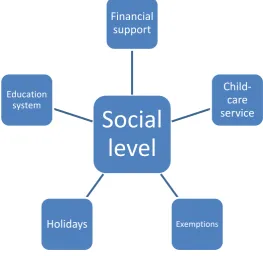
It is emphasised that there is lack of financial support and a more consistent infrastructure implementation programme for young families. Still, during conversations, participants of the research mostly focus on the situations of the social and institutional character and analysis of the problems. Figure 1 presents social categories distinguishing the main factors of social level formulated in the process of theory and narrative analysis.
Fig. 1 Factors at the social level
Social
level
Financial
support
Child-care
service
Exemptions
Holidays
Education system
When talking about studies, it was indicated that higher education or acquisition of a profession is very important for young families. It is maintained that there is an attempt to acquire education/profession and studies and maternity are reconciled. Women say that in the first year they would usually take the maternity leave if at work and those who were studying at the time would take the academic leave. It has to be acknowledged though that expectation and appearance of a new family member means certain adjustments of the family plans and the plans and wishes of the mother. Still women say that to a large extent they were ready to postpone their personal and family plans for the sake of the child’s upbringing. Maternity leave allowed before and after child birth is one of the oldest social welfare policy means in Europe. It is given for the family and is one of the main policy elements (Gauthier 2004). Most often women take child-care leave and men take short-term holidays they are entitled to after the birth of a child.
I think we have to start with time before child birth as I got pregnant after I defended my Master thesis. Before pregnancy I was planning to enter a doctoral study programme and in fact right after the MA defence I had to apply for doctoral studies, but on that very day I learnt that I was pregnant and I refused this plan. I thought if I was raising my child it had to be so that I would be able to give everything to the child and not something here – something there. Then I gave birth to a second girl, so all in all I spent four years at home. It was very hard… It is very hard to be at home all the time, you cannot do everything you want and you cannot go out. Somehow gradually we got used to the rhythm so I cannot even tell how much our life changed (Family P5: husband - 34, wife - 33, daughters - 6 and 4).
When children are born there is lack of time for everything and first of all for us. Everything had to be redistributed, we had to reduce our needs automatically – if earlier e.g. there was time for sports and leisure after work, now it has to be given for children. The individual kind of disappears; father and mother become the main persons. That is how everything is redistributed. (Family P7: husband - 31, wife - 32, daughter - 3).
It is observed, however, that the lack of financial support forces families to make unpopular decisions; in the case of family P1 the husband had to withdraw from the formal education system and though he attempted to return to his studies for several times, he did not succeed.
Husband was studying, but he had to quit studies as he had to earn money. He tried to return to his studies but he could not graduate and would quit again half-way. Of course his job does not require a diploma; if you know how to do it, you can work (Family P1: husband - 33, wife - 33, son -12 and daughter – 8).
Most often young families get support from their families or close relatives. In relation to that a problem is indicated, namely that quite often grandparents are still active professionally or are living in another city; therefore sometimes it is difficult to solve the problem fast and efficiently.
It was hard for me. We took our daughter to the nursery when she was two years old. For the first year I stayed with my daughter, but then I had to return to work earlier so my father would come for two days from another town (Ukmergė) to look after her. He agreed to help me because our other grandmother in Kaunas was still working and could not help. It happened so that we could not find a nanny, or maybe we could not afford it, because at that time we were building a house and we had a lot of expenses (Family P3: husband- 36, wife - 30m, daughter - 7).
It was complicated. It is good that we have grandparents who can help. At present they are helping us so much as our daughter does not go to the kindergarten. She is staying at the grandparents’. Adaptation after maternity leave after two years or a year is exceptionally hard, because you have to leave the child at home and go to work where you are thinking about the child every minute and have to focus on your work at the same time. (Family P7: husband - 31, wife - 32, daughter - 3).
Families say that hiring a temporary or permanent nanny is complicated because of low incomes. Children usually go to the kindergarten at the age of two (in some kindergartens the age limit is three years). The situation becomes complicated when mothers return to work or studies after a year. Most often the situation is solved by asking relatives for help. Stankuniene (2001) maintains that young families raising small children face an insufficiently developed children education service system, in the quantitative and qualitative sense. This system has to be favourable for working young families reconciling career and family obligations.
It was hard and complicated to continue studies. My husband helped me when I had to go to evening classes/consultations. The grandmother also helped a lot as I studied in the extramural programme and I had classes on weekends. I got a lot of support from family members (Family P4: husband - 33, wife - 35, daughter - 8).
The state only gives a maternity allowance and there is one more that is paid once. I do not know other. We do not have a kindergarten option as we registered late. The system here is that you have to register when the child is born. You go and you register though you do not know if in two or three years you will choose the same kindergarten and you do not even know if you are going take your child there after two years. A silly system, I think. We are tenants and we do not have our own home so we could not decide (Family P7: husband - 31, wife - 32, daughter - 3).
When a child starts school the family often faces another set of problems, because new obligations emerge, as well as a new rhythm. It is quite common that lessons at school finish at 2 p.m. and parents have to find ways to pick a child up and find a place where he/she could spend time while parents are still working. Most often relatives help again, but the problem still remains related to children occupation and extra-curricular activities. Child-care and education services have to be subsidised, flexible and provided for all pre-school and primary school children. State financed child-care services are provided for the children whose parents ask for it. Child-care and education centres are considered to be not only children education institutions but also means serving the economic need in labour force (Second European Quality of Life Survey – Family life and work 2010).
There were more concerns about the first form. I do not drive and the school can only be reached by car. The child has to be taken to school and picked up from school every day. My husband has to take up this burden. <...> I had perfect conditions – I work, I take care of home but I do not drive. Grandmother lives near the school, so she picks her up after classes. I can say that it is even easier now – our child is healthier, she is taken to school by car and her grandmother picks her up after classes. It means that she is safe and she adapted at school very fast and the overall atmosphere is really normal. (Family P3: husband - 36, wife -30, daughter - 7).
As we finish work in the evening and our son who is in the first form comes home at 1 – 1:30 p.m., we have to resort to the grandmother’s help. We are afraid to leave the child alone; therefore grandmother’s help is indispensable. She takes him from school and spends time with him until we
come back from work. Sometimes she even has to take him to extra-curricular activities. She is so helpful. (Family P4: husband -33, wife -35, daughter - 8).
In summary, it could be stated that young families really face considerable challenges where a dialog is most important between spouses, as well as common planning or search for strategy. Strategy in this context means coordination of emerging problems and indication of needs. At this point Rusconi and Solga’s concept of “family adaptive strategy” (2011) could be mentioned where the couple discusses and attempts to find a strategy that would help them to cope with difficulties. Strategy planning is related with combination of family needs and objectives of professional activity, as well as conflict elimination.
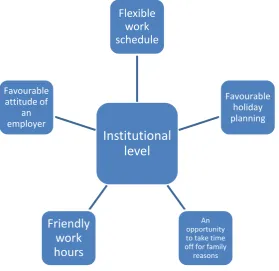
Presentation of the third criterion named as the institutional level discloses five factors significantly influencing the formation of a family and work reconciliation model that would be favourable for young families. According to Kempe & Otonkorpi-Lehtoranta (2006) support provided by employers and flexible professional activity organisation principle are of utmost importance (Fig.2).
Fig. 2 Factors of institutional level
Research participants emphasize that a mother faces considerable difficulties when coming back to work. To a large extent due to the lack of places in pre-school institutions children stay at home with nannies or relatives for two or three years. According to Davidavicius (2005), employers are not always satisfied with this situation. Still most often employers support young families raising children by allowing them to combine and plan their work hours and the speed of their activities. Quite often it happens so because employers themselves have families and thus understand the situation. If an employer does not have small children, employees often notice lack of benevolence for the employer’s part in terms of flexible work hours or family life inclusion in planning activities. Employers’ benevolence enhances stress-free working environment for employees and allows them to plan their activities according to the situation that is related with family needs.
Institutional
level
Flexible
work
schedule
Favourable holiday planning
An opportunity to take time off for family reasons
Friendly
work
hours
Favourable attitude of
an employer
In my workplace results actually depend on how you work. I mean the salary. There is a plan, so if I postpone something for tomorrow that would be all….. So if you take a day off, you have to accomplish about one third of the tasks not to fall behind. On the whole, employers are positive - there is no such situation when they would say “do your work first and then go”. They understand us very well, all have families. They have experience and they follow the principle to show that an employee is important and his/her family is also important. Of course, not all employers are kind; it depends on the company, the staff, the staff age and professionalism. The companies chosen are really good and it would be perfect to get there. The people who work there are professionals in their field so they are the same in everyday life – they give a lot of attention to families and employees feel very well in such companies. (Family P13: husband - 32, wife - 32 m., son - 6, son – 3 and daughter - 4).
In this job the situation is cardinally different – we do not even take the sick-leave when we fall ill or when a child falls ill. Our employers understand that you will not be at work for two or three days because of illness, they are tolerant. Let’s say you come after a few days off and there will be work to do, you can work longer hours for a couple of days and everything will be fine. (Family P4: husband - 33, wife - 35, daughter - 8).
Rusconi & Solga (2011) maintain that the issue about the care of children from one to three years of age is really urgent. The researchers say that it very important to consider flexible work hours where a fixed 8 to 5p.m. work day cannot be offered. They also touch upon “facilitation” related to the employer’s docility and creation of a system of certain privileges in a company where a representative of a young family is working. In order to achieve success, the importance of satisfaction with professional activity and family life, the so called “work-life balance” is emphasised. In this respect it is stressed that the couple’s agreement and balance between professional activity and private life is of utmost importance. It is often mentioned that long working hours have a negative impact in the family life (Golden & Wiens 2006).
I have noticed that a lot depends on the employer – if he has a preschool age child, he is more permissive to the others having children of this age. <...>You have to do your job, it does not matter if you come at 9 or 10 and leave at 7 or 8 in the evening, you just have to do your job. I was in the situation when the employer had a child and it was much simpler if you came 5-10 minutes later or you had to leave earlier. The employer who does not have children of this age, on the contrary, finds it problematic when I come an hour later after the lunch break or if I do not pick up the phone and he needs it to be done at that moment. (Family P 12: husband - 32, wife - 32, daughter - 9, daughter- 6).
I have a very good work schedule as I finish my work at 3 p.m. and can take my children and bring them home. The employer cannot do more in this situation. In our workplace we are not in the habit of negotiating if we want to come later or leave earlier; we just follow the general procedure. The kindergarten that our children go to is good in this respect as well, because when I have to go to work early I can take my children there even before 7 a.m. Not all kindergartens do it. Of course we were lucky to get places in nurseries for both children when we needed them. The system was not very simple, we had to go ourselves, stand in queues in order to register on time. When the system is like this you cannot change anything. (Family P 9: husband - 33, wife - 34, daughter – 6, daughter – 4).
It was observed that parents who participated in the research are trying to make use of exemptions and their employers encourage them to do so. In Lithuania parents can use a legal opportunity to take one day off per month - the so called father’s day or mother’s day. This day is meant for visits to the doctor or to school. When holidays are planned employees with small children are also taken into
consideration and they can plan their holidays in advance and adjust them to the holidays of their preschool/school age children.
Yes, here we really have very good conditions. I have been using my “mother’s days” since the very first day at work in this museum, I take a day off every month because I am entitled to that. I never have any problems if my children fall ill or I have to take a sick leave; no reproaches, no remarks that I can’t do it. If you need you take it and after they even ask if my children are OK. Even if I don’t take a formal sick leave and I need to take my child for medical examination, they always allow me to do it. As I have two small children and not many employees in our institution have small children the director has said “do what you want, but XX always gets holidays in August, so you have to adjust, because she does not have a way out”. It happens when the kindergarten is closed in August, for example. (Family P5: husband - 34, wife - 33, daughter – 6, daughter - 4).
For example, during summer holidays or on other occasions when children have some free days, we have opportunities to bring children to the workplace; they have a special playroom there. Before holidays the employees are interviewed to find out who will have to bring their children to work. Then the company hires a nanny at its own expense and children can spend time there – they can go outside to play and are taken care off all day long. (Family P4: husband - 33, wife - 35, daughter - 8).
Narratives also disclose negative situations when the atmosphere in the work place is unfavourable for young families raising small children. There are cases when the employer is unwilling to take into account the needs of a young family and to preserve a work place for a young family representative.
I think at present it is quite hard to find a good employer who would pay attention to the number of children you have and would provide some privileges. The overall result based on company goals and strategy - that is what matters. Nobody takes into consideration the fact that you have three children – if you cannot reach a certain result, you cannot work there. I think the employer does not care. Sometimes he asks “so you have two children? No? Three?”, but this is more for a joke. Everybody cares only for the result. (Family P13: husband - 32, wife - 32, son - 6, son – 3, daughter - 4 months).
Because of redundancy at work I was told that my colleague, who is much older than I, got the position, because she does not have small children who would often be sick. Probably they wanted to have some guarantees, because her children are grown up already, so she would be available at work any time. It makes you feel bad about it, because in the course of my long-term work I have never taken sick leaves, but it was not taken into account. In the future, probably, I am not going to sacrifice my personal life for the sake of work. (Family P4: husband - 33, wife - 35, daughter - 8).
In summary, it could be stated that to a large extent families are trying to reconcile work and family needs, but the employer’s understanding and employee - friendly working environment covering flexible work schedule, well planned holidays and friendly work place are indispensable. It allows the family to avoid conflict situations and facilitates the process of work and family life reconciliation.
CONCLUSIONS
The main external factors that have been distinguished in the process of theoretical material analysis have been grouped into three big levels: political, social and institutional. The three levels were given more attention, as well as the factors dominating at those levels. In the course of the empiric research, the external factors of the social and institutional levels were revealed more prominently. The
following factors have been distinguished at the social level: exemptions covering paternal and maternity leaves, the system of exemptions, child-care services and services of educational institutions. It is emphasised at this level that child-care services are limited due to the fact that most of the children get into kindergartens at the age of two/three, while mothers and fathers who would like to return to the labour market earlier and, therefore, have to look for help themselves. Certain drawbacks of the education system have also been indicated, focusing on the after-class time when parents have to ask for some help so that the children would be taken care of. The analysis of factors at the institutional level reveals the need in a flexible work schedule, well-planned holidays, friendly work hours and favourable attitude of the employer. Greater attention is given to the significance of the employer’s favourable position which helps a young family reconcile work and family needs and efficiently plan time which is a very sensitive factor for a young family. Together with the flexible schedule and employer’s favourable attitude a factor of employee-friendly environment in the work place is emphasised related with the opportunity not to come to work, equipment of a play room for children in the work place or a chance to work at home if children fall ill. In any case, young families are trying to reconcile the needs of all family, avoid conflicts and strive for a common goal covering time planning, avoidance of stressful situations and conflicts.
REFERENCES
Civilinio kodekso patvirtinimo, isigaliojimo ir igyvendinimo istatymas, 2000, Nr. 74-2262.
Davidavicius, A. 2006, “Darbo ir seimos suderinimo politikos kryptys bei galimybės ES ir Lietuvoje: vyraujancių viesosios politikos paradigmu kaitos analize”, (Ne)apmokamas darbas: seimai palanki darbo aplinka ir lyciu lygybe Europoje, p. 203-236. Download from: http://gap.lt/wp-content/uploads/2014/02/ataskaita2006_LT.pdf [active: 2015-03-02].
Del Valstybines seimos politikos koncepcijos patvirtinimo, LR Seimo nutarimas , 2008 06 03, Nr. X-1569, p.1.4.
Den Dulk, L. 2001, “Work-family arrangements in organizations”, A crossnational study in the Netherlands, Italy, th United Kingdom and Sweden. Amsterdam: Rosenberg publishers.
Dromantiene, L. 2008, Socialinės Europos kūrimas. Monografija. Vilnius: Mykolo Romerio universiteto leidybos centras, p.140.
Dunn, W. N. 2006, Viešosios politikos analizė. Vilnius: Homo liber.
Esping-Andersen, G.1999, Social Foundations of Postindustrial Economies. Oxford University Press. Oxford, New York.
Gauthier, H. A. 2004, Choises, opportunities and constraints on partnership, childbearing and parenting: the policy responses. Background paper for the session on: International migration:
promoting management ant integration. Download from:
http://www.unece.org/fileadmin/DAM/pau/_docs/pau/2004/PAU_2004_EPF_BgDocGauthier.pdf [active: 2015-01-15].
Golden, L. & Wiens –Tuers, B. 2006, To your happiness? Extra hours of labor supply and worker well-being. The Journal of Socio-Economics, No. 35, p. 382–397.
Hewlett, S. A. 2007, Off-Ramps and On-Ramps: Keeping Talented Women on the Road to Success. Harvard Business Review Press.
Jancaitytė R. 2006, “Family-friendly policies and wellfare state: a comparative analysis. Between paid and unpaid work: Family-friendly policies and gender equality in Europe”, Social research center of Vytautas Magnus University. Vilnius
Kairiene, B., Jancaityte, R. & Kolbergyte A. 2009, “Darbdaviu poziuris i apmokamo darbo ir seimos vaidmenu derinimo galimybes Lietuvoje”, Socialinis darbas. Mokslo darbai, No. 8 (1), Vilnius: Mykolo Romerio universitetas, p. 28-37.
Kempe, J. & Otonkorpi-Lehtoranta, K. 2006, “Family-friendly personnel policy and workplace culture-challenges for working life. Posibilites and challenges mens reconciliation of work and family life”, Conference report. Nord ic Council of Ministers, Copenhagen.
Lietuvos Respublikos Konstitucija, 38 str., Zin., 1992, Nr. 33-1014.
LR Konstitucinis Teismas, 2011-09-28 nutarimas.
Moen, P. 2003, It‘s about Time: Couples and Careers. ILR Press Books.
Parsons, W. 2001, Viešoji politika. Politikos analizes teorijos ir praktikos ivadas. Vilnius: Eugrimas.
Reingardiene, J. 2006, Tyrimas „Issukiai seimos ir profesines veiklos suderinamumui Lietuvoje“. VDU Socialiniu tyrimu centras.
Rusconi A. & Solga H. 2011, "Linked Lives" in der Wissenschaft – Herausforderungen für berufliche Karrieren und Koordinierungsarrangements. Gemeinsam Karriere machen. Download from: http://www.budrichverlag.de/upload/files/artikel/00000517_010.pdf?SID=2b952f28efe7e96539b455a 5d0a3e348. [Active: 2015-03-07].
Second European Quality of Life Survey – Family life and work, 2010.
Søderberg, A. M. 2006, Narrative interviewing and narrative analysis in a study of a cross-border merger August Management International Review. Springer, Volume 46, p. 397-416.
Stankuniene, V., Jasilioniene, A. & Jancaityte, R. 2001, Paramos seimai politika: samprata ir patyrimas. Kolektyvinė monografija. Lietuvos filosofijos ir sociologijos institutas. Vilnius.
Steen, M. 2010, “Balancing Family and Career”, Stanford Business, Winter 2009-2010. p. 14-17.
Tarptautiniu pilietiniu ir politiniu teisiu paktas, 23 str.
Virgilaite-Meckauskaite E. & Mazeikiene N. 2012, “Biografinio tyrimo galimybes tiriant magistrantu tarpkulturines kompetencijos ugdymasi socializacijos procese”, Kokybiniai edukaciniai tyrimai: Teorijos, duomenu rinkimas ir analize. Siauliai: VSI Siauliu universiteto leidykla, p. 208-227.
Visuotine zmogaus teisiu deklaracija, 16 str., Paskelbta: Valstybės zinios, 2006-06-17, Nr. 68-2497.