© 2015 IJSRSET | Volume 1 | Issue 5 | Print ISSN : 2395-1990 | Online ISSN : 2394-4099 Themed Section: Engineering and Technology
IPSO-Based FOPI Controller Design for Horizontal Cylindrical
Tank Liquid Level Process
S. Mourouga Pragash1 , R. Ananda Natarajan2
1Professor, Department of Electronics and Instrumentation Engineering, Pondicherry Engineering College,
Pondicherry, India
2Associate Professor, Department of Electronics and Instrumentation Engineering, Pondicherry Engineering
College, Pondicherry, India
ABSTRACT
This paper depicts the Fractional Order PI controller to control the level of horizontal cylindrical shaped tank. A main goal to beat the disadvantages of standard PSO, some enhanced mechanisms for velocity updating, the boundary limit control, global best perturbation and the Simplified Quadratic Interpolation (SQI) administrator are adopted. Improved Particle Swarm Optimization technique is utilized for design the parameters of Fractional PI controller in this work. Simulation results demonstrate that the refined pinpointing search capacity and the global search capacity of the proposed algorithm are essentially improved when compared with the Particle Swarm Optimization (PSO) and PI controller. The controller needs to improve the dynamic characteristic for the level control in horizontal tank.
Keywords : IPSO , FOPI, horizontal cylindrical , optimaization
I.
INTRODUCTIONNowadays, the different parameters during the time spent industrial are controlled, for example, temperature, level, and so on. Some procedure needs to keep the fluid level in the horizontal tank, such as, oil, substance fluid in its surge drum level control system. The level control is a sort of control technique for regular in process system. The level control system must be controlled by the best possible controller. The objective of the controller in the level control is to maintain a level set point at a given value and have the capacity to acknowledge new set point values dynamically. The conventional PI controller is normally used in controlling the level, however the parameter of those controllers must be turned by tuning method either in time response of frequency to meet their required performances [1,2]. In order to
handle this issue and improve the dynamic response of the horizontal cylindrical tank system, a Fractional Order PI controller has been utilized. The design aspects of the controllers based on various soft computing techniques. A Fractional Order PI controller has been utilized to regulate the process of the system inside a specified tolerance limit.A very important aspect of designing FOPI controllers is to decide upon the values of KP, Ki, Kd, λ.
electronics [3], system identification [4], automated controllers [5], etc., It should be noticed that there are a developing number of physical systems whose behaviour can be minimalistically decided utilizing the fractional order system theory and can be controlled with Fractional Order Proportional-Integral (FOPI) controllers [6].
The proposed work deals with the design and control of a horizontal cylindrical tank system. The influence of this work consists mainly in the design of KP, Ki, λ values are finding using improved Particle swarm optimization technique to design the Fractional order PI controller and compared with conventional one. The development and implementation of the proposed system and controllers was done using MATLAB/Simulink.
II.
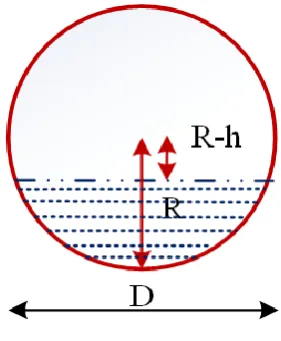
Horizontal Cylindrical Tank SystemThe horizontal tank, for example, oil, chemical fluid in its surge drum level control system has demonstrated Fig.1. The reason for the surge vessel is to smooth varieties in the flow from process one and keep up a generally consistent flow rate to process two. The level can vary substantially from the set point, as long as the vessel does not overflow or go dry. The main object is to vary the manipulated flow rate (the outlet flow from the vessel) as little as possible, while satisfying level constrains. Surge vessels are used to help reduce the effect of flow rate variations between interconnected process units. It is necessary to maintain tight level control in a surge vessel
Fig. 1 The horizontal cylindrical tank model
The mathematical model of the horizontal cylindrical tank liquid level system considered for the study is expressed as
Let R, be radius of cross section. h, be level of liquid inside the tank. D, be diameter of cross section. L, be height of the tank.
As per the conservation of mass,
out in F F dt dv
−
=
(1)
Where dv/dt is change of volume of liquid in tank with respect to time
Fin - is Volume flow rate at inlet Fout - is Volume flow rate at outlet
in conservation of mass,
out in
2 F F
dt dh h Rh L
2 − = −
(2)
2 out in
h Rh 2 L 2
F F dt dh
− − =
(3) Where
2
2
2
L
Rh
h
h
c
F
dt
dh
in−
−
=
(4)This is the mathematical model of the horizontal cylindrical Therefore the equation holds good for all the different level of the tank.
III.
FRACTIONAL ORDER PICONTROLLERThe general procedure of a FOPI controller is the PIλ controller comprising an integrator of order λ where λ
can be any real numbers. The transfer function of such a controller has the form
(5) Where Gc(s) is the transfer function of the controller, E(s) is an error, and U(s) is controller’s output. Fig. 2 show the block-diagram configuration of FOPI. The integrator term is 1sλ, that is to say, on a semi-logarithmic plane, there is line having slope -20λdB/decade. The control signal u(t) can then be
expressed in the time domain as,
(6) Fig. 2 Block diagram configuration of Fractional
Order PI controller
It can be normal that the PIλ controller may enhance the systems control execution. A standout amongst the most important advantages of the PIλ controller is the better control of dynamical systems, which are depicted by fractional order modelling [7]. Another advantage lies in the way that the PIλ controllers are less impatient to changes of parameters of a controlled system.
IV.
IMPROVED PARTICLE SWARM OPTIMIZATIONNowadays, it is common to find complex problems to be solved in diverse areas of human life. Optimization problems can be considered among them. Different sources of difficulty can be associated in their resolution e.g. a very high number of possible solutions (very large search spaces), hard-to-satisfy constraints and a high nonlinearity. Mathematical Programming (MP) offers a set of techniques to solve different type of problems like numerical, discrete or combinatorial optimization problems. To upgrade the refined pinpointing look capacity and to strike a exploration investigation and exploitation of accessible PSOs, the following changes are proposed.
Velocity Updating
Since the two random parameters r1 and r2 are autonomously produced, definitely there are cases in which they are both too expansive and too little. In the previous, both the individual and social experiences gathered so far are abused and the particle may be away from the local optimum. For the last case, both the individual and social experiences are not completely utilized, so the particle won't not have the capacity to locate the local optimum. Therefore, the convergence execution of the algorithm is undermined. As it were, the two random weighting parameters reflecting the experiences of its own and its companions are not totally autonomous. By modelling this reasoning capacity into a refreshing equation and taking note of the entirety of the two inter-related weighting parameters can be set to 1, one single arbitrary parameter that involves the discerning and aggregate abilities of the particle for advising its velocity is recommended. So, the velocity is refreshed by using
It ought to be noticed that the correspondence between various particles in the proposed research ) 0 , ( , S k S 1 k k ) S ( E ) S ( U ) s (
GC = = p+ I + D
) t ( e D k ) t ( e D k ) t ( e k ) t (
methodology is set up in a progressive way as opposed to a progressive way.
Implementation SQI optimizer
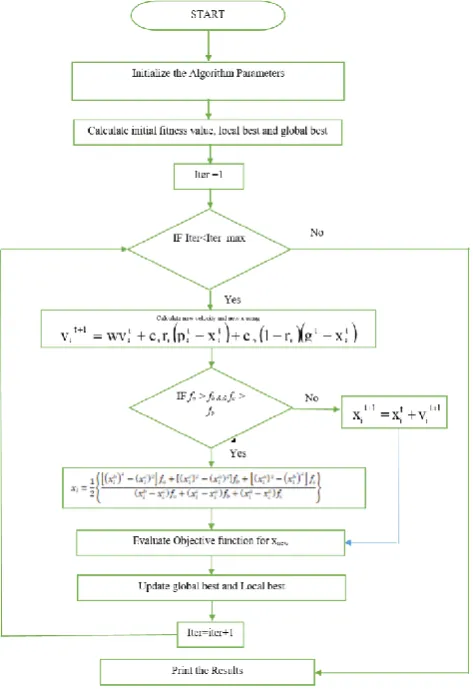
As an equipped for local search optimizer, the three-point Quadratic Interpolation method is consolidated into PSO to upgrade its local search capacity and maintain a strategic distance from its premature convergence.
Represent three particles by
and calculate their fitness values
, , .
Suppose fa > fband fc > fb, then the approximate
minimal point x=[x1,…….,xn]T derived from the three-point quadratic interpolation is expressed as follows,
(i=1,… ,n)
Fig. 3 Block diagram configuration of Fractional Order PI controller
Fig.4. Flow chart of Particle swarm optimization
V.
SIMULATION RESULTSWe analysis λ value and applied to the Fractional
simulated responses of Horizontal Cylindrical tank system using PI and FOPI controller parameters obtained using Conventional and IPSO method with disturbances at time period of t =10000 sec and t=25000 with value of +5 and -5 respectively. The performance and analysis of Horizontal cylindrical
tank process with PI and FOPI using conventional method and IPSO algorithm shown in Table.1 It’s
clear that the Figs.7,10 and 13 show the FOPI controller has better and quicker response than PI controller.
1 Out1
sqrt
sqrt(h)
sqrt sqrt(2Rh-h2)
u2
h^2
1
u h^1 1 s
xo
h
4
c*sqrt(h)
Rh2
Rh1
30
Constant2 15
Constant1
-K-2*L*sqrt
Fig.5: Simulink diagram of fractional order PI controller
Fig.6. Simulated responses of Horizontal cylindrical tank system using PI and FOPI controller parameters obtained using Conventional method under Nominal case with set value of 30% in Level
Fig.7. Simulated responses of Horizontal cylindrical tank system using PI and FOPI controller parameters obtained using Conventional and IPSO method under Nominal case with set value of 30% in Level
0 5000 10000 15000
0 5 10 15 20 25 30 35 40 45
Time in sec
L
eve
l
in
%
CONV PI CONV FOPI
0 1000 2000 3000 4000 5000 6000 7000 8000 9000 10000
0 5 10 15 20 25 30 35 40 45
Time in sec
L
eve
l
in
%
Fig.8. Simulated responses of Horizontal Cylindrical tank using PI and FOPI controller parameters obtained using Conventional method with set point tracking at time period of t =10000 sec and t=15000 with value of 40
and 35.
Fig.9. Simulated responses of Horizontal Cylindrical tank using PI and FOPI controller parameters obtained using IPSO method with set point tracking at time period of t =10000 sec and t=15000 with value of 40 and 35.
0 0.5 1 1.5 2 2.5
x 104 0
5 10 15 20 25 30 35 40 45 50
Time in sec
Le
ve
l i
n
%
CONV PI CONV FOPI
0 0.5 1 1.5 2 2.5
x 104 0
5 10 15 20 25 30 35 40 45 50
Time in sec
L
e
v
e
l
in
%
Fig.10. Simulated responses of Horizontal Cylindrical tank system using PI and FOPI controller parameters obtained using Conventional and IPSO method with set point tracking at time period of t =10000 sec and
t=15000 with value of 40 and 35.
Fig.11. Simulated responses of Horizontal Cylindrical tank system using PI and FOPI controller parameters obtained using Conventional method with disturbances at time period of t =10000 sec and t=25000 with value
of +5 and -5.
0 0.5 1 1.5 2 2.5
x 104 0
5 10 15 20 25 30 35 40 45 50
Time in sec
L
e
v
e
l
in
%
CONV PI CONV FOPI IPSO PI IPSO FOPI
0 0.5 1 1.5 2 2.5
x 104 0
10 20 30 40 50
Time in sec
L
eve
l
in
%
Fig.12. Simulated responses of Horizontal Cylindrical tank system using PI and FOPI controller parameters obtained using IPSO method with disturbances at time period of t =10000 sec and t=25000 with value of +5%
and -5%.
Fig.13. Simulated responses of Horizontal Cylindrical tank system using PI and FOPI controller parameters obtained using Conventional and IPSO method with disturbances at time period of t =10000 sec and t=25000
with value of +5% and -5%.
0 0.5 1 1.5 2 2.5
x 104 0
5 10 15 20 25 30 35 40 45 50
Time in sec
L
eve
l i
n
%
IPSO PI IPSO FOPI
0 0.5 1 1.5 2 2.5
x 104 0
5 10 15 20 25 30 35 40 45 50
Time in sec
Le
ve
l i
n
%
Table.1 Performance and analysis of Horizontal cylindrical tank process with PI and FOPI using conventional method and IPSO algorithm
Controller
Controller Parameters Peak time
sec
Max overshoo
t %mp
Settling time
sec
Cost
KP Ki ISE IAE
Conventional PI
1.440 7
0.0023 - 2748 6.53 9886 6.5466e+10 1.0161e+10
Conventional FOPI
0.724 3
2.1850 0.9 99 36.4 2424 1.7029e+10 3.5100e+09
IPSO PI 10.00 0
0.1238 - 310 13.1 1759 3.8528e+09 8.2080e+08
IPSO FOPI 9.469 6
0.3743 0.842 246 15.86 1279 3.5244e+09 7.4108e+08
VI.
CONCLUSIONPI and FOPI controller are used to control the level in the horizontal cylindrical tank. It has been demonstrated that the speed of responses of the level control system with and without load interrupt in the tank are quick. This paper introduced a keen advancement technique for Fractional Order PI controller tuned with enhanced Particle Swarm Optimization. In order to appraise the performance of the controller, the proposed system was done with MATLAB/Simulink. The robust design of the Fractional Order PI controller is difficult to compare to the PI controller, since the FOPI controller includes more parameters. All of the parameters related to the FOPI controller were determined using IPSO. Considering the greater part of the outcomes from the simulation, the IPSO based FOPI controller can accomplish great performance and robustness, better than those acquired with other one.
Authors :
Dr. Mourouga Pragash.S obtained his bachelor degree in Electrical and Electronic Engineering from Bharathiyar University in 1998 and M.E (Process Control and Instrumentation) from Annamalai University, Ph.D from Pondicherry
University 2001 and 2015 respectively .Presently he is an Associate Professor of the Department of Electronics and Instrumentation Engineering Pondicherry Engineering College, Puducherry, India. His area of interest in process control, intelligent control, optimal control and nonlinear control
Dr .R. Anandanatarajan obtained his B.Sc (Mathematics ) from Madras University in 1984, bachelor degree in Electrical from Institution of Engineers (India) in 1989, M.Sc (Mathematics) and M.E
(Process Control and