CIC-FBK Approach to Native Language Identification
Ilia Markov1, Lingzhen Chen2, Carlo Strapparava3, Grigori Sidorov1
1Instituto Polit´ecnico Nacional, CIC, Mexico City, Mexico
2University of Trento, DISI, Trento, Italy
3FBK-irst, Trento, Italy
[email protected], [email protected], [email protected], [email protected]
Abstract
We present the CIC-FBK system, which took part in the Native Language Iden-tification (NLI) Shared Task 2017. Our approach combines features commonly used in previous NLI research, i.e., word n-grams, lemma n-grams, part-of-speech n-grams, and function words, with re-cently introduced charactern-grams from misspelled words, and features that are novel in this task, such as typed char-acter n-grams, and syntactic n-grams of words and of syntactic relation tags. We use log-entropy weighting scheme and perform classification using the Support Vector Machines (SVM) algorithm. Our system achieved 0.8808 macro-averaged F1-score and shared the 1strank in the NLI Shared Task 2017 scoring.
1 Introduction
Native language identification (NLI) is a natural language processing (NLP) task that aims at au-tomatically identifying the native language (L1) of a language learner based on his/her writing in the second language (L2). Identifying the native language is based on the hypothesis that the L1 of a learner impacts his/her L2 writing due to the language transfer effect. NLI can be used for a variety of purposes, including marketing, security, and educational applications. From the machine-learning perspective, the NLI task is viewed as a multi-class, single-label classification problem, in which automatic methods have to assign class la-bels (L1s) to objects (texts).
Recent trends in NLI include cross-genre and cross-corpus NLI scenarios (Malmasi and Dras, 2015a), as well as identifying the L1 based on writings in other non-English L2s and
cross-lingual NLI research (Malmasi and Dras,2015b). However, following the practice of the first NLI shared task (Tetreault et al.,2013), this year’s task focuses on L2 English data (Malmasi et al.,2017). This can be related to the use of English aslingua franca on the Internet and academia, when NLI methods are particularly useful for languages with a large number of foreign speakers. Moreover, following the 2016 Computational Paralinguistics Challenge (Schuller et al.,2016) and the VarDial workshop (Malmasi et al.,2016), this year’s com-petition covers an NLI task based on the spoken response. Overall, this year’s task consists of three tracks: NLI on the essay only, NLI on the spoken response only, and NLI on both essay and spoken response. In this paper, we describe the CIC-FBK approach to the essay-only track.
Previous works on identifying the native lan-guage from texts explored a large variety of features, including lexical and part-of-speech (POS) features (Koppel et al., 2005a), charac-ter n-grams (Ionescu et al., 2014), spelling er-rors (Koppel et al., 2005b), and syntactic fea-tures (Wong and Dras, 2011). Following previ-ous research on the NLI task, we incorporate com-monly used wordn-grams, lemman-grams, POS n-grams, and function words. In order to capture the L1 influences at the character level, we use recently introduced character n-grams from mis-spelled words (Chen et al., 2017), as well as 10 categories of character n-gram features proposed by Sapkota et al. (2015). We also include syn-tactic features by extracting synsyn-tactic dependency-basedn-grams of words and of syntactic relation tags (Sidorov et al.,2014) using the algorithm de-signed byPosadas-Dur´an et al.(2014,2017). We describe the features used by the CIC-FBK system in more detail in subsection3.1.
Our system achieved 0.8808 macro-averaged F1-score and 0.8809 accuracy in the essay-only
track and shared the 1st rank in the NLI Shared Task 2017 scoring, obtaining the 2nd absolute score with the difference of 0.0010 F1-score and 0.0009 accuracy with the 1stplace.
2 Data
The dataset used in the NLI Shared Task 2017 is composed of English essays written by non-native learners in a standardized assessment of English proficiency for academic purposes. The corpus consists of 13,200 essays (1,000 essays per L1 for training, 100 for development, and 100 for test-ing). The essays are sampled from 8 prompts, and score levels (low/medium/high) are provided for each essay. The training, development, and test sets are balanced in terms of the number of essays per L1 group. The 11 L1s covered by the corpus are: Arabic (ARA), Chinese (CHI), French (FRE), German (GER), Hindi (HIN), Ital-ian (ITA), Japanese (JAP), Korean (KOR), Span-ish (SPA), Telugu (TEL), and Turkish (TUR). The detailed description of the corpus and its statistics can be found inMalmasi et al.(2017).
3 Methodology
Our system incorporates a wide range of features, i.e., word, lemma, and POSn-grams, spelling er-ror character n-grams, typed character n-grams, and syntacticn-grams. We used the tokenized ver-sion of essays provided by the organizers. For the evaluation of our approach, we merged the train-ing and development sets, and conducted experi-ments under 10-fold cross-validation. System per-formance was measured in terms of both classifi-cation accuracy and F1 (macro) score. The for-mer was used as evaluation metric in the majority of previous works on NLI, whilst the later is the official evaluation metric in the NLI Shared Task 2017.
3.1 Features
3.1.1 Word, lemma, and POSn-grams
Word and lemma features represent the lexical choice of a writer, while part-of-speech (POS) features capture the morpho-syntactic patterns in a text. Following previous works on the NLI task (Jarvis et al.,2013;Malmasi and Dras,2017), we use word, lemma, and POS n-grams with n ranging from 1 to 3. We include punctuation marks and splitn-grams by a full stop. We lower-case word and lemma n-grams and replace each
digit by the same symbol (e.g., 12,345→00,000), as proposed inMarkov et al.(2017), to capture the format (e.g., 00.000 vs. 00,000), which reflects stylistic choice of a learner and not the value of a number that does not carry stylistic information. Lemmas and POS tags were obtained using the TreeTagger software package (Schmid,1995).
3.1.2 Function words
Function words are the most common words in a language (e.g., articles, determiners, con-junctions). They are considered one of the most important stylometric features (Kestemont,2014). Function words can be seen as indicators of the grammatical relations between other words. We use a set of 318 English function words from the scikit-learn package (Pedregosa et al., 2011). Other examined function word lists obtained from the Natural Language Toolkit1(127 function words) and the Onix Text Retrieval Toolkit2 (429 function words), as well as function word skip-grams (Guthrie et al., 2006) did not lead to an improvement in accuracy.
3.1.3 Spelling error charactern-grams
Spelling errors have been used as features for NLI sinceKoppel et al.(2005b). They are considered a strong indicator of an author’s L1, since they reflect L1 influences, such as sound-to-character mappings in L1. Recently, Chen et al. (2017) introduced the use of character n-grams from misspelled words. The authors showed that adding spelling error character n-grams to other commonly used features (word and lemma n-grams) improves NLI classification accuracy. We extract 39,512 unique misspelled words from the training and development sets using thespell shell command. Then we build charactern-grams (n = 4) from the extracted misspelled words. Other examined size of spelling error character n-grams (n = 1, 2, 3, and 5), as well as their combinations did not lead to an improvement in system performance.
3.1.4 Typed charactern-grams
Character level features are sensitive to both the content and the form of a text and able to
cap-1http://www.nltk.org
ture lexical and syntactic information, punctuation and capitalization information related with the au-thors’ style (Stamatatos,2013). The effectiveness of character n-gram features for representing the stylistic properties of a text has been demonstrated in previous NLI studies (Ionescu et al.,2014;Chen et al.,2017). Their effectiveness in NLI is hypoth-esized to be a result of phoneme transfer from the learner’s L1, and by their ability to capture ortho-graphic conventions of a language (Tsur and Rap-poport,2007).
Sapkota et al.(2015) defined 10 different char-acter n-gram categories based on affixes, words, and punctuation. In this approach, instances of the samen-gram may refer to different typedn-gram features. For example, in the phrase less care-lessness, the two instances of the 4-gramlessare assigned to different charactern-gram categories. As an example, consider the following sample sen-tence:
(1) Lisa said, “John should repair it tomorrow.” The character n-grams (n = 4) for the sample sentence (1) for each of the categories proposed bySapkota et al.(2015) are shown in Table1. For clarity, spaces are represented by the underscore.
SC Category N-grams
affix
prefix shou repa tomo suffix ould pair rrow
space-prefix sai sho rep it tom space-suffix isa ohn uld air
w
ord whole-wordmid-word Lisa said Johnhoul epai omor morr orro multi-word∗ sa s hn s ld r ir i it t
punct
beg-punct “Joh
mid-punct∗∗ , “ . ”
end-punct aid, row.
∗If the previous word is more than one character long, two characters are
considered; otherwise, only one character is considered.
∗∗We use the tokenized version of essays and set the size ofn-grams to 3
[image:3.595.75.288.423.577.2]for this category. For other categories of typed charactern-grams, the size is set to 4.
Table 1: Typed character 4-grams per category for the sample sentence (1) after applying the algo-rithm proposed bySapkota et al.(2015).
Typed charactern-grams have shown to be pre-dictive features for other classification tasks, such as authorship attribution (Sapkota et al., 2015), author profiling (Markov et al., 2016), and dis-criminating between similar languages ( G´omez-Adorno et al., 2017). In our experiments, typed
character n-grams (n = 4) outperformed tradi-tional charactern-grams of the same size in most system configurations. In addition, we compared the performance of typed and traditional charac-tern-grams on the 7-way ICLEv2 corpus (Granger et al.,2009), following the corpus splitting as de-scribed in Ionescu et al. (2014). In this experi-ment, typed charactern-grams proved to be more indicative than traditional charactern-grams when used in combination with features described in this paper.
3.1.5 Syntacticn-grams
Syntactic features, including production rules (Wong and Dras, 2011) and Tree Sub-stitution Grammars (TSGs) (Swanson and Charniak, 2012), have been previously explored for NLI.Tetreault et al.(2012) experimented with the Stanford parser (de Marneffe et al., 2006) dependency features and concluded that they are strong indicators of structural differences in L2 writing. We exploit the Stanford depen-dencies to build syntactic n-gram features by using the algorithm designed and made available byPosadas-Dur´an et al. (2014,2017).3 Consider the following sample sentence:
(2) I remember this great experience.
The dependencies generated by the Standard parser for the the sample sentence (2) are the fol-lowing:
root(ROOT, remember),
nsubj(remember, I),
dobj(remember, experience),
det(experience, this),
amod(experience, great).
These dependencies, including backoff trans-formation based on POS, were used as features for NLI in Tetreault et al.(2012). According to the metalanguage proposed in Sidorov (2013a), the syntactic 2-grams of words are the following:
remember[I],
remember[experience],
experience[this],
experience[great];
when the syntactic 3-grams of words are:
remember[I,experience],
remember[experience[this]],
remember[experience[great]],
3The Python implementation of the algorithm is available
experience[this,great];
the syntactic 2-grams of syntactic relation tags are:
root[nsubj],
root[dobj],
dobj[det],
dobj[amod];
the syntactic 3-grams of syntactic relation tags are:
root[nsubj,dobj],
root[dobj[det]],
root[dobj[amod]],
dobj[det,amod].
Here, the head element is on the left of a square parenthesis and inside there are the dependent el-ements; the elements separated by a coma refer to non-continuous syntacticn-grams, that is, the ele-ments are at the same level in a syntactic tree.
Syntactic n-grams can be used in any task where traditionaln-grams are applied. They allow to introduce syntactic information into machine-learning methods (obviously, at cost of previ-ous syntactic parsing). Syntacticn-grams outper-formed traditionaln-grams in the task of author-ship attribution (Sidorov et al.,2014) and were ap-plied in tasks related with L2, for example, auto-matic English as L2 grammar correction (Sidorov, 2013b). In our system, we use only continuous syntactic n-grams of words and of syntactic re-lation tags with n ranging from 2 to 3. The in-clusion of non-continuous syntactic n-grams im-proved 10-fold cross-validation accuracy; how-ever, did not perform well on the test set.
3.2 Frequency threshold
The fine-tuning of feature set size has proved to be a useful strategy for NLI (Jarvis et al.,2013) and other NLP tasks (Stamatatos,2013;Markov et al., 2017). In our approach, we selected the frequency threshold value that provided the highest 10-fold cross-validation result. We consider only those features that occur in at least two documents in the training corpus and that occur at least 4 times in the entire training corpus. This frequency thresh-old improves 10-fthresh-old cross-validation accuracy by about 1%, compared to the configuration when all the features are considered, and reduces the size of the feature set by approximately 90% of the origi-nal. The final size of our feature set is 726,494.
3.3 Weighting scheme
We use log-entropy weighting scheme, which showed good results in previous studies on NLI (Jarvis et al., 2013; Chen et al., 2017).
Log-entropy weighting scheme consists of lo-cal weighting (denoted as Llog(i, j)) and global
weighting (denoted asGent(i)). The local
weight-ing is calculated by takweight-ing the logarithm value of adding-one smoothed term frequency:
Llog(i, j) = log(frequency(i, j) + 1), (1)
where frequency(i, j) is the frequency of term iwith regard to documentj. The global entropy weighting is calculated by the following formula:
Gent(i) = 1 + J P
j=1pijlogpij
log(J+ 1) , (2)
whereJ is the total number of documents in the corpus. PJ
j=1pijlogpij is the additive inverse of
en-tropy of the conditional distribution giveniand
pij = Pfrequency(i, j) j frequency(i, j)
. (3)
The final weightingW is calculated as follows: W =Llog(i, j)×Gent(i). (4)
Other examined feature representations, i.e., bi-nary feature representation, tf, tf-idf, and nor-malized feature representation did not enhance system performance. Using log-entropy weight-ing scheme outperforms tf-idf, the second best scheme in our experiments, by 2.6% in 10-fold cross-validation accuracy.
3.4 Classifier
Support Vector Machines (SVM) is considered among the best performing classification algo-rithms for text categorization tasks; moreover, it was the classifier of choice for the majority of the teams in the previous edition of the NLI shared task. We use the liblinear scikit-learn (Pedregosa et al., 2011) implementation of SVM with ‘ovr’ multi-class strategy. We set the penalty hyper-parameterCto 100 based on our model selection result.
4 Results
obtained on the test set with other participating teams. We present the 10-fold cross-validation re-sults in terms of classification accuracy. For each experiment, the difference between accuracy and F1 (macro) score was less than 0.0003.
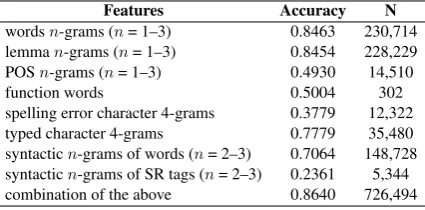
The individual performance of the features used in our system with the configurations described in the previous section, as well as the number of fea-tures (N) of each type are shown in Table2.
Features Accuracy N
wordsn-grams (n= 1–3) 0.8463 230,714 lemman-grams (n= 1–3) 0.8454 228,229 POSn-grams (n= 1–3) 0.4930 14,510
function words 0.5004 302
[image:5.595.308.528.62.182.2]spelling error character 4-grams 0.3779 12,322 typed character 4-grams 0.7779 35,480 syntacticn-grams of words (n= 2–3) 0.7064 148,728 syntacticn-grams of SR tags (n= 2–3) 0.2361 5,344 combination of the above 0.8640 726,494
Table 2: 10-fold cross-validation accuracy of each feature type individually on the merged training and development sets.
In line with the previous works on the NLI task (Tetreault et al., 2013; Jarvis et al., 2013; Chen et al., 2017), in our configurations word and lemma n-grams are the most predictive fea-tures. They showed 0.8463 and 0.8454 10-fold cross-validation accuracy, respectively, when eval-uated in isolation. Typed charactern-grams also performed well with a much smaller feature size, achieving 0.7779 accuracy. Syntacticn-grams of syntactic relation tags showed the lower accuracy when evaluated in isolation; however, when used in combination with other features, they improve 10-fold cross-validation accuracy by 0.2%. The combination of all the features showed 0.8640 10-fold cross-validation accuracy on the merged training and development sets.
The NLI Shared Task 2017 organizers reported several 1stranked teams based on McNemar’s sta-tistical significance test with an alpha value of 0.05. The official results for the essay-only track in terms of F1 (macro) score and classification ac-curacy for the 1stranked teams, as well as the base-line results are shown in Table3.
The CIC-FBK best run differs 0.0009 in terms of classification accuracy from the highest result achieved by the ItaliaNLP Lab system, which cor-responds to one correctly predicted label. All the 17 participating teams in the NLI Shared Task 2017 achieved higher level of F1 (macro) score than the official baseline of 0.7104.
[image:5.595.76.289.196.301.2]Rank Team F1 (macro) Accuracy 1 ItaliaNLP Lab 0.8818 0.8818 1 CIC-FBK 0.8808 0.8809 1 Groningen 0.8756 0.8755 1 NRC 0.8740 0.8736 1 taraka rama 0.8716 0.8718 1 UnibucKernel 0.8695 0.8691 1 WLZ 0.8654 0.8655 - Official baseline 0.7104 0.7109 - Random baseline 0.0909 0.0909
Table 3: Results for the essay-only track for the 1st ranked teams. The results for our team are high-lighted in bold typeface.
The CIC-FBK system showed 0.8639 F1 (macro) score and 0.8640 accuracy under 10-fold cross-validation on the merged training and devel-opment sets. Our other runs in the NLI Shared Task 2017 included small modifications in sys-tem configurations, such as variations in frequency threshold values and different strategy for dealing with digits (e.g., 12,345→0,0). However, since these modifications showed only marginal accu-racy variations and did not improve system perfor-mance on the test set, the results for these runs are omitted in this paper.
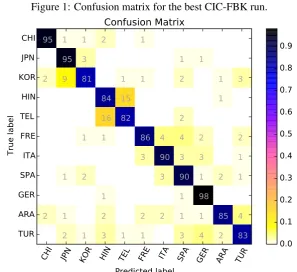
The confusion matrix for our best run is shown in Figure 1. The highest level of confusion is between Hindi and Telugu classes. Korean and Japanese is another problematic language pair, in which Korean native speakers are often classified as Japanese. The highest accuracy of 0.9800 was achieved for German native speakers. These re-sults are in line with the ones reported in the pre-vious edition of the NLI share task (Tetreault et al., 2013), where the teams achieved low levels of ac-curacy for the Hindi/Telugu (none of the systems was able to reach 0.8000 accuracy for Hidni) and the Korean/Japanese pairs. In future work, we in-tend to tackle these two language pairs in isola-tion in order to improve the overall system perfor-mance.
5 Conclusions
Figure 1: Confusion matrix for the best CIC-FBK run.
CHI JPN KOR HIN TEL FRE ITA SPA GER ARA TUR
Predicted label
CHI
JPN
KOR
HIN
TEL
FRE
ITA
SPA
GER
ARA
TUR
True label
95 1 1 2
1
95 3
1 1
2 9 81
1 1
2
1 3
84 15
1
16 82
2
1 1
86 4 4 2
2
3 90 3 3
1
1 2
3 90 1 2 1
1
1 98
2 1
2
2 2 1 1 85 4
2 1 3 1 1
3 4 2 83
Confusion Matrix
0.0
0.1
0.2
0.3
0.4
0.5
0.6
0.7
0.8
0.9
Typed charactern-grams and syntacticn-grams are new types of features that are introduced in the NLI task for the first time. It was found during the preliminary experiments on the train-ing and development sets that these features im-prove the classification accuracy when used in combination with other types of features, such as wordn-grams, lemman-grams, part-of-speech n-grams, spelling error character n-grams, and function words. The CIC-FBK system achieved 0.8808 F1 (macro) score and 0.8809 accuracy and shared the 1strank in the competition.
Acknowledgements
This work was partially supported by the Mexican Government (CONACYT project 240844, SNI, COFAA-IPN, and SIP-IPN 20171813, 20171344, 20172008). We would like to thank Vivi Nastase for the discussion about spelling errors.
References
Lingzhen Chen, Carlo Strapparava, and Vivi Nastase. 2017. Improving native language identification by using spelling errors. InProceedings of the 55th
an-nual meeting of the Association for Computational Linguistics (ACL 2017). ACL, Vancouver, Canada.
Marie-Catherine de Marneffe, Bill MacCartney, and Christopher D. Manning. 2006. Generating typed
dependency parses from phrase structure parses. In Proceedings of the Fifth International Confer-ence on Language Resources and Evaluation (LREC 2006). ELRA, Genoa, Italy, pages 449–454. Helena G´omez-Adorno, Ilia Markov, Jorge Baptista,
Grigori Sidorov, and David Pinto. 2017. Discrim-inating between similar languages using a combi-nation of typed and untyped character n-grams and words. In Proceedings of the Fourth Workshop on NLP for Similar Languages, Varieties and Dialects (VarDial 2017). ACL, Valencia, Spain, pages 137– 145.
Sylviane Granger, Estelle Dagneaux, and Fanny Me-unier. 2009. The International Corpus of Learner English. Version 2. Presses Universitaires de Lou-vain.
David Guthrie, Ben Allison, Wei Liu, Louise Guthrie, and Yorick Wilks. 2006. A close look at skip-gram modelling. InProceedings of the Fifth International Conference on Language Resources and Evaluation (LREC 2006). ELRA, Genoa, Italy, pages 1222– 1225.
Radu Tudor Ionescu, Marius Popescu, and Aoife Cahill. 2014. Can characters reveal your native lan-guage? A language-independent approach to na-tive language identification. In Proceedings of the 2014 Conference on Empirical Methods in Natural Language Processing (EMNLP 2014). ACL, Doha, Qatar, pages 1363–1373.
Workshop on Innovative Use of NLP for Building Educational Applications. ACL, Atlanta, Georgia, USA, pages 111–118.
Mike Kestemont. 2014. Function words in authorship attribution. From black magic to theory? In Pro-ceedings of the 3rdWorkshop on Computational
Lin-guistics for Literature (EACL 2014). ACL, Gothen-burg, Sweden, pages 59–66.
Moshe Koppel, Jonathan Schler, and Kfir Zigdon. 2005a. Automatically determining an anonymous author’s native language. In Proceedings of the IEEE International Conference on Intelligence and Security Informatics (ISI 2005). Springer, Atlanta, Georgia, USA, pages 209–217.
Moshe Koppel, Jonathan Schler, and Kfir Zigdon. 2005b. Determining an author’s native language by mining a text for errors. In Proceedings of the Eleventh ACM SIGKDD International Confer-ence on Knowledge Discovery in Data Mining (KDD 2005). ACM, Chicago, Illinois, USA, pages 624– 628.
Shervin Malmasi and Mark Dras. 2015a. Large-scale native language identification with cross-corpus evaluation. In Proceedings of the 2015 Annual Conference of the North American Chapter of the ACL: Human Language Technologies (NAACL-HLT 2015). ACL, Denver, Colorado, USA, pages 1403– 1409.
Shervin Malmasi and Mark Dras. 2015b. Multilingual native language identification. Natural Language Engineering1:1–56.
Shervin Malmasi and Mark Dras. 2017. Native lan-guage identification using stacked generalization.
arXiv preprint arXiv:1703.06541.
Shervin Malmasi, Keelan Evanini, Aoife Cahill, Joel Tetreault, Robert Pugh, Christopher Hamill, Diane Napolitano, and Yao Qian. 2017. A report on the 2017 native language identification shared task. In
Proceedings of the 12th Workshop on Building
Ed-ucational Applications Using NLP. ACL, Copen-hagen, Denmark.
Shervin Malmasi, Marcos Zampieri, Nikola Ljubeˇsi´c, Preslav Nakov, Ahmed Ali, and J¨org Tiedemann. 2016. Discriminating between similar languages and Arabic dialect identification: A report on the third DSL shared task. In Proceedings of the Var-Dial Workshop. Osaka, Japan.
Ilia Markov, Helena G´omez-Adorno, Grigori Sidorov, and Alexander Gelbukh. 2016. Adapting cross-genre author profiling to language and corpus. In
Working Notes Papers of the CLEF 2016 Evaluation Labs. CLEF and CEUR-WS.org, ´Evora, Portugal, volume 1609, pages 947–955.
Ilia Markov, Efstathios Stamatatos, and Grigori Sidorov. 2017. Improving cross-topic authorship at-tribution: The role of pre-processing. In Proceed-ings of the 18th International Conference on
Com-putational Linguistics and Intelligent Text Process-ing (CICLProcess-ing 2017). Springer, Budapest, Hungary, in press.
Fabian Pedregosa, Ga¨el Varoquaux, Alexandre Gram-fort, Vincent Michel, Bertrand Thirion, Olivier Grisel, Mathieu Blondel, Peter Prettenhofer, Ron Weiss, Vincent Dubourg, Jake Vanderplas, Alexan-dre Passos, David Cournapeau, Matthieu Brucher, Matthieu Perrot, and ´Edouard Duchesnay. 2011. Scikit-learn: Machine learning in Python. Journal of Machine Learning Research12:2825–2830. Juan-Pablo Posadas-Dur´an, Grigori Sidorov, and Ildar
Batyrshin. 2014. Complete syntactic n-grams as style markers for authorship attribution. In Proceed-ings of the 13th Mexican International Conference
on Artificial Intelligence (MICAI 2014). Springer, Tuxtla Guti´errez, Mexico, pages 9–17.
Juan-Pablo Posadas-Dur´an, Grigori Sidorov, Helena G´omez-Adorno, Ildar Batyrshin, Elibeth Mirasol-M´elendez, Gabriela Posadas-Dur´an, and Liliana Chanona-Hern´andez. 2017. Algorithm for extrac-tion of subtrees of a sentence dependency parse tree.
Acta Polytechnica Hungaricain press.
Upendra Sapkota, Steven Bethard, Manuel Montes-y-G´omez, and Thamar Solorio. 2015. Not all char-acter n-grams are created equal: A study in author-ship attribution. InProceedings of the 2015 Annual Conference of the North American Chapter of the ACL: Human Language Technologies (NAACL-HLT 2015). ACL, Denver, Colorado, USA, pages 93–102. Helmut Schmid. 1995. Improvements in part-of-speech tagging with an application to German. In
Proceedings of the ACL SIGDAT-Workshop. ACL, Dublin, Ireland, pages 47–50.
Bj¨orn Schuller, Stefan Steidl, Anton Batliner, Julia Hirschberg, Judee K. Burgoon, Alice Baird, Aaron Elkins, Yue Zhang, Eduardo Coutinho, and Keelan Evanini. 2016. The INTERSPEECH 2016 computa-tional paralinguistics challenge: Deception, sincer-ity & native language. In Interspeech 2016. pages 2001–2005.
Grigori Sidorov. 2013a. Non-linear Construction of N-grams in Computational Linguistics. SMIA. Grigori Sidorov. 2013b. Syntactic dependency based
n-grams in rule based automatic English as second language grammar correction. International Jour-nal of ComputatioJour-nal Linguistics and Applications
4(2):169–188.
Grigori Sidorov, Francisco Velasquez, Efstathios Sta-matatos, Alexander Gelbukh, and Liliana Chanona-Hern´andez. 2014. Syntactic n-grams as machine learning features for natural language processing.
Efstathios Stamatatos. 2013. On the robustness of au-thorship attribution based on character n-gram fea-tures. Journal of Law & Policy21(2):427–439. Ben Swanson and Eugene Charniak. 2012. Native
lan-guage detection with tree substitution grammars. In
Proceedings of the 50th Annual Meeting of the
As-sociation for Computational Linguistics: Short Pa-pers – Volume 2 (ACL 2012). ACL, Jeju Island, Ko-rea, pages 193–197.
Joel Tetreault, Daniel Blanchard, and Aoife Cahill. 2013. A report on the first native language iden-tification shared task. InProceedings of the Eighth Workshop on Building Educational Applications Us-ing NLP. ACL, Atlanta, GA, USA.
Joel Tetreault, Daniel Blanchard, Aoife Cahill, and Martin Chodorow. 2012. Native tongues, lost and found: Resources and empirical evaluations in na-tive language identification. In Proceedings of the 24stInternational Conference on Computational
Linguistics (COLING 2012). The COLING 2012 Or-ganizing Committee, Mumbai, India, pages 2585– 2602.
Oren Tsur and Ari Rappoport. 2007. Using classifier features for studying the effect of native language on the choice of written second language words. In Proceedings of the Workshop on Cognitive As-pects of Computational Language Acquisition (CA-CLA 2007). ACL, Prague, Czech Republic, pages 9– 16.