LEARNING FOR
MARKER-LESS HUMAN
POSTURE ANALYSIS
Ahmed Abobakr
Principal Supervisor: Mohammed Hossny Associate Supervisor: Saeid Nahavandi
A thesis submitted for the high degree by research
A Doctor of Philosophy
Institute for Intelligent Systems Research and Innovation (IISRI)
Deakin University
Human posture analysis is a multidisciplinary area of research that receives focus from different communities. Extracting plausible posture information is a preliminary step for many tasks, in-cluding but not limited to, ergonomic posture assessment, human pose estimation and human behavior understanding. This information can be in the form of 3D Cartesian coordinates of joint positions, body parts segmentation or joint angles. The articulated posture analysis pipeline in-cludes real time acquisition, processing and understanding of high dimensional visual information. The development of low cost depth technologies has led to significant progress in tackling this problem. Further, leveraging the impressive learning capabilities of deep machine learning models for depth-based posture analysis forms a promising direction towards obtaining accurate systems. These models are highly optimised and are achieving the state-of-the-art performance in majority of computer vision tasks such as visual object recognition, localisation and detection, and semantic segmentation.
In this research, a comprehensive human posture analysis system that efficiently evaluates the articulated human posture is proposed. This system analyses the human posture holistically, does not rely on any attached markers, uses low cost depth technologies and leverages the state-of-the-art deep learning techniques. In particular, a deep convolutional neural network has been trained to analyse the articulated posture and extract domain-specific postural information from a single depth image, without modeling temporal dependencies. Generalisation to different domains is made possible via training on synthetic depth images, with ground truth data modelled using the developed multipurpose data generation pipeline. Moreover, a new nonlinear computational layer of considerably high learning capacity is proposed to the deep convolutional neural network architectures. This layer performs a set of comprehensive convolution operations to incorporate human perception capabilities and allow the deep convolutional networks to see beyond the noise and grasp the meaningful pictorial information.
The keys to this research are fourfold. First, the holistic analysis of human postures which en-sures robustness to missing body parts due to self-occlusions and cluttered environments. Second, the automatic learning of discriminative and hierarchical levels of features from raw input data
information. This allows simulating a wide range of human activities, different body shapes and rendering parameters and obtaining highly generalisable learning models. The proposed pipeline generates ground truth 3D Cartesian coordinates of joint positions and body part segmentations. Moreover, it incorporates a novel inverse kinematics stage that features generating depth images with biomechanically modelled ground truth joint angles. This facilitates and overcomes a major research gap in automating ergonomic posture assessment tasks that require body joint angles esti-mation. Finally, a new computational layer is proposed towards obtaining high capacity, accurate, robust and shallower models at a limited parameters budget.
The effectiveness of the proposed posture analysis approach has been demonstrated via appli-cation to several domains. In manufacturing plants, the ergonomic assessment of adopted working postures is indispensable to assess and avoid risk factors of musculoskeletal disorders. This pro-cess requires a direct prediction of body joint angles to estimate the postural load resulting from adopting a certain posture. The proposed approach reported an average joint angle absolute pre-diction error of 4.18±2.17 deg on real images. Further, state-of-the-art results in identifying fall events in healthcare environments via analysing the change of body postures over time have been achieved. The holistic posture analysis approach achieved competitive results in the marker-less posture estimation problem by achieving high localisation rates of body joint positions. Finally, the proposed deep learning layer demonstrated better convergence capabilities than the traditional convolutional layer, bypassed the need for nonlinear transformations and showed more robustness against noise perturbations and adversarial attacks.
I dedicate this thesis to my parents; Reda Mokhtar and Ataallah Abobakr, my lovely wife Hala Abdelkader, my sisters; Hanan, Eman and Aya, whose affection, love, encouragement and prays made me able to achieve such success and honor, along with my supportive, creative and inspiring supervisor Dr. Mohammed Hossny.
I would like to thank my principle supervisor Dr. Mohammed Hossny for his trust in my capabilities and his continuous guidance and support during my research. It has been a great privilege and unique experience to grow as a researcher under his guidance.
I would like also to thank Prof. Saeid Nahavandi, my associate supervisor, for his support throughout my PhD studies at Deakin University.
I would like to thank my colleageus at the Human Computational Performace lab for their help in several aspects of my research.
Finally, I am indebted my parents, for their infinite support and encouragement to achieve such success.
This PhD thesis documents research that was conducted at the Institute for Intelligent Systems Research and Innovation (IISRI), Deakin University, Australia, over the course of 3 years as a PhD student, from 2015 to 2018. This research was done under a close supervision of Dr. Mohammed Hossny and Prof. Saeid Nahavandi.
Journals
• A. Abobakr, M. Hossny, and S. Nahavandi, “A Skeleton-Free Fall Detection System from Depth Images Using Random Decision Forest,”IEEE Systems Journal, 2018.
• A. Abobakr, D. Nahavandi, M. Hossny, J. Iskander, M. Attia, and M. Smets, “ RGB-D
Ergonomic Assessment System of Adopted Working Postures,” Applied Ergonomics, 2018,
Second Revision.
International Conferences
• A. Abobakr, M. Hossny, H. Abdelkader, and S. Nahavandi, ”RGB-D Fall Activity Recog-nition via Deep Residual Convolutional LSTM Networks,” in International Conference on
Digital Image Computing: Techniques and Applications (DICTA), IEEE, 2018, Submitted.
• A. Abobakr, D. Nahavandi, J. Iskander, M. Hossny, and S. Nahavandi, ”A kinect-based workplace postural analysis system using deep residual networks”, inSystems Engineering
(ISSE), IEEE International Symposium on. IEEE, 2017.
• A. Abobakr, D. Nahavandi, J. Iskander, M. Hossny, and S. Nahavandi, ”RGB-D Human Posture Analysis for Ergonomic Studies using Deep Convolutional Neural Network”, in
Sys-tems, Man and Cybernetics (SMC), IEEE International Conference on. IEEE, 2017.
• A. Abobakr, M. Hossny, and S. Nahavandi, “Body joints regression using deep convolutional neural networks,” inSystems, Man and Cybernetics (SMC), IEEE International Conference on. IEEE, 2016.
• H. Haggag,A. Abobakr, M. Hossny, and S. Nahavandi, “Semantic Body Parts Segmentation
for Quadrupedal Animals,” in Systems, Man and Cybernetics (SMC), IEEE International
• A. Abobakr, M. Hossny and S. Nahavandi, ”SSIMLayer: Towards Robust Deep Repre-sentation Learning via Nonlinear Structural Similarity.” arXiv preprint arXiv:1806.09152, 2018.
1 Introduction 13
1.1 Human Posture Analysis . . . 13
1.1.1 Posture Analysis Approaches . . . 17
1.1.2 Pose from Depth . . . 18
1.2 Learning from Synthetic Data . . . 19
1.3 Deep Representation Learning . . . 20
1.4 Learning Through Noise . . . 21
1.5 Contributions . . . 22
1.6 Outline . . . 22
2 Literature Review 24 2.1 Approaches to Human Posture Analysis . . . 25
2.1.1 Body Parts Based Methods . . . 27
2.1.1.1 Deep Body Part Detectors . . . 29
2.1.2 Holistic Analysis Methods . . . 30
2.1.2.1 Deep Posture Regressors . . . 30
2.2 Machine Learning Tasks . . . 31
2.2.1 Learning Methodologies . . . 31
2.2.2 Taxonomy of Tasks . . . 32
2.3 Ensemble Learning . . . 32
2.3.1 Random Decision Forest (RDF) . . . 33
2.3.1.1 Unified RDF Model . . . 34
2.3.2 Decision Tree . . . 35
2.3.2.1 Weak learner model . . . 36
2.3.2.2 Training Objective Function . . . 37
2.3.2.3 Mathematical Formulation . . . 37
2.3.2.5 Randomness Degree . . . 39
2.3.2.6 Ensemble Model . . . 39
2.3.2.7 RDF Model Parameters . . . 39
2.4 Deep Learning Paradigm . . . 40
2.4.1 Why Deep Learning? . . . 41
2.4.2 Multi-Layer Perceptrons . . . 42
2.4.2.1 Mathematical Formulation . . . 43
2.4.2.2 Hidden Layer Activations . . . 44
2.4.2.3 Sigmoid . . . 44
2.4.2.4 Hyperbolic Tangent . . . 44
2.4.2.5 Rectified Linear Unit . . . 44
2.4.2.6 Output Layer Activations . . . 45
2.4.2.7 Challenges with MLP . . . 45
2.4.3 Convolutional Neural Networks . . . 46
2.4.3.1 ConvNet Architecture . . . 46
2.4.3.2 Convolution Layer . . . 47
2.4.3.3 Pooling Layer . . . 48
2.4.3.4 Mathematical Formulation of ConvNet . . . 48
2.4.4 Gradient Based Learning . . . 48
2.4.5 Unsupervised Learning: Auto-Encoders . . . 49
2.4.5.1 Deep Auto-Encoders . . . 50
2.4.6 Fully ConvNets for Segmentation Tasks . . . 51
2.4.7 Deep Learning: Open Challenges . . . 52
2.5 Depth Technologies . . . 53
2.5.1 Depth Synthesis . . . 54
2.5.1.1 Motion Mapping . . . 54
2.5.1.2 Depth Rendering and Labelling . . . 54
2.6 Critical Analysis . . . 55
2.6.1 Posture Interpretation: Body Parts vs Holistic . . . 56
2.6.2 Features: Hand-crafted vs Learned . . . 56
2.6.3 Research Gaps . . . 57
3 Holistic Posture Recognition 59 3.1 Synthetic Postures Dataset . . . 60
3.1.1 Articulating Postures to Human Models . . . 60
3.1.3 Posture Labelling . . . 63
3.2 Dense Ensemble Posture Recognition . . . 64
3.2.1 Feature Extraction . . . 64
3.2.2 Training with Random Decision Forests . . . 65
3.2.2.1 Training Procedure . . . 65
3.2.2.2 Batch RDF Training . . . 66
3.2.2.3 Votes Ensemble Model . . . 67
3.3 RDF Dense Pose Experiments . . . 68
3.3.1 Test Datasets . . . 69
3.3.2 Effect of Training Dataset Size . . . 69
3.3.3 Effect of Forest Size . . . 69
3.3.4 Effect of Tree Depth . . . 71
3.3.5 Qualitative Results . . . 71
3.3.6 Frame Rate . . . 73
3.4 Discussion . . . 74
4 Deep Posture Analysis 76 4.1 Human Pose Estimation . . . 76
4.1.1 Training Data . . . 77
4.1.1.1 RDF Labelling . . . 79
4.1.1.2 RGB Colorisation . . . 79
4.1.2 Deep Offset Joints Regressor . . . 80
4.1.3 Fine-Tuning Deep ConvNet Models . . . 81
4.1.4 Experiments and Results . . . 82
4.1.4.1 Test Datasets . . . 82
4.1.4.2 Evaluation Criteria . . . 82
4.1.4.3 Quantitative Results . . . 82
4.1.4.4 Qualitative Results . . . 84
4.2 Joint Angles Regression for Ergonomic Studies . . . 86
4.2.1 Musculoskeletal disorders (MSDs) . . . 87
4.2.2 Ergonomic Assessment Approaches . . . 87
4.2.2.1 RULA: Rapid Upper Limb Assessment . . . 88
4.2.3 Proposed System Description . . . 89
4.2.3.1 Generating Images with Biomechanical Joint Angles . . . 90
4.2.3.2 Joint Angles Estimation using ConvNet . . . 97
4.2.4 Experiments and Results . . . 101
4.2.4.1 Comparison between ResNet-18 and 34 . . . 101
4.2.4.2 Effect of Depth Encoding . . . 102
4.2.4.3 Generalisation to Real Data . . . 102
4.2.4.4 RULA Score Analysis . . . 103
4.2.4.5 Qualitative Results . . . 103
4.2.4.6 Frame Rate . . . 104
4.2.5 System Performance Analysis and Limitations . . . 105
4.3 Discussion . . . 107
5 Activity Recognition via Temporal Posture Analysis 108 5.1 A Case Study on Fall Detection . . . 108
5.2 A Brief Survey on Fall Detection Methods . . . 110
5.2.1 RGB-D Fall Detection Datasets . . . 112
5.2.2 Evaluation Criteria . . . 113
5.3 Fall Detection via Dense Posture Recognition and SVM . . . 113
5.3.1 SVM Temporal Analysis of Posture Confidence . . . 114
5.3.1.1 SVM Training . . . 115
5.3.1.2 Fall Confirmation . . . 116
5.3.2 RDF+SVM Experiments and Results . . . 116
5.3.2.1 RDF Lying Posture Classification: URFD Dataset . . . 116
5.3.2.2 Fall Detection Results . . . 117
5.3.2.3 Qualitative Results . . . 118
5.3.2.4 Frame Rate . . . 118
5.4 Deep Residual Convolutional LSTM (ConvLSTM) for Fall Detection . . . 119
5.4.1 ConvLSTM Model Components . . . 119
5.4.1.1 Preprocessing Depth Sequences . . . 121
5.4.2 Deep Features Extraction using ResNet . . . 121
5.4.3 LSTM Modeling of Temporal Dynamics . . . 122
5.4.4 ConvLSTM Experiments and Results . . . 124
5.4.4.1 Training Datasets . . . 124
5.4.4.2 Training Parameters . . . 125
5.4.4.3 ConvLSTM Fall Detection Results . . . 125
6 Deep Representation Learning via Nonlinear Structural Similarity 128
6.1 Challenges with Deeper Convolutional Networks . . . 128
6.1.1 Gradients Instability . . . 129
6.1.2 Vulnerability to Noisy Inputs . . . 129
6.2 Structural Similarity Index SSIMLayer . . . 132
6.2.1 Mathematical Formulation . . . 133
6.2.2 Gradient Based Learning for SSIM Parameters . . . 133
6.3 Experiments and Results . . . 135
6.3.1 Training Details . . . 135
6.3.2 SSIM for Image Classification . . . 135
6.3.3 SSIM Nonlinearity . . . 137
6.3.4 Robustness to Adversarial Examples . . . 138
6.3.4.1 Higher Resolution CIFAR-10 . . . 140
6.4 Discussion . . . 141
7 Conclusions 142 7.1 Future Directions . . . 144
7.1.1 A Single-Shot Multi-Task Deep Network . . . 144
1.1 Human motion capture and analysis using wearable markers . . . 15
1.2 Example application domains for human posture analysis . . . 16
1.3 Markerless human posture analysis approaches . . . 17
2.1 The common building blocks of human posture analysis systems . . . 25
2.2 Taxonomy of vision-based posture analysis approaches . . . 26
2.3 Unified RDF model components . . . 34
2.4 Decision tree structure and inference example . . . 35
2.5 The effect of decision tree depth on a regression task . . . 36
2.6 Different geometric primitives for decision tree training . . . 37
2.7 Traditional machine learning versus deep representation learning . . . 41
2.8 Visualisations for learned features at each layer of a deep network for a visual object recognition task . . . 41
2.9 A deep feedforward artificial neural network model . . . 43
2.10 Examples for common non-linear activation functions . . . 44
2.11 An example for a convolutional neural network model. . . 47
2.12 Segmentation tasks. . . 51
2.13 Fully convolutional instance aware segmentation network (FCIS). . . 52
2.14 Synthetic data generation and preparation pipeline . . . 55
2.15 Comparison between body parts classification and offset joints regression . . . 57
3.1 Customised synthetic data generation pipeline for holistic posture recognition . . . 61
3.2 Examples 3D manikin generation . . . 62
3.3 Articulating a virtual human manikin . . . 63
3.4 Applying the DCF to discriminate between body postures . . . 65
3.5 Pixel labelling confusion matrices on synthetic and real test dataset . . . 72
3.6 Example holistic posture recognition inferences on real test images . . . 73 3.7 Holistic posture recognition confusion matrices on synthetic and real test datasets 75
4.1 The proposed holistic offset joints recognition: Method overview . . . 77
4.2 Customised data generation pipeline for holistic offset joints regression . . . 78
4.3 Label fusion strategy for generating ground truth joint positions . . . 79
4.4 Fine-tuning AlexNet model for offset joint regression . . . 81
4.5 Percentage of correct parts at varying thresholds . . . 83
4.6 Percentage of detected joints on the synthetic test dataset . . . 84
4.7 Percentage of detected joints at varying thresholds. . . 84
4.8 Example joint regression inferences on real test images . . . 85
4.9 RULA ergonomic posture assessment worksheet . . . 88
4.10 RULA ergonomic posture assessment MSD risk levels . . . 89
4.11 Ergonomic posture assessment method overview . . . 90
4.12 Data generation pipeline with biomechanical modeling for ergonomic joint angles regression . . . 91
4.13 Blensor virtual scene creation for synthetic depth generation . . . 92
4.14 Proposed BVH model for motion retargeting while preserving marker offsets from the body . . . 94
4.15 The biomechanically modelled joint angles . . . 95
4.16 Example visual results of applying the proposed colorisation method on synthetic depth images. . . 96
4.17 Residual learning block . . . 98
4.18 Example background rejection results on real RGB and depth image pairs . . . 100
4.19 Comparison of the generalization performance of deep residual ConvNet models. . 101
4.20 Example ergonomic posture analysis on real test images . . . 104
4.21 Example system inferences in case of occlusions . . . 105
5.1 Fall detection approaches in the literature . . . 110
5.2 The proposed skeleton-free fall detection system. . . 114
5.3 Fall and non-fall patterns for the posture recognition module . . . 115
5.4 Fall detection system architecture . . . 116
5.5 Applying the proposed method on a fallen activity from the URFD dataset . . . . 118
5.6 Fall detection system using an end-to-end deep ConvLSTM model . . . 120
5.7 Fall event detection using recurrent convolutional neural networks . . . 120
5.8 Example depth preprocessing and encoding results using RGB colorisation . . . 122
6.1 The effect of different noise models on the predictions of a ConvNet model . . . 129
6.3 Deep neural networks are easily fooled . . . 131
6.4 Network architectures used in evaluating the performance of the proposed SSIM-Layer on CIFAR-10 dataset . . . 136
6.5 Training the SSIMLayer on CIFAR-10 dataset . . . 136
6.6 Visualisation of trained convolution and SSIMLayer kernels . . . 137
6.7 Network architectures used in evaluating the SSIM nonlinearity . . . 138
6.8 Evaluating the SSIM nonlinearity . . . 139
6.9 Comparing the effect of adversarial attacks on the proposed SSIMLayer. . . 140
6.10 Robustness of the SSIMLayer to adversarial attacks on ImageNet images. . . 141
2.1 Categories of machine learning tasks with respect to the target output. . . 32
3.1 Effect of Training Dataset Size (N) . . . 70
3.2 Effect of Forest Size (T) . . . 70
3.3 Effect of Tree Depth (D) . . . 70
3.4 Effect of Image Resolution on Posture Recognition Accuracy and Frame Rate . . . 74
4.1 Percentage of correct parts versus training iterations . . . 83
4.2 Anthropometric measures of 3D virtual human models used in generating training images . . . 92
4.3 Benchmarking deep residual models for holistic posture analysis . . . 102
4.4 Effect of depth encoding on prediction errors of ResNet-18 . . . 102
4.5 Prediction errors on real data . . . 103
4.6 Effect Joint Angle Errors on RULA Postural Scores . . . 106
5.1 RDF Lying Posture Recognition on the URFD dataset . . . 117
5.2 Evaluation and comparison of SVM fall detection on the URFD dataset . . . 117
5.3 Evaluation and comparison of the proposed ConvLSTM method on the URFD dataset125 6.1 Evaluating the performance of the proposed SSIMLayer on CIFAR-10 dataset . . . 137
6.2 Evaluating the performance of the proposed SSIMLayer on high resolution ImageNet images of CIFAR-10 classes . . . 141
IMU Inertial Measurement Unit
HCI Human Computer Interaction
RGB-D Red, Green, Blue, Depth Image Channels
BCP Body Parts Classification
OJR Offset Joints Regression
AR Augmented Reality
VR Virtual Reality
IR Infrared
FPS Frames Per Second
MLP Multilayer Perceptron
ConvNet Convolutional Neural Networks
RDF Random Decision Forest
HOG Histogram of Oriented Gradients
SC Shape Context
SIFT Scale Invariant Feature Transform
DCF Depth Comparison Feature
ResNet Residual Network
PAF Part Affinity Field
RVM Relevance Vector Machine
GP Gaussian Process
DT Decision Trees
GPU Graphics Processing Unit
CPU Central Processing Unit
DAG Direct Acyclic Graph
RNN Recurrent Neural Networks
LSTM Long Short Term Memory
ConvLSTM Convolutional Long Short Term Memory
ReLU Rectified Linear Unit
SGD Stochastic Gradient Descent
PCA Principal Component Analysis
FCIS Fully Convolutional Instance-aware Segmentation
RPN Region Proposal Network
ROI Region of Interest
MoCap Motion Capture
HDFS Hadoop Distributed File System
RAM Random Access Memory
EMR Elastic MapReduce
PCP Percentage of Correct Parts
PDJ Percentage of Detected Joints
RULA Rappid Upper Limb Assessment
MSD Musculoskeletal Disorder
SDK Software Development Kit
EKF Extended Kalman Filters
JAR Joint Angles Regression
BN Batch Normalisation
FC Fully Connected
SVM Support Vector Machine
KNN K-Nearest Neighbors
GMM Gaussian Mixture Model
SSIM Structural Similarity Index
HVS Human Visual System
Introduction
Human performance analysis is of utmost importance for achieving better human machine inter-facing. A reliable posture analysis system is a preliminary step towards building an understanding of the human behavior in complex systems. The target for this system is to accurately extract plausible postural information for domain specific problems. For instance, estimating body joint angles from an input image is of great interest for ergonomics specialists and manufacturing plants. It allows developing and evaluating ergonomic assessment metrics for assessing exposure to risk factors of work-related musculoskeletal injuries. Moreover, an accurate posture analysis system is essential for medical applications such as body composition analysis and body type categorisation to ensure health and well-being of humans.
In this dissertation, a comprehensive holistic posture analysis system has been researched, developed and applied to several research studies. This introduction Chapter identifies the context of this research. The first Section defines the holistic posture analysis task, highlights its possible application domains and common approaches used to address this task. In the second Section, a quick overview of representation learning using deep architectures is provided. The research objective is highlighted in the third Section. The contribution of this research is described in the fourth Section. Finally, the outline of this thesis is presented.
1.1
Human Posture Analysis
Human posture analysis is a broader term that describes the process of extracting necessary pos-tural information for different application domains, ranging from ergonomics and biomechanics to healthcare and entertainment. Analysing the articulated human posture is a well-known computer vision and machine learning task that receives intensive research interest. It involves deriving an internal representation to allow mapping an input image of the body posture into more meaningful
information for analysis, independently of environmental effects such as clutters, illumination and self-occlusions. The focus of this work is to provide an approach that would allow obtaining such robust and generic representation of the human body. The proposed approach relies on analysing the human posture holistically and learning a nearly optimal representation to approximate the desired mapping. This is a supervised learning formulation from labeled training images to discrete categorical labels or continuous target outputs.
The proposed comprehensive holistic posture analysis approach could benefit many vision-based tasks. First, predicting the 3D Cartesian coordinates of body joints from images or videos is known as human pose estimation. This results into a skeletal structure that works as a high level repre-sentation for the human body. This reprerepre-sentation could be used for further subsequent processes such as activity recognition via analysing the temporal changes of the skeleton. Second, posture recognition where the target is to semantically interpret the current body posture, e.g., standing, sitting or lying. Third, the multidisciplinary ergonomic posture assessment tasks that require es-timating body joint angles. The terms posture and pose are used interchangeably throughout this thesis.
During the past decades, analysing the human pose was achieved by the means of wearable devices. Optical and inertial sensors have been intensively investigated for human performance analysis [1]. Optical motion capture requires reflective sensors to be attached on body joints of interest, and cameras mounted around the desired space. The cameras emit infrared light and track reflections from the attached markers. The tracked reflection of a marker is used to determine the 3D Cartesian coordinates of that marker. Having more cameras mounted in the space ensures better tracking and higher localisation accuracy, since self-occlusions can affect other markers during movement. On the other hand, inertial motion capture uses inertial measurement units (IMUs) with built in sensors to detect position and movement of different body parts. An IMU unit includes sensors such as a gyroscope, an accelerometer and sometimes a magnetometer. IMU measurements are used to determine position, velocity and angular rates relative to a global reference frame that is usually calibrated as an initialisation step. Figure 1.1 shows examples for optical and inertial marker-based motion capture systems.
Although the marker-based posture analysis approach provides postural information of high quality, it has many limitations. The markers have a limited battery lifetime, require continuous maintenance and precise calibration for initialisation and are easily disconnected. Furthermore, wearable devices are unfavorable to human subjects and difficult to be applied in real working conditions [2–4].
Alternatively, the markerless human pose analysis approach provides a non-invasive access to postural information via relying on a combination of computer vision, machine learning and
Figure 1.1: Human motion capture and analysis using wearable markers. The left image shows an optical motion capture system setup and the right image demonstrates IMUs based motion capture.
image processing techniques. The core to this approach is a computational learning model that approximates a mapping function from an input image to the target output. This mapping function should be robust to variations in body shapes and sizes, computationally efficient and resilient to
environmental challenges. The markerless human pose analysis techniques empowered by the
recent technological advances receive a great research interest and benefits various application domains [5, 6]. From a high level perspective, these domains are:
• Human-Computer Interaction (HCI): systems in this category receive instructions via analysing human gestures or recognising sign languages [7]. Recently, these systems are emerging in areas like gaming, driving and robotics learning.
• Human-Robot Interaction: the efficient pose estimation allows the robots to interact more effectively with humans, e.g., in assisted living situations [8].
• Automated Video Surveillance: applications in this domain aim at monitoring and track-ing subjects to detect the occurrence of a specific action, such as fall detection [2].
• Sport Performance Analysis: is an active area of research that relies on the successful estimation of the articulated human pose to track and analyse the movements of atheletes [9].
• Medical Imaging: estimating body measurements from scanned posture images in real time can help derive an understanding of the body composition and type and expose health issues [10].
• Ergonomic Posture Assessment: observational ergonomic assessment metrics require body joint angles to analyse the adopted posture, in daily life activities or working environ-ments, and assess exposure to risk factors of musculoskeletal injuries [11].
Figure 1.2: Example application domains for human posture analysis (images from left to right and top to bottom): Human-Computer Interaction, Human-Robot Interaction, Video Surveillance, Sports Biomechanics, Body Composition Analysis, Physiotherapy and the last row shows that extracting body joint angles can be used to ergonomically assess the adopted working posture.
Application domains further include military and virtual reality. Figure 1.2 demonstrates by examples the use of human posture analysis in the aforementioned application domains. This wide range of applications, accompanied with the recent advances in imaging technologies, e.g., color and depth (RGB-D) sensors, learning models and computational resources has accelerated research in the human posture analysis problem.
The generic pose analysis pipeline includes real time acquisition, processing and understanding of high dimensional visual information. Many factors control the accurate estimation of postural information. First, the efficient utilisation of the acquired high dimensional visual information via compact, discriminative, and hierarchical representation. Second, the availability of diverse training datasets that feature large variations of human poses articulated with subjects of different anthropometric measures and rendering scenarios. Moreover, the datasets should be balanced among classes of interest to ensure obtaining unbiased models. Third, the ability of the learning model to approximate a generalisable mapping function that is robust to challenging situations such as clutters, self-occlusions, noisy data sources and lighting conditions.
BPC
Holistic Regression BPC
Input image Body parts Front view Side view Top view
Example body joints localization
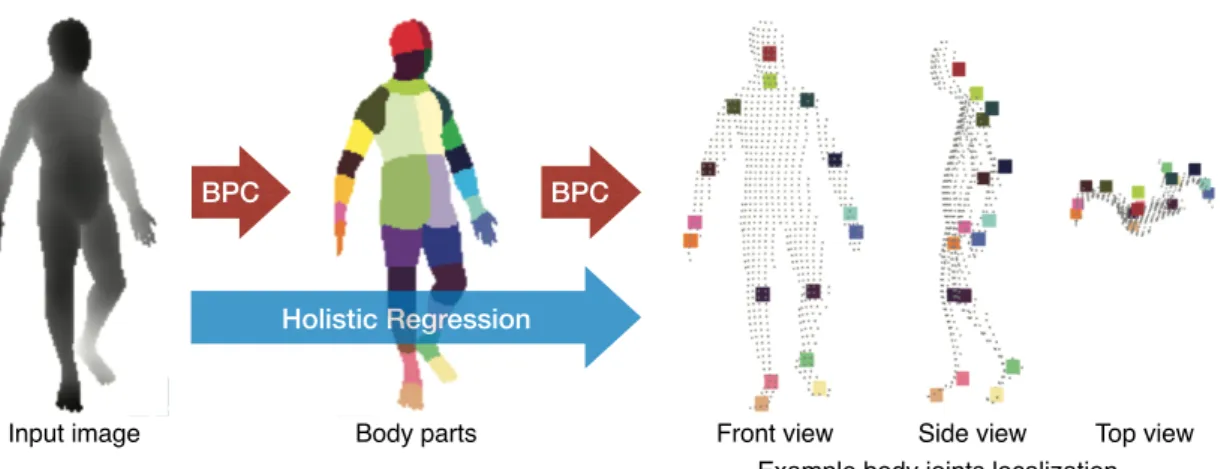
Figure 1.3: An example posture analysis approaches applied to the human pose estimation problem. The body parts classification (BPC) approach uses local body part detectors as an intermediate stage. Then, a joint localisation algorithm is applied to locate 3D joint positions. On the other hand, the holistic analysis approach bypasses the body parts decomposition step and directly estimates postural information from the input image using a supervised regression algorithm. This figure has been adapted from [6].
1.1.1
Posture Analysis Approaches
There are two main approaches to the markerless human pose analysis problem: body parts based methods and holistic regression methods, as shown in Fig. 1.3.
The parts-based approach divides the object into parts and uses local body part detectors to locate and connect parts following a presumed deformation. Hence, the body parts detection is an intermediate representation for subsequent analysis tasks. For instance, in the context of skeleton estimation, the current state-of-the-art performance in terms of accuracy and real time applicability was reported by Shotton et al. [6] and Buys et al. [5] using depth technologies. In these approaches, to analyse a depth frame, three pipelined steps are performed. First, a pixel-wise classification problem is formulated to segment the human body into parts that are spatially localised near skeletal joints of interest such as head and shoulders. Second, a localisation module, e.g., mean shift [12] is used to localise the 3D coordinates of each joint. Third, an expectation maximisation problem is formulated to keep track of the localised joints and hence maintain the extracted skeleton even if some body parts are hidden. This allows the extracted skeleton to accommodate a wide range of postures.
The main advantage of the parts-based approach is the ability to model strong pose artic-ulations [13]. However, this approach has limitations. First, it requires a task specific priori information on the number of body parts and the relationship between them. Second, body parts based methods rely on local detectors, hence, they are prone to losing track of unobservable body parts due to self-occlusions or cluttered environments. Third, the space of possible human pose
articulations grows exponentially with the number of joints that could be modelled, therefore, it is infeasible to model all possible interactions between body parts [13]. To address these limitations, the holistic posture analysis approach has received more interest from computer vision researchers. The holistic posture analysis approach provides a direct inference of postural information from an input image, without relying on any intermediate or presumed representations. Thus, this becomes a supervised learning problem where the model tries to approximate a direct mapping from the input posture image to the target regression or classification output. Throughout the learning process, the objective function is optimised over the full context of the body. Therefore, the model will be able to derive a global understanding of possible body part deformations. This means that the model will be able to give reliable estimates to occluded body parts, in contrast to the body parts approach which give no proposals for occluded joints. Furthermore, this feature simplifies the pose analysis pipeline to a single prediction module which relies on minimal prior knowledge about the topology of the body and the relationship between parts.
The most successful example for the holistic regression approach is the work performed by Shotton et al [6]. They used a random regression forest model to perform the mapping from an input depth image to joint positions. The authors demonstrated robustness of this approach to occlusions compared to body parts based approaches which give no proposals for unseen body parts. Further, they have also shown that the holistic regression quantitatively outperforms the body parts based approach. However, they reported several challenges that require attention from the research community. First, holistic regression models are more complex as they require special formulation for the objective function to be optimised and an exhaustive hyper-parameters tuning. Second, they require large amounts of labelled training datasets that cover as many pose configu-rations as possible. This research adopts the holistic reasoning approach to analyse the articulated posture and estimate necessary postural information. We overcome the difficulties mentioned in the literature for this approach via using deep learning architectures with a well-defined train-ing objective function. The deep models are trained on large amounts of synthetic depth images generated using the data generation pipeline that we extended throughout this research.
1.1.2
Pose from Depth
A key factor of this research is the ability to perform accurate posture analysis from a single depth image, without exploiting temporal information. Depth imaging technologies have advanced dramatically over the last few years providing high quality input for a wide range of applications [5, 6]. In contrast to RGB images where pixels represent color or intensity values, pixels in a depth image specify the distance of 3D points away from the camera. Traditional 2D approaches have much difficulties such as ambiguities of appearance, occlusions, modelling 3D objects and high
dependency on illumination [5]. Hence, depth sensing provides an essential information to enable better understanding of the real world along with the 2D imaging. This combined modality is known as RGB-D and has achieved high object detection accuracy in [14].
Depth sensors are inexpensive, operate in low light conditions (even in dark environments), help reduce ambiguities in size, are largely color and texture invariant and resolve silhouette prob-lems [6]. They have been extensively used in augmented and virtual reality AR/VR applications to accurately sense and reconstruct the real world into a virtual one and allow proper virtual object augmentation. In robotics, the depth information is necessary for localisation, mapping, navigation and collision avoidance. Moreover, depth sensing is important for authentication purposes, e.g., in 3D facial modelling and recognition application. Recently, using depth imaging technologies has become the preferred option for posture analysis tasks due to the capability to provide more robust estimation of the body pose, as explained in [15]. The Kinect is one of the most popular depth cameras that has been used in several application domains with proven effectiveness including, but not limited to, ergonomics and occupational safety applications [3, 16–20]. It uses the structured infrared (IR) light depth sensing method. It projects a known pattern onto the scene using an IR projector. Then, an IR camera is used to capture the deformation of this pattern. Finally, the depth sensor’s processor infers the depth map of the scene. Most of the depth sensors are capable of producing depth maps of high spatial and depth resolution at 30 frames per second (FPS).
1.2
Learning from Synthetic Data
The main bottleneck that limits further advancements in 3D sensing based applications is the availability of training datasets. For human posture analysis in particular, it is a hard task to collect labelled datasets that are essential for training generalisable machine learning models. It requires capturing movements of people in front of a camera, in addition to acquiring high quality ground truth such as body part labels, joint positions or joint angles which is an expensive process in terms of time and efforts. However, based on the facts that depth cameras are texture invariant, rely only on reflectivity and can provide strong learning signal, many approaches have proposed to learn from synthetic depth images, created using computer graphics tools. This approach has been proved effective and used to develop the skeletal tracking pipeline of the Kinect [6].
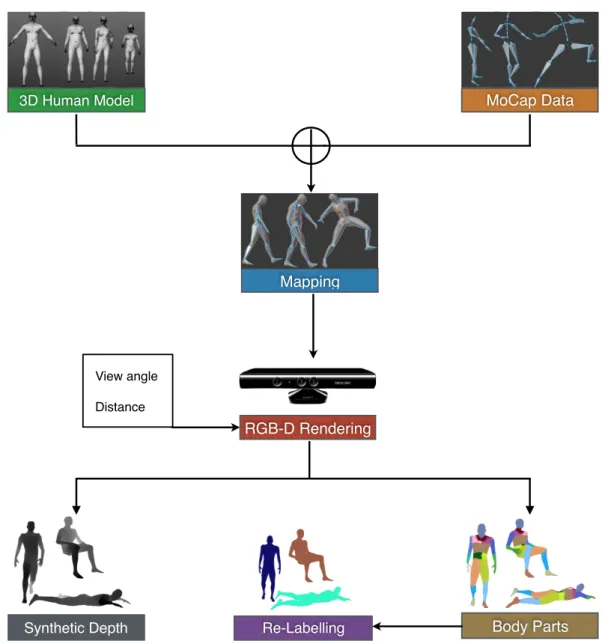
This research ascribes to the approach of generalisation from synthetic training data. We built a multipurpose data generation pipeline that features generating large amounts of realistic training images of humans of different shapes and sizes with domain specific ground truth labels. This approach overcomes the training data scarcity limitation for the majority of applications such as pose estimation, ergonomic assessment and body composition analysis.
1.3
Deep Representation Learning
One of the most studied questions in vision over the past decades is how to represent the visual world and provide a powerful discriminative signal for the learning algorithm. Obtaining a good internal representation or set of features would allow vision systems to detect, analyse and classify objects into categories, with resilience to pose, scale and environmental effects. In other words, representation is the key for machine learning and vision systems to generalisation and visual perception. Hence, complex learning tasks can be solved by extracting the right set of features and providing them to a simple learning algorithm to optimise a mapping from this representation to the target output. This was traditionally known as the feature extraction stage, where internal representations were produced by hand-crafted feature extractors and fed to a trainable classifier. While much of the hand-crafted feature extractors achieve a good generalisation performance, the main limitation to this approach is that the generalisation performance is highly dependent on the chosen features. Crafting representations is a time consuming task that must be repeated for each new problem. It also requires considerable domain expertise. Recently, representation learning using deep learning architectures is receiving much focus from research communities to answer this question. This approach aims at extending the role of the learning algorithm to discovering the appropriate representation for the task at hand from raw input data, and the mapping from this representation to the target output. Further, it allows machines to automatically learn and interpret the visual world in a form of an aggregated hierarchy of concepts.
The visual world is hierarchical. To be perceived, the human brain performs hierarchical levels of processing, where each level is learning features or representations at increasing level of abstrac-tion [21]. The standard model for the visual cortex suggests that, the brain first extracts edges, then patches, then surfaces, then objects, etc. These facts suggest that building a visual perception system requires learning a hierarchical representation of the visual world [21, 22]. Deep learning architectures have demonstrated high learning capacity to capture the most suitable representation from raw input data [22]. They are used to build even more complex hierarchy of concepts. Each level in the feature hierarchy is obtained by a non-linear transformation of its input. Composing a sufficient set of such transformations allows learning any function regardless of its complexity [22].
The key aspects of deep learning methods are: first, the ability to learn the appropriate repre-sentation from raw input, using a generic learning procedure. Second, learning multiple levels of features, defined in terms of each other, through a deep architecture [21]. A deep feedforward neu-ral network or multilayer perception (MLP) is the most basic example of a deep learning model [23]. Convolutional neural networks (ConvNet) [24], are the most widely used deep learning model for vision [22]. The architectural ideas of the ConvNets are well designed to exploit strong local
depen-dencies and stationarity of input signals [23]. The proposed comprehensive posture analysis system relies on the ConvNet as the basic computational model. The ConvNet has demonstrated superior generalisation performance in several research domains, including but not limited to, visual object recognition [25] and detection [26], instance segmentation [27] and posture estimation [28, 29]. It has substantial learning capabilities and representational power to approximate complex mapping functions [22]. It learns multiple levels of features from raw data using an end-to-end trainable yet non-linear stack of computational layers. Hence, this setting alleviates the need for the time consuming and task specific feature extraction stage [22, 28]. In this work, we demonstrate the possibility of leveraging the highly optimised ConvNet models in building an efficient and fully automated posture analysis system.
1.4
Learning Through Noise
Deep learning methods are the breakthrough for visual object recognition, localisation and de-tection tasks. However, these models are generally sensitive to noise patterns augmented on the input data. This is an unsolved problem that is receiving high research interest. As our approach relies on learning from synthetic depth images of high quality, we anticipate that to cause a gen-eralisation issue with real data. Depth sensors exhibit noise due to several environmental effects such as illumination, infrared (IR) interference from ambient light sources and non-IR-reflecting materials [6]. There are several approaches to address this problem. The most intuitive approach is to ensure noise free input to the deep network via preprocessing operations such as (erosion, hole filling and blob analysis). Despite the effectiveness of this approach, it requires a calibration phase to model the existing noise and computationally expensive preprocessing.
Another common approach is augmenting different noise models on the training dataset. This solution would require simulating different noise models, which is feasible, easy to implement and computationally free. Therefore, to ensure resilience with real depth cameras, we extended the data generation pipeline to feature Kinect-like noise augmentation with different noise levels.
Since modelling all existing noise models is intractable as there are several variables that may affect the input signal such as lighting conditions, environments and materials. The main research question becomes: how to enable resilience to noise in deep learning architectures? In this research, a new computational layer is proposed as an attempt to answer this question. The new layer integrates the characteristics of the human visual system into the deep learning architectures via allowing these models to focus more on the meaningful structural information in the input. Hence, it extracts more expressive learning details and provides more powerful representational power than the traditional convolutional layers.
1.5
Contributions
This work addresses the markerless RGB-D human posture analysis problem and the represen-tational power and resilience of deep convolutional neural networks to noisy inputs. We propose a comprehensive and generic approach which can be integrated in complex systems that involve human machine interaction to provide better understanding for the human behaviour. The pro-posed approach analyses the body posture holistically, and it has been effectively trained on large amounts of synthetic training images. It performs the analysis from a single depth image, without relying on temporal information, and extract domain specific postural information. The proposed system is end-to-end, fully automated and does not require calibration or specific sensor place-ment. We have also presented a tuning stage to allow supporting different depth sensors such as Microsoft Kinect and ASUS Xtion. Finally, a new computational layer that focuses on analysing the structural information is proposed to the deep convolutional neural network stack.
The contributions of this research are as follows:
• An end-to-end holistic posture analysis system that is robust to occlusions and challenging environments.
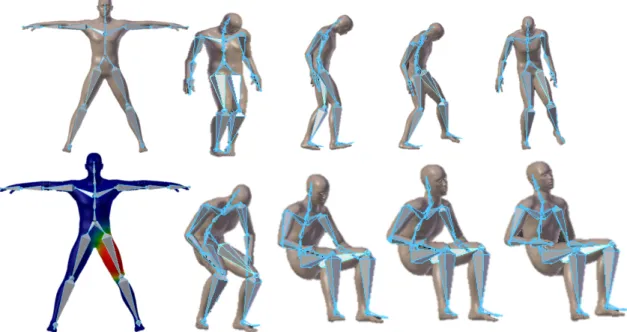
• A multipurpose data generation pipeline that provides high quality annotated datasets, over-comes challenges in several research domains and allows for training holistic posture reasoning models. The proposed pipeline extends research in learning from synthetic images and in-corporates inverse kinematics modelling to generate biomechanically plausible ground truth annotations for musculoskeletal discomfort analysis tasks.
• An efficient formulation for the holistic regression approach using deep learning techniques trained on synthetic depth images. This formulation proposes a depth invariant encoding method to efficiently represent depth information for deep learning models.
• A perceptually inspired new computational layer that focuses on analysing the structural information is proposed to the deep convolutional neural network stack.
1.6
Outline
The rest of this thesis is organised as follows. Chapter 2, provides a systematic review about the human posture analysis problem, the commonly used computational models, deep representation learning methods, 3D data acquisition technologies and finally identifies limitations and gaps in the literature. Chapter 3, introduces the holistic posture reasoning approach in the form of a pose recognition task, and demonstrates difficulties of following traditional learning methods for addressing the pose reasoning problem. Instead, deep machine learning based posture analysis
approach has been proposed in Chapter 4. The proposed method has been validated against the XSENS motion capture system and acheived an average joint angle absolute prediction error of 4.18±2.17 deg on real images. This allows accurate evaluations of ergonomic posture assessment metrics to assess and avoid risk factors of musculoskeletal disorders in manufacturing plants. We achieved state-of-the-art results in detecting fall events for surveillance in healthcare environments via analysing temporal posture changes, as described in Chapter 5. Chapter 6 describes the proposed perceptually inspired nonlinear computational layer. Finally, conclusions and future research directions are presented in Chapter 7.
Literature Review
Marker-less human posture analysis is a well-known computer vision problem that receives inten-sive research interest. This interest is attributed to the wide range of applications that benefit from the accurate estimation of the human posture. It is considered one of the hardest tasks for several reasons [30]. First, heterogeneity resulting from the large space of human poses that could be mod-elled. The space of possible human poses increases exponentially with the number of considered joints [6]. Second, invisible body parts due to self-occlusions or cluttered environments. Third, the variability of anthropometric measures and clothing styles adds more complexity. Forth, the high dimensionality of input image signal, lighting conditions, camera view angle and many other factors need to be taken into consideration when addressing this task. Although the combination of computer vision and deep learning methods has achieved a remarkable progress in detecting and estimating posture information from 2D images, human behaviour analysis in 3D remains an open problem [31]. The main challenges are the need for a well-defined objective function formu-lation, the lack of enough labelled datasets that would allow training models of high complexity to generalise and ensure resilience to the aforementioned difficulties.
This Chapter starts with a recent review of the literature on the human posture analysis task. Ensemble learning and deep learning models are the most commonly used computational models for this task. Hence, the second Section provides a thorough review on the ensemble learning paradigm and the random decision forest (RDF) model in particular. The third Section presents a comprehensive review on deep representation learning methods, which are the main focus of this research, and justifies the need for the feature learning paradigms. Section four demonstrates the need for depth imaging technologies, reviews approaches that relied on learning from synthetic depth images, in addition to discussing different encoding methods to allow using depth images with deep learning models. Finally, Section five critically reviews the literature and identifies research gaps that are addressed in this work.
Input Image
Preprocessing
Feature Extraction
Body Modeling
Model Learning
Posture
Information
Mapping Function
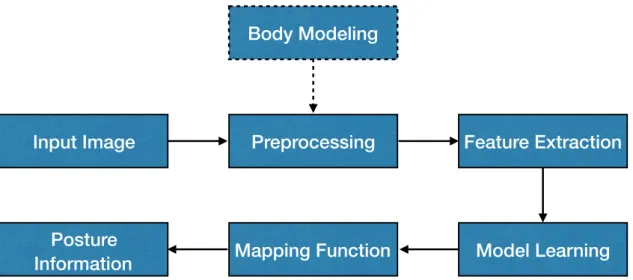
Figure 2.1: The common building blocks of human posture analysis systems. The body modeling stage discriminates between model-based and model-free methods.
2.1
Approaches to Human Posture Analysis
The generic posture analysis pipeline includes real time acquisition, processing and understand-ing of high dimensional visual information via choosunderstand-ing or learnunderstand-ing an efficient set of features. Figure 2.1 summarizes the building blocks implemented in most human posture analysis systems. Vision based human posture analysis systems can be categorised as model-based where a priori information about the body is utilised, or model-free. The input image is acquired using the data acquisition module, e.g., depth sensor. The preprocessing stage includes background subtraction and human body detection methods. Extracting a set of features that efficiently represents the articulated posture is a key stage that greatly affect the generalisation of the learning algorithm. The extracted feature either via hand-crafting or deep representation learning are fed to a machine learning model to learn a mapping from an input image to the required posture information.
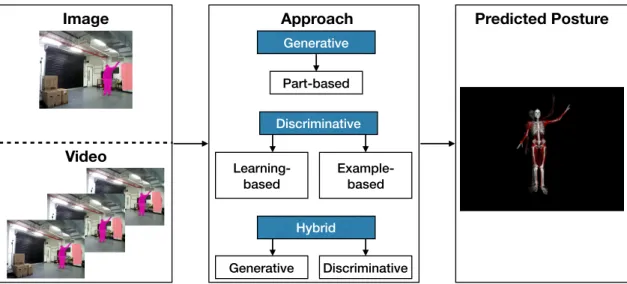
According to the body interpretation method, human posture analysis approaches are cate-gorised into: generative which assumes a prior body model and includes body parts-based con-tributions, discriminative (model-free) which contain learning- and example-based methods and hybrid approaches that combine ideas from both generative and discriminative methods [31]. This taxonomy of approaches is shown in Fig. 2.2.
Generative model approaches exploit a prior information such as the skeletal structure of the human body [6] or specific motion [32]. These approaches divide the task into modeling and estimation stages [31]. In the modeling phase, a likelihood function is formulated based on the image features, the presumed body or motion model, the camera model and any task related constraints. In the estimation stage, the pose is predicted and refined based on extracted image descriptors and the likelihood function. For instance, Daubney et al. [32], assumed that the performed action, e.g., walking and jogging, is known in advance. This allowed the authors to learn
Approach Generative Discriminative Hybrid Part-based Example-based Learning-based Generative Discriminative Image Video Predicted Posture
Figure 2.2: Taxonomy of vision-based posture analysis approaches. Methods operating on an input image or video sequence are categorised into generative which includes body parts-based contributions, discriminative which contain learning- and example-based methods. Hyprid posture analysis methods combine ideas from both generative and discriminative approaches [31].
low-level generative models using motion cues and compare with expected motion trajectories to estimate the articulated posture. The main advantage of generative models is their ability to cover a wide range of complex body configurations. However, relying on local body part detectors cab also be seen as a drawback, as it does not allow inferring invisible body parts [6, 13].
Discriminative posture analysis approaches, also known as model-free, do not exploit any prior knowledge. In learning-based discriminative approaches, a learning model is trained to optimise a mapping from the input image to pose predictions [13,28,33]. Example-based methods, on the other hand, a set of example postures is represented using pose descriptors and stored. Then, a similarity search algorithm is used to match the articulated posture with the stored examples [33]. The main advantage for this category is the holistic analysis of the human posture. This allows the learning algorithm to capture the full context of the articulated posture and derive a full understanding of the human body structure. This allows the algorithm to provide plausible predictions in presence of occlusions [2, 6]. Finally, hybrid approaches combine generative and discriminative methods to achieve pose predictions of high accuracy. The likelihood function constructed using a generative model is used to verify predictions from the learned discriminative mapping function [34].
Recent works on human posture analysis are focused towards the bottom-up generative body parts-based and the holistic discriminative learning approaches [15]. Therefore, the rest of this
section reviews the most recent advances in each approach. The reviewed works are divided
into two categories: methods relying on hand-crafted features and deep representation learning methods.
2.1.1
Body Parts Based Methods
These methods follow the model-based generative posture analysis and are also referred as bottom-up approaches. In these methods, the human body is described by a presumed kinematic structure of connected parts following the notion of the pictorial structure model [35]. Hence, the body pose could be estimated using trained local body part detectors and the kinematic structure. This approach was utilised by Felzenszwalb et al. [36], to efficiently estimate the 2D human pose and has recently been extended to 3D pose estimation in [37]. First, the body is represented by a collection of parts arranged in a deformable configuration. Then, pairwise connections are used between parts to model the deformations, and kinematic constraints are modeled to ensure plausible pose parameters. The most commonly used body model in the literature is the skeleton [31]. Finally, the pose is estimated via training body part detectors and using an efficient dynamic programming algorithm that searches the pose space for the pose configuration that matches the observation.
Training local body-part detectors require choosing a set of features that efficiently represent the human body. There are two approaches for feature optimisation: hand-crafted or learned
features. The most commonly used crafted features among methods in the literature are the
Histogram of Oriented Gradients (HOG) [38–40], Shape Context (SC) [41, 42] and Scale Invariant Feature Transform (SIFT) [43, 44]. Furthermore, researchers combine several local features and build hierarchical feature representation to achieve desired generalisation performance [45].
Ioffe et al. [46], modeled the person as a collection of cylinders and applied an expectation maximisation algorithm to find candidate body segments by detecting parallel edges based on extracted features such as image edges. Then, using a tree-like structure of projected classifiers, combinations of segments are pruned to produce a realistic body configuration. Ramanan et al. [47], suggested a two phases algorithm. The first phase is learning the appearance model of the human body by clustering candidate body part segments, exploiting kinematic constraints. The second phase utilises the learned model to estimate and track human poses. Following that, much research efforts have been done to further improve the performance of body part methods [5, 6, 48–51].
The current state-of-the-art performance, in terms of accuracy and real time applicability, was achieved by Shotton et al. [6] from depth images. Shotton et al. [6], performed joints localisation via semantic body parts segmentation, also known as pixel-wise classification. In this method, a random decision forest (RDF) classifier is trained using low level representations of body pixels and used to assign a discrete categorical body part label to every body pixel. These dense repre-sentations were computed using a hand-crafted depth comparison feature extractor (DCF). The resulting body parts are considered a mid-level representation from which the joints positions are interpolated. This work is considered the first successful example for generalisation from training on synthetic depth images to real test images, and currently being used in practice as the skeletal
tracking component of the Kinect. However, the main limitation to this method is; being accus-tomed to the gaming setting, where there exists a stationary frontal camera and little occlusions. Further, adapting this solution to different tasks and environmental settings is difficult.
Buys et al. [5], built on top of Shotton’s et al. [6], work. They contributed an adaptable and customisable system that incorporates depth and colour RGB-D modalities, to iteratively estimate
the body pose. In this method, pixel-labelling is performed using an RDF model trained on
synthetic depth images. The DCF feature extractor is further tuned and used to generate dense pixel-wise representations for training and evaluation. The first iteration of this system labels the entire depth image, including the background, clusters these labels into body parts and a rough skeleton is extracted based on a predefined kinematic structure. Using colour information, the second iteration segments the body from the background and refines the skeleton. The main advantages of this work is its adaptability to new environments through dynamic background segmentation and contributing with the state-of-the-art synthetic data generation pipeline.
Recently, Dantone et al. [50], achieved the state-of-the-art performance for the 2D human pose estimation problem from RGB still images. They composed classification and regression forests as two-layered body part regressors. The first classification forest performs patch-wise body parts classification. To train this classifier, sampled body part patches are represented using a combination of 17 feature extractors, such as HOG [38], and colour, and used with a discrete entropy minimisation objective function. The second regression forest was trained on both the extracted features and the predicted body parts from the first forest, using a sum of squared distances minimisation objective function. Limitations to this work are inherent from the use of RGB images.
Although most of the previously mentioned approaches achieve a competitive state-of-the-art performance, the common difficulty is the relying on hand-crafted feature extractors, for instance, DCF and HOG. These extractors are task specific, time consuming as they usually require exhaus-tive search for parameters settings and a considerable domain expertise is assumed. Further, the choice of the optimal set of features is always questionable. These limitations complicate extending or customising these methods for different scenarios.
Deep learning methods provide the solution to this difficulty, through the end-to-end learning of the appropriate set of feature extractors using the standard backpropagation algorithm [21, 22]. Hence, they assume minimal prior knowledge and human intervention. Convolutional neural networks (ConvNets) are the most commonly used deep architecture for computer vision tasks, and pose estimation in particular, due to their architectural design. Through parameters sharing; they greatly reduce the number of trainable parameters and ensure translation invariance. The basic operation used is the convolution, which is computationally inexpensive and could be easily
parallelised on GPU [52]. For more information, see Section 2.4.3.
2.1.1.1 Deep Body Part Detectors
Jian et al. [30], introduced the first deep learning architecture for the human pose estimation task that outperforms the state-of-the-art at their time, in many cases. In this method, multiple binary ConvNet body part detectors are trained to independently detect the presence of a certain body part within a sliding window. This results into a set of confidence maps, each of which represents a single body part at the current location. Consistency and validity of the pose configuration are maintained in a post-processing step by exploiting the spatial relationships between body parts.
Li et al. [15], proposed a heterogeneous multitask deep ConvNet model. In their work, the network was trained simultaneously to perform body parts detection, joints detection and joint coordinates regression. Given an RGB image, the upper body is segmented using a bounding box detector, and fed into the network. The ConvNet produces three outputs: a binary map for each body part at all possible locations in the input, a similar binary map for joints and the 2D coordinates of the modelled joints, (8 upper joints in that case).
Deep body parts parsing methods have notably progressed after the work of Pishchulin et al. [53]. They proposed a bottom-up formulation that jointly groups and labels body parts de-tected using a deep learning model from RGB images. However, this approach forms a fully con-nected graph NP-hard problem which is computationally expensive [29]. Insafutdinov et al. [54], extended the approach of [53] with deeper and stronger part detectors using the residual learning deep network ResNet [25] and image-dependent pairwise scores. The improvements induced by [54] further advanced the state-of-the-art. However, it takes several minutes to process a single RGB image and it requires an extra logistic regression model to accurately regress pairwise scores [29]. Recently, Cao et al. [29] achieved state-of-the-art results in terms of accuracy and runtime perfor-mance. They used a nonparametric representation called Part Affinity Fields (PAFs) to associate body parts with individuals in the image. The proposed deep architecture contains two branches to jointly learn to detect body parts and associate them in a plausible deformation.
The main advantage of the parts-based approach is the ability to model a wide range of pose articulations [13]. However, this approach has some limitations. First, it requires a task specific priori information on the number of body parts and the relationship between them. Second, body parts based methods rely on local detectors, hence, they are prone to losing track of unobservable body parts due to self-occlusions or cluttered environments. Third, human poses space grows exponentially with the number of joints that could be modelled [6], therefore, it is infeasible to model all possible interactions between body parts [13]. Forth, it is too expensive for real time applications [55]. To address these limitations, the holistic posture reasoning approach is emerging.
2.1.2
Holistic Analysis Methods
Learning-based model-free discriminative posture analysis methods focus on optimising a mapping function from an input image to posture information using a supervised regression model. The key aspects of this formulation are: first, the absence of any arbitrary intermediate body part representation or kinematic constraints. Second, the learning model receives the full context of the body joints, providing reliable estimates for invisible parts due to occlusions and cluttering. Third, its simplicity and applicability to learn complex pose configurations with minimal prior knowledge grasped the attention of many researchers. Examples for regression from monocular 2D images include [56–62], and from depth images include [6, 63].
In the seminal works of [6, 63], a random decision forest regressor is trained and used to localise body joints from an input depth image. These works are considered the state-of-the-art holistic posture estimation from depth images. The input image is densely represented using the DCF feature extractor. For evaluation, the trained RDF regressor is applied on each pixel, allowing pixels to vote for joints positions. Finally, the statistical mode of these votes is determined using the mean shift algorithm [12]. Agarwal et al. [58] trained a nonlinear regression models on shape descriptor features extracted from image silhouettes. They explored different regressors such as regualarised least squares and relevance vector machine (RVM) with both linear and kernel bases [58]. Local mixture of Gaussian Processes (GP) was proposed in [60] to provide efficient probabilistic mapping from a complex, high dimensional input to pose configuration.
2.1.2.1 Deep Posture Regressors
Recently, deep learning methods have been used to perform holistic posture regression from both RGB and depth modalities [13,64]. Toshev et al. [13] proposed a multistage 7-layered deep ConvNet joints regressor, where the input is a raw RGB image and the output is 2D joints coordinates. Each stage of this model refines results from the previous stage by using wider contextual window centered around joint position. With this architecture, they outperformed all reported results on several benchmarks with large margin, specially for challenging limbs such as lower legs and arms. Crabbe et al. [64] demonstrated the possibility to fine-tune an existing deep classification models for regression problems. More interestingly, their approach trained and achieved good generalisation performance on depth modalities, while the original network was trained using generic RGB images. For more information, Moeslund et al. [65,66] and Poppe [67] provide a comprehensive overview of the analysis of human behaviour and its application domains. A thorough review of the history of the human behaviour detection and pose estimation challenges is detailed in [55, 68, 69].
Throughout this review, it can be concluded that, the posture analysis problem is a supervised learning task from an input image to target posture space. Ensemble learning models such as
random decision forests and deep representation learning models are widely used and have achieved competitive generalisation performance in approximating this mapping. Therefore, the next three sections provide a review on machine learning task formulations, ensemble learning and deep learning models.
2.2
Machine Learning Tasks
Machine learning is one of the most important disciplines in computer science and engineering. The main purpose of machine learning related research is to enable better human machine interaction via building an understanding from data. Example applications of machine learning are visual perception such as scene understanding in images, human posture analysis and activity recognition, and text perception such as speech and handwriting recognition.
2.2.1
Learning Methodologies
Supervised and unsupervised learning are the two main types of machine learning tasks. A super-vised learning algorithm optimizes a mapping function based on the analysis of a training dataset of labelled pairs. Entries of this dataset are feature vectors each has an associated target. The feature vector are d dimensional input of real valued numbers, called features, representing the input object. These values may be raw pixels of an image, the responses of applying a sliding window filter, or any other feature detector. Optimizing a set of features that characterizes and discriminates an object is a necessary step that directly affects the generalization performance of the system. The generalization error quantifies the ability of this function to correctly assign a target value to unseen instances.
In unsupervised learning, also known as descriptive learning, the training procedure is applied to unlabeled training data. The target is to explore the intrinsic characteristics and the underlying probability distribution of the input data, p(x|θ). Unsupervised learning is a less well defined class of tasks because of the lack of error metrics and unknown objects of interest. It is arguably more similar to humans and animals learning and more widely applicable since it does not rely on labelled data [70]. Popular examples of unsupervised learning are clustering and dimensionality reduction.
Recently, semi-supervised learning approach into which training data are partially labelled, is emerging as a solution to tackle difficulties of obtaining large labelled training dataset for certain domains. In this approach, the parameters of the learning algorithm are initialized and pre-trained using unlabeled data, and then fine-tuned by training using the labelled data.
2.2.2
Taxonomy of Tasks
In terms of the target output, machine-learning tasks could further be categorised into classification, regression, density estimation and manifold learning.
Task Description Example
Classification Given a labelled training set, learn
a general mapping function that associates a previously unseen test sample with its correct class. The output is a discrete categorical la-bel.
The recognition of a handwritten digit is an example where the out-put is a discrete digit.
Regression Given a set of input training data
with continuous labels, learn a general mapping function that as-sociates a previously unseen test sample with its correct continuous prediction.
Predicting the price of a house
based on location, number of
rooms and other factors. Estimat-ing body joint angles from an in-put image is also an example.
Density Estimation Given a set of observed unlabeled data that has been generated via a probabilistic density function, estimate the unobserved underly-ing generative function. Which is known as estimating the structure and the intrinsic nature of the un-labeled data.
Grouping a set of objects in such a way that objects in the same group are similar.
Manifold Learning Given a set of k unlabeled observa-tions, find a smooth mapping func-tion that transforms these obser-vations to ones with lower dimen-sionality and preserves the obser-vations’ geodesic distance.
The interpretation of high dimen-sional data is difficult. One ap-proach to simplification is to as-sume that the data lies on an em-bedded non-linear manifold within the higher-dimensional space. Es-timating the manifold and trans-forming it to lower dimensional space would allow better data vi-sualisation and understanding.
Table 2.1: Categories of machine learning tasks with respect to the target output.
2.3
Ensemble Learning
Real life applications such as handwriting and speech recognition, require processing and categoris-ing high dimensional data. It was a challenge until researchers discovered that uscategoris-ing ensembles of weak learners can decompose high dimensional problems and yields a predictor with greater accuracy and better generalisation performance [71]. The inspiration to ensemble learning was the popular greedy boosting algo


![Figure 2.14: Building blocks of the state-of-the-art synthetic data generation pipeline proposed by [5]](https://thumb-us.123doks.com/thumbv2/123dok_us/765551.2596837/65.892.125.754.107.666/figure-building-blocks-state-synthetic-generation-pipeline-proposed.webp)