R E S E A R C H
Open Access
Research on sensor network optimization
based on improved Apriori algorithm
Qiang Ji
*and Shifeng Zhang
Abstract
Traditional node deployment strategies have problems such as slow deployment, small coverage, and poor service quality. Based on this, this study improves the traditional Apriori. This study uses the grid overlay model as the basic model and applies the improved Apriori algorithm to the WSN (wireless sensor networks) coverage optimization process of mobile nodes. This study simulates from different population sized SizePops, different search interval lengthsL, and different maximum iterations Maxgen. At the same time, this paper selects the traditional Apriori algorithm and the improved Apriori optimization algorithm to compare and analyze. The research shows that the improved Apriori optimization algorithm can better combine the wireless sensor network model of the mobile node and can obtain higher network coverage under the same parameters, and the problem can be solved more effectively.
Keywords:Apriori, Sensor network, Optimization, Improvement
1 Introduction
As one of the key technologies to promote the develop-ment of the Internet of Things technology, the first task of the wireless sensor network is to perceive the physical world information. The coverage control problem is dir-ectly related to the sensor network’s acquisition of de-tailed and accurate information of the target in the monitoring area, and the perceived quality of service provided by the sensor network, which reflects the per-formance of the wireless sensor network. The main problem solved by wireless sensor network coverage control is how to deploy sensor nodes in the monitoring area, which enables it to maximize network coverage while ensuring quality of service. In practical applica-tions, sensor nodes are usually different in sensing func-tions, computing power, energy, links, protocols, and so on, resulting in heterogeneous wireless sensor networks. How to use the existing coverage algorithm and the hardware and software resources in the network to solve the coverage control problem in heterogeneous wireless sensor networks has become an important development direction of wireless sensor network coverage control re-search, which has great scientific significance and wide application value. Since 2001, the US Defense Advanced
Research Projects Agency has invested heavily in re-search on wireless sensor network technologies and pro-posed the concept of C4KISR systems (command, control, communications, computer, kill, intelligence, re-connaissance, surveillance), which aims to highlight the need for intelligence on the battlefield, the comprehen-sive ability of information, and the need to utilize it. Therefore, wireless sensor networks are an important re-search area. For C4KISR technology, DARPA (Defense Advanced Research Projects Agency) has established a number of military sensor network research projects such as mart Sensor Web, sensor information technol-ogy, unattended ground sensor group, sensor networking system, advanced battlefield target positioning technol-ogy, battlefield intelligence surveillance, and reconnais-sance management [1]. Driven by the Natural Science Foundation of the USA, many well-known universities (e.g., MIT, UC Berkeley, UCLA, University of Southern California, Cornell University, University of Illinois, etc.) in the USA have made extensive research on the basic theories and key technologies of wireless sensor net-works [2]. Some large IT companies in the USA such as Intel, HP, Rockwell, and Texas Instruments are also ac-tively collaborating with universities to participate in the research and development of wireless sensor network technology and have achieved many fruitful research re-sults in the miniaturization of node size, low-power * Correspondence:[email protected]
College of Aerospace Science and Engineering, National University of Defense Technology, Changsha, China
design of nodes, self-organizing control of networks, data transmission and processing, and specific practical applications of wireless sensor networks [3,4]. Represen-tative research results include Dust Networks’Dust Net-works network recently acquired by Linear Technology,
Crossbow Technologies’ Mote2, MoteWorks software
platform, and Crossbow Mote hardware platform [5]. Representative research results include Dust Networks’ network of Dust Networks, recently acquired by Linear Technology, and Mob2, MoteWorks software platform, and Crossbow Mote hardware platform from Crossbow Technologies. In addition to the USA, many other coun-tries in the world, such as Japan, the UK, Italy, and Brazil, have also paid close attention to and conducted research on sensor network technologies, such as the EU EYES project.
In China, the wireless sensor network and its application technology were first proposed in the research report on information and automation in the “Investigation in the Field of Knowledge Innovation Engineering Pilots” pub-lished by the Chinese Academy of Sciences in 1999, which marks the official launch of the theory and application of wireless sensor networks in China’s modern sense [6]. In order to advance the research work of sensor networks, in 2001, the >Chinese Academy of Sciences established the Microsystems Research Technology and Development Center. From 2002 to now, the National Natural Science Foundation of China, the National “863” Key Project Development Plan, and the National Key Basic Research and Development Program“973” have invested heavily in sensor network technology research to support related projects [7].
One of the research hotspots of wireless sensor net-works is the optimization of network coverage [5, 8]. This paper is doing some innovation work for this re-search direction and based on Apriori algorithm to im-prove the coverage rate of wireless sensor networks.
2 Research methods
2.1 Improved analysis of Apriori optimization algorithm Apriori optimization algorithm is a new intelligent optimization algorithm proposed in 2011, which has good global optimization performance and can solve many problems. The Apriori optimization algorithm flow can be summarized as follows [9]:
1) Apriori algorithm population size SizePop, algorithm maximum iteration number Maxgen is initialized, and Apriori algorithm seed group positionX_axis,Y_axis is randomly initialized. 2) The individual randomly searches for positions in
all directions. It can be expressed as Formula (1) and Formula (2). Among them, Hr is a random
number between fixed intervals [−H, H], which
can be expressed as Eq. (3). His the maximum step length for each search.
Xi¼X axisþHr ð1Þ
Yi¼Y axisþHr ð2Þ
Hr¼H½2 randðÞ−1 ð3Þ
3) The distancedbetween the individual and the origin is calculated, and the reciprocal of the distance is taken as the individual taste density determination value Si.
d¼
4) The taste concentration determination valueSiis
substituted into the fitness function to determine the taste concentration of the individual
(Formula (6)).
5) The best individual of Smelliin the population is
found (minimum value is min, maximal value is max), seeing Eq. (7).
bestSmellbestIndex
½ ¼ min Smellð iÞ ð6Þ
6) The best taste concentration value bestSmell andX andYcoordinates are recorded and retained.
Smelli¼function Sð Þi ð7Þ
7) The iteration is started, and it is repeated (steps 2–5), and it is judged whether the optimal taste
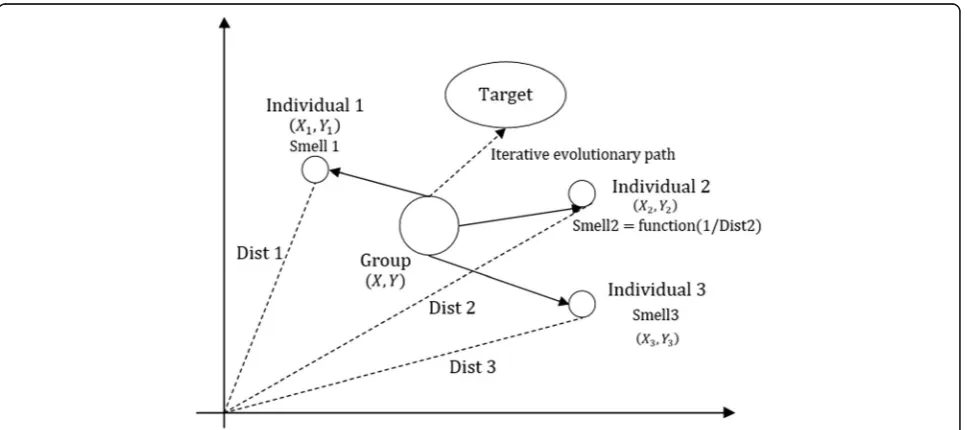
of iterations is less than the maximum number of iterations Maxgen, then step 6 is performed; otherwise, the algorithm ends [5] (Fig.1).
The Apriori algorithm has several obvious advantages compared to several other group intelligent algorithms [10,11]. For example, the Apriori algorithm has a small amount of computation, a short running time, a low al-gorithm complexity, and a high precision. However, the Apriori algorithm has a short time and the algorithm theory and method are not mature. Therefore, the algo-rithm also has great defects. For example, the Apriori al-gorithm is not stable, and it is easy to fall into local optimum, and the convergence accuracy is reduced in the later stage, and the convergence speed is slowed down. These are the things that need to be studied and the aspects of improvement when using algorithms (Kong, 2015).
In view of the limitations of the above algorithm, the variable step size Apriori algorithm proposed in this paper divides the search into several loops [12, 13]. For example, 50 iterations are treated as a periodT, and the step size in each period is changed in the form of sin(x).
Xi¼Xaxisþð2 randðÞ−1Þ Hi ð9Þ
α¼ modði;TÞ iϵ½1;Maxgen ð10Þ
Hi¼Lðsinð Þ þi 1Þ α
Hi≤l L Hi>l
ð11Þ
Among them, L is the length of the algorithm search interval,T is the number of iterations per unit period,
and mod(i,T) is the remainder of the iteration of theith order relative toT. It can be seen from Eq. (8) to For-mula (11) that the variable step size Apriori algorithm first divides the entire search process into several cy-cles, which can increase the diversity of the search process, so that the algorithm can effectively jump out of local convergence and greatly reduce the possi-bility of local convergence. Secondly, the variable step size Apriori algorithm uses the sin(x) function in each cycle, so that the step size can be changed within the unit period T. When sin(x) monotonically increases, the step size increases. At this time, the algorithm has a strong global search ability, which can achieve fast convergence, and the convergence result is not easy to accompany the local optimum. At the same time, the bigger of step size can solve the local
con-vergence problem that sin(x) may have in the last
monotonic decreasing interval. In the monotonically decreasing interval of sin(x), the step size index is re-duced, which enables the algorithm to perform high-precision search in a small range, and the result has better convergence effect.
The variable step size Apriori algorithm is an improve-ment of the Apriori algorithm [14], so the flow of the al-gorithm inherits the ideas and steps of the optimization algorithm and makes some changes in the parameter initialization and step change of the algorithm. The de-tailed flow of the algorithm is as follows:
1) Population size SizePop, algorithm maximum iteration number Maxgen, unit cycle iteration numberT, and search interval lengthLis initialized, group positionX_axis andY_axis are
randomly initialized, and the optimal concentration value Smellbest is obtained.
2) The iteration is started, the remainderαof the current iteration in the period is calculated, and it can be expressed as Eq. (12).
3) According to step (2), combined with Formula (8)– Formula (10), the search stepHiof the current
iteration is obtained. Individuals search in random directions within the search step range, and the formula is shown in Eq. (13).
4) Xiis substituted into the fitness function to
determine the taste concentration of the individual, and the formula is shown in Eq. (14).
5) The best individual of Smell in the population is found (minimum value is min, and maximal value is max), and the formula is shown in Eq. (15) [10]. 6) Record and retain the optimal taste concentration
value.
7) The iteration is started, and steps (steps 2–5) are repeated and it is judged whether the optimal taste concentration is better than the taste concentration obtained in the previous iteration. When it is better than the previous generation and the current number of iterations is less than the maximum number of iterations Maxgen, then step 6 is performed; otherwise, the algorithm ends.
2.2 Sensor network optimization based on improved Apriori algorithm
One of the hottest research areas of wireless sensor net-works is the optimization of network coverage [15, 16]. This paper is to carry out some innovation work for this research direction and based on Apriori algorithm to improve the coverage of wireless sensor networks.
This paper adopts the grid coverage model. In a two-dimensional region ofa×b, the region is discretized into a×b receiving points, and the position of each re-ceiving point is represented as (at,bt).Nnumber of sen-sor nodes is randomly deployed in the target area, and the nominal effective radius of the node coverage is R. Each node sends its own location to the Sink node, and
the Sink node performs an optimization operation. Each set of sensor nodes can be expressed as Eq. (16), the dis-tance between the node wi and the receiving point (ak,
bk) is expressed as Eq. (17), and the probability that the receiving point (ak,bk) can receive the node signal is expressed as Eq. (18). At the same time, the probability that the receiving point (ak,bk) can receive the signal transmitted by the group of nodes is expressed as Eq. (19), and the signal coverage of the transmitter W
for this area can be expressed as Eq. (20).
W¼ðw1;w2;…;wNÞ;wi¼ðxi;yiÞ ð16Þ
The algorithm flow for applying the improved Apriori algorithm to WSN coverage optimization of mobile nodes is as follows:
1) The wireless sensor network related parameters are initialized, including the area length and width, the node’s rated effective coverage radiusJ, and the number of sensor nodes arranged in the area isN. 2) The relevant parameters of the Apriori algorithm
are initialized and improved, including the population size SizePop, the maximum number of iterations Maxgen, the number of iterations per unit periodT, and the lengthLof the search interval.
3) The position of SizePop getWtis randomly
initialized. According to Eq. (15), the sensor node of theitth individual is represented as
wt;j¼ xt;j;yt;j
;t∈½1;SizePop;i∈½1;N ð21Þ
4) According to Formula (17)–Formula (21),GWis
calculated, the largest individual inGWis marked as
the best individual, and the individual’sGWand
positionWare recorded, which can be expressed as Eq. (21).
the previous research method and randomly searches in various directions.
6) Step 4 is performed to find the individual with the highest coverage. This location and coverage are recorded and compared to the best individual coverage of the previous generation. If the individual coverage is greater than the previous generation coverage, then the individual is marked as the best individual. The position of the best individual is set to the node position, which is also the initial position of the next search, and all individuals gather to the individual.
bestG BESTpos
½ ¼ maxðGWÞ ð22Þ
bestG¼GW Gaxis¼bestPosðGWÞ
ð23Þ
7) Steps 5–6 are executed cyclically until the number of iterations reaches Maxgen, and the final result is recorded. At this time, the maximum coverage rate bestG of the wireless sensor network and the corresponding node positionG_axisare obtained.
3 Results
Twenty-five wireless sensor nodes are placed in a 50 × 50 square monitoring area, which are characterized by a positional shift and a fixed effective radius. The node
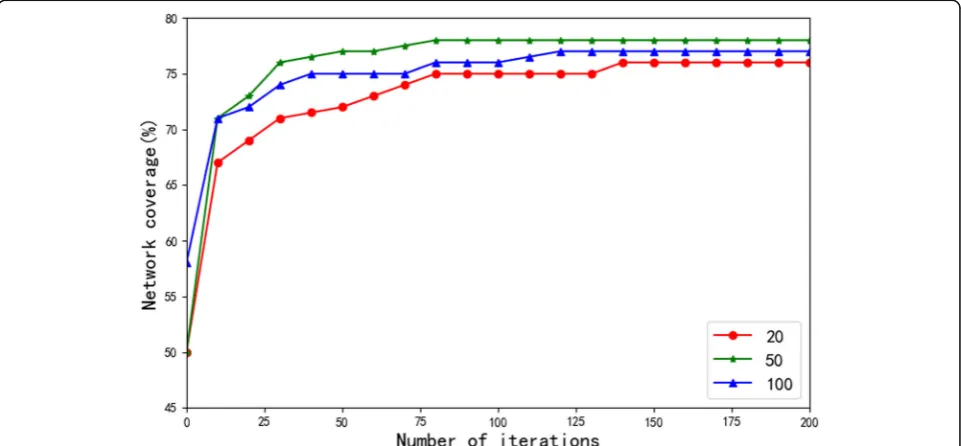
has a rated effective radius Rof 5 m and a communica-tion radius of 2R. In order to select reasonable parame-ters, this paper simulates from different population size SizePop, different search interval lengthL, and different maximum iterations Maxgen. At the same time, the average of 50 experimental results was selected as the result in each set of experiments, and finally, the appro-priate parameters were selected for the wireless sensor network coverage optimization research. The search intervalLis set to 5 m, the number of iterations Maxgen is set to 200, and the population size SizePop is set to 20, 50, and 100, respectively. A comparison of the differ-ent coverage rates of the population number is shown in Fig.2.
The population size SizePop is set to 50, the number of iterations Maxgen is set to 200, and the search length
Lis set to 2 m, 5 m, and 10 m, respectively. The result is shown in Fig.3.
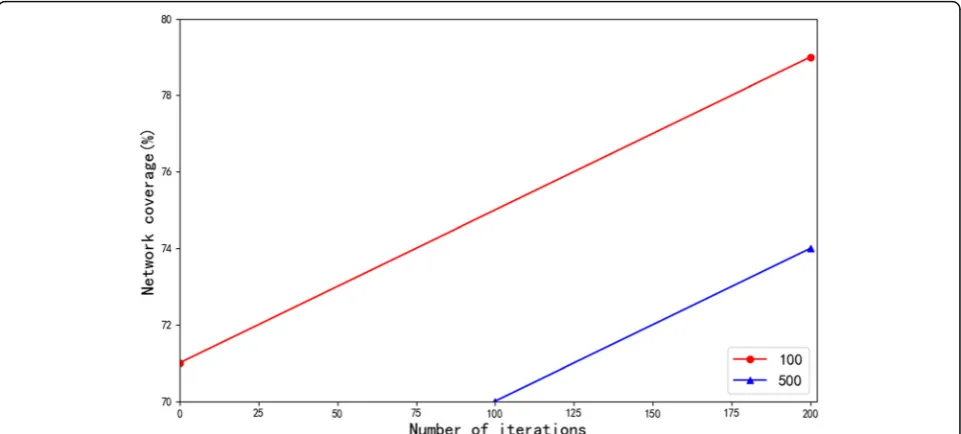
The population size SizePop is set to 50, the search lengthLis set to 5 m, and the maximum iteration num-ber Maxgen is set to 100, 200, and 500, respectively. The results are shown in Fig.4.
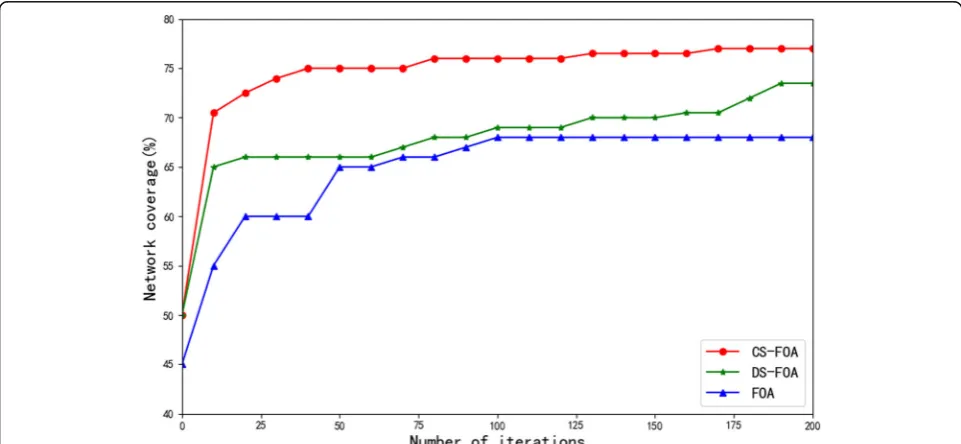
Under the above wireless sensor network model, the traditional Apriori algorithm, Apriori optimization algo-rithm, and the improved Apriori optimization algorithm proposed in this paper are selected for comparative ana-lysis. The number of iterations Maxgen is set to 200, the population size SizePop is set to 50, the search lengthL
is set to 5 m, and the search interval is set to [0, 50].The simulation experiment was run 50 times, and the experi-mental results were averaged. The simulation results are
Fig. 2Comparison of different coverage rates of population number. Figure 2 shows the comparison of the different coverage rates of
shown in Fig.5. The theoretical maximum coverage rate is 78.5%. On this basis, the coverage of the above three algorithms is compared, and the convergence is ana-lyzed. The results are shown in Fig.6.
4 Discussion and analysis
It can be seen from Fig. 2 that when the population is 20, the population is too small, resulting in insufficient network coverage accuracy. When the number of popu-lations is 50 and 100, the final convergence accuracy
tends to be consistent as the number of iterations in-creases. When the population is 100, the algorithm con-verges faster, but the search time consumed is too long and the performance is not high. Based on the compre-hensive consideration of search speed and accuracy, the population number SizePop = 50 is selected.
It can be seen from Fig. 3 that when the search
length L= 2 m, the search interval is too small, which leads to slow convergence in the early stage of the al-gorithm, low convergence accuracy in the later stage,
Fig. 3Comparison of different search length coverage ratios. The population size SizePop is set to 50, the number of iterations Maxgen is set to
200, and the search lengthLis set to 2 m, 5 m, and 10 m, respectively. The result is shown in this figure
Fig. 4Comparison of coverage ratios for different iteration number. The population size SizePop is set to 50, the search lengthLis set to 5 m,
and the obtained network maximum coverage effect
is not excellent enough. When the search length L=
10 m, the search interval is too large, which leads to rapid convergence in the early stage of the algorithm, but the convergence effect decreases in the later stage. At the same time, the final convergence accur-acy is low, and the resulting maximum network coverage is not good enough. When the length of the cable is L= 5 m, the early period can be quickly con-verge, and the convergence accuracy can be further improved in a small range in the later stage, and a higher network coverage is obtained. For the compre-hensive consideration of search speed and accuracy, the search length L= 5 m is selected.
As can be seen from Fig.4, when the number of itera-tions is 100, the number of searches is too small, result-ing in insufficient convergence precision, and the
obtained network maximum coverage accuracy is low. When the number of iterations is 200 and 500, the final convergence accuracy tends to be consistent, and the maximum coverage of the network with higher precision can be obtained. Based on the comprehensive consider-ation of search speed and accuracy, the maximum num-ber of iterations Maxgen = 200 is selected.
As shown in Fig. 5, after 200 iterations, the coverage of the improved Apriori optimization algorithm is 77.12%, reaching 98.24% of the theoretical maximum coverage, and the coverage of the Apriori optimization algorithm is 75.03%, reaching 95.54% of the theoretical maximum coverage. The coverage rate of the traditional Apriori algorithm is 68.28%, reaching 86.98% of the the-oretical maximum coverage. It can be seen from the comparison that the improved Apriori optimization al-gorithm can better combine the wireless sensor network
Fig. 5Distribution map of cover nodes. The simulation experiment was run 50 times, and the experimental results were averaged. The simulation
results are shown in this figure
Fig. 6Comparison of algorithm convergence. The theoretical maximum coverage rate is 78.5%. On this basis, the coverage of the above three
model of the mobile node and can obtain higher net-work coverage under the same parameters, and the problem can be solved more effectively.
It can be seen from Fig. 6 that the traditional Apriori algorithm is trapped in local convergence after 100 itera-tions because the search step is fixed. At the same time, as the number of iterations increases, the algorithm itself cannot jump out of local convergence, and the conver-gence accuracy of the final result is not ideal. Due to the excessively previous search step size of the Apriori optimization algorithm, the convergence speed of the al-gorithm is too slow, and the convergence accuracy to the mid-term is still not high, which affects the overall progress of convergence, leads to a poor starting point for optimization in the later stage, and causes the algo-rithm to require more iterations to achieve a certain effect. The improved Apriori optimization algorithm not only has fast convergence speed, but also has good con-vergence precision. Through the periodicity and fall of the step size, in the early stage of the optimization cycle,
the improved Apriori optimization algorithm can
achieve rapid convergence with the increase of the step size, and thus quickly approach the theoretical coverage. The improved Apriori optimization algorithm has good stability on the coverage optimization problem of WSN, and the algorithm does not easily fall into local optimum. At the same time, in the process of optimization, the algorithm itself has the ability to correct and can automat-ically jump out of local convergence, and the accuracy of the search will be further improved along with the optimization process.
Through the data display and analysis of the simula-tion experiment, it can be seen that the improved Apriori optimization algorithm has good performance (convergence precision and convergence speed) on the wireless sensor network coverage optimization prob-lem of the mobile node. Compared with several other improved intelligent optimization algorithms for wire-less sensor network coverage optimization problems applied to mobile nodes, the proposed algorithm in this paper can better combine the network model, has better effect and more stable process, and finally ob-tains higher network coverage, which is more suitable for wireless sensor network coverage optimization of mobile nodes.
5 Conclusion
In this paper, some innovations are carried out for wire-less sensor network optimization, and this paper im-proves Apriori algorithm based on Apriori algorithm to optimize the coverage of wireless sensor networks. The Apriori algorithm is unstable, easy to fall into local optimum, the convergence precision is reduced, and the convergence speed is slowed down later. These are the
aspects and areas of improvement that need to be stud-ied when applying algorithms. In view of the limitations of the above algorithm, the variable step size Apriori algorithm proposed in this paper divides the search into several cycles. For example, 50 iterations are taken as a period T, and the step size in each period is changed in the form of sin(x).
This paper adopts the grid coverage model. In a two-dimensional region ofa×b, the region is discretized into a×b receiving points, and the position of each receiving point is represented as (at,bt). In this paper, the traditional Apriori algorithm, Apriori optimization algorithm and the improved Apriori optimization algo-rithm proposed in this paper are selected for compara-tive analysis. The number of iterations Maxgen is set to 200, the population size SizePop is set to 50, the search length L is set to 5 m, and the search interval is set to [0, 50]. The simulation experiment was run 50 times, and the experimental results were averaged. Through the data display and analysis of the simulation experiment, it can be seen that the improved Apriori optimization algo-rithm has good performance (convergence precision and convergence speed) on the wireless sensor network cover-age optimization problem of the mobile node. Compared with several other improved intelligent optimization algo-rithms for wireless sensor network coverage optimization problems applied to mobile nodes, the proposed algo-rithm in this paper can better combine the network model, has better effect and more stable process, and finally obtains higher network coverage, which is more suitable for wireless sensor network coverage optimization of mobile nodes.
Abbreviations
C4KISR:Command, control, communications, computer, kill, intelligence, reconnaissance, surveillance; DARPA: Defense Advanced Research Projects Agency; WSN: Wireless sensor networks
Acknowledgements Not applicable.
Funding No
Availability of data and materials Not applicable.
Authors’contributions
QJ is in charge of the major theoretical analysis, algorithm design, and numerical simulations. SZ is in charge of part of the theoretical analysis and algorithm design. Both authors read and approved the final manuscript.
Competing interests
The authors declare that they have no competing interests.
Publisher’s Note
Received: 15 August 2018 Accepted: 23 October 2018
References
1. J. Yang, H. Zhang, Y. Ling, et al., Task allocation for wireless sensor network using modified binary particle swarm optimization [J]. IEEE Sensors J.14(3), 882–892 (2014)
2. M. Iqbal, M. Naeem, A. Anpalagan, et al., Wireless sensor network optimization: multi-objective paradigm [J]. Sensors15(7), 17572–17620 (2015)
3. J. Li, X. Chen, X. Huang, et al., Secure distributed deduplication systems with improved reliability. IEEE Trans. Comput.64(12), 3569–3579 (2015) 4. G. Sun, H. Yu, V. Anand, et al., A cost efficient framework and algorithm for
embedding dynamic virtual network requests. Futur. Gener. Comput. Syst. 29(5), 1265–1277 (2013)
5. R. Mijumbi, J.L. Gorricho, J. Serrat, et al., A neuro-fuzzy approach to self-management of virtual network resources. Expert Syst. Appl.42(3), 1376– 1390 (2015)
6. Y. Ge, J.H. Wang, G.B.M. Heuvelink, et al., Sampling design optimization of a wireless sensor network for monitoring ecohydrological processes in the Babao River basin, China [J]. Int. J. Geogr. Inf. Sci.29(1), 92–110 (2015) 7. W. Xu, Y. Zhang, Q. Shi, et al., Energy management and cross layer
optimization for wireless sensor network powered by heterogeneous energy sources [J]. IEEE Trans. Wirel. Commun.14(5), 2814–2826 (2015) 8. G. Sun, H. Yu, L. Li, et al., The framework and algorithms for the survivable
mapping of virtual network onto a substrate network. IETE Tech. Rev.28(5), 381–391 (2011)
9. D.T. Ho, P.B. Sujit, T.A. Johansen, Optimization of wireless sensor network and UAV data acquisition [J]. J. Intell. Robot. Syst.78(1), 159–179 (2015) 10. D. Qiao, G.K.H. Pang, A modified differential evolution with heuristic
algorithm for nonconvex optimization on sensor network localization [J]. IEEE Trans. Veh. Technol.65(3), 1676–1689 (2016)
11. Y. Zhang, X. Chen, J. Li, et al., Ensuring attribute privacy protection and fast decryption for outsourced data security in mobile cloud computing. Inf. Sci. 379, 42–61 (2017)
12. G. Yang, W. Tan, H. Jin, T. Zhao, L. Tu, Review wearable sensing system for gait recognition [J]. Clust. Comput. (2018). https://doi.org/10.1007/s10586-018-1830-y
13. Y. Lin, C. Wang, J. Wang, Z. Dou, A novel dynamic spectrum access framework based on reinforcement learning for cognitive radio sensor networks [J]. Sensors16(10), 1–22 (2016).https://doi.org/10.3390/s16101675
14. G. Yang, Y. Zhang, J. Yang, et al., Automated classification of brain images using wavelet-energy and biogeography-based optimization [J]. Multimed. Tools Appl.75(23), 15601–15617 (2016)
15. Z. Zheng, A.K. Sangaiah, T. Wang, Adaptive communication protocols in flying ad hoc network [J]. IEEE Commun. Mag.56(1), 136–142 (2018) 16. S. Su, Z. Zhang, A. Liu, et al., Energy-aware virtual network embedding. IEEE/