This is the merged full version of two independent papers that have appeared in the proceedings of ACISP 2006 and SCN 2006.
Direct Chosen-Ciphertext Secure Identity-Based Key Encapsulation
without Random Oracles
Eike Kiltz1 David Galindo2
August 4, 2006
Abstract
We describe a new and practical identity-based key encapsulation mechanism that is secure in the standard model against chosen-ciphertext (CCA2) attacks. Since our construction is direct and not based on hierarchical identity-based encryption, it is more efficient than all previously proposed schemes. Furthermore, we give the first chosen-ciphertext secure identity-based key encapsulation mechanism with threshold key delegation and decryption in the standard model.
1CWI Amsterdam, The Netherlands. Email: [email protected]. URL:http://kiltz.net.
Contents
1 Introduction 1
1.1 Our Contributions . . . 2
1.2 Related Work and Comparison . . . 3
1.3 Publication Info . . . 4
2 Definitions 4 2.1 Notation . . . 4
2.2 Identity Based Key Encapsulation . . . 4
2.3 Target Collision Resistant Hash Functions . . . 5
3 Assumptions 6 3.1 Parameter generation algorithms for Bilinear Groups. . . 6
3.2 The BDDH assumption . . . 6
4 A chosen-ciphertext secure IB-KEM based on BDDH 6 4.1 Waters’ Hash . . . 6
4.2 The IB-KEM Construction . . . 7
4.3 More Efficient Decapsulation . . . 8
4.4 Security . . . 8
5 IB-KEM with threshold key-delegation and decapsulation 9 5.1 Definitions . . . 9
5.2 Security requirements . . . 10
5.3 Discussion and Difficulties . . . 12
5.4 The Scheme . . . 12
6 Extensions 15 6.1 Chosen-ciphertext secure Hierarchical Identity-Based Key Encapsulation . . . 15
6.2 Identity-based Encryption . . . 15
6.3 A Tradeoff between public key size and security reduction . . . 16
6.4 Selective-identity chosen-ciphertext secure IB-KEM . . . 16
6.5 Implementing the collision resistant hash function TCR. . . 16
7 Efficiency comparison of our IB-KEM 16 7.1 IB-KEM scheme obtained by the generic CHK transformation . . . 16
7.2 IB-KEM mentioned in BMW . . . 17
7.3 A comparison . . . 17
A Security of the IB-KEM 22 A.1 Proof of Lemma A.3 . . . 29
A.2 Proof of Lemma A.2 . . . 31
B Security of the Threshold IB-KEM 32 B.1 Proof of Theorem 5.4 . . . 32
B.2 Proof of Theorem 5.3 . . . 32
1
Introduction
Identity-Based Encryption and Key Encapsulation. An Identity-Based Encryption (IBE) scheme is a public-key encryption scheme where any string is a valid public key. In particular, email addresses and dates can be public keys. The ability to use identities as public keys avoids the need to distribute public key certificates.
Instead of providing the full functionality of an IBE scheme, in many applications it is sufficient to let sender and receiver agree on a common random session key. This can be accomplished with an identity-based key encapsulation mechanism (IB-KEM) as formalized in [7]. Any IB-KEM can be updated to a full IBE scheme by adding a symmetric encryption scheme with appropriate security properties.
After Shamir proposed the concept of IBE in 1984 [39] it remained an open problem for almost two decades to come up with a satisfying construction for it. In 2001, Boneh and Franklin [11] proposed formal security notions for IBE systems and designed a fully functional secure IBE scheme using bilinear maps. This scheme and the tools developed in its design have been successfully applied in numerous cryptographic settings, transcending by far the identity based cryptography framework. IBE is currently in the process of getting standardized — from February 2006 on the new IEEE P1363.3 standard for “Identity-Based Cryptographic Techniques using Pairings” [29] accepts submissions. An alternative but less efficient IBE construction was proposed by Cocks [19] based on quadratic residues. Both IBE schemes (through the Fujisaki-Okamoto [24] transformation) provide security against chosen-ciphertext attacks. In a chosen ciphertext attack, the adversary is given access to a decryption oracle that allows him to obtain the decryptions of ciphertexts of his choosing. Intuitively, security in this setting means that an adversary obtains (effectively) no information about encrypted messages, provided the corresponding ciphertexts are never submitted to the decryption oracle. For different reasons, the notion of chosen-ciphertext security has emerged as the “right” notion of security for encryption schemes. We stress that, in general, chosen-ciphertext security is a much stronger security requirement than chosen-plaintext attacks [4], where in the latter an attacker is not given access to the decryption oracle.
The drawback of the IBE scheme from Boneh-Franklin and Cocks is that security can only be guaranteed in the random oracle model [5], i.e. in an idealized world where all parties magically get black-box access to a truly random function. Unfortunately a proof in the random oracle model can only serve as a heuristic argument and has proved to possibly lead to insecure schemes when the random oracles are implemented in the standard model (see, e.g., [15]).
Waters’ IBE.To fill this gap Waters [45] presents the first efficient Identity-Based Encryption scheme that is chosen-plaintext secure without random oracles. The proof of his scheme makes use of an algebraic method first used by Boneh and Boyen [8] and security of the scheme is based on the Bilinear Decisional Diffie-Hellman (BDDH) assumption. However, Waters’ plain IBE scheme only guarantees chosen-plaintext security.
1.1 Our Contributions
Our three main contributions can be summarized as follows.
A direct chosen-ciphertext secure IB-KEM based on Waters’ IBE. Our main idea is to enhance (the IB-KEM version of) Waters chosen-plaintext secure IBE by adding some redundant information to the ciphertext (consisting of a single group element) to make itchosen-ciphertextsecure. This information is used to check whether a given IB-KEM ciphertext was “properly generated” by the encryption algorithm or not; if so decryption is done as before, otherwise the ciphertext is simply rejected. Intuitively, this “consistency check” is what gives us the necessary leverage to deal with the stronger chosen-ciphertext attacks. Unfortunately implementing the consistency check is relatively expensive and an equivalent “implicit rejection” method is used to improve efficiency.
This provides the first direct construction of a chosen-ciphertext secure IB-KEM that is not ex-plicitly derived from hierarchical techniques. No exogenous consistency test relying on a symmetric primitive like one-time signatures or MACs is required. Our scheme can be proved secure under the Bilinear Decisional Diffie-Hellman (BDDH) assumption in pairing groups. Chosen-ciphertext security is obtained at sheer minimal cost. Compared to Waters’ IB-KEM our scheme comes with a cipher-text overhead of only one single element whereas computational overhead is one more exponentiation for encryption and one pairing plus two exponentiations for decryption. The security reduction is comparable to the one for Waters’ scheme, i.e. it introduces only a small additive component.
Using a chosen-ciphertext secure symmetric encryption scheme (also called a data-encapsulation mechanism DEM) our IB-KEM can be extended to a chosen-ciphertext secure IBE scheme [20, 7]. From a theoretical point of view IB-KEM and IBE are equivalent, i.e. the can can be transformed into the other and vice-versa. However, there are a numerous practical reasons to prefer a IB-KEM over an IBE scheme. The biggest advantage is its flexibility, i.e. an IB-KEM completely decouples the key encapsulation from the asymmetric part. So when performing encryption one is free to pick whatever security parameter necessary without changing the size of the message space. For (standard) public-key encryption the same modular approach is incorporated in many standards due to his simplicity and flexibility (see, e.g., [41, 21, 35]). The same is expected to happen in the new IEEE P1363.3 standard for “Identity-Based Cryptographic Techniques using Pairings” [29]. Since the IB-KEM part of a hybrid scheme is independent of the message to be encrypted, many session keys and the corresponding encapsulated ciphertexts can be pre-computed and stored in memory. So if one uses a particularly fast symmetric encryption scheme, such as a stream cipher using the MULTI-S01 mode of operation [27], then one can just about perform real-time symmetric encryption.
Our IB-KEM scheme can be extended in a natural way to obtain a chosen-ciphertext secure HIB-KEM with only one additional element in the ciphertext compared to Waters’ chosen-plaintext secure HIB-KEM.
A rigorous game-based proof. The proof of Waters’ IBE is already quite complex and has many technical parts that we found pretty hard to verify. Additionally, many recent results [14, 18, 33] already use ingredients of Waters’ IBE, some more or less in a “black-box” manner which makes verification nearly impossible without having completely understood the original work. This goes along with a general movement in our field to produce proofs that are increasingly hard to verify [6, 42] and in our opinion this situation has been getting worse and worse. Our additional components to make Waters IB-KEM chosen-ciphertext secure add even more complexity to the proof.
Motivated by this we give a rigorous, games-based proof of our result that can be easily understood and verified.
additional secret input. The idea is to share this secret input among a number of independent players and only if a sufficiently large fraction of players (determined by a threshold bound) interact (in an honest way), the cryptographic operation can be successfully accomplished. No useful information should be leaked otherwise. We refer to [44] for the numerous applications of threshold cryptography. In Identity-Based Key Encapsulation there are many operations to which one can possibly apply threshold techniques. Here we consider making key decapsulation and key delegation threshold. We will call such schemes threshold identity-based key encapsulation mechanisms, or threshold IB-KEM for short.
Threshold key delegation means that the user secret key (with respect to some identity) is shared among many players. Sufficiently many players are needed to reconstruct the full user secret key that enables to decapsulate any ciphertext received by the identity.
Threshold decapsulation means that a ciphertext is shared among many players into ciphertext shares. Again, sufficiently many ciphertext shares are needed to combine the shares into the original encapsulated session key. Note that no (shares of the) user secret key is needed to perform the reconstruction of the encapsulated key from its shares. Threshold decapsulation in the context of IBE was first introduced in [3], whereas threshold key delegation was first informally introduced in [12].
In this work we consider chosen-ciphertext secure threshold schemes. In such a chosen-ciphertext attack, the adversary is given access to an oracle that allows him to obtain partial decapsulation shares of ciphertexts and partial user secret key shares of identities of his choosing. Intuitively, security in this setting means that an adversary obtains (effectively) no information about an encapsulated session key, provided he did not receive sufficiently many partial decapsulation/user secret key shares.
Additionally every threshold IB-KEM has to fulfill some “consistency requirements”. That is, roughly, it should be impossibly to “abuse” a set of valid shares (i.e. shares that pass their respective consistency tests) to make the scheme inconsistent, which means (for instance) that the same ciphertext is decapsulated into distinct session keys.
Extending [43, 3, 10] we introduce the conceptidentity-based key encapsulation with threshold key-delegation and decapsulation (or short “threshold IB-KEM”) and provide full security definitions to model chosen-ciphertext attacks and consistency requirements. To the best of our knowledge we are the first to define a rigorous model for threshold IB-KEM – all previously proposed models either did not consider consistency requirements [3] or were only defined for a weaker threshold functionality (i.e., [17, 10] only consider threshold key-delegation and not threshold decryption).1
We give a new construction of a threshold IB-KEM in the above sense. Our scheme is uncondi-tionally consistent and can be proved chosen-ciphertext secure under the BDDH assumption in the standard model. To the best of our knowledge, it is the first threshold IB-KEM proved secure in the standard model.
1.2 Related Work and Comparison
Our technique to obtain the chosen-ciphertext secure IB-KEM is somewhat reminiscent of the method used in [14, 31] to obtain chosen-ciphertext secure standard encryption. In fact, as it turns out, our scheme can be seen as a generalization of the standard public-key encryption scheme from [14], i.e. ignoring the “identity-based components” of our scheme simplifies to exactly their scheme.
In the same work [14] a technique is sketched how to avoid the CHK transformation to get a direct chosen-ciphertext secure IB-KEM construction based on Waters’ 2-level HIB-KEM. Compared to our IB-KEM, however, this construction has a weaker (quadratic) security reduction and nearly doubles the public key size. In that light our construction can also be viewed as the schemes obtained by 1Here we don’t claim that the scheme from [3] does not fulfill the necessary consistency requirements. We further
combining the 2-level HIBE scheme obtained from Waters’ IBE at the first level and Boneh-Boyen [8] at the second level with certain “direct chosen-ciphertext secure” techniques from [14] to obtain a direct chosen-ciphertext secure IBE scheme.
We will carefully review all known chosen-ciphertext secure IB-KEM constructions, including the above proposal, and make an extensive comparison with our scheme.
It turns out that, to the best of our knowledge, our IB-KEM is the most efficient chosen-ciphertext secure IB-KEM scheme in the standard model based on a standard complexity-theoretic assumption. Baek and Zheng [3] give an IBE scheme with threshold decryption. The drawback of this scheme is that generic proofs of knowledge (POK) of the equality of two discrete logarithms are used and therefore it inherently relies on random oracles to make the POK non-interactive. Our threshold IB-KEM is the first such scheme that is provably secure in the standard model. Our construction is direct and avoids any form of generic POK. We remark that an existing threshold IBE in the standard model [17] is based on a much weaker security model that in particular avoids all difficulties encountered in [3] that would made POK necessary. More concretely, the scheme in [11] does not deal with chosen ciphertext attacks. In [10] it was shown how to transform any IBE scheme into a threshold (standard) encryption scheme. A special instance of that transformation was already worked out in [14]. A special instance of that transformation was already worked out in [14].
We stress that, however, it is not trivial to extend the techniques used in [10, 14] in order to obtain a full threshold IB-KEM. The main difficulty lies in making the IBE decapsulation algorithm threshold, i.e. to define the partial decapsulation shares. To avoid this difficulties we (roughly) make use of certain linearity properties of the user secret key of the underlying Waters IBE scheme that can be used to define and (in conjunction with bilinear maps) check for consistency of the decapsulation shares.
1.3 Publication Info
An extended abstract of the IB-KEM part of this paper was published in the proceedings of ACISP 2006 [32]; an extended abstract of the threshold IB-KEM part was published in the proceedings of SCN 2006 [25]. This is the merged full version of the two papers containing all proofs.
2
Definitions
2.1 Notation
Ifxis a string, then|x|denotes its length, while ifS is a set then|S|denotes its size. Ifk∈Nthen 1k
denotes the string ofkones. IfS is a set then s←$ S denotes the operation of picking an element sof
S uniformly at random. We write A(x, y, . . .) to indicate that Ais an algorithm with inputs x, y, . . .
and by z ← A$ (x, y, . . .) we denote the operation of running A with inputs (x, y, . . .) and letting z be the output. We write AO1,O2,...(x, y, . . .) to indicate that A is an algorithm with inputs x, y, . . . and access to oraclesO1,O2, . . .and by z
$
← AO1,O2,...(x, y, . . .) we denote the operation of running Awith inputs (x, y, . . .) and access to oracles O1,O2, . . ., and lettingz be the output.
2.2 Identity Based Key Encapsulation
An identity-based key-encapsulation mechanism (IB-KEM) scheme [39, 12]
IBKEM
= (IBKEMkg,(C, K)←$ IBKEMenc(pk,id) a sender creates a random session keyK and a corresponding ciphertext C with respect to identityid; viaK ←IBKEMdec(sk,C) the possessor of secret keysk decapsulates ciphertext C to get back a the session key K. Associated to the scheme is a key space KeySp. For consistency, we require that for all k ∈ N, all identities id, and all (C, K) ←$ IBKEMenc(pk,id), we
have Pr[IBKEMdec(IBKEMkeyder(msk,id),C) =K] = 1, where the probability is taken over the choice of (pk,msk)←$ IBKEMkg(1k), and the coins of all the algorithms in the expression above.
Let
IBKEM
= (IBKEMkg,IBKEMkeyder,IBKEMenc,IBKEMdec) be an IB-KEM with associatedkey spaceKeySp. To an adversary Awe associate the following experiment:
Experiment ExpibIBKEM−kem-,Acca(k) (pk,msk)←$ IBKEMkg(1k)
(id∗,state)← A$ KeyDer(·),Dec(·,·)(find,pk)
K∗
0
$
←KeySp; (C∗, K∗
1)
$
←IBKEMenc(pk,id)
γ← {$ 0,1}; K∗ ←K∗ γ
γ0 $
← AKeyDer,Dec(guess, K∗,C∗,state) Ifγ 6=γ0 then return 0 else return 1
The oracleKeyDer(id) returnssk[id]←$ KeyDer(msk,id) with the restriction thatAis not allowed to query oracleKeyDer(·) for the target identityid∗. The oracleDec(id,C) first computessk[id]←$
KeyDer(msk,id) as above and then returns K ← IBKEMdec(sk[id],id,C) with the restriction that in the guess stage A is not allowed to query oracle Dec(·,·) for the tuple (id∗,C∗). state is some internal state information of adversary A and can be any (polynomially bounded) string. We define the advantage of A in the IND-CCA experiment as
AdvibIBKEM−kem-,Acca(k) =
¯ ¯ ¯ ¯Pr
h
ExpibIBKEM−kem-,Acca(k) = 1i− 1 2
¯ ¯ ¯ ¯ .
An IB-KEM
IBKEM
is said to besecure against adaptively-chosen ciphertext attacks if the advantage functions AdvibIBKEM−kem-,Acca(k) is a negligible function in kfor all polynomial-time adversariesA.We remark that our security definition is given with respect to “full-identity” attacks, as opposed to the much weaker variant of “selective-identity” attacks where the adversary has to commit to its target identity id∗ in advance, even before seeing the public key.
2.3 Target Collision Resistant Hash Functions
LetF = (TCRs)s∈S be a family of hash functions for security parameterk and with seeds∈S =S(k).
F is said to be collision resistant if, for a hash function TCR = TCRs (where the seed is chosen at random from S), it is infeasible for an efficient adversary to find two distinct values x 6=y such that TCR(x) =TCR(y).
A weaker notion is that oftarget collision resistant hash functions. Here it should be infeasible for an efficient adversary to find, given a randomly chosen elementxand a randomly drawn hash function TCR = TCRs, a distinct element y 6= x such that TCR(x) = TCR(y). (In collision resistant hash functions the valuex may be chosen by the adversary.) Such hash functions are also called universal one-way hash functions [34] and can be built from arbitrary one-way functions [34, 36]. We define (slightly informal)
AdvhashTCR,H-tcr(k) = Pr[H finds a collision inTCR].
In practice, to build a target collision resistant hash functionTCR, one can use a dedicated cryp-tographic hash function, like SHA-1 [38]. For that reason and to simplify our presentation, in what follows we will consider the hash function TCR to be a fixed function.
3
Assumptions
3.1 Parameter generation algorithms for Bilinear Groups.
All pairing based schemes will be parameterized by a pairing parameter generator. This is a PTA
G that on input 1k returns the description of an multiplicative cyclic group G
1 of prime order p,
where 2k < p < 2k+1, the description of a multiplicative cyclic group GT of the same order, and a
non-degenerate bilinear pairing ˆe: G1×G1→GT. See [12] for a description of the properties of such
pairings. We use G∗
1 to denote G1\ {0}, i.e. the set of all group elements except the neutral element.
Throughout the paper we use
PG
= (G1,GT, p,eˆ) as shorthand for the description of bilinear groups.3.2 The BDDH assumption
Let
PG
be the description of pairing groups. Consider the following problem first considered by Joux [30] and later formalized by Boneh and Franklin [12]: Given (g, ga, gb, gc, W) ∈ G41 ×GT as input, output yes if W = ˆe(g, g)abc and no otherwise. More formally, to a parameter generation algorithm for pairing-groups G and an adversary Bwe assotiate the following experiment.
Experiment ExpbddhG,B (k)
PG
$← G(1k)
a, b, c, w←$ Z∗
p
β← {$ 0,1}
Ifβ = 1 thenW ←ˆe(g, g)abc elseW ←eˆ(g, g)w
β0 $
← B(1k,
PG
, g, ga, gb, gc, W) Ifβ 6=β0 then return 0 else return 1 We define the advantage of Bin the above experiment asAdvbddhG,B (k) =
¯ ¯ ¯ ¯Pr
h
ExpbddhG,B (k) = 1i−1 2
¯ ¯ ¯ ¯ .
We say that the Bilinear Decision Diffie-Hellman (BDDH) assumption relative to generator G holds ifAdvbddhG,B is a negligible function ink for all PTAsB. The BDDH assumption was shown to hold in the generic group model in [9].
4
A chosen-ciphertext secure IB-KEM based on BDDH
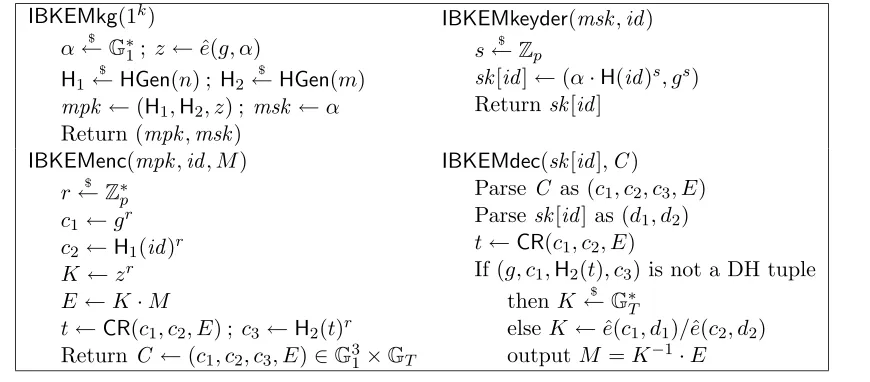
In this section we present our new chosen-ciphertext secure IB-KEM. From now on let
PG
= (G1,GT, p,e, gˆ )be public system parameters obtained by running the group parameter algorithmG(1k).
4.1 Waters’ Hash
We review the hash functionH:{0,1}n→G
1 used in Waters’ identity based encryption schemes [45].
On input of an integern, the randomized hash key generatorHGen(G1) choosesn+ 1 random groups
IBKEMkg(1k)
u1, u2, α←$ G∗
1; z←ˆe(g, α)
H←$ HGen(G1)
mpk ←(u1, u2, z,H) ; msk←α
Return (mpk,msk)
IBKEMkeyder(msk,id)
s←$ Zp
sk[id]←(α·H(id)s, gs) Return sk[id]
IBKEMenc(mpk,id)
r ←$ Z∗
p
c1 ←gr
c2 ←H(id)r; t←TCR(c1) c3 ←(ut1u2)r
K ←zr∈GT
C ←(c1, c2, c3)∈G31
Return (K,C)
IBKEMdec(sk[id],C) Parse C as (c1, c2, c3)
Parse sk[id] as (d1, d2)
t ←TCR(c1)
If (g, c1, ut1u2, c3) is not a DH tuple
or (g, c1,H(id), c2) is not a DH tuple
thenK ←$ G∗
T
elseK ←eˆ(c1, d1)/eˆ(c2, d2)
Return K
Figure 1: Our chosen-ciphertext secure IB-KEM.
function. The hash functionH:{0,1}n→G∗
1 is evaluated on a stringid = (id1, . . . ,idn)∈ {0,1}n as the product
H(id) =h0
n
Y
i=1 hidi
i .
4.2 The IB-KEM Construction
Let TCR:G1 → Zp be a target collision-resistant hash function (which we assume to be included in
the system parameters). Our IB-KEM with identity space IDSp ={0,1}n (n=n(k)) and key space KeySp=GT is depicted in Figure 1.
A tuple (g, c1, ut1u2, c3) is a Diffie-Hellman tuple2if ˆe(g, c3) = ˆe(ut1u2, c1). Analogously, (g, c1,H(id), c2)
is a Diffie-Hellman tuple if ˆe(g, c2) = ˆe(H(id), c1). Therefore the check in the decapsulation algorithm
IBKEMdec can be implemented by evaluating the bilinear map four times.
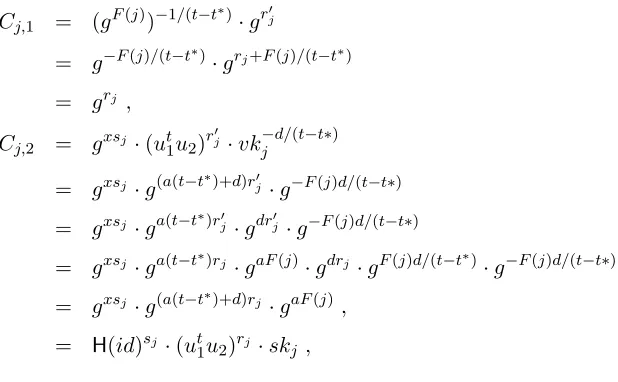
We now show correctness of the scheme, i.e. that the session keyK computed in the encapsulation algorithm matches the K computed in the decapsulation algorithm. A correctly generated ciphertext for identity id has the form C = (c1, c2, c3) = (gr,H(id)r,(ut1u2)r) and therefore (g, c1, ut1u2, c3) = (g, gr, ut1u2,(ut1u2)r) is always a DH tuple. A correctly generated secret key for identity id has the
form sk[id] = (d1, d2) = (α·H(id)s, gs). Therefore the decapsulation algorithm computes the session
key K as
K = ˆe(c1, d1)/eˆ(c2, d2)
= ˆe(gr, αH(id)s)/ˆe(H(id)r, gs)
= ˆe(gr, α)·eˆ(gr,H(id)s)/eˆ(H(id)r, gs) = zr·eˆ(gs,H(id)r)/eˆ(H(id)r, gs) = zr,
as the key computed in the encapsulation algorithm. This shows correctness. 2A tuple (h, ha
LetC = (c1, c2, c3)∈G3
1 be a (possibly malformed) ciphertext. CiphertextC is calledconsistent
(w.r.t the public keypk and identity id) if (g, c1, ut1u2, c3) and (g, c1,H(id), c2) are Diffie-Hellman
tu-ples, wheret=TCR(c1). Note that any ciphertext properly generated by the encapsulation algorithm
is always consistent. The decapsulation algorithm tests for consistency of the ciphertext. Note that this consistency test can be performed by anybody knowing the public-key. We call this property “public verification” of the ciphertext. In the words of [1] the IB-KEM ciphertext is not anonymous.
4.3 More Efficient Decapsulation
We now describe an alternative decapsulation algorithm which is more efficient (but less intuitive). The idea is to make the Diffie-Hellman consistency check implicit in the computation of the key K. This is done by choosing a random valuesr1, r2∈Z∗p and computing the session key as
K ← eˆ(c1, d1·(u
t
1u2)r1·H(id)r2)
ˆ
e(c2, d2·gr2)·eˆ(gr1, c3) .
We claim that this is equivalent to first checking for consistency and then computing the key as
K ←ˆe(c1, d1)/eˆ(c2, d2) as in the original decapsulation algorithm.
To prove this claim we define the functions ∆1(C) = ˆe(c1, ut1u2)/eˆ(g, c3) and ∆2(C) = ˆe(H(id), c1)/ˆe(g, c2).
Then ∆1(C) = ∆2(C) = 1 if and only if C is consistent. Consequently, for random r1, r2 ∈ Z∗p,
K = ˆe(c1, d1)/eˆ(c2, d2)·(∆1(C))r1·(∆2(C))r2 ∈G∗T evaluates to ˆe(c1, d1)/eˆ(c2, d2)∈GT ifC is con-sistent and to a random group element otherwise. As in the original decapsulation algorithm. The claim then follows by
K = ˆe(c1, d1)/eˆ(c2, d2)·∆1(C)r1·(∆2(C))r2
= ˆe(c1, d1)/eˆ(c2, d2)·(ˆe(c1, ut1u2)/ˆe(g, c3))r1 ·(ˆe(H(id), c1)/ˆe(g, c2))r2
= ˆe(c1, d1(u t
1u2)r1H(id)r2)
ˆ
e(c2, d2·gr2)·ˆe(gr1, c3) .
We remark that the alternative decapsulation algorithm roughly saves two pairing operation (for the cost of a couple of exponentiations).
4.4 Security
Theorem 4.1 AssumeTCRis a target collision resistant hash function. Under the Bilinear Decisional Diffie-Hellman (BDDH) assumption relative to generator G, the IB-KEM from Section 4.2 is secure against chosen-ciphertext attacks.
In particular, given an adversary Aattacking the chosen-ciphertext security of the IB-KEM with advantage εA = AdvIBKEMib−kem-,Acca and running time TimeA(k) we construct an adversary B breaking the BDDH assumption with advantage εB =AdvbddhG,B (k) and running time TimeB(k) with
εB(k) ≥
εA(k)−AdvhashTCR,H-tcr(k)
8(n+ 1)q −q/p; TimeB(k) ≤ TimeA+ ˜O(nq·ε−A2(k)),
A game-based proof of Theorem 4.1 will be given in Appendix A. The proof is mainly based on the one given by Waters [45]. However, we have to do some important modifications to be able to deal with chosen-ciphertext attacks.
Intuitively, security can be best understood by observing that our scheme is a generalization of Waters’ (chosen-plaintext secure) IBE scheme, as well as of the chosen-ciphertext secure public-key encapsulation scheme from [14]. We remark that unfortunately, there does not seem to be a way to derive security of our IBE scheme directly from security of either of the two schemes and hence details of the whole proof have to be worked out from scratch.
Relation to Waters’ IBE scheme. The ciphertext in our scheme is basically identical to the ciphertext from Waters’ IBE scheme plus one redundant element (the element c3) used to check for
consistency of the ciphertext. Hence Waters’ IBE scheme is obtained by ignoring the computation of
c3 in encapsulation as well as the consistency check in decapsulation.
Relation to the Encryption Scheme from BMW. Clearly, IB-KEM implies (standard) public-key encapsulation by simply ignoring all operations related to the identity. We remark that viewed in this light (i.e. ignoring the elementc2 in encapsulation/decapsulation and ignoring the key derivation
algorithm) our IB-KEM can be simplified to the chosen-ciphertext secure encryption scheme recently proposed by Boyen, Mei, and Waters [14].
5
IB-KEM with threshold key-delegation and decapsulation
We start with some history and motivation. Threshold key-delegation for IBE was introduced in [11, 10]. The idea is that the master key msk is distributed among different secret key generation players. Given a master-key share ski, each player can compute a partial secret key sk[id]i for the user with identityid. Finally, a sufficiently large fraction of partial user secret keys is needed to reconstruct the user secret key sk[id].
In contrast, in the model given in [3] the master key is not shared but only the user secret key sk[id]. Then partial user secret key shares sk[id]i are distributed among a number of decryption players. Given the share sk[id]i, the i-th decryption player can compute a partial decryption share Ci of a given an ciphertext C. A sufficiently large fraction of correctly generated ciphertext shares is needed to finally reconstruct the message. No information about the message should be leaked otherwise.
Our model of threshold IB-KEM is aimed at capturing the functionalities of both threshold key-delegation IBE and threshold decryption IBE. That is, in a threshold IB-KEM the players can act at the same time as private key generation players and decapsulation players, so that they can choose which role they want to assume depending on the application. Therefore, an encapsulationC sent to user id can be decapsulated either by reconstructing the user secret key sk[id], or by joining together a large enough fraction of decapsulation shares Ci.
5.1 Definitions
We now give a formal definition of the functionality of a threshold IB-KEM. A threshold IB-KEM with participating players 1, . . . , m consists of nine polynomial-time algorithms
TIBKEM
= (TIBKEMkg,TIBKEMkey.Share,TIBKEMkey.Vfy,TIBKEMkey.Combine,TIBKEMenc,TIBKEMdec,TIBKEMdec.Share,
TIBKEMdec.Vfy,TIBKEMdec.Combine). Via (pk,vk,sk) ←$ TIBKEMkg(1k, l, m) the randomized
re-spect to identityid; viask[id]i $
←TIBKEMkey.Share(pk, i,id,ski) theith sharesk[id]iof the user secret key sk[id] is generated; via {accept,fail} ←TIBKEMkey.Vfy(vk, i,id,sk[id]i) the validity of the ith user secret key sharesk[id]iis verified; via{sk[id],fail} ←TIBKEMkey.Combine(pk,vk,id,(sk[id]i)i∈Ir)
sufficiently many valid user secret key shares{(sk[id]i}i∈Ir are combined to reconstruct the user secret
key sk[id]. The set of players Ir is called the user secret key reconstruction set. Via {K,fail} ← TIBKEMdec(pk,sk[id],C) the possessor of the user secret key sk[id] decapsulates the ciphertext C; via {(i, Ci),fail} ←TIBKEMdec.Share(pk,vk,id, i,sk[id]i,C) the possessor of theith user secret key share sk[id]i partially decapsulates the ciphertextC encrypted with respect toid to get back theith decapsulation share Ci; via {accept,fail} ←TIBKEMdec.Vfy(i,pk,vk, id, Ci,C) it can be publicly verified if the ith decapsulation share Ci is valid; via {M,fail} ← TIBKEMdec.Combine(pk,vk,id, (Ci)i∈I0
r,C) sufficiently many valid decapsulation shares{Ci}i∈I0r are combined to reconstruct the
ses-sion key K. The set of players I0
r is called the session key reconstruction set (and may be distinct from Ir).
Roughly speaking, for correctness we require that all correctly generated shares pass their respective verification tests. Furthermore, any set of at leastlhonest players holding shares of a common identity id should be able to correctly operate the threshold IB-KEM, i.e. they should be able to reconstruct the user secret keysk[id], or alternatively to decapsulate any correctly generated encapsulation sent to id. We say that a user secret key or decapsulation share is correctly generated if it has been obtained by following the protocol specification. Moreover, a user secret key or decapsulation share is said to bevalid if it passes the corresponding verification test.
Each threshold IB-KEM naturally has to fulfull security and consistency requirements. In terms of security we have to extend the security models in [3, 10] to our setting, meaning that an adversary, in addition to the master-key shares for corrupted players, gets access to oracles for user secret key and decapsulation shares. Regarding consistency, we must recall that often one wants threshold key-delegation (resp. threshold decryption) to be robust, namely if the reconstruction of sk[id] (resp. threshold decapsulation of a valid encapsulationC) fails, it is useful to detect the players that supplied invalid partial user secret keys (resp. invalid partial decapsulation shares). This also means that it should be impossibly to “abuse” shares that passed their respective consistency tests (i.e. shares that are valid) to make the scheme inconsistent, for instance by decapsulating the same encapsulation into distinct session keys. We will call this property consistency of the threshold IB-KEM.
5.2 Security requirements
Formally, we associate to a threshold IB-KEM
TIBKEM
and an adversaryAthe experimentExptibkem-ccaTIBKEM,A
as follows:
Experiment ExptibkemTIBKEM-cca,A(k)
(Ic,state0)← A$ (1k,init) //adversary outputs the set of corrupted users
(pk,sk,vk)←$ TIBKEMkg(1k, l, m)
(id∗,state)← A$ KeyShare(·,·),DecShare(·,·,·)(find,pk,vk,{sk
i}i∈Ic,state0) K0∗←$ KeySp; (C∗, K1∗)←$ TIBKEMenc(pk,id)
δ← {$ 0,1};K∗←K∗ δ
δ0 $
← AKeyShare(·,·),DecShare(·,·,·)(guess, K∗,C∗,state) Ifδ6=δ0 then return 0 else return 1
The set Ic ⊂ {1, . . . , m} is called the set of corrupted players and its cardinality, |Ic|must be upper bounded by l−1. The oracle KeyShare(i,id) returns ski ←$ TIBKEMkey.Share(pk, i,id,ski) with the restriction that A is not allowed to query for id 6= id∗ for non-corrupted players i 6∈ Ic. The oracleDecShare(i,id,C) returnsCi
$
key sk[id]i was generated usingsk[id]i $
←TIBKEMkey.Share(pk, i,id,ski)) with the restriction that A is not allowed to query for (i,id∗,C∗) for non-corrupted players i6∈Ic. We define the advantage of A in the experiment as
AdvtibkemTIBKEM-cca,A(k) =
¯ ¯ ¯ ¯Pr
h
ExptibkemIBKEM-cca,A(k) = 1i−1 2
¯ ¯ ¯ ¯ .
Definition 5.1 A threshold IB-KEM
TIBKEM
is said to besecure against chosen-ciphertext attacks if for any l, m with 0< l≤m, the advantage function AdvTIBKEMtibkem-cca,A(k) is a negligible function in kfor all polynomial-time adversariesA.
Consistency requirements. Any threshold IB-KEM
TIBKEM
should satisfy two consistency re-quirements. On the one hand, user secret key consistency requires that for any reconstructed user secret keysk[id] (obtained from a set oflvalid user secret key shares) the same session key is obtained when decapsulating (via TIBKEMdec) a valid ciphertext under the corresponding id. Secondly, de-capsulation consistency requires that reconstructing the session key via TIBKEMdec.Combine for the same ciphertext C and identity id but for several different sets ofl valid decapsulation shares results in the same session key.Following [43, 10] we will formalize both consistency requirements using an adversary “attacking” the consistency of the schemes. Here we refer to reader to [1] for a general discussion on defining adveraries attacking consistency of a cryptographic scheme. As usual, “adversary” refers to a PTA but we stress that the consistency of our particular scheme can be proven with respect to unbounded adversaries.
For secret key consistency, we associate to an adversaryAthe experiment
Experiment ExptibkemTIBKEM-key-consist
,A (k) (Ic,state0)
$
← A(1k,init) //adversary outputs the set of corrupted users
(pk,sk,vk)←$ TIBKEMkg(1k, l, m)
(id, D, D0, C)← A$ KeyShare(·,·),DecShare(·,·,·)(find,pk,vk,{ski}i∈Ic,state0)
sk[id]←TIBKEMkey.Combine(pk,vk,id, D) ;K ←TIBKEMdec(pk,sk[id], C) sk[id]0←TIBKEMkey.Combine(pk,vk,id, D0) ; K0 ←TIBKEMdec(pk,sk[id]0, C) If fail6=sk[id]6=sk[id]0 6=fail and K6=K0 then output 1 else output 0
The setIc and the oraclesKeyShare(i,id) andDecShare(i,id,C) are as defined in the experiment
ExptibkemTIBKEM-cca,A. The sets D = {D1, . . . , Dl} and D0 = {D01, . . . , D0l} are two sets of valid key shares with respect to identity id. We define the advantage ofA in the experiment as
AdvtibkemTIBKEM-key,A-consist(k) = PrhExptibkemTIBKEM-key,A-consist(k) = 1i.
For decapsulation consistency we associate to an adversaryA the following experiment:
Experiment ExptibkemTIBKEM-dec,A-consist(k) (Ic,state0)
$
← A(1k,init) //adversary outputs the set of corrupted users
(pk,sk,vk)←$ TIBKEMkg(1k, l, m)
(id, S, S0, C) $
← AKeyShare(·,·),DecShare(·,·,·)(find,pk,vk,{sk
i}i∈Ic,state0) K←TIBKEMdec.Combine(pk,vk,id, S,C)
K0←TIBKEMdec.Combine(pk,vk,id, S0,C)
Iffail6=K 6=K0 6=fail then return 1 else return 0
The setIc and the oraclesKeyShare(i,id) andDecShare(i,id,C) are as defined in the experiment
shares with respect to (id, C). We define the advantage of Ain the experiment as
AdvtibkemTIBKEM-dec,A-consist(k) = PrhExptibkemTIBKEM-dec,A-consist(k) = 1i.
The experimentExptibkemTIBKEM-key-consist
,A has already been considered in [10], while the experimentExp
tibkem-dec-consist
TIBKEM,A
is considered here for the first time. In particular, previous papers [3, 17] did not consider decapsulation consistency.
Definition 5.2 A threshold IB-KEM
TIBKEM
is said to be consistent if for any l, m with 0 < l ≤ m, and for any PTA adversaries A1 and A2 the two functions AdvtibkemTIBKEM-key,A1-consist(k) and Advtibkem-dec-consistTIBKEM,A2 (k) are negligible.
5.3 Discussion and Difficulties
It is already known how to make the key derivation threshold [10]. The crucial trick is to use bilinear pairings to explicitly check if a shared secret key sk[id]i was correctly generated. If not it can be rejected beforethe secret is reconstructed.
The difficulty for a full fledged threshold IB-KEM lies in the decapsulation shares. A similar method as above for generating decapsulation shares does not work since the plaintextM in an element from the second group GT and we are not given a bilinear pairing on the group GT (which does not exist
since DDH in GT and hence BDDH would be easy otherwise). In existing solutions [3] (based on the
Boneh-Franklin IBE [12]) generic proofs of knowledge (POK) are used instead to prove consistency and random oracles are essential to make the proofs non-interactive.
We propose a different technique that completely avoids generic POK. The key idea is to make the decapsulation shares elements from G1. That makes possible to employ our techniques from the
last section to prove consistency of the decapsulation shares. Our technique is reminiscent to the one proposed in [22] based on the 2-level hierarchical IBE from Gentry and Silverberg [26]. However, chosen-ciphertext security was not considered in [22]. In contrast to [22] our scheme does not add any further information to the ciphertext, i.e. we basically get “threshold for free” from chosen-ciphertext properties.
5.4 The Scheme
For the user secret key reconstruction set Ir ⊆ {1, . . . , m} we define the Lagrange Coefficients λi (i ∈ Ir) as λi = Qj∈Ir\{i} j−ij ∈ Z∗p. For any polynomial F ∈ Zp[X] of degree at most |Ir| − 1 this entails Pi∈I
rF(i)λi = F(0). The coefficients λ
0 i =
Q
j∈I0
r\{i}
j
j−i ∈ Z∗p are defined analogously for the session key reconstruction set I0
r ⊆ {1, . . . , m}. We call a (user secret key/ciphertext) share valid if it passes the respective consistency check. Let TCR : G1 → Zp be a target collision restant
hash function. Our threshold IB-KEM for identity space {0,1}n and threshold parameters m and l (l-out-of-m threshold scheme – at least l honest players are needed to perform threshold operations) is described by the following algorithms:
Key generation TIBKEMkg(1k, l, m). Choose u1, u2 ←$ G∗1 and b
$
←Zp, and compute α=ub
1 and z←eˆ(g, α). Choose a random hash
functionH←$ HGen(G1) and a parameters the the target collision resistant hash function TCR.
The public key is defined aspk = (u1, u2, z,TCR,H).
Generate shared keys using l-out-of-m secret sharing by choosing Fi $
← Zp for i= 1, . . . , l−1
Shared user secret key delegation TIBKEMkey.Share(pk, i,id,ski) Choose si
$
←Zp and computedi,1 ←ski·H(id)si andd
i,2 ←gsi. The shared user secret key for
player iis defined as sk[id]i = (di,1, di,2).
Shared user secret key verification TIBKEMkey.Vfy(pk,vk, i,id,sk[id]i) Parse sk[id]i= (di,1, di,2) and check if ˆe(di,1, g) = ˆe(vki, u1)·eˆ(di,2,H(id)) Shared user secret key combine TIBKEMkey.Combine(pk,vk,id,(sk[id]i)i∈Ir)
If |Ir| < l or if one of the shares user secret keys sk[id]i (i ∈ Ir) is not valid return fail. Otherwise parsesk[id]i= (di,1, di,2) and return sk[id] = (d1, d2) = (Qi∈Irdλi,i1,Qi∈Irdλi,i2). Encapsulation TIBKEMenc(pk,id)
Choose r←$ Z∗
p and compute the encapsulationC = (c1, c2, c3)∈G31 as
(c1=gr, c2=H(id)r, c3 = (ut1u2)r),
wheret=TCR(c1). The corresponding session key is K=zr∈GT.
Decapsulation TIBKEMdec(pk,sk[id],C)
Parse C as (c1, c2, c3) and sk[id] as (d1, d2). Compute t =TCR(c1). We call a encapsulation C
consistent iff (g, c1, ut1u2, c3) and (g, c1,H(id), c2) are DH tuples3. (Checking for a DH tuple can be done by computing the ratio of two pairings, i.e. (g, c1, ut1u2, c3) is a DH tuple if ˆe(g, c1) =
ˆ
e(ut
1u2, c3).) If C is not consistent then return fail. Otherwise reconstruct the session key as K = ˆe(c1, d1)/eˆ(c2, d2).
Shared decapsulation TIBKEMdec.Share(pk,vk, i,id,sk[id]i,C)
Parse C as (c1, c2, c3) and compute t = TCR(c1). If C is not consistent then return fail.
Otherwise chooseri ←$ Zp and return the shared decapsulation for playeri,Ci= (Ci,1, Ci,2, Ci,3)
as
(Ci,1 =gri, Ci,2 =di,1·(ut1u2)ri, Ci,3 =di,2). Decapsulation share verification TIBKEMdec.Vfy(pk,vk, i,id, Ci,C)
IfC is not consistent or if ˆ
e(g, Ci,2)6= ˆe(vki, u1)·eˆ(Ci,3,H(id))·ˆe(Ci,1, ut1u2)
then returnfail.
Combine decapsulation shares TIBKEMdec.Combine(pk,vk,id,(Ci)i∈I0
r,C)
Parse C as (c1, c2, c3) and compute t = TCR(c1). If |Ir0| < l or if one of the shares Ci is not valid then return fail. Otherwise compute the values B1 = Qi∈I0
rC
λ0
i
i,1, B2 = Qi∈I0
rC
λ0
i
i,2, and B3=Qi∈I0
rC
λ0
i
i,3. Reconstruct the session key as K = eˆ(c1, B2)
ˆ
e(c2, B3)·eˆ(ut1u2, B1) .
3A tuple (g, ga
Correctness and Security. It is easy to verify that all verification checks are passed for correctly generated keys/encapsulations.
We now show correctness of the reconstructed private key. Let Ir a set of cardinality at least
l. Assume the shares sk[id]i are all correct, that is di,1 = ski·H(id)si and di,2 = gsi. Let us define s=Pi∈Irsiλi.Then d02=
Q
i∈Ird
λi
i,2 =gs and d01= Y
i∈Ir dλi
i,1 = Y
i∈Ir
sk[id]i·H(id)siλi =H(id)s Y
i∈Ir
uF1(i) =ub1H(id)s,
as in key derivation.
We now show correctness of the reconstructed session key. LetIr0 be a set of cardinality at least
l. Assume the shares Ci are all correct, i.e. Ci,1 =gr
0
i,Ci,2 =di,1·(ut 1u2)r
0
i =ski·H(id)si·(ut 1u2)r
0
i,
and Ci,3 =di,2 =gsi. We definer0 =Pi∈I0
rr
0
iλ0i and s=
P
i∈I0
rsiλ
0
i. ThenB1 =Qi∈I0
rC
λ0
i
i,1 =gr
0 and
B3=Qi∈I0
rC
λ0
i
i,3=gs. Furthermore,
B2 = Y
i∈I0
r Cλ
0
i
i,2= Y
i∈I0
r
gF(i)·λ0i·H(id)si·λ0i ·(ut 1u2)r
0
i·λ
0
i
= gPi∈I0
rF(i)λ
0
i·H(id)s·(ut 1u2)r
0
= α·H(id)s·(ut1u2)r0 The key is computed as
K = ˆe(c1, C20)/(ˆe(c2, C30)·eˆ(c3, C10)) = ˆe(gr, α·H(id)s·(ut1u2)r
0
)/(ˆe(H(id)r, gs)·eˆ(urt1 ur2, gr0)) = ˆe(gr, α)·ˆe(gr,H(id)s)/ˆe(H(id)r, gs)·eˆ(gr,(ut1u2)r
0
)/ˆe(urt1 ur2, gr0)) = zr,
as in encapsulation.
Theorem 5.3 Assume TCR is a target collision resistant hash function. Under the Bilinear Deci-sional Diffie-Hellman (BDDH) assumption relative to generator G, our threshold IB-KEM is secure against chosen-ciphertext attacks. In particular, given an adversaryAattacking the chosen-ciphertext security of the threshold IB-KEM with advantage εA =AdvtibkemTIBKEM-cca,A and running time TimeA(k) we construct an adversary B breaking the BDDH assumption with advantage εB =AdvbddhG,B (k) and running timeTimeB(k) with
εB(k) ≥
εA(k)−AdvhashTCR,H-tcr(k)
8(n+ 1)q −q/p; TimeB(k) ≤ TimeA+ ˜O(nq·ε−A2(k)),
where q is an upper bound on the number of key derivation/decapsulation share queries made by adversaryA.
Theorem 5.4 Our threshold IB-KEM is consistent. In particular, we have
AdvtibkemTIBKEM-key,A1-consist(k) =AdvtibkemTIBKEM-dec,A2-consist(k) = 0.
The proofs of the two theorems will be given in Appendix B.
Relation to the threshold KEM from BMW. Clearly, our threshold IB-KEM implies (stan-dard) threshold KEM by simply ignoring all operations related to the identity. We remark that viewed in this light, our threshold IB-KEM can be simplified to the chosen-ciphertext secure threshold KEM scheme recently proposed by Boyen, Mei, and Waters [14]. Although the computational cost remains the same, the public key of our scheme still saves two elements inG1 compared to BMW’s public key. From threshold IB-KEM to full threshold IBE.Designing a full threshold IBE from a thresh-old IB-KEM is not an easy task. Let us have a glimpse on that.
In the IB-KEM framework [7], a standard (hybrid) IBE scheme can be obtained by using the IB-KEM to securely transport a random session key that is fed into a symmetric encryption scheme to encrypt the plaintext message. If both the IB-KEM and the symmetric encryption scheme are chosen-ciphertext secure, then the resulting hybrid IBE is also chosen-ciphertext secure, with a tight reduction. A symmetric encryption scheme secure against chosen-ciphertext attacks can be built from relatively weak primitives, i.e. from any (one-time) symmetric encryption scheme by essentially adding a MAC. Alas, sharing a MAC is not trivial in general, and will often lead to costly computations.
This problem can be solved by using the related notion of Tag-IB-KEM, which is obtained by translating the notion of Tag-KEM [2] to the identity-based encryption setting. A Tag-IB-KEM is an IB-KEM which takes an additional input calledtag. Such a tag is a binary string of appropriate length, and need not have any particular structure. By extending the results in [2] to the IBE framework, is it possible to show that combining a CCA secure Tag-IB-KEM with chosen-plaintext secure symmetric encryption yields a CCA secure IBE scheme. This immediately implies a construction for threshold IBE from any threshold Tag-IB-KEM, since now we do not need to share the symmetric encryption component anymore. Finally, a CCA secure threshold Tag-IB-KEM can be built from combining a threshold IB-KEM, a key derivation function and a MAC, without considerable overheads.
6
Extensions
6.1 Chosen-ciphertext secure Hierarchical Identity-Based Key Encapsulation
Hierarchical identity-based key encapsulation (HIB-KEM) is a generalization of IB-KEM to identities supporting hierarchical structures [28, 26]. By the relation to Waters IBE scheme it is easy to see that our technique can also be used to make (the KEM variant of) Waters’ HIBE chosen-ciphertext secure. To be more precise, we modify Waters’ HIB-KEM and add one more element hrt1 hr2 to the the ciphertext, wheretwas computed by applying a target-collision hash function togr (here r is the randomness used to create the ciphertext). The additional element is used for a consistency check at decryption. The security reduction is exponential in the depth dof the hierarchy, i.e. it introduces, roughly, a multiplicative factor of (nq)d.
6.2 Identity-based Encryption
Given a IB-KEM and a symmetric encryption scheme, a hybrid identity-based encryption scheme can be obtained by using the IB-KEM to securely transport a random session key that is fed into the symmetric encryption scheme to encrypt the plaintext message. It is well known [20, 7] that if both the IB-KEM and the symmetric encryption scheme are chosen-ciphertext secure, then the resulting hybrid encryption is also chosen-ciphertext secure. The security reduction is tight.
MAC. For concreteness we mention that a chosen-ciphertext secure IBE scheme can be built from our IB-KEM construction with an additional overhead of about 128 bits (for the MAC).
We note that for the natural task of securely generating a joint random session key, a IB-KEM is sufficient and a fully-fledged identity-based encryption scheme is not needed.
The same remark holds for hierarchical based encryption (HIBE) and threshold identity-based encryption.
6.3 A Tradeoff between public key size and security reduction
As independently discovered in [18, 33], there exists an interesting trade-off between key-size of Waters’ hashHand the security reduction of the IBE scheme.
The construction modifies Waters hashHas follows: Let the integer l=l(k) be a new parameter of the scheme. In particular, we represent an identity id ∈ {0,1}n as ann/l-dimensional vector id = (id1, . . . ,idn/l), where each idi is an l bit string. Waters hash is then redefined toH:{0,1}n →G1,
with H(id) = h0Qn/li=1hiidi for random public elements h0, h1, . . . , hn/l ∈ G1. Waters’ original hash
function is obtained as the special casel= 1. It is easy to see that using this modification in our IBE scheme (i) reduces the size of the public key fromn+ 4 ton/l+ 4 group elements, whereas (ii) it adds another multiplicative factor of 2l to the security reduction of the IBE scheme (Theorem 4.1).4
6.4 Selective-identity chosen-ciphertext secure IB-KEM
For the definition of a selective-identity chosen-ciphertext secure IB-KEM we change the security experiment such that the adversary has to commit to the target idenity id∗ before seeing the public key. Clearly, this is a weaker security requirement. We quickly note that (using an algebraic technique from [8]) by replacing Waters’ hash HwithH(id) =h0·hid1 (forid ∈Zp) we get a selective-id chosen-ciphertext secure IB-KEM. Note that the size of the public-key of this scheme drops to 3 elements.
6.5 Implementing the collision resistant hash function TCR
In practice, to build a target collision resistant hash function, one can use a dedicated cryptographic hash function, like SHA-1 [38].
Every injective function TCR : G1 → Zp trivially also is (target) collision resistant (with zero
advantage). Boyen, Mei and Waters [14] note that for bilinear maps defined on elliptic curves there exists a very efficient way to implement such injective mappings. We refer to [14] for more details.
7
Efficiency comparison of our IB-KEM
In this section we compare our IB-KEM from Section 4 with the previous chosen-ciphertext secure IB-KEM/IBE schemes in the literature.
Basically, there are two proposals of IBE scheme in the literature, one by combining the IBE schemes [8, 45] with the generic transformation from [16], the other one stems from a remark from [14]. We will now carefully review both constructions and compare them to our proposed scheme.
7.1 IB-KEM scheme obtained by the generic CHK transformation
We begin by reviewing the generic transformation from any (weakly secure) 2-HIBE into a chosen-ciphertext secure IBE scheme by Canetti, Halevi, and Katz [16] (CHK), which was later improved by 4On the technical side our proof basically stays the same, only the bound from Lemma A.2 needs to be adapted to
Boneh-Katz [13] (BK). We describe the CHK transformation in terms of key encapsulation and note that this is not possible for the improved BK transformation.
The CHK method transforms any two level HIB-KEM into an IB-KEM scheme as follows: the identity of the IB-KEM scheme becomes the identity of the first level HIB-KEM. To create a ciphertext of the IB-KEM a random pair of signing/verification keys is chosen. A HIB-KEM ciphertext for the message is created with respect to the two-level identity consisting of the HIB-KEM identity at the first level and the verification key at the second level. The resulting HIB-KEM ciphertext is signed using the signing key. Finally, the HIB-KEM ciphertext is then composed by the HIB-KEM ciphertext, the signature, and the corresponding verification key.
For decapsulation first the validity of the signature is checked and then, conditioned it was correct, the HIB-KEM ciphertext is decapsulated using the hierarchical key-derivation algorithm for the 2-level “identity” consisting of id plus the verification key.
It was proved in [16] that any chosen-plaintext secure 2-HIB-KEM with a weak security property with respect to the second level of the hierarchy (i.e. selective-identity security) and (full) security at the first level is sufficient to obtain a chosen-ciphertext secure IBE. Consequently, as noted in [45], the most efficient instantiation of this transformation is obtained from the hybrid HIB-KEM using Waters IB-KEM [45] at the first level and Boneh/Boyen’s IB-KEM [8] at the second level.
Combining the results from [16] with [45, 8] we get a chosen-ciphertext secure IB-KEM under the BDDH assumption. Similar to our scheme the security reduction roughly comes with a multiplicative factor of ≈nq.
7.2 IB-KEM mentioned in BMW
In contrast to [16, 13], Boyen, Mei, and Waters [14] propose a non black-box technique to obtain a chosen-ciphertext secure IB-KEM from a 2-level HIB-KEM without relying on additional primitives like signatures or MACs. For concreteness we cite their concrete statement (from Sec. 5.3 of the full version of [14]), referring to the two HIBE constructions from Boneh-Boyen [8] and Waters [45]:
“It is easy to see that we obtain the desired result [i.e. a construction avoiding a signa-ture/MAC] very simply, by extending the hierarchy in either HIBE construction by one level, and setting the “identity” for that last level to be the hash value of the previous ci-phertext components. This gives us (in the Waters case) an adaptive-identity CCA2-secure HIBE, and (in the Boneh-Boyen case) a selective-identity CCA2-secure HIBE.”
No theorem statement (or further explanation beyond that) is given but it is clear that security relies on Waters 2-HIBE which has a loss-factor of roughly (nq)2 in the reduction from BDDH. We want to
stress that in their construction the “hashing the previous ciphertext” makes it basically impossible to replace the second level of Waters HIBE with the more efficient (but only weakly=selective-identity secure) IBE scheme from Boneh-Boyen. (This is since the challenge ciphertext depends on the target identity which is used in the second-level of the HIBE scheme and the target identity is not known until the adversary outputs it.)
Since the construction uses Waters 2-HIBE the public-key has to include two independent sets of hash public-keys, i.e. the public key contains roughly 2nelements from G1. For the same reason the
security reduction of the proposed IBE scheme depends on the security of Waters’ 2-HIBE which is quadratic inq and n.
7.3 A comparison
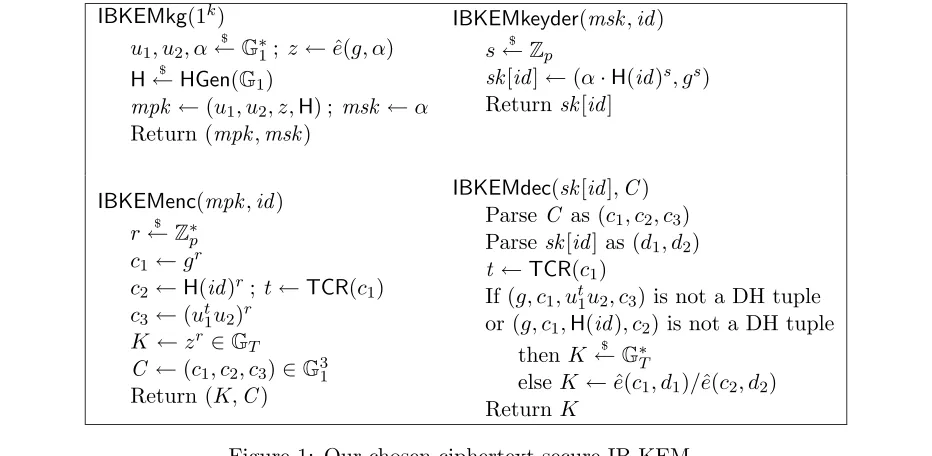
Scheme CCA? Ciphertext Encapsulation Decapsulation Keysize Security Overhead #pairings + #[multi,regular,fixed-base]-exp+... pk Reduction Ours (§4) √ 3` 0 + [1,3,1] 3 + [1,0,2] n+ 4 nq
Hybrid + CHK (§7.1) √ 3`+25600 (704) 0 + [1,3,1]+Sig 3 + [1,0,1]+Vfy n+ 4 nq BMW (§7.2) √ 3`0 0 + [0,5,1] 4 + [0,1,0] 2n+ 3 (nq)2
Waters — 2` 0 + [0,3,1] 2 + [0,0,0] n+ 2 nq
Figure 2: Efficiency comparison for CCA-secure IB-KEMs for identity-space IDSp={0,1}n. BMW is the IB-KEM as proposed in [14], Hybrid + BK is the Waters/BB hybrid HIB-KEM scheme applied to the CHK transformation as proposed in [45], and Waters is Waters’ original chosen-plaintext secure IBE scheme [45] (which is added for comparison). The keysize is measured in terms of the number of group elements of the public keypk. Ciphertext overhead represents the difference (in bits) between the ciphertext length and the message length. `is the length of the representation of an element inG1
with respect to the security reduction O(nq),while`0 is the length of aG1 group element with respect
to the security reduction O(n2q2) (thus `¿`0). For comparison we mention that relative timings for the various operations are as follows: bilinear pairing ≈ 5 [37], multi-exponentiation ≈ 1.5, regular exponentiation = 1, fixed-base exponentiation ¿0.2.
performance of the security reduction is a crucial parameter here. In light of the keysize/security reduction tradeoff from Section 6.3 we can also compare the BMW scheme to all other schemes by “normalizing” the security reduction for all schemes toO(n2q2), i.e. by setting the tradeoff parameter
l tol= log2(nq)≈20 + 7 = 27 (for very optimistic <220 adversary queries and identities of n= 160 bits5) we get a public-key size ofn/27 + 4 ≈9 group elements compared to the 2n+ 3 = 323 group
elements of BMW with the same security.
The symmetric overhead of the CHK transformation consists of a strong one-time signature plus a verification key which sums up to≈1602 = 25600 (“security parameter squared”) bits [23].
Since computing Waters hash requires computingn/2 products in G1 on the average, where n≈
log2p, it can be seen as a single exponentiation. Therefore we count computing H(id)r for random r
as two (regular) exponentiations. In the decapsulation algorithm of our IB-KEM we assume H(id) to be precomputed. The size of the secret key sk is the same for all three schemes (a single element in
G1).
To summarize, compared to BMW (from Section 7.2) our proposed chosen-ciphertext secure IBE scheme achieves better performance and public key sizes with half of the BMW public key size. In addition, the fact that our security reduction is more efficient than that of the BMW scheme means that for concrete values of the security parameter our ciphertexts are much shorter even if the two schemes have the same number of elements in the ciphertext.
In terms of computational efficiency our scheme has one fixed-based exponentiation more than the the Hybrid + CHK scheme from Section 7.1 but it does not have to resort on any kind of exogenous consistency check such as a signature or a MAC. Since one fixed-based exponentiation is¿0.2 regular exponentiations (which can fairly be neglected) we conclude that encapsulation/decapsulation in our scheme is as efficient as in the Hybrid + CHK scheme. The most striking difference, however, is that our scheme comes with shorter ciphertexts: for current security requirements the ciphertexts difference (a strong one-time signature plus a verification key) amounts to a couple of thousand bits [23].
We remark that, in order to get a direct full IBE scheme (in contrast to an IB-KEM) we can also apply the BK-transformation [13] to the construction from Section 7.1 and get a full IBE scheme with shorter ciphertexts. The latter construction significantly reduces the ciphertext overhead compared 5160 bits seems to be a reasonable value since for larger identity space you can always first apply a collision resistant
hash functionCR:{0,1}∗
to the CHK-transformation (by replacing the signature with a MAC). Compared to our construction, however, there is still a difference in the ciphertext size of a MAC tag plus a “commitment” which sums up to ≈576 bits [13].
We conclude that our scheme seems to outperform both existing chosen-ciphertext secure IB-KEM proposals.
References
[1] Michel Abdalla, Mihir Bellare, Dario Catalano, Eike Kiltz, Tadayoshi Kohno, Tanja Lange, John Malone-Lee, Gregory Neven, Pascal Paillier, and Haixia Shi. Searchable encryption revisited: Consistency properties, relation to anonymous ibe, and extensions. In Victor Shoup, editor, CRYPTO 2005, LNCS, Santa Barbara, CA, USA, August 14–18, 2005. Springer-Verlag, Berlin, Germany.
[2] Masayuki Abe, Rosario Gennaro, Kaoru Kurosawa, and Victor Shoup. Tag-KEM/DEM: A new framework for hybrid encryption and a new analysis of kurosawa-desmedt KEM. In Ronald Cramer, editor, EUROCRYPT 2005, volume 3494 of LNCS, pages 128–146, Aarhus, Denmark, May 22–26, 2005. Springer-Verlag, Berlin, Germany.
[3] Joonsang Baek and Yuliang Zheng. Identity-based threshold decryption. In Feng Bao, Robert Deng, and Jianying Zhou, editors,PKC 2004, volume 2947 ofLNCS, pages 262–276, Singapore, March 1–4, 2004. Springer-Verlag, Berlin, Germany.
[4] Mihir Bellare, Anand Desai, David Pointcheval, and Phillip Rogaway. Relations among notions of security for public-key encryption schemes. In Hugo Krawczyk, editor,CRYPTO’98, volume 1462 of LNCS, pages 26–45, Santa Barbara, CA, USA, August 23–27, 1998. Springer-Verlag, Berlin, Germany.
[5] Mihir Bellare and Phillip Rogaway. Random oracles are practical: A paradigm for designing efficient protocols. In ACM CCS 93, pages 62–73, Fairfax, Virginia, USA, November 3–5, 1993. ACM Press.
[6] Mihir Bellare and Phillip Rogaway. The game-playing technique. Cryptology ePrint Archive, Report 2004/331, 2004. http://eprint.iacr.org/.
[7] Kamel Bentahar, Pooya Farshim, John Malone-Lee, and Nigel P. Smart. Generic constructions of identity-based and certificateless KEMs. Cryptology ePrint Archive, Report 2005/058, 2005.
http://eprint.iacr.org/.
[8] Dan Boneh and Xavier Boyen. Efficient selective-id secure identity based encryption without random oracles. In Christian Cachin and Jan Camenisch, editors, EUROCRYPT 2004, volume 3027 of LNCS, pages 223–238, Interlaken, Switzerland, May 2–6, 2004. Springer-Verlag, Berlin, Germany.
[9] Dan Boneh, Xavier Boyen, and Eu-Jin Goh. Hierarchical identity based encryption with constant size ciphertext. In Ronald Cramer, editor, EUROCRYPT 2005, volume 3494 of LNCS, pages 440–456, Aarhus, Denmark, May 22–26, 2005. Springer-Verlag, Berlin, Germany.
[11] Dan Boneh and Matthew K. Franklin. Identity-based encryption from the Weil pairing. In Joe Kilian, editor,CRYPTO 2001, volume 2139 ofLNCS, pages 213–229, Santa Barbara, CA, USA, August 19–23, 2001. Springer-Verlag, Berlin, Germany.
[12] Dan Boneh and Matthew K. Franklin. Identity based encryption from the Weil pairing. SIAM Journal on Computing, 32(3):586–615, 2003.
[13] Dan Boneh and Jonathan Katz. Improved efficiency for CCA-secure cryptosystems built using identity-based encryption. In Alfred Menezes, editor,CT-RSA 2005, volume 3376 ofLNCS, pages 87–103, San Francisco, CA, USA, February 14–18, 2005. Springer-Verlag, Berlin, Germany. [14] Xavier Boyen, Qixiang Mei, and Brent Waters. Simple and efficient CCA2 security from IBE
techniques. InACM Conference on Computer and Communications Security—CCS 2005, pages 320–329. New-York: ACM Press, 2005. Available at http://eprint.iacr.org/2005/288/, Au-gust 2005.
[15] Ran Canetti, Oded Goldreich, and Shai Halevi. The random oracle methodology, revisited. In 30th ACM STOC, pages 209–218, Dallas, Texas, USA, May 23–26, 1998. ACM Press.
[16] Ran Canetti, Shai Halevi, and Jonathan Katz. Chosen-ciphertext security from identity-based encryption. In Christian Cachin and Jan Camenisch, editors,EUROCRYPT 2004, volume 3027 of LNCS, pages 207–222, Interlaken, Switzerland, May 2–6, 2004. Springer-Verlag, Berlin, Germany.
[17] Zhenchuan Chai, Zhenfu Cao, and Rongxing Lu. ID-based threshold decryption without random oracles and its application in key escrow. Proceedings of ICISC, 2004.
[18] Sanjit Chatterjee and Palash Sarkar. Trading time for space: Towards an efficient IBE scheme with short(er) public parameters in the standard model. Proceedings of ICISC, 2004.
[19] Clifford Cocks. An identity based encryption scheme based on quadratic residues. In Bahram Honary, editor, Cryptography and Coding, 8th IMA International Conference, volume 2260 of LNCS, pages 360–363, Cirencester, UK, December 17–19, 2001. Springer-Verlag, Berlin, Germany.
[20] Ronald Cramer and Victor Shoup. Design and analysis of practical public-key encryption schemes secure against adaptive chosen ciphertext attack. SIAM Journal on Computing, 33(1):167–226, 2003.
[21] CRYPTREC (cryptography research & evaluation committees): The cryptographic technique evaluation project, August 2003. http://www.ipa.go.jp/security/enc/CRYPTREC/index.html. [22] Y. Dodis and M Yung. Exposure-resilience for free: The hierarchical id-based encryption case.
InProceedings of IEEE Security in Storage Workshop 2002, pages 45–52, 2002.
[23] Shimon Even, Oded Goldreich, and Silvio Micali. On-line/off-line digital signatures. Journal of Cryptology, 9(1):35–67, 1996.
[24] Eiichiro Fujisaki and Tatsuaki Okamoto. Secure integration of asymmetric and symmetric encryp-tion schemes. In Michael J. Wiener, editor,CRYPTO’99, volume 1666 ofLNCS, pages 537–554, Santa Barbara, CA, USA, August 15–19, 1999. Springer-Verlag, Berlin, Germany.
![Figure 2:Efficiency comparison for CCA-secure IB-KEMs for identity-spaceto the CHK transformation as proposed in [45], and Waters is Waters’ original chosen-plaintext secureis the IB-KEM as proposed in [14], Hybrid + BK is the Waters/BB hybrid HIB-KEM scheme](https://thumb-us.123doks.com/thumbv2/123dok_us/1853408.1240597/20.595.64.556.109.183/eciency-comparison-identity-transformation-original-plaintext-secureis-proposed.webp)