Faculty of Computing, Engineering and Media
Machine Learning for Human Activity
Detection in Smart Homes
Author: Anastasios Vafeiadis
Affiliation: Center for Research & Technology Hellas - Information Technologies Institute
Sponsorship: European Union’s Horizon 2020 research and innovation program under the Marie Sk lodowska-Curie grant agreement No. 676157, project
ACROSSING
First Supervisor:
Professor Liming Chen
Second Supervisor:
Professor Raouf Hamzaoui
External Advisers:
Dr. Konstantinos Votis Dr. Dimitrios Giakoumis Dr. Dimitrios Tzovaras
A thesis submitted for the degree of
PhD in Computer Science
Abstract
Recognizing human activities in domestic environments from audio and active power consumption sensors is a challenging task since on the one hand, environ-mental sound signals are multi-source, heterogeneous, and varying in time and on the other hand, the active power consumption varies significantly for similar type electrical appliances.
Many systems have been proposed to process environmental sound signals for event detection in ambient assisted living applications. Typically, these systems use fea-ture extraction, selection, and classification. However, despite major advances, several important questions remain unanswered, especially in real-world settings. A part of this thesis contributes to the body of knowledge in the field by addressing the following problems for ambient sounds recorded in various real-world kitchen environments: 1) which features, and which classifiers are most suitable in the presence of background noise? 2) what is the effect of signal duration on recogni-tion accuracy? 3) how do the SNR and the distance between the microphone and the audio source affect the recognition accuracy in an environment in which the system was not trained? We show that for systems that use traditional classifiers, it is beneficial to combine gammatone frequency cepstral coefficients and discrete wavelet transform coefficients and to use a gradient boosting classifier. For sys-tems based on deep learning, we consider 1D and 2D CNN using mel-spectrogram energies and mel-spectrograms images, as inputs, respectively and show that the 2D CNN outperforms the 1D CNN. We obtained competitive classification results for two such systems and validated the performance of our algorithms on public datasets (Google Brain/TensorFlow Speech Recognition Challenge and the 2017 Detection and Classification of Acoustic Scenes and Events Challenge).
Regarding the problem of the energy-based human activity recognition in a house-hold environment, machine learning techniques to infer the state of househouse-hold appliances from their energy consumption data are applied and rule-based sce-narios that exploit these states to detect human activity are used. Since most activities within a house are related with the operation of an electrical appliance, this unimodal approach has a significant advantage using inexpensive smart plugs and smart meters for each appliance. This part of the thesis proposes the use of unobtrusive and easy-install tools (smart plugs) for data collection and a de-cision engine that combines energy signal classification using dominant classifiers (compared in advanced with grid search) and a probabilistic measure for appliance
usage. It helps preserving the privacy of the resident, since all the activities are stored in a local database.
DNNs received great research interest in the field of computer vision. In this thesis we adapted different architectures for the problem of human activity recog-nition. We analyze the quality of the extracted features, and more specifically how model architectures and parameters affect the ability of the automatically ex-tracted features from DNNs to separate activity classes in the final feature space. Additionally, the architectures that we applied for our main problem were also applied to text classification in which we consider the input text as an image and apply 2D CNNs to learn the local and global semantics of the sentences from the variations of the visual patterns of words. This work helps as a first step of creating a dialogue agent that would not require any natural language preprocessing.
Finally, since in many domestic environments human speech is present with other environmental sounds, we developed a Convolutional Recurrent Neural Network, to separate the sound sources and applied novel post-processing filters, in order to have an end-to-end noise robust system. Our algorithm ranked first in the Apollo-11 Fearless Steps Challenge.
Declaration
I declare that the material presented in this thesis consists of original work under-taken solely by myself. Information derived from the published and unpublished work of others has been properly referenced. The material has not been submitted in substantially the same form for the award of a higher degree elsewhere.
Anastasios Vafeiadis
Acknowledgements
First of all, I am profoundly thankful to my local advisers Dr. Konstantinos Votis, Dr. Dimitrios Giakoumis and Dr. Dimitrios Tzovaras for selecting me amongst other candidates as a recipient of the Marie Sk lodowska-Curie fellowship. I am grateful to have Professor Liming Chen and Professor Raouf Hamzaoui as supervisors in this PhD. Their knowledge in the field and the constant support helped me mature as a researcher and as a person.
Secondly, I would like to thank all my fellow Early Stage Researchers whom I am privileged to call them friends and not just colleagues. We had a great collabora-tion and exchange of knowledge throughout the project.
I would also like to thank my friend Eleftherios Fanioudakis whom I met when participating at the Google Brain TensorFlow speech recognition challenge. At the speech activity detection task of the Fearless Steps Challenge, we achieved the first place among 27 submissions, after endless Skype chats. This collaboration has shown to me that when people are fully dedicated into solving a problem, they can accomplish great things, even if they have never met in person.
Fourth, I would like to thank all my friends and colleagues at CERTH and espe-cially Aris and Thanasis that provided constant moral support during this PhD and helped me look at life from another perspective. I consider myself lucky that I have met these people.
Lastly, I would like to thank my parents, Petros and Evangelia and my sister Eleni. I would not be able to reach this point in my life without them. They were always next to me and they provided the utmost support at every step, especially of my academic career.
Abstract 2 Declaration 4 Acknowledgements 5 Contents 6 List of Figures 10 List of Tables 12 Acronyms 13 1 Introduction 16 1.1 Project Background . . . 16
1.2 Research Problems and Questions . . . 17
1.3 Project Objectives . . . 20
1.4 Proposed Approaches . . . 21
1.5 Contributions and Paper Publications . . . 22
1.6 Outline of the Thesis . . . 25
2 Background 27 2.1 Introduction to Human Activity Recognition . . . 27
2.2 Audio-based Event Detection and Activity Recognition . . . 28
2.2.1 Computational Auditory Scene Analysis . . . 29
2.2.2 Acoustic Scene Recognition . . . 30
2.2.3 Deep Learning in Audio-based Event Detection . . . 32
2.2.4 Privacy Issues . . . 33
2.3 Energy-based Event Detection and Activity Recognition . . . 33
2.3.1 Statistical and Traditional Machine Learning Approaches in Energy-based Event Detection . . . 33
2.3.2 Deep Learning in Energy-based Event Detection . . . 35
2.3.3 Privacy Issues . . . 35
2.4 Comparison of Human Crafted Engineering Features and Learnt Features of a CNN for Activity Recognition . . . 36
2.4.1 Inertial sensor . . . 38
2.4.2 Audio Features . . . 38
3 Audio-based Event Detection 40 3.1 Introduction . . . 40
3.2 Acoustic Event Detection Frameworks . . . 42
3.2.1 Signal Acquisition . . . 42
3.2.2 Data Augmentation . . . 45
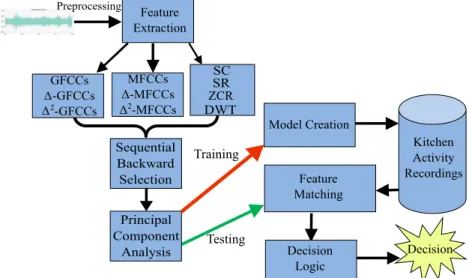
3.2.3 Feature Extraction . . . 46
3.2.3.1 Mel-Frequency Cepstral Coefficients . . . 46
3.2.3.2 Discrete Wavelet Transform . . . 47
3.2.3.3 Zero-Crossing Rate . . . 47
3.2.3.4 Spectral Roll-off . . . 47
3.2.3.5 Spectral Centroid . . . 48
3.2.3.6 Gammatone Frequency Cepstral Coefficients . . . . 49
3.2.4 Feature Selection . . . 50
3.2.4.1 Feature Aggregation . . . 50
3.2.4.2 Sequential Backward Selection . . . 50
3.2.4.3 Principal Component Analysis . . . 51
3.2.5 Activity Classification . . . 51
3.3 Results . . . 52
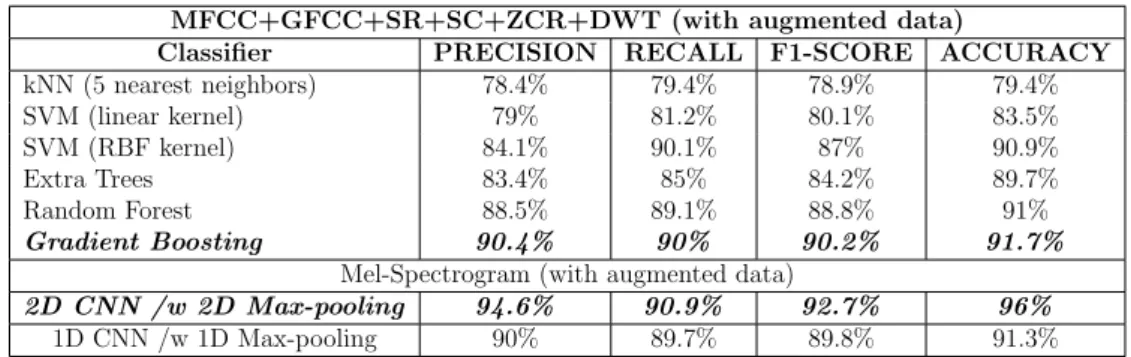
3.3.1 Comparison of the recognition accuracy of traditional clas-sifiers against CNNs for AED . . . 53
3.3.2 Fusion of features for the first AED approach . . . 56
3.3.3 Recognition accuracy as a function of the audio sample du-ration . . . 57
3.3.4 Dependence of recognition accuracy on certain distance and SNR in a new environment . . . 58
3.3.5 Tests with activity that was not included in the training set (coffee machine) using the second AED system . . . 60
3.4 Conclusions . . . 60
4 Convolutional Recurrent Neural Networks for Speech Activity Detection 62 4.1 Introduction . . . 62
4.2 Proposed Approach for Speech Activity Detection . . . 64
4.2.1 Feature Extraction . . . 64
4.2.2 Convolutional Recurrent Neural Networks Description . . . . 64
4.3 Evaluation and Analysis . . . 66
4.3.1 Network Architectures . . . 66
4.3.2 Network Training . . . 67
4.5 Conclusions . . . 71
5 Energy-based Event Detection 72 5.1 Introduction . . . 72
5.2 Data Collection and Analysis . . . 73
5.2.1 Data Collection Infrastructure . . . 73
5.2.2 Data Pre-Processing . . . 75
5.2.3 Appliance State Proportion Feature . . . 77
5.3 Decision Engine for Human Activity Recognition . . . 78
5.4 Results . . . 80
5.5 Conclusions . . . 81
6 Investigation of 2D Convolutional Neural Networks 82 6.1 Introduction . . . 82
6.2 Comparison of Human Crafted Engineering Features and Learnt Features of a CNN . . . 83
6.2.1 Automatic Feature Extraction . . . 84
6.2.2 Approach and Experiment . . . 84
6.2.3 Evaluation . . . 87 6.2.3.1 Extracted Features . . . 88 6.2.3.2 Experimental Environment . . . 88 6.2.4 Results . . . 88 6.2.4.1 IMU CNN Features . . . 88 6.2.4.2 Audio CNN Features . . . 91 6.2.5 Discussion . . . 93 6.2.5.1 IMU CNN Features . . . 93 6.2.5.2 Audio CNN Features . . . 96 6.2.6 Conclusions . . . 97
6.3 2D Convolutional Neural Networks for dialogue modelling . . . 98
6.3.1 Related Work . . . 100 6.3.2 Proposed Method . . . 101 6.3.2.1 Models . . . 102 6.3.2.2 Data Augmentation . . . 103 6.3.3 Results . . . 104 6.3.3.1 Text classification . . . 104 6.3.3.2 Dialogue modeling . . . 106 6.3.4 Conclusions . . . 107 7 Conclusions 109 7.1 Summary of Contributions . . . 109
7.2 Limitations of this Work . . . 110
7.3 Open Issues and Future Work . . . 112
7.4 Concluding Remarks . . . 113
2.1 CASA System Overview . . . 30 2.2 Intersection of Audio Event Recognition with the wider scientific field 31 3.1 First proposed AED approach. . . 42 3.2 Experimental Setup . . . 43 3.3 MFCC Feature Extraction [127] . . . 46 3.4 SR comparison between the sound of the kitchen sink (top) and the
sound of a violin (bottom). The x-axis shows the time in s . . . 48 3.5 SC comparison between the sound of the kitchen sink (top) and the
sound of a violin (bottom). The x-axis shows the time in s . . . 49 3.6 Second proposed AED approach . . . 51 3.7 ROC curves for the selected classifiers. Classes 0, 1, 2, 3, 4, 5 and 6
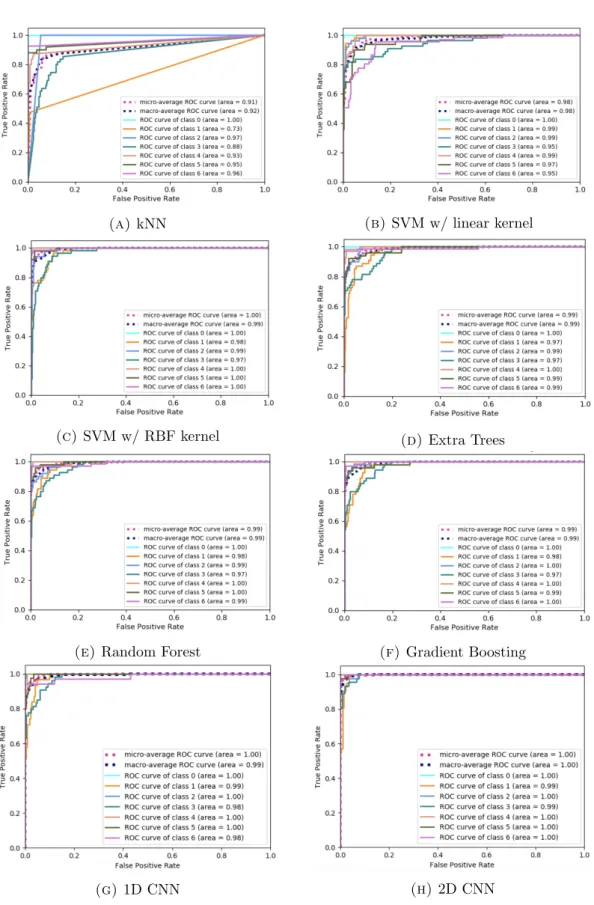
correspond to boiling, cutting bread, dishwasher, doing the dishes, frying, operating the kitchen faucet and mixer, respectively . . . 55 3.8 Recognition accuracy for different audio features using Gradient
Boosting. The results are after the aforementioned feature selection. 56 3.9 Recognition accuracy (using the Gradient Boosting classifier and
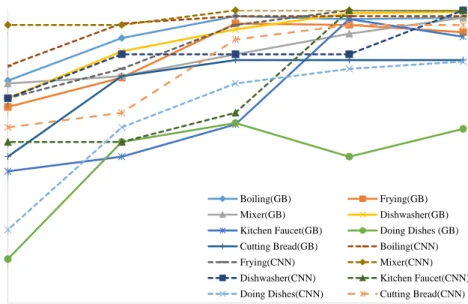
the CNN) as a function of the sample duration . . . 58 4.1 2D CRNN architecture with STFT spectrogram magnitude
repre-sentation as input. The arrows around the Conv2D blocks indicate the same max-pooling operation applied after each convolutional layer 65 4.2 1D CRNN architecture with raw waveform as input. The arrows
around the Conv1D blocks indicate the same max-pooling operation applied after each convolutional layer . . . 67 4.3 Examples of speech and non-speech activity detection of 1D and 2D
(STFT) CRNN architectures with the ground truth of the develop-ment dataset . . . 69 4.4 SAD results for the 5-folds and the ensembled majority on an
ex-ample of the evaluation dataset (no ground truth given) using 2D (STFT) CRNN . . . 70 4.5 SAD results using the moving average filter of the convolutions
(temporal smoothing) after averaging the 5 folds . . . 70 5.1 Data collection environments . . . 74 5.2 Data collection infrastructure . . . 75
5.3 Power consumption plots of the selected appliances. Top-left is the cooker hood, top-right is the oven, bottom-left is the fridge and bottom-right the dishwasher. . . 76 5.4 Fridge power consumption from House B . . . 77 5.5 Overview of energy sensor-based decision engine human activity
detection . . . 79 6.1 A typical CNN architecture taking IMU raw data as input will
include multiple convolutional layers, with each layer followed by a max-pooling operation. The output of last convolutional layer is then flattened. The vector obtained corresponds to a feature vector automatically extracted. Finally, softmax is generally applied to connect to the output layer in multi-class problems. . . 86 6.2 Cross-validation of a CNN automatic feature extractor: (top) two
CNN feature extractors are trained using datasets collected in con-trolled conditions (UCI-HAR and the DCASE 2017 development datasets), (middle) the CNN model is used as feature extractor, and training data from the final real-world dataset is used to train IMU-HAR and AUDIO-HAR models, (bottom) finally results are evaluated over the final test data. . . 87 6.3 Architecture used to compare HCF and CNN features: taking
fea-tures in input, one dense layer (64 nodes) and 6 classes (for the inertial sensors) and 3 classes (for the audio sensors) on the output layer. . . 89 6.4 Visual comparison of 1D CNN architectures using n = 1,2 and 4
layers with a kernelk= 2 (on the left), and kernel sizek = 2,16,32 using n= 3 layers (on the right). . . 90 6.5 Visual comparison of (a) HCF, and (b) CNN using 3 layers. . . 91 6.6 Normalized confusion matrices obtained using (a) HCF and (b)
us-ing CNN. . . 92 6.7 Visual comparison (first with second PCA and first with third PCA)
of 2D CNN architectures using n = 1 (top left), n = 2 (mid left) and n = 4 (bottom left) layers with a kernelk = 2, and kernel size
k = 8 (top right), k = 16 (mid right), k = 32 (bottom right) with
n= 2 layers for the audio dataset. . . 94 6.8 Visual comparison of HCF (top) and CNN using 2 layers (bottom)
for the audio sensor. . . 95 6.9 Un-normalized confusion matrices obtained using (a) HCF and (b)
using CNN for the audio dataset. . . 96 6.10 Top: Sogou News dataset with Chinese characters. Bottom: Sogou
News dataset with pinyin (romanization of the Chinese characters based on their pronunciation) . . . 102 6.11 Proposed model: 3 convolutional layers consisting of 32 filters with
a kernel of size 5×5 each, are followed by 4 convolutional layers consisting of 64 filters with a kernel of size 5×5 each. A linear fully connected layer and a classification output layer complete the model.103
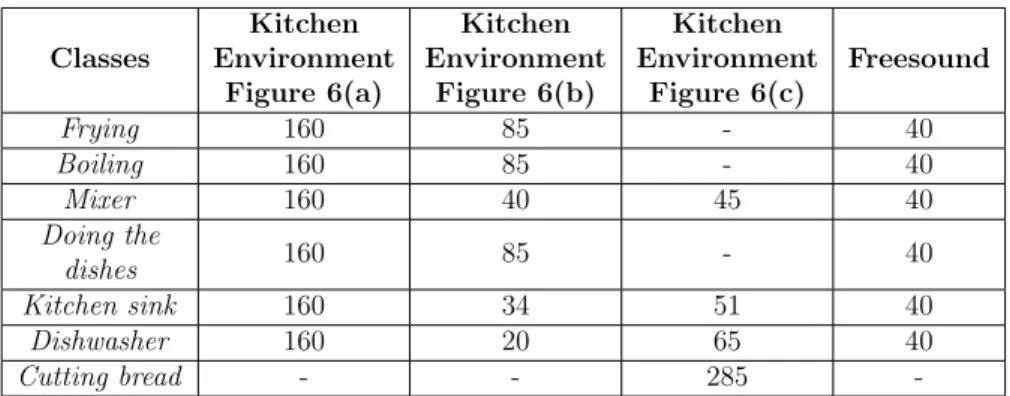
3.1 Number of recordings of each class from different sources . . . 44
3.2 Classifier Performance Comparison . . . 53
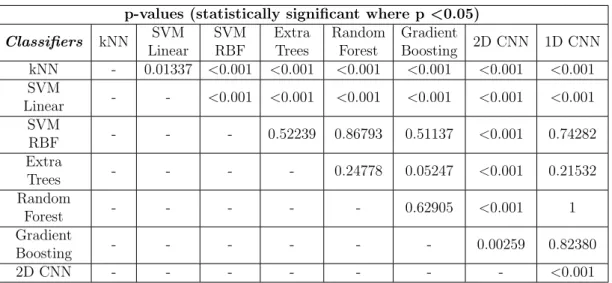
3.3 McNemar’s test results . . . 54
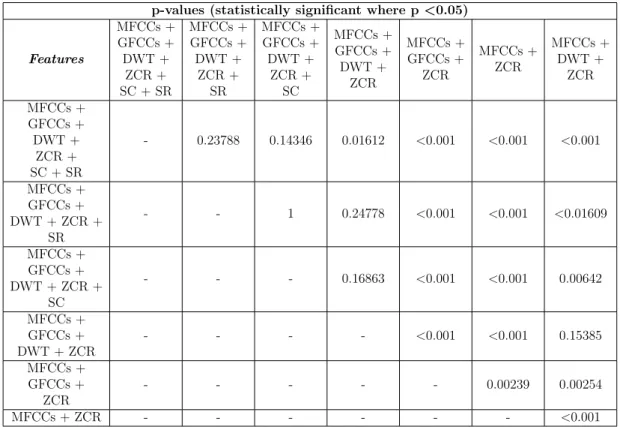
3.4 McNemar’s test on the features . . . 57
3.5 Confusion matrix using Gradient Boosting for the classes of the framework in a new environment (not included in the training dataset). The distance between the microphone and each activity was 3 m . . 58
3.6 Confusion matrix using CNN for the classes of the framework in a new environment (not included in the training dataset). The distance between the microphone and each activity was 3 m . . . . 59
3.7 Recognition accuracy of Gradient Boosting and CNN according to distances and SNRs . . . 59
4.1 Performance of different architectures using DCF as a metric on the development dataset. No temporal collars are used . . . 68
5.1 Accuracy of proposed decision engine . . . 79
6.1 Precision, Recall and F-Score obtained on UCI-HAR Dataset using HCF and CNN features obtained with different parameters using accelerometer only. . . 92
6.2 Precision, Recall and F-Score obtained on UCI-HAR Dataset using HCF and CNN features obtained with different parameters using accelerometer and gyroscope. . . 92
6.3 Precision, Recall and F-Score (averaged over 4-folds) obtained on the DCASE 2017 development using different parameters. . . 95
6.4 Results of Latin and Chinese text classification in terms of held-out accuracy. Worst-Best Performance reports the results of the worst and best performing baselines from Table 4 of Zhang et al. [208] and Conneau et al. [209]. Results reported for TI-CNN were obtained in 10 epochs . . . 104
6.5 Generated text for testing. The following text samples were not seen during the training . . . 105
6.6 Facebook bAbI Dialogue Task 4 . . . 107
AAL Ambient Assisted Living. 17, 18, 36, 72
ADL Activities of Daily Living. 37
AED Acoustic Event Detection. 40, 42, 45, 46, 50–54, 56, 58, 60
ANN Artificial Neural Network. 28, 79
ARC Activity Recognition Chain. 37
ASR Acoustic Scene Recognition. 18, 19, 30, 31, 62
BPN Back-Propagation Network. 79, 80
CASA Computational Auditory Scene Analysis. 29, 30
CNN Convolutional Neural Network. 2, 3, 22, 23, 25, 26, 29, 32, 35–39, 41, 42, 51, 52, 54, 56, 58–60, 63, 65, 66, 82–86, 88, 89, 91, 93, 96–104, 106–114
CRF Conditional Random Field. 33
CRNN Convolutional Recurrent Neural Network. 23, 26, 63–68, 70, 71, 110, 113
DBN Deep Belief Network. 28
DCF Decision Cost Function. 63, 65, 67, 70
DCT Discrete Cosine Transform. 50
DFT Discrete Fourier Transform. 38, 49
DL Deep Learning. 36–39, 63, 84
DNN Deep Neural Networks. 3, 17, 18, 29, 32
DSP Digital Signal Processing. 44 13
DT Decision Trees. 79, 80
DWT Discrete Wavelet Transform. 42, 47, 50, 56, 57, 60
ELU Exponential Linear Unit. 51, 52
ERB Equivalent Rectangular Bandwidth. 31, 56
FFT Fast Fourier Transform. 54, 64, 66, 85, 91, 93
GB Gradient Boosting. 79, 80
GFCC Gammatone Frequency Cepstral Coefficient. 31, 42, 50, 56, 60
GMM Gaussian Mixture Model. 63
GPS Global Positioning System. 38, 87
GPU Graphic Processing Unit. 32, 104
GRU Gated Recurrent Unit. 64–66, 98, 101
HAR Human Activity Recognition. 25, 28, 36–38, 40
HCF Human Crafted Features. 23, 36–38, 83–86, 88, 89, 91, 96, 97, 110
HMM Hidden Markov Model. 28, 29, 32–34
ICT Information and Communications Technology. 28
IMU Inertial Measuring Unit. 25, 83, 85, 87–89, 113
IoT Internet of Things. 21, 35
kNN k-Nearest Neighbors. 28, 51
LR Logistic Regression. 79, 80
LSTM Long Short-Term Memory. 36, 66, 67, 98
MCC Matthews Correlation Coefficient. 79, 80
MEMS Micro Electrical-Mechanical System. 17, 44, 60
MFCC Mel-frequency Cepstral Coefficient. 10, 28, 30, 32, 39, 42, 46, 47, 50, 56, 57, 66, 83–85, 97
ML Machine Learning. 36
MP Matching Pursuit. 30, 31
NB Naive Bayes. 79
NILM Non-Intrusive Load Monitoring. 34, 35, 72
NLP Natural Language Processing. 23, 26, 82, 98, 100, 101, 105–108, 114
NUC Next Utterance Classification. 101, 107
nZEB nearly Zero Energy Building. 43
OCR Optical Character Recognition. 23, 98
OOV Out-Of-Vocabulary. 107
PCA Principal Component Analysis. 51, 90, 93
RBF Radial Basis Function. 51, 53, 79, 80
RBS Rule-Based Scenarios. 78
ReLU Rectified Linear Unit. 52, 66, 93
RF Random Forest. 79, 80
RNN Recurrent Neural Networks. 63–66, 82, 98, 99, 114
ROC Receiver Operating Characteristic. 54
SAD Speech Activity Detection. 62, 63, 65, 68, 70, 71, 111, 113
SBS Sequential Backward Selection. 50, 51
SC Spectral Centroid. 10, 42, 48–50
SNR Signal-to-noise Ratio. 2, 19, 23, 29, 40, 41, 44, 52, 59, 62
SR Spectral Roll-Off. 10, 42, 47, 48, 50
STFT Short-time Fourier Transform. 23, 64, 66, 68, 70, 71, 110
SVM Support Vector Machine. 27, 29, 34, 51, 53, 79, 80
VAD Voice Activity Detection. 66, 68, 71
Introduction
1.1
Project Background
Assisted living in smart homes can change the way millions of elderly people live, manage their conditions and maintain well-being [1]. This could support the age-ing population to live longer independently and to enjoy comfort and quality of life in its private environments. While current monitoring and assistive technologies are selectively deployed due to high cost, limited functionality and interoperabil-ity issues, future smart homes could leverage cheap ubiquitous sensors, intercon-nected smart objects, packaged with robust context interference and interaction techniques [2]. The next generation of smart home technologies will be adaptive to fit versatile living environments, and interoperable for heterogeneous applica-tions. In addition, a service-oriented cloud-based system architecture will support reconfiguration and modular design that is essential to empower care providers to customize solutions.
With the increasing ageing population and the growing demand on novel health care models, research on smart homes for independent living, self-management and well-being has intensified over the last decade due to the wide availability of afford-able sensing and effective processing technologies. Yet, it remains a challenge to develop and deploy smart home solutions that can handle everyday life situations and support a wide range of users and care applications. Smart home technologies must be interoperable for seamless technology integration and rapid application development, and adaptable for easy deployment and management, achieved by thorough testing and validation in multiple application scenarios. This requires a joint multidisciplinary cross-sector effort of research and development.
A monitoring system within a smart home checks the daily activities and decides whether the behavior of the residents is regular or irregular. The success of such a system depends on understanding the normal lifestyle and the degree to which the behavior of the elderly has deviated from what is defined as normal.
This project developed an in-depth understanding of automatic activity detection and context inference within smart home environments of healthy people, but also patients with mild cognitive impairments, dementia and Parkinson’s disease. Specifically, the project investigated the use of wireless acoustic and energy me-ter sensor network for daily activity monitoring and detection. It developed: i) a holistic framework that integrates low-cost sensors (power consumption smart meters and MEMS microphones) for activity detection and behavior modeling of elderly people suffering with dementia or Parkinson, ii) algorithms for audio-based event classification using statistical feature analysis, data augmentation, feature extraction techniques and deep learning, iii) an automatic activity detection frame-work to recognize events and create user profile, with daily activities, based on acoustic and active power consumption sensors, iv) associated technologies and an integration of the developed algorithms on a low-power single board computer for evaluation by real users from care homes and living lab environments.
1.2
Research Problems and Questions
This research seeks to investigate four main aspects of building an AAL system. These aspects include building a holistic framework using open source and off-the-shelf products (e.g., MEMS microphones, Raspberry Pi), speech/non-speech activity detection, energy-based event detection and adaptation of algorithms in a different domain (e.g., CRNNs used for object detection can also be used for speech activity detection).
A few research questions regarding the problem of audio-based event detection are related to the distance of the sensor from the target appliance related to an activity, the selection of features and classifiers for an indoor environment and the parameters of DNN and their impact on recognition accuracy. Regarding speech/non-speech activity detection, the fundamental problem is the design of a general system that would perform equally well in a very noisy and a quiet en-vironment. For the problem of energy-based event detection, a computationally inexpensive system is needed, that would make use of the active power consump-tion and discard other features such as statistical time-series features (skewness,
kurtosis). Finally, there is the research problem of adapting a DNN architecture and training it from scratch for a different task (e.g., natural language processing) and pre-training on a dataset of a particular domain and testing on a different dataset, but in the same domain. In this way, one can examine how well a DNN system generalizes and which parameters would require fine tuning.
Knowing the activity of occupants in a building at any given time is fundamental for the effective management of various building operation functions ranging from energy savings to security targets, especially in complex buildings with different internal kind of use (e.g., an office building, a hotel). As the activities of occupants within the building vary throughout the day, it is difficult to characterize the different activities in different time periods. In general, activity monitoring in buildings is of high interest, since it significantly contributes to the improvement of a building’s energy efficiency [3] and increases the quality of life of people in AAL environments [4]. Therefore, there is a need for detailed activity knowledge.
Human activity can be estimated using various sources, such as movement sensors [5], occupancy sensors [6], cameras [7], audio [8], as well as appliance current consumption [9].
Let us imagine that one is listening to an audio recording, in which one can hear boiling sounds, frying sounds, sounds of cutlery or chewing. If one wanted to identify the source of the recording, one would most likely answer that the recording is taking place in a kitchen (e.g., cooking, doing the dishes). In the above scenario, the person would take the task of auditory scene recognition. One of the goals of this research is to develop advanced methods that would enable a computer to do the same task, or as the scientific term refers to this problem as, ASR [10].
Practical applications of ASR include intelligent wearable devices [11], automatic speech recognition [12] and hearing aids that sense the environment of the user in real time [13]. The information about the environment enables the device to provide accurate and better service to the user. As mentioned above, ASR is used in content-based audio indexing and retrieval at the level of different environments.
The goal of acoustic event detection is to label temporal regions, such that each one represents a single event of a specific class. Early work in event detection treated the sound signal as monophonic, with only one event detectable at a time [14]. Events in a typical sound scene may be simultaneous; hence polyphonic event detection with overlapping event regions is desirable. There has been some work
on extending monophonic systems to polyphonic detection [15, 16]. Audio tagging is probably more demanding (complexity, computational cost) than monophonic event detection, but at the same time heavily intertwined to real-world scenarios where multiple audio events are co-occurring.
ASR can be jointly used with processing of other signals to obtain a more thorough understanding of user activities; for instance, processing of the fridge electrical power signal can also provide further information on a detected cooking activity, related to the times that the user opens the fridge and the time it is left open.
The main research question is how to improve the quality of living of elderly people with mild cognitive impairments using an unobtrusive sensor network, in order to understand their daily activities by creating a profile for each user (e.g., how many times there was a visit to the bathroom, time spent for cooking) and contact their relatives regarding abnormalities in their daily lives.
To answer this question there are several aspects that need to be covered. This research is going to cover the capabilities of individual sensor modalities and fo-cus, specifically, on audio and energy consumption sensors. Robust audio event detection remains an unsolved problem. Environmental sound signals can vary according to the different environment (indoor, outdoor). Annotating audio data and assigning class labels (especially when sound events are overlapping) is a te-dious task and since the human factor is involved, we can have mislabeling of the dataset. Secondly, background noise is a factor that affects the performance of an audio event detection system. Traditional approaches, such as filtering the input signal, can fail when the SNR is very small, meaning that we will “cancel” our entire input signal and miss any event for that time. Furthermore, another important question is, when applying deep learning models and our input data is not sufficient for training how we can explore additional data augmentation techniques for environmental signals. Regarding the energy consumption sensors, most researchers focus on data disaggregation (identifying appliances operating in a house from the total-main power consumption) techniques. Most public datasets (REDD [17], BERDS [18], Belkin Energy Dataset [19]) are released for research in novel methods for data disaggregation. Activity inference in a smart home environment from energy consumption has received less attention compared to the data disaggregation [20]. Finally, a thorough comparison of sensor modalities (energy, audio) in different house environments has to be conducted in order to understand which of these can output the highest accuracy for activity recogni-tion. In theory the more types of sensors inside a house, the higher the accuracy
of specific activities. However, an important question lies with the recognition accuracy that can we achieve with one acoustic sensor placed at various distances from the target activities.
1.3
Project Objectives
Researchers are working on telemedicine and telemonitoring solutions to allow elderly people to stay at home as long as they can. Meanwhile, elderly care units have limited capacities (space and resource limitations). Mobility, which is currently a common request of companies, adds distance between family members. Elderly people often live alone and have to be autonomous. Moreover, with the increase of life expectancy, cognitive impairments such as dementia and diseases such as Alzheimer’s are more and more prevalent. All this leads to implementing telemonitoring systems, able to detect a distress situation, or a significant change in the habits or behavior of the person.
Systems for enhancing medical diagnosis and information technology often focus on the clinical environment and depend on the extensive infrastructure present in traditional health care settings. Most high-fidelity sensor networks are expensive and require specialized training to operate [21].
Detecting normal and abnormal activities in a domestic environment necessitates an “always-on” and unobtrusive monitoring system. Gietzelt et al. [22] evalu-ated gait parameters measured by a single waist mounted accelerometer during everyday life of patients with dementia. Marschollek et al. [23] developed an unobtrusive method to determine individual fall risk based on the use of motion sensor data. Palmerini et al. [24] measured the acceleration of the low back to differentiate gait patterns in healthy adults and those with Parkinson’s disease. An important scope of this research is to infer events offline, where no data will be sent to a cloud server but instead run locally on a Raspberry Pi, based on the input data. Most existing systems entail delays in detecting and reporting urgent situations. As such, offline activity recognition models are necessary for real-time analysis of sensor data. Therefore, it is important for a home care system to sum-marize the health status and daily behavior of the elderly, in order to guide the elderly towards healthy and active living. For instance, an activity recognition system would detect the activity of cooking for a week and notify the user’s rel-atives with a phone call if no cooking activity was detected within the following week.
The innovative sensing infrastructure of this research aims towards the accurate, unobtrusive and privacy preserving monitoring of behavioral parameters and risk indicators in the daily living environment of older individuals and their use for the assessment of the mental condition of older individuals. An IoT environment comprising active power consumption and acoustic sensors will be the basis for retrieving large-scale data without posing any threats to the privacy of users. This data will then be processed and annotated to knowledge concerning the mental health and safety of their users, protecting at the same time their privacy and health record, using modern hardware and software data encryption approaches of the project’s security and privacy framework. Specifically the recorded datasets (kitchen audio and power consumption) will be pseudo-labeled, the training would be done on a desktop computer and the inference on a Raspberry Pi would not save audio clips. Instead an audio stream will be stored in a buffer and logs of the recognized activities will be stored in a text file.
The main novelty of this research lies in utilizing the scope of different sensor modalities, using acoustic sensors and plug-wise energy meters. Specifically:
• The performance of each modality will be examined along with statistical significance tests. Starting from single-user single-activity use scenarios to real-world complex use scenarios, e.g., multiple users, interleaved and con-current activity recognition
• Data mining and event detection recognition algorithms will be improved
• Feature extraction techniques and importance of CNN hyper-parameters in recognition accuracy will be explored
• A smart audio sensing infrastructure (integrated to a single board computer) using acoustic sensors will be created
• Deep learning algorithms for separating the speech from any other non-speech signals will be investigated
1.4
Proposed Approaches
This thesis presents the use of various machine learning and deep learning algo-rithms for the problem of human activity detection in domestic environments to
address the aforementioned aims and objectives. In order to achieve this an ex-tensive review of the literature is carried out. Beginning the literature review on audio-based event detection from the theory of the computational auditory scene analysis to the machine and deep learning methods applied for the problem. The key relevant research in both audio-based event detection and speech/non-speech activity detection is surveyed. An understanding of the state-of-the-art approaches is provided and the research gaps are highlighted. Furthermore, the same process is followed for the energy-based event detection part.
Based on this understanding, two main frameworks are proposed to satisfy our objectives, about the audio-based event detection, set out to achieve. Using these frameworks, several tests are implemented to evaluate their performance in the task of audio-based event classification and speech activity detection. Various deep learning architectures are experimented to optimize our final system for high classification performance. For evaluation purposes tests with different parameters that are affected by randomness are conducted. Additionally, the filter size and the kernel size of the 2D CNNs and test their impact on classification accuracy are examined. Finally, the adaptation of the 2D CNN system in a natural language processing problem is examined and compared with traditional 1D CNN systems.
Regarding the energy-based event detection, a metric for the status of electrical appliances and the relation with the human activity is defined, Monte Carlo sim-ulations and grid search are performed, in order to find the optimal parameter settings of traditional classifiers.
1.5
Contributions and Paper Publications
This thesis studies the task of using machine learning algorithms for human ac-tivity detection in domestic environments, with a particular focus on acoustic and energy consumption sensors. The contributions of this thesis are summarized as follows:
• Two frameworks for audio-based event detection are developed and statis-tical significance between traditional classifiers and a CNN architectures is examined.
• The statistical significance of well-known audio features for the problem of audio-based event detection in a kitchen environment, in the presence of background noise is examined.
• The effect of the duration of the signal segment used for classification on recognition accuracy is demonstrated.
• The SNR, the distance between the microphone and the effect of the audio source on the recognition accuracy in a new environment (i.e., one which was not used to train the classifier) is investigated.
• An end-to-end 1D CRNN and a 2D CRNN, using the 2D magnitude STFT representation as input, for speech/non-speech activity detection is proposed.
• A framework for unobtrusive human activity context inference, based on energy consumption rate from selected appliances and using a decision engine based on operation of the appliances is presented.
• The performance of CNN extracted features is studied. The experiments fo-cus on comparison of automatically extracted and HCF for activity recogni-tion. In particular, the audio signal, accelerometer and gyroscope data have been investigated. Moreover, the effect of important parameters, namely number of convolutional layers, and kernel size used for the convolutions, is evaluated.
• A framework for an NLP task based on visual features of text is presented. Similarly to understanding patterns in the magnitude representation of the audio spectrogram, two-dimensional CNNs, that use an image of a text as in-put, can build semantic representations which let them detect abnormalities in a text (i.e., garbage characters) without the need of OCR. This framework could help in the creation of a virtual assistant that would receive an image related to the timestamp and the activity detected by the audio sensor and perform a conversation between the user and the assistant.
During this PhD study, the following publications were made:
1. Federico Cruciani, Anastasios Vafeiadis, Chris Nugent, Ian Cleland, Paul Mc-Cullagh, Konstantinos Votis, Dimitrios Giakoumis, Dimitrios Tzovaras, Liming Chen and Raouf Hamzaoui. “Feature learning for Human Activity Recognition using Convolutional Neural Networks”, CCF Transactions on Pervasive Computing and Interaction, 2020,
https://doi.org/10.1007/s42486-020-00026-2.
Contribution with respect to co-authors: Developed and implemented the system using the audio modality for the DCASE 2017 Task 1 develop-ment dataset and the ExtraSensory dataset.
2. Anastasios Vafeiadis, Konstantinos Votis, Dimitrios Giakoumis, Dimitrios
Tzovaras, Liming Chen and Raouf Hamzaoui. “Audio Content Analysis for Unobtrusive Event Detection in Smart Homes”, Engineering Applications of Artificial Intelligence, Elsevier, Vol. 89 (103226), 2020,
https://doi.org/10.1016/j.engappai.2019.08.020.
Contribution with respect to co-authors: Data collection, designed and implemented the proposed frameworks.
3. Anastasios Vafeiadis, Eleftherios Fanioudakis, Ilyas Potamitis,
Konstanti-nos Votis, Dimitrios Giakoumis, Dimitrios Tzovaras, Liming Chen and Raouf Hamzaoui. “Two-Dimensional Convolutional Recurrent Neural Networks for Speech Activity Detection”, in Proc. 20th Annual Conference of the Inter-national Speech Communication Association (INTERSPEECH 2019), Graz, Sep.2019. Contribution with respect to co-authors: The end-to-end convolutional recurrent neural network and the spectrogram 2D CNN for speech activity detection.
4. Federico Cruciani, Anastasios Vafeiadis, Chris Nugent, Ian Cleland, Paul Mc-Cullagh, Konstantinos Votis, Dimitrios Giakoumis, Dimitrios Tzovaras, Liming Chen and Raouf Hamzaoui. “Comparing CNN and human crafted features for human activity recognition”, in Proc. 16th IEEE International Conference on Ubiquitous Intelligence and Computing (UIC), Leicester, Aug. 2019. (best student paper award) Contribution with respect to co-authors: Developed and implemented the comparison systems for the audio modality using the DCASE 2017 Task 1 development dataset.
5. Erin¸c Merdivan, Anastasios Vafeiadis, Dimitrios Kalatzis, Sten Hanke, Johannes Kropf, Konstantinos Votis, Dimitrios Giakoumis, Dimitrios Tzo-varas, Liming Chen, Raouf Hamzaoui and Matthieu Geist. “Image-based text classification using 2D convolutional neural networks”, in Proc. IEEE Smart World Congress 2019, Leicester, Aug. 2019. Contribution with respect to co-authors: Domain adaptation of the 2D CNN, using 2D magnitude spectrogram representation for audio-based event detection, to a natural language processing task.
6. Anastasios Vafeiadis, Thanasis Vafeiadis, Stelios Zikos, Stelios Krinidis, Konstantinos Votis, Dimitrios Giakoumis, Dimosthenis Ioannidis, Dimitrios Tzovaras, Liming Chen and Raouf Hamzaoui. “Energy-based decision engine for household human activity recognition”, in Proc. Pervasive Computing and Communications Workshops (PerCom Workshops), 2018 IEEE Interna-tional Conference on Pervasive Computing Athens, Mar. 2018. Contri-bution with respect to co-authors: Development of the communication infrastructure for data collection, decision framework implementation.
7. Anastasios Vafeiadis, Dimitrios Kalatzis, Konstantinos Votis, Dimitrios
Giakoumis, Dimitrios Tzovaras, Liming Chen and Raouf Hamzaoui. “Acous-tic Scene Classification: From a Hybrid Classifier to Deep Learning”, in Proc. Detection and Classification of Acoustic Scenes and Events 2017 Workshop (DCASE 2017), Munich, Nov. 2017. Contribution with respect to co-authors: Design and implementation of the hybrid SVM-HMM and 2D CNN systems.
8. Anastasios Vafeiadis, Konstantinos Votis, Dimitrios Giakoumis, Dimitrios
Tzovaras, Liming Chen and Raouf Hamzaoui. “Audio-based event recogni-tion system for smart homes”, in Proc. 14th IEEE Internarecogni-tional Conference on Ubiquitous Intelligence and Computing (UIC), San Francisco, Aug. 2017.
Contribution with respect to co-authors: Data collection and design of the system based on traditional classifiers.
1.6
Outline of the Thesis
The thesis is organized as follows. Chapter 2 presents the background of HAR, with an emphasis on sound and energy-based activity recognition and the privacy issues related to each modality. Additionally, it presents related work on human crafted engineering features, focusing on IMUs and acoustic sensors, and the features learnt by a CNN. The aim of this Chapter is to identify the research gaps in the literature.
Chapter 3 describes the approach in the area of acoustic event classification in smart homes and presents two approaches for audio-based event detection in an indoor environment. Moreover, several advanced classification techniques are com-pared in that Chapter. Statistical importance of audio features and classifiers are also investigated, applying McNemar’s test. The proposed frameworks are tested
for their generalization ability in an environment that is not seen during training and their ability to recognize a class not included in the training, but with similar sound characteristics as the trained ones.
Chapter 4 details the problem of the speech activity detection and propose two frameworks. An end-to-end one dimensional CRNN and a two dimensional CRNN. The Chapter highlights the importance of the post-processing convolution opera-tions for the problem of speech activity detection and their effect in a real-world dataset.
Chapter 5 describes the work done in the energy-based activity detection problem, using a decision engine based on active power consumption. There is a focus on the data collection infrastructure and the classification accuracy of traditional classifiers is compared, using the active power consumption as the only feature vector.
Chapter 6 presents the study of human crafted features and the automatic CNN features in real-world datasets. The effect of the number of layers and the kernel sizes of simple CNN architectures is compared. The second part of the Chapter presents the adaptation of a 2D CNN, which was used for audio-based event de-tection, in a NLP problem. It shows that for a dialogue task the 2D CNN, which receives an image of a text as input, can significantly outperform the memory networks without a match type.
Finally, Chapter 7 concludes the thesis, summarizing the contributions, the limi-tations of this work and presenting the open issues for future work.
Background
2.1
Introduction to Human Activity
Recognition
Activity recognition methods in smart homes rely mostly on sensors, which are further separated into wearable [25] and environment-related ones [26]. Recent work [27] shows that ontologies and semantic technologies have been used for ac-tivity modeling and representation. Wearable-based techniques depend on user interaction with the sensor and in most cases on user motion by employing ac-celerometers.
He et al. [28] provide the time series from such sensors as input to autoregressive models to extract features and classify four activities (running, still, jumping and walking) utilizing an SVM classifier. Subsequent works [29, 30] use more advanced models to extract features, namely autoregressive combined with signal magnitude area and tilt angles, while employing modules to further enhance the data sepa-rability, for activities such as resting (lying/sitting/standing), walking, walking-upstairs, walking-downstairs, running, cycling, and vacuuming. Pl¨otz et al. [31] perform feature extraction on the time-series using layered Restricted Boltzmann Machines, on four public datasets. Considering methodologies focusing on sensors attached to the environment, there is a significant diversity of types, ranging from light sensors, humidity ones, thermometers and others. Since the extracted in-formation from such sensors can be insufficient, they are usually accompanied by accelerometers [32], which are attached to objects of interest. However, this cate-gory of methods fails when activities do not involve the registered objects. Several
works [33, 34] place sensors on objects and track their movement, thus activities are inferred through the traces of the objects which are modeled using a HMM or a DBN, respectively. Bourobou et al. [35] propose a two-step procedure that relies on smart environments to recognize five activities (taking a bath, preparing breakfast, listening to music, playing a game and preparing lunch). The first step comprises the discretization of activity patterns while the second step trains an ANN based on the temporal relations of those patterns.
Smart home-based ambient assisted living ICT solutions can allow the elderly to remain in their own homes and live independently for longer [1]. Research on ICT solutions for ambient assisted living has intensified over the last decades considerably, due to the emergence of affordable powerful sensors and progress in artificial intelligence [25, 36, 37].
Various HAR systems that monitor daily activities to identify abnormal behavior have been proposed for ambient assisted living applications [32, 38].
One common approach to automated HAR uses portable sensors such as ac-celerometers and gyroscopes [39, 40]. However, these sensors require cooperation of the subject, may restrict body movement, and are energy constrained [41, 42]. Another approach relies on computer vision [43, 44]. However, privacy concerns are hindering its adoption. A further approach is based on audio processing. Features are extracted from the environmental sounds and classifiers are used to recognize the corresponding human activity [45, 46, 47].
2.2
Audio-based Event Detection and Activity
Recognition
Audio-based activity recognition has received a lot of attention from researchers in recent years [48, 49]. A number of studies have also taken the first steps to characterize the indoor sound environment and the classification of events [50, 51].
While many approaches addressed the problem of audio-based activity recognition in a home environment [52, 53, 54, 55], there is not enough justification for the classifier and feature selection. Most of them used well-known features from the field of speech recognition (e.g., MFCCs) along with classifiers, such as the kNN algorithm, to serve as a proof of concept for indoor audio-based activity classifica-tion. Chu et al. [56] showed that increasing the number of audio features does not
improve the recognition accuracy of a system classifying environmental sounds and used the matching pursuit algorithm to obtain effective time-frequency features.
DNNs are able to extract important information from the raw data without the need for hand-crafted feature extraction and outperform traditional classifiers in many tasks. There is significant research on recognizing single events in mono-phonic recordings [57] and multiple concurrent events in polymono-phonic recordings [58]. Different feature extraction techniques [59], hybrid classifiers [60, 61] and very deep neural models [62] have been explored. However, none of these works compared 1D and 2D CNN architectures for ambient sounds.
Another focus of this work is the duration of the signal used with an audio-based event detection system. The works [63, 64, 65] examined the length needed for suf-ficient recognition accuracy. They used systems based on time-frequency features and simple classifiers, such as SVMs and HMMs. The proposed approaches work well with datasets that contain indoor or outdoor environmental sounds. How-ever, due to the high variability in the class and the similarity between different classes, they can fail in a specific acoustic event detection task (e.g., in a kitchen environment).
Finally, there has been extensive research on the effect of the SNR in the pres-ence of background noise [66, 67, 68]. Wang et al. [69] performed experiments for various artificially added SNRs (0-10 dB and clean recordings) using different environmental sound datasets and a hierarchical-diving deep belief network. How-ever, all previous work assumed prior knowledge of the SNR, which is not possible in a real-world environment.
2.2.1
Computational Auditory Scene Analysis
CASA is the study of auditory scene analysis by computational means. In essence, it refers to how the human auditory system organizes the sounds of a complex environment. Bregman [70] was one of the pioneers in this field, studying the processes in the human brain, how humans perceive the auditory environment by grouping sounds into objects. Bregman suggests that there are many phenomena going on in the auditory perception that are similar to those in visual perception, such as exclusive allocation (properties belonging to one event only) and apparent motion (a motion is perceived, although the stimulus is not moving). Dan Ellis has contributed a lot to the research on CASA. In his Ph.D. thesis [71] he presents an
approach, in which the analysis is done by matching the predictions of an internal world model and observed acoustic features.
Feature
Extraction Segmentation GroupingRules Input Mixture
Signal
Signal 1 Signal 2
Figure 2.1: CASA System Overview
Figure 2.1 shows a typical architecture of a CASA system. All these systems start with an analysis of the signal in the time-frequency domain. In most cases, a gammatone filterbank [72] is applied to the input signal, in order to “mimic” the frequency selectivity of the human ear.
The next stage includes the feature extraction of the signal. Some of the most important features are the fundamental frequency, onset/offset of the signal, am-plitude/frequency modulation. The extracted features enable the system to form the segments. The segments provide a mid-level representation on which grouping operates. Finally, grouping rules are applied, in order to identify components that have the highest probability to come from the same source [73].
2.2.2
Acoustic Scene Recognition
ASR is closely related to CASA. ASR is a particular task that is related to CASA, however, the focus is the context recognition, or the environment recognition, rather than the analysis and interpretation of discrete sound events [74]. Applica-tions of ASR include intelligent wearable devices and hearing aids that sense the environment and adjust the mode of operation accordingly.
Research on unstructured audio recognition, such as environmental sounds, has received less attention than that for structured audio such as speech or music. Only a few studies have been reported, and most of them were conducted with raw environment audio. Because of randomness, high variance and other difficulties associated with environmental sounds, their recognition rates are smaller than those for structured audio are. This is especially true when the number of sound classes increases. To overcome the insufficiency of MFCCs and other commonly used features, Chu et al. [56] proposed a set of features based on the MP technique.
Although the MP-based features provide good performance, their computational complexity is too high for real-time applications.
The performance of ASR algorithms dramatically decreases when the number of sound classes increases (even with good features). It will need more good features for performance improvement. On the other hand, a larger number of features not only results in higher complexity but also demands more samples while there is no guarantee on performance improvement. That is because some features may help classify some classes but hamper the classification results for the others. Besides, it is not easy to train a classifier for better discriminant power in a higher dimension feature space. As a result, feature selection and reduction is an important task.
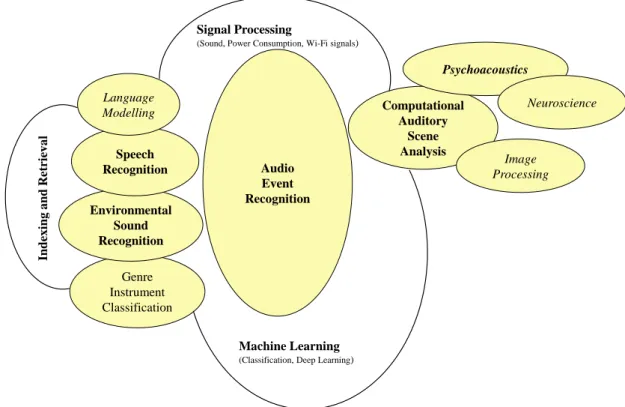
Genre Instrument Classification Environmental Sound Recognition Speech Recognition Language Modelling Index ing a nd R etri ev a l Audio Event Recognition Computational Auditory Scene Analysis Psychoacoustics Neuroscience Image Processing Signal Processing
(Sound, Power Consumption, Wi-Fi signals)
Machine Learning (Classification, Deep Learning)
Figure 2.2: Intersection of Audio Event Recognition with the wider scientific
field
Figure 2.2 shows how the field of audio-based event detection intersects with other scientific fields, such as psychoacoustics (e.g., ERB scale for the construction of the GFCC features) and how environmental sound classification is often based on methods from the voice activity detection and music genre classification. Ex-amples of domain intersection include data augmentation techniques (e.g., image rotation, salt and pepper noise) that are applied in the image domain but also in the audio/spectrogram respresentation, DNNs designed for computer vision prob-lems that are also applied to the audio-based event recognition problem, audio
features that are important for speech and music classification, can be extracted for environmental sound classification.
2.2.3
Deep Learning in Audio-based Event Detection
Deep learning is a machine learning field based on learning direct representations from the input data rather than task specific algorithms (e.g., time-dependent algo-rithms such as HMMs and time-independent algoalgo-rithms such as Random Forests). The first neural network can be tracked back in 1967 [75], when Rosenblatt intro-duced the idea of a perceptron unit capable of learning weights from input data to find patterns. The ability of deep learning networks to extract unique features from raw data and the high processing speeds of modern GPUs lead these net-works to receive a lot of attention in a wide range of scientific fields, such as natural language processing, image/video classification and segmentation, reinforcement learning and audio event detection.
Lee et al. [76] were one of the first ones to introduce unsupervised learning for audio data using convolutional deep belief networks. In particular they showed that the learned features from the neural networks corresponded to phones/phonemes in speech data. They also showed that these models could be applied to other datasets, such as music genre classification with promising results (comparing to traditional MFCC extraction with a classifier). Since then there were a number of research outcomes in the field of speech recognition [77, 78, 79, 80].
Piczak [81] tested a very simple CNN architecture with environmental audio data and achieved accuracies comparable to state-of-the-art classifiers. Cakir et al. [82] used one dimensional (time domain) DNNs in polyphonic sound event detection for 61 classes to achieve an accuracy of 63.8%, which was a 19% improvement over a hybrid HMM/Non-negative Matrix Factorization method. Lane et al. [83] created a mobile application capable of performing very accurate speaker diariza-tion and emodiariza-tion recognidiariza-tion using deep learning. Recently, Wilkinson et al. [84] performed unsupervised separation of environmental noise sources adding artificial Gaussian noise to pre-labeled signals and used auto-encoders to cluster. However, background noise in an environmental signal is usually non-Gaussian, making this method to work on specific datasets only.
Creating a network for robust environmental sound classification in different envi-ronments with highly variable datasets (in terms of noise) remains an open issue. There is a strong need of a model that would generalize with unlabeled data.
2.2.4
Privacy Issues
The key question regarding acoustic monitoring for activity recognition is the following: Will sound “surveillance” be socially acceptable in private places, such as bedroom or bathroom where the use of video is not? Therefore, a framework has to be developed in order to address this issue.
A useful term about the privacy discussion is Palen and Dourish’s genre of disclo-sures [85], in which they created social patterns of privacy management involving recognizable, socially meaningful patterns of information disclosure and use. Given a genre, people expect each other to disclose this information but not that, under these conditions but not those, to this but not that person, and to use information in this but not that way. Within this framework, the degree of perceived “privacy loss” caused by the introduction by a new technological construct is related to its non-conformity to these expectations of disclosures within a given genre.
2.3
Energy-based Event Detection and Activity
Recognition
2.3.1
Statistical and Traditional Machine Learning
Approaches in Energy-based Event Detection
Many approaches have been proposed to address the problem of activity recog-nition in domestic environments. Most methods operate on the basis of multi-parametric data, taken from multiple modalities; i.e., various kind of sensors in-stalled in the house environment. Kim et al. [86] compared the performance of HMMs, CRFs and the Skip-Chain CRF, of eating activities in a home envi-ronment. Nazefrad et al. [87] compared the performance of HMMs and CRFs for activity recognition in a smart home environment, using real time data from motion and temperature sensors. Giakoumis et al. [43] proposed an activity recognition scheme for daily activities such as cooking, eating, dishwashing and watching TV, based on depth video processing and Hidden Conditional Random Fields, achieving an overall accuracy of 90.5% in a natural home environment.
More recently, Stankovic et al. [88] proposed an innovative methodology that characterizes the energy consumption rate of domestic life by making the linkages
between appliance end-use and activities through an ontology built from qualita-tive data about the household and NILM data. Lavin and Klabjan [89] proposed a clustering technique for time series, on energy usage data provided by several U.S. power utilities, aiming to compare and contrast those with similar energy usage tendencies and to identify potentials for energy efficiency along with the open and close hours for business.
Cottone et al. [90] trained an HMM as an automated activity recognizer using sensors network readings initially converted into meaningful events, by applying a lossy compression algorithm based on minimum description length. The aim of their work was to level out peaks of energy consumption rate by identifying the appliances whose service is effectively needed by users, and postponing the use of the others until the combined demand for energy falls below some prede-fined threshold. In the work of Xu et al. [91] an alternative scalable two- stage methodology for household consumption segmentation is proposed that considers both the shape of a load profile (the time and magnitude of its peaks in household appliances consumption) along with its overall consumption to determine different typical consumer behavior patterns. Rao et al. [92] proposed an approach combin-ing machine learncombin-ing (SVMs) edge analysis and time series models (autoregressive moving average) on the identification of active appliances and on the prediction of future power usage utilizing demographic data in addition to aggregate power usage over time. Deshmukh and Lohan [93] proposed a framework for creating the appropriate features and labels from the training data and used these features to predict the appliance status (ON/OFF) and appliance energy consumption rate using a variety of classifiers. Finally, Belley et al. [94] proposed an algorithm for human activity recognition extracting features from the active and reactive power of each device using a Gavazzi meter. This method does not consider the case where a smart home would be equipped with several devices of a specific model. Furthermore, it would require the purchase of materials to measure the harmonics in power system in some cases, such as the television.
Contemporary activity recognition methods in smart homes rely mostly on sensors, which are further separated into wearable [26] and environment-related ones [25]. Recent work [27] shows that ontologies and semantic technologies have been used for activity modeling and representation, as well as knowledge-driven approaches [95]. Wearable-based techniques depend on user interaction with the sensor and, in most cases, on user motion measured with accelerometers.
2.3.2
Deep Learning in Energy-based Event Detection
Most of the deep learning frameworks, developed for a NILM task, focus on dis-aggregating specific electrical appliances. That means that given only the total power consumption of a house, one can identify operating appliances.
Kelly et al. [96] developed three deep neural network architectures (feed-forward fully connected, recurrent neural network, one-dimensional autoencoder) for en-ergy disaggregation of five appliances (kettle, washing machine, dishwasher, fridge and microwave), using a real-world dataset (UK-DALE). Zhang et al. [97] used a CNN architecture for sequence to sequence learning on the UK-DALE dataset and the same five appliances as Kelly et al. They showed that the sequence to sequence learning based on CNNs can achieve better results in disaggregating appliances, since the networks can capture most of the information in the time domain. Fi-nally, Krystalakos et al. [98] pointed the importance of sliding windows in the time domain that could significantly affect the performance of the neural network architectures.
Despite the developed approaches, there is a strong need for reproducibility of the results reported in the papers, as with any deep learning algorithm. Additionally, for the NILM problem, there are appliances (e.g., desk lamp) that occupy a small portion of the total energy consumption and are therefore, not easily detectable. The architectures developed for a specific dataset may not work on another dataset and finally, any developed architecture should report the results on the same time windows, when using public datasets, in order to have a fair comparison.
2.3.3
Privacy Issues
Privacy using the active power consumption sensors is related to the energy data that are transmitted to an IoT device for further processing. A few services that an IoT device can provide are elderly monitoring, theft detection and management of the power consumption [99]. Most of the times there is a client/server based solution, either via a RESTful application or another telemetry transport protocol, the data is sent over the cloud. Despite the useful services that can be provided to the user, the can be accessed by attackers and important information about human activity can be retrieved. Past studies [100, 101] have focused in developing unsupervised, non-invasive privacy protection techniques based on public datasets from real-world homes.
2.4
Comparison of Human Crafted Engineering
Features and Learnt Features of a CNN for
Activity Recognition
HAR finds several real-life applications; in smart home research, for instance, it can be applied to support AAL [102][103]. AAL is among the application scenarios making this research branch particularly relevant. Its relevance is linked to the potential role AAL could play in dealing with rising healthcare costs associated with an ageing demographic [104]. At the same time, HAR is also among the main fields of application of ML. As in other cases of ML applications (e.g., speech-recognition or visual object speech-recognition), DL has been increasingly employed in recent years, and its adoption has led to a significant improvement in the state-of-the-art performance metrics [105]. HAR is no exception in this sense. DL methods such as CNN and LSTM networks have shown good results in terms of recognition accuracy both in the case of simple activities (e.g., ‘sitting’, ‘standing’, ‘walking’) and complex activities (e.g., preparing a meal) [102, 106]. One of the distinctive traits of DL approaches to HAR is that these methods simplify some stages of the conventional approach taken to activity recognition, by automating some of the steps commonly employed in similar classification tasks (e.g., feature extraction). In sensor-based HAR, DL allows direct use of raw data as input [105] (e.g., in the case of HAR based on inertial sensors [107]). For instance, CNNs have been successfully employed to extract relevant features from the accelerometer raw data signal, in an automated fashion [102]. The ability of processing data in its raw form represents a disruptive change in comparison to conventional ML approaches. In the past, the step of feature extraction would require (in most cases) an advanced degree of domain specific expertise [105]. Despite the popularity of DL methods, very little focus has been put on automatically extracted features, particularly in comparison with the case of HCF. While in the first case, HCF have been the objective of several studies attempting to identify optimal feature sets for different target activities [108, 109], for automatically extracted features, implementation of the HAR chain focuses on the recognition accuracy performance of different classifiers and less on the impact of the extracted features. Some recent studies have attempted to fill this gap [102, 110]. In [102], 1D temporal convolution has been examined for HAR using inertial sensors. In [110], different feature learning methods have been compared including CNN, LSTM and HCF. The comparison, however, has been measured on the final F1-score obtained on the same dataset
using different methods, rather than focused on comparison between HCF and automatic features.
The process of activity recognition usually includes a specific sequence of steps, also known as ARC [111]. The chain describes the process of HAR going from raw data to final classification, and includes the following steps: pre-processing, seg-mentation, feature extraction, and classification. In the pre-processing step, raw data are processed in order to transform them into a form suitable for processing by a classification model. Typical operations performed at this stage include for instance filtering (e.g., in the attempt or removing noise or not relevant parts of the signal), or re-sampling, as in the case where multiple inputs acquired at differ-ent sampling rates need to be put together into a time-series. In the segmdiffer-entation step, the data sequence is divided into a set of segments. This operation introduces a relevant parameter for classification which is the window size, that will deter-mine the length of each segment [111]. The choice of the window size can influence the ability of extracting informative features from the segment. If, for instance, the window size is too short, relevant features may be missed. Window sizes of 1-4 seconds are often used for HAR of simple activities, while larger window sizes are considered generally for complex activities, as in the case of ADL [107, 112]. The following step in the ARC is the feature extraction step [111], that typically requires domain specific expertise [105]. It is common at this stage to perform an additional step, known as feature selection. Feature selection normally consists in an iterative process, in which different subsets of HCF at each iteration are evaluated based on the final accuracy. This process allows for the identification of an optimal set of features [113]. Although feature selection further exacerbates the complexity of generating a candidate feature set, this process can be auto-mated, as for instance in [113]. In this case, an algorithm has been proposed to discard features with low importance (i.e., not improving classification accuracy), however, the initial set of features prior to selection are still human crafted. DL approaches facilitate automation of both feature extraction and selection [105], and that is also the case of CNN based methods [102, 103, 110] but do not omit the entire ARC. In this work, two main cases are analyzed: inertial sensors and au-dio signals for HAR. Consequently, the following subsections will describe common feature extraction techniques for the two cases.
2.4.1
Inertial sensor
Inertial sensors are commonly used in HAR as they are less power demanding compared to other sensors, such as GPS, and do not pose privacy issues by cap-turing location data anonymously [114], which occur in the case of video-based approaches. Several studies have investigated different HCF sets as well as feature selection techniques [108]. Common features used for inertial-based HAR usually belong to two main groups, depending on the fact if they are extracted from the time or the frequency domain [107, 108]. Time domain features are more often used and include the statistical moments of the signal (e.g., mean, variance, skewness), or other simple features such as max and min values in the interval. Frequency do-main features require DFT computation, and therefore are more rarely employed due to the inherent computational complexity [107]. Identifying an optimal fea-ture set for HAR has been the objective of several studies. Consequently, it is possible to rely on existing literature, that provides a comprehensive analysis of feature quality, as in [108]. The UCI-HAR dataset [115] includes a set of 561 features extracted from accelerometer and gyroscope signals (348 considering the accelerometer only), both from the time and frequency domain and both at single axis and at magnitude level. When focusing on DL approaches, and particularly on automating feature extraction, only few studies attempted to do an analysis of produced features [103]. Feature learning strategies including DL has been the ob-jective of [110]. In this case however, the comparison is provided only on the final accuracy of models, that are trained using different approaches (including CNN). In [102], a more detailed analysis of features extracted using CNN is provided, including an insight on the effect of main parameters used for CNN classifiers (e.g., number of convolutional layers and filter size). The objective of the study, however, was to evaluate optimal CNN parameters for HAR, rather than focusing on CNN features. Also in this case, results were provided on the final