110
©IJRASET: All Rights are Reserved
Optimization of Process Parameter of Die
Sinking EDM for machining of SS316H using
Taguchi L9 Approach
Akash Sihore1, Dr. Vandhana Somkuwar2
1
Department of Mechanical Engineering, National Institute of Technical Teachers’ Training and Research.
2
Department of Mechanical Engineering, Associate Professor, National Institute of Technical Teachers’ Training and Research.
Abstract: In Electric discharge machining metal is removed by mechanism of Electro-thermal phenomenon where thermal energy is produced in plasma channel and heat is dissipated through tool, work piece and dielectric. The objective of this work optimization of input process parameter like Input current, pulse on time and pulse off time of EDM using different method such as ANOVA.
For optimization response parameters MRR is taken in larger is better criteria, SR is adopted in smaller is better criteria. In industries now a day it is demand of machining hard material with intricate and complex shape and getting higher rate of material removal and good surface finishing.
In conventional machining process machining occurs by direct contact of tool and work piece. EDM is electro discharge machining by which material is removed by thermo spark mechanism without contact of tool and work piece because of this tool wear rate is very low. Various input process parameters affect output parameters so most important parameters peak current, pulse on time and pulse off time are selected for the experimentation and their better combination achieved the desired value of response factor MRR and SR.
This work has investigated experimental study of Die sinking EDM and used a Taguchi parameter design for experimental work to optimize surface roughness and material removal rate.
In this experimental work, work piece materials are used SS316H and copper is used for electrode. So this thesis work mainly focus on the better combination of the input data in order to find the target value that observed by experiment and measurement of response parameter.
Results obtained from this work show MRR increases with increase in both current and pulse on time. It was also found that pulse on time is the most dominating factor for Surface roughness.
Keyword: EDM, ANOVA, MRR, SR.
I. INTRODUCTION
A. Introduction Of EDM
Electro Discharge Machining (EDM) is an electro-pulse non-traditional machining Process, where electrical energy is utilized to create an electrical spark and this spark delivers a high measure of heat, material removal mainly happens because of hitting a thermal spark.
EDM is basically used to machining of hard materials, extremely complex shape, and high-quality temperature resistance alloy. In this machining procedure, the workpiece is known as the anode since it is associated with the positive terminal and electrode is associated with a negative terminal i.e. called cathode. The dielectric liquid can be EDM oil, transformer oil, refined water etc. The machining process is carried out within the dielectric fluid which creates a path for discharge. When a potential difference is applied between the two surfaces of workpiece and tool, the dielectric gets ionized and electric sparks/discharges are generated across the two terminals.
111
©IJRASET: All Rights are Reserved
B. Evolution Of EDM
The historical backdrop of EDM Machining systems goes as far back as the 1770s when it was found by an English Scientist. Nonetheless, Electrical Discharge Machining was not completely exploited until the point when 1943 when Russian researchers figured out how the erosive impacts of the system could be controlled and utilized for machining purposes. When it was originally observed by Joseph Priestly in 1770, EDM Machining was very imprecise and riddled with failures. Commercially developed in the mid-1970 wire EDM began to be a viable technique that helped shape the metalworking industry we see today. In the mid1980s, the EDM techniques were transferred to a machine tool. This migration made EDM more widely available and appealing over traditional machining processes.
C. Working Principle Of EDM
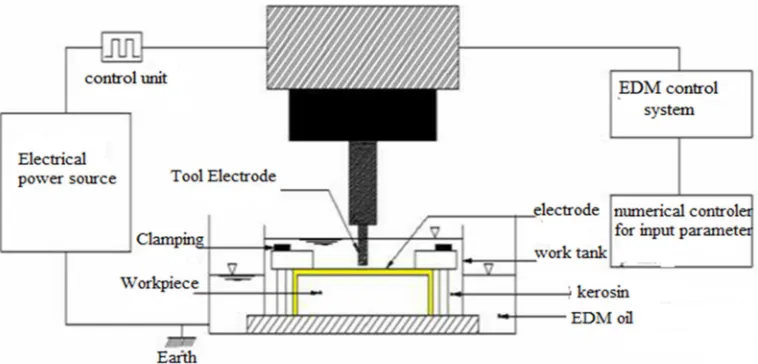
[image:2.612.112.491.318.500.2]EDM machining is carried out by means of electric sparks that jumps between two electrodes subjected to a voltage and submerged in a dielectric fluid. Both the tool and work material are the conductor of electricity. It is a controlled metal removal process that is used to remove metal by means of electric spark erosion. In this process, an electric spark is used as the cutting tool to cut (erode) the workpiece to produce the finished part in the desired shape. The tool is connected with a negative terminal and workpiece with positive terminal submerged with dielectric fluid. As the electric field is established the free electron is emitted from the tool called as Cold Emission. The electrode emits electron gets high velocity and energy is accelerated towards job into dielectric medium and a positive ion.
Figure 1.1 Systematic Diagram of EDM Machine
The tool is made cathode and workpiece is an anode. When voltage became sufficiently high, it discharges current for microseconds at that time positive particles and electrons are collided resultant creating a release channel that winds up conductive. It is exactly now when the start bounces causing crashes among particles and electrons and making a channel of plasma. A sudden drop of the electric obstruction of the past channel permits that flow thickness achieves high qualities delivering an expansion of ionization and the develop the electric field. The moment spark occurs sufficiently pressure developed between work and tool as a result of which a very high temperature is reached and at such high pressure and temperature that some metal is melted and eroded.
Such localized extreme rise in temperature liable remove material. Material removal
occur due to instant vaporization of the material as well as due to melting. The molten metal is not removed completely but only partially as the potential difference produces a spark. The plasma channel is no longer sustained, as the plasma channel collapse, it generates pressure or shock waves, which remove the molten material and forming a crater around the place of the spark.
D. Types Of EDM
Basically, there are three different types of EDM:
1) Die-sinking.
112
©IJRASET: All Rights are Reserved
3) Hole drilling EDM
E. Process Parameters In EDM 1) Input Parameter
2) Performance Parameter
a) Input Parameters
i) Pulse On Time: It is the time of flowing current during a complete cycle. It is measured in a microsecond. The material removal rate is directionally proportional to an amount of energy applied during the spark on time. This energy is controlled by the peak current and time length of spark produced.
ii) Pulse Off Time: It is a duration of time between the sparks. In this time molten metal gets solidify and it is washed out and provides a spark gap. This parameter is to affect the speed and the stability of the cut. Thus if the off-time is too short, it will cause sparks to be unstable.
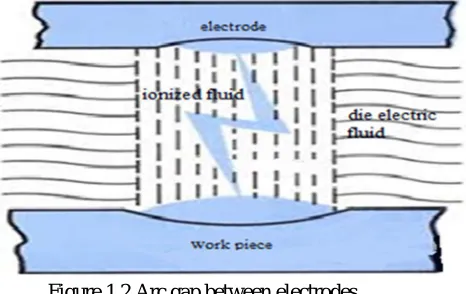
iii) Arc Gap: The Arc gap is a distance between the electrode and workpiece during the process of EDM. It may be called as a spark gap. Spark gap can be maintained by a servo system.
[image:3.612.205.438.250.397.2]
Figure 1.2 Arc gap between electrodes
iv) Pulse current IP: It is the most important machining parameter because it is related to power consumption during machining. Until reaches the preset level, the current is increased which is known as discharge current. The setting of discharge current on static pulse generators generally determines the number of power units connected parallel to the gap. The larger discharge current means the higher power intensity during electrical discharge.
v) Duty Cycle: It is a percentage of on time of spark to the total time. Mathematically it is expressed as a ratio of the time to the sum of the and is called total cycle time.
= +
vi) Voltage: It is potential that can be measured by volt. Material removal rate also depends on the voltage value in this experiment voltage is given by 50V.
vii) The Diameter of Electrode (D): It is an electrode of Cu tube it’s worked as a tool for the removing material. Diameter Size of the electrode is taken 10 mm.
viii) Overcut: It is clearance both side of workpiece and electrode during the machining operation.
ix) Flushing Pressure: Flushing is a critical factor in EDM of providing clean separated dielectric liquid into the machining zone. Flushing is troublesome if the depression is more profound, wasteful flushing may start arcing and may make undesirable pits which can obliterate the work-piece. There are a few strategies, for the most part, used to flush the whole: infusion flushing, suction flushing, side flushing, movement flushing and drive flushing. The typical scope of weight utilized is between 0.1 to 0.4
kgf/ .
113
©IJRASET: All Rights are Reserved
xi) Lift Time: It is a time interval in this flush clean the debris after lifting the electrode into the electrode gap. MRR, TWR, SR, and Surface trustworthiness, used to assess the machining procedure in both subjective and quantitative terms.
F. Characteristics Of EDM 1) Benefit of EDM Machine
a) It is a non-traditional process that generates no cutting forces, produces burr-free edges, permitting the production of small, fragile pieces.
b) EDM machines allow the production of intricate parts and superior finishes with minimum operator intervention.
c) Since material removing by melting and evaporation in EDM, so there is no limitation of Machining of hard materials, eliminating the deformation caused by heat treatment.
2) Disadvantage of EDM
a) MRR is very less compared to other machining operation like chip machining turning, milling etc.
b) The necessary condition to be machined in EDM is material must be electrically conducting.
c) The tool wear is excessive during machining
d) The different parameter has to be optimized to get a good result that is a complicated process.
e) Due to excessive tool wear, it is difficult to reproduce sharp corner.
3) Application of EDM
a) The EDM process is most widely used by the mold-making tool and dies industries, but is becoming a common method of making prototype and production parts, especially in the aerospace, automobile and electronics industries in which production quantities are relatively low.
b) It is used to machine extremely hard materials that are difficult to a machine like alloys, tool steels, tungsten carbides etc.
c) It is used for forging, extrusion, wire drawing, thread cutting.
d) For getting higher Tolerance limits obtains, EDM machining is used.
G. Work Piece Material
1) Stainless Steel SS316H: Type 316H has higher carbon than 316L, this characteristic making the steel appropriate for use in applications where raised temperatures are present. Stabilized Grade 316Ti offers similar qualities and due to higher carbon content it has a greater tensile and yield strength. The austenitic structure of the material provides this grade comparatively high toughness, even down to cryogenic temperatures. The corrosion resistance of Alloy 316H is comparable to Alloy316/316L and is superior to Alloy 304/304L in moderately corrosive environments. It is often used in the industries where deal with chlorides and halide. to resists atmospheric corrosion, as well as, moderately oxidizing and reducing environments it have good resistivity. It also resists corrosion in polluted marine conditions.
Table1.1 Chemical composition of SS316H
Element C Mn Si P Cr Mo Ni N Fe
(%) 0.04-0.10 2 0.75 0.03 16-18 2-3 10-14 0.10 balance
2) Characteristic of SS316H: Alloy 316H is non-magnetic in the annealed condition. It is difficult to hard by any heat treatment; but the material will harden due to cold working condition. It has good weld ability and machining occur by standard shop fabrication practices;
1. Additional carbon percentage increase heat resistance quality. 2. It has greater tensile yield strength.
3. Also having greater short and long-term creep strength.
3) Application of SS316H: The steel come in the having good resistivity material category and well for use in the petrochemical, gas and chemical industry. MA steel supplies Grade 316H to a variety of customers including fabricators of pressure vessels, industrial boilers, and heat exchangers.
a) Food and Beverage process.
114
©IJRASET: All Rights are Reserved
c) In Water filter industries Alloy 316H performs well in fresh water service even with high levels of chlorides.
II. LITERATURE REVIEW
Many researchers have published a research paper on EDM with the effect of MRR, Surface Roughness, and TWR workpiece material. The survey is done and categorized into two groups viz. Experimental techniques used and Numerical technique (FEM) used by various authors.
Sanjeev et al. [1] has taken a shot at metal expulsion component in Electrical Discharge Machining is mostly a hard material where warm vitality is created in a plasma channel and is dispersed however workpiece, instrument, and dielectric. The procedure is for the most part utilized in circumstances where machining of hard materials, unpredictable parts, complex shapes. The target of this work is the advancement of the cutting parameters for Electric release machining of AISI 316 hardened steel to accomplish the better surface get done with utilizing terminal is utilized in this work as a device is graphite and Taguchi's system. Taguchi Parameter Design is a suitable and proficient technique for improving quality and execution yield of assembling forms. it is a reasonable instrument for addressing this difficulty. This work talked about an examination concerning the utilization of Taguchi Parameter Design for upgrading surface unpleasantness produced by an EDM task.
Ashok et al. [2] In this paper, a researcher has worked on a micro hole in workpiece material they took SS316H as workpiece material and study on micro hole through EDM process. Microhole by EDM process is nonconventional machining process and for a machine tool is used as an electrode but during machining wear of tool is significantly showed and for that they optimized the input process parameter by Taguchi method. An electrode is taken in this study of copper of 300μm diameter. A varying parameter
in this study is current, pulse off time, pulse on time. And after optimization they made a conclusion that Electrode Tool wears rate of experiment and predicated values difference were up to 0.00021 mg could be achieved by this process and a combination of A3B1C3 i.e. current of 0.8 Amps, T-on 6μs, T-off 8μs. from Signal to noise ratio the optimum parameters combination value is 32.207
Dhar et al. [3] assesses the impact of current (c), beat on time (p) and air hole voltage on MRR, TWR, ROC of EDM with SiC composites. This test has done utilizing the PS LEADER ZNC EDM machine and a tube-shaped metal terminal of 30 mm breadth. For optimization three elements, three levels full factorial plan was utilizing and analyzing the results. They built up a second request, a non-direct scientific model for establishing the relationship among machining parameters. The critical of the models were checked using technique ANOVA and find the MRR, TWR and ROC increment huge in a non-linear fashion with increment in a current.
Alexia et al. [4] In this research work, a new modeling of energy density in EDM proposed. Energy density model helped to quantify the material removal volume. They purposed technique on Inconel 600 alloy using Cu-C electrode. The experimental results confirmed that the use of negative polarity leads to a higher material removal rate, higher electrode wear and higher surface roughness. The optimal condition has been obtained a maximum MRR of 30.49 cub.mm/min with 8 A, 100 s and 0.6, respectively, for the current intensity, pulse time and duty cycle.
Gupta et al. [5] This paper portrays the test investigation of the information parameters of EDM i.e. current, beat on time and heartbeat off time on yield parameters material expulsion rate (MRR), instrument wear rate and surface unpleasantness (SR). The workpiece materials are chosen AISI D2. The aluminum utilized as instrument anode and EDM oil as a dielectric liquid. Taguchi, the technique was utilized to perform tests, L9 symmetrical cluster was connected utilizing MINITAB programming. Flag to Noise proportion and ANOVA were utilized for parameter enhancement and to accomplish max MRR, min SR, and TWR. The outcomes show that the most inciting component for MRR is Pulse off time. The paper anticipated, For TWR, the most impacting element is current. For SR, the most inciting component is beat on time.
Hang et al. [6] EDM process is studied in this paper. Based on the solid-liquid two-phase flow equation, the mathematical model on the gap flow field with flushing and self-adaptive distribution is developed. In the 3D simulation process, the count of debris increases with a number of EDM discharge cycles, and the distribution generated by the movement of a self-adaptive tool in the gap flow is considered. The methods of smoothing and enmeshing are also applied in the modeling process to enable a movable tool. Under different depth, flushing velocity, and tool diameter, the distribution of velocity field, pressure field of gap flow, and debris movement are analyzed.
115
©IJRASET: All Rights are Reserved
movement of a tool can generate disturbance to the machining region, flush velocity, debris distribution affect the gap flow field and increase the depth of the hole.
III. METHODOLOGY
In this, the framework is developed in order to experimentally investigate the electro-discharge machining process and get the important process parameters that have a maximum effect on the response parameters. Further, these process parameters are varied in a specified range and response is noted down. The design of the experiment is carried out by the Taguchi design so that the data collected is appropriate and the method used to analyze this data is statistical methods which result in valid conclusions. The purpose of the experimental study is to optimize the performance parameters of die sinking electro discharge machine which includes surface roughness, material removal rate, and tool wear ratio. In this chapter detailed methodology to steps performed and path followed are given.
A. Methodology
1) Study of die Sinking EDM machine with benefit involves.
2) Formulation of the objective and research problem.
3) Identification of appropriate workpiece for experiment work.
4) Study the process parameters and performance parameters.
5) Study of optimization techniques and selecting the appropriate
6) Design of experiment by Taguchi method.
7) To perform the experiment on Electro Discharge Machining.
8) Get the output result and measure the performance parameter.
9) Creating data table and arranging the performance parameter.
10) Analyze all experiment data and optimization on MINI Tab software with appropriate optimization technique.
11) Plotting the effect of process parameter on the performance parameter.
12) Presenting the optimized result in the different format.
B. Electro Discharge Machining Of Material
Electro Discharge Machining (EDM) is an electro-thermal non-traditional machining process, spark generating between gaps produce high amounts of electrical energy which is responsible for generating extensive temperature that is capable to melting material and also vaporize under the die electric fluid. EDM is mainly used to machine difficult-to-machine materials and high strength temperature resistant alloys. EDM can be used to machine difficult geometries in small batches or even on the job-shop basis. Necessary condition is work material to be machined by EDM has to be good conductance of electricity.
C. EDM Operation And Related Process Parameters
In the manufacturing industry, various manufacturing process is performed to make a product and these manufacturing processes are categorized in deferent categories, these are casting, forming, welding and machining. In this manufacturing process, the machining process is most significant among other processes. The machining process is also classified into various material removal processes like turning operation, milling, drilling etc.
We are using conventional machining process and nonconventional machining process. Unconventional machining process are frequently used in industries due to the necessity of high precision, good surface finishing and also complicated shape that are the demand of this era. Milling operation, Grinding operation, shaping, drilling, boring and finishing operations are conventional machining technique. EDM, ECM, CNC milling and turning, LBM are all the unconventional machining process.
Among these machining process, EDM operation is widely used in industry to create industrial component having slots, cut, intricate shape.
EDM operation is carried on EDM machine which is preferred because it provides the power to run the workpiece at a given input parameter pulse on time, pulse off time, current (Ip), voltage and servo feed.
116
©IJRASET: All Rights are Reserved
An EDM machine is a numerical control machine with the added feature of an onboard computer. In EDM machine, the command is given through programming. EDM machine tool consists of the following important elements.
1) Part programming
2) Program input device and display
3) Machine control unit
4) Drive system
5) Machine tool
6) Feedback system
D. EDM Machining Parameters and their Levels
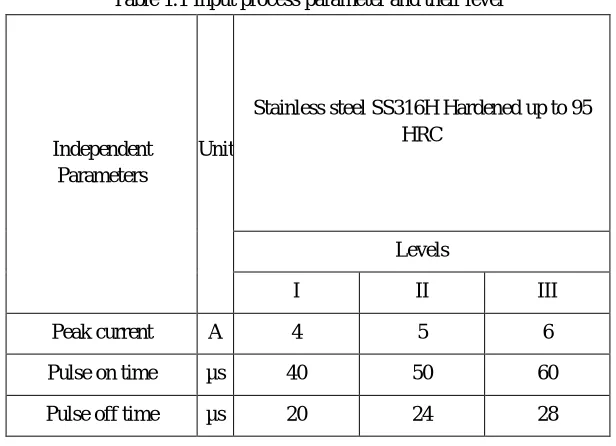
[image:7.612.152.460.332.555.2]In addition to Electrode as cutting tool and workpiece material, maximum current, pulse on time, and pulse off time are most important machining parameters which dominantly affect the performance characteristics. Therefore it is essential to select the most appropriate process parameters and tool electrode in order to improve material removal efficiency, reduce process cost and produce high-quality products. In EDM operation basically, there are three major parameters viz. pulse on time, pulse off time, peak current which plays a significant role to get desired quality level. Servo feed and servo voltage is also an important parameter. Therefore the process parameters like peak current IP (Amp), pulse on time (µs), and pulse off time (µs), and their associated levels are selected based on preliminary literature review and properties of work-piece given in table 1.1
Table 1.1 Input process parameter and their level
Independent Parameters
Unit
Stainless steel SS316H Hardened up to 95 HRC
Levels
I II III
Peak current A 4 5 6
Pulse on time µs 40 50 60
Pulse off time µs 20 24 28
E. Selection of Electrode
EDM electrodes consist of highly conductive and arc erosion-resistant materials such as graphite or copper. EDM is an acronym for electrical discharge machining a process that uses a controlled electrical spark to erode metal. EDM electrodes include components made from brass, copper and copper alloys, graphite, molybdenum, silver, and tungsten. Electrical discharge machining makes it doable to work with metal for which established machining techniques are useless. It only works with materials that are electrically conductive. Using recurring electric discharge, it is possible to cut small, odd-shaped angles and detailed contours or cavities in hardened steel as well as exotic metals such as titanium and carbide. In this experiment work copper is used as electrode it has better wear resistance and useful in the application of machining of hard material.
IV. EXPERIMENTAL WORK
117
©IJRASET: All Rights are Reserved
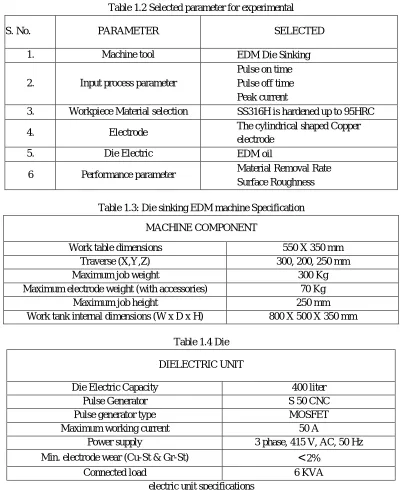
nine samples are taken to perform the experimental with a combination of a different process parameter that is designed by Taguchi method.
[image:8.612.105.506.139.629.2]A. Selection Of Associated Elements
Table 1.2 Selected parameter for experimental
S. No. PARAMETER SELECTED
1. Machine tool EDM Die Sinking
2. Input process parameter
Pulse on time
Pulse off time
Peak current
3. Workpiece Material selection SS316H is hardened up to 95HRC
4. Electrode The cylindrical shaped Copper
electrode
5. Die Electric EDM oil
6 Performance parameter Material Removal Rate
Surface Roughness
Table 1.3: Die sinking EDM machine Specification
MACHINE COMPONENT
Work table dimensions 550 X 350 mm
Traverse (X,Y,Z) 300, 200, 250 mm
Maximum job weight 300 Kg
Maximum electrode weight (with accessories) 70 Kg
Maximum job height 250 mm
Work tank internal dimensions (W x D x H) 800 X 500 X 350 mm
Table 1.4 Die
DIELECTRIC UNIT
Die Electric Capacity 400 liter
Pulse Generator S 50 CNC
Pulse generator type MOSFET
Maximum working current 50 A
Power supply 3 phase, 415 V, AC, 50 Hz
Min. electrode wear (Cu-St & Gr-St)
<
2%Connected load 6 KVA
electric unit specifications
B. Major Component Of The Edm Machine 1) Servo system to feed the electrode
2) Tool/ electrode holder
3) Die electric fuel reservoir tank, pump, circulating system
4) Working table
5) Control unit
118
[image:9.612.184.464.77.291.2]©IJRASET: All Rights are Reserved
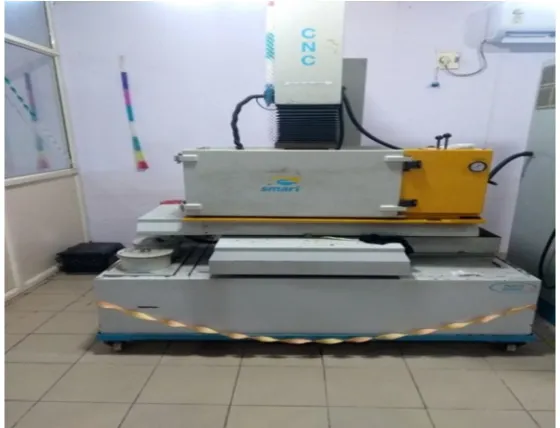
Figure 1.3 Electro discharge machining setup
C. Experimental Setup And Procedure
The test set up begins with planning work piece test and terminal. In this experiment work there are add up to nine work samples has been readied. We select SS316H plate of 150*150*12 mm and afterward, it is cut in power saw machine into little nine-piece with the goal that it can measured otherwise difficult to weight such a big plate. weight in gauging machine since machine gauging limit is 210gm, apparatus is made in conventional lathe machine of the copper terminal of 10 mm dia. Analysis leading on the Electronica S50 CNC type Die sinking EDM machine. The dielectric liquid which is utilized in this trial is a physical parameter with explicit gravity = 0.763, the point of solidification = - 94°C. Inside flushing is utilized with the goal that the expelled material is diverted by the oil.
The three factors are tackled with a total number of 9 experiments which are performed on die sinking EDM. Measuring of material removal rate and tool wear rate is done by weighting the workpiece before and after conducting the experiment and value are recorded. The weight machine which is use for this purpose has the capacity of 210gm and accuracy of 0.0001 gram. And for measuring the overcut toolmaker microscope is use with the accuracy of 0.0001mm. Apart from the parameters mentioned above following parameters were kept constant at a fixed value during the experiment:
1) Workpiece material: SS316H
2) Cutting tool: Copper electrode with 10 mm diameter
3) Flushing pressure: 15 Kg/sq.cm
4) The conductivity of dielectric: 15 mho
5) Workpiece height: 12 mm
6) Servo feed 80
7) Servo Voltage 100 V
8) Electrode gap 0.1 mm
D. Surface Roughness Tester
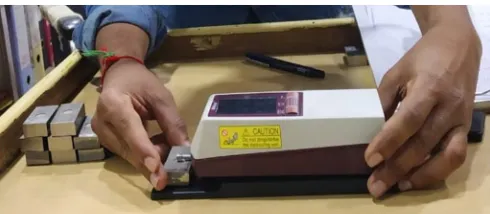
Surface roughness tester measures the roughness value of machined surface. This device gives a highly precise value. Process for measurement, sampling length is kept as 5 mm. The surface tester has 2.4"color LCD display having backlighting and over-size fonts, measuring range is 360 micrometer, measuring method: skidded Measuring force: 0.75mN or 4mN, Stylus tip: Diamond of
119
[image:10.612.183.428.75.182.2]©IJRASET: All Rights are Reserved
Figure 1.4 Setup of roughness tester (MUTITOYO SJ210
E. Material Removal Rate
The material Removal Rate MRR is expressed as the ratio of the difference of weight of the work piece before and after machining (EDM) to the machining time.
MRR = ( )
Figure 1.5 Electronic weighing machines
V. RESULTS
[image:10.612.200.436.267.426.2]A L9 Taguchi’s experimental design is considered as shown in table 5.1. The procedure of experimental work is discussed above, the response are calculated by the equations. For MRR and Ra, for surface roughness lower the better type characteristics are used and for MRR, higher the better type of characteristics is used.
Table 1.5 Experimental result
Exp. No
.
Input Process Parameters Response factor
Peak current (A)
Pulse on time (µs)
Pulse off time (µs)
MRR
( )
SR (µm)
1.
4 40 20 0.0429 1.6872.
4 50 24 0.0542 2.8903.
4 60 28 0.0505 2.5684.
5 40 24 0.0475 1.7105.
5 50 28 0.0485 2.0516.
5 60 20 0.0484 2.7307.
6 40 28 0.0503 2.3228.
6 50 20 0.0511 2.902120
©IJRASET: All Rights are Reserved
VI. OPTIMIZATION TECHNIQUE
[image:11.612.153.459.163.314.2]An optimization problem is a problem in which certain parameters (design variables) needed to achieve the best measurable performance (objective function) under given constraints. In EDM operation, pulse on time, pulse off time, gap current, are considered as design variable and flushing pressure, servo voltage, servo feed etc. is taken constant, while surface roughness, MRR, EWR, etc. are considered as response parameter. In the present research work, Taguchi method, ANOVA, has been used to optimize process parameter in EDM operation.
Figure 1.6 Main Effect Plot for MRR
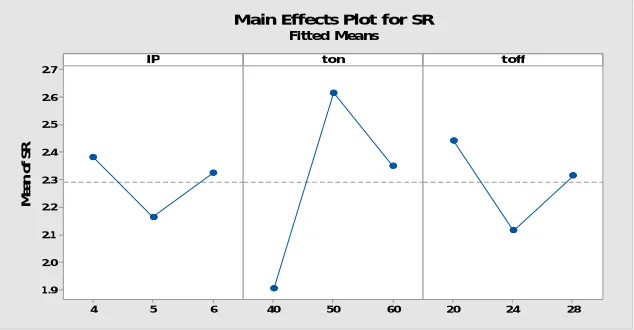
Figure 1.7 Main Effect Plot for SR
VII. CONCLUSION
In the present research work, experimental study of EDM operation, study of most influential parameter and optimization techniques are done. The residual plots for material removal rates and surface roughness are generated by ANOVA optimization technique.
1) On the basis of ANOVA optimization technique, optimum solution occurs at Peak current value 6 (Amp), pulse on time 60 (µs) and pulse off time 24 (µs) with composite desirability 0.8163 for EDM machining of SS316H.
2) Experiment number nine has got the maximum value of MRR which is 0.0562 gm/min and minimum surface roughness is found in experiment no. 1, in this experiment combination of parameter gave value of Ra is 1.687 micro meter.
From Taguchi and the ANOVA optimization technique following conclusion is drawn;
a) For Material removal rate the main significant factor is a current deviation and the second significant factor is a pulse on time. MRR increased with the increase in peak current value (Ip)..
b) It is found that pulse on time is the most significant factors for surface finishing and the second significant factor is pulse off time. 6 5 4 0.053 0.052 0.051 0.050 0.049 0.048 0.047 60 50
40 20 24 28
IP M e a n o f M R R ( g m /m in ) ton toff
Main Effects Plot for MRR (gm/min)
Fitted Means 6 5 4 2.7 2.6 2.5 2.4 2.3 2.2 2.1 2.0 1 .9 60 50
40 20 24 28
IP M e a n o f S R ton toff
[image:11.612.148.465.352.517.2]121
©IJRASET: All Rights are Reserved
REFRENCES
[1] Kumar sanjeev,rupinder singh, TP singh, BL Sethi, “Surface modification by electrical discharge machining journal of material processing technology “ 209(8),3675-3685, 2009.
[2] Ashok kumar, P.Laxminarayana, “Optimization of Electrode Tool Wear in micro holes machining by Die Sinker EDM using Taguchi Approach” Journal of/Materials Today: Proceedings 5 1824–183, 2018.
[3] Alexia Torres Salcedo, Ignacio Puertas Arbizu and Carmelo J. Luis Pérez “Analytical Modeling of Energy Density and Optimization of the EDM Machining Parameters of Inconel 600” journal of Metals 2017, 7, 166.
[4] Ali TolgaBozdana and Nazar Kais Al-Karkhi “Comparative experimental investigation and gap flow simulation in electrical discharge drilling using new electrode geometry”, Journal of Mech. Sci., 8, 289–298, 2017.
[5] Dhar S, Purohit R, Saini N, Sharma A, and Hemanth kumar G. “Mathematical modeling of electric discharge machining of cast Al-4Cu-6Si alloy- 10 wt.% SiCp composites”, J Mater Process Technol 194:24–29, 2007.
[6] Goutam Dubey, VarunDutta “Optimization of Process Parameters for Rotary EDM using EN31 Tool Steel”: Present and Future Scope”. International Journal of Scientific and Technical Advancements Volume 4, Issue. 1, pp. 81-84, 2018.
[7] Ghoreishi, M. and Tabari, C. “Investigation into the effect of voltage excitation of pre-ignition spark pulse on the electro-discharge machining (edm) process”. Materials and Manufacturing Processes, 22(7): 833–841, 2007.