R E S E A R C H
Open Access
Power allocation for SWIPT in
K
-user
interference channels using game theory
Zhigang Wen, Ying Liu, Xiaoqing Liu
*, Shan Li and Xianya Chen
Abstract
A simultaneous wireless information and power transfer system in interference channels of multi-users is considered. In this system, each transmitter sends one data stream to its targeted receiver, which causes interference to other receivers. Since all transmitter-receiver links want to maximize their own average transmission rate, a power allocation problem under the transmit power constraints and the energy-harvesting constraints is developed. To solve this problem, we propose a game theory framework. Then, we convert the game into a variational inequalities problem by establishing the connection between game theory and variational inequalities and solve the variational inequalities problem. Through theoretical analysis, the existence and uniqueness of Nash equilibrium are both guaranteed by the theory of variational inequalities. A distributed iterative alternating optimization water-filling algorithm is derived, which is proved to converge. Numerical results show that the proposed algorithm reaches fast convergence and achieves a higher sum rate than the unaided scheme.
Keywords: Distributed algorithm, Game theory, Interference channels, Power allocation, Simultaneous wireless information and power transfer, Variational inequality theory
1 Introduction
Simultaneous wireless information and power transfer (SWIPT), which transports both information and energy simultaneously by the same radio-frequency (RF) signal, has caused great concern in both academic and industrial fields and offers great convenience to wireless terminals [1–3]. According to [3], time switching (TS) and power splitting (PS) are two practical receiver designs. As a PS receiver plays a significant role in SWIPT, it divides the received signal into two signal flows, one for energy har-vesting (EH) and the other for information decoding (ID) [4,5]. Based on the position relationship between the ID receiver and the EH receiver, which is spatially separated or co-located, there are two types of SWIPT networks [6]. Recently, the study of realizing SWIPT in the interfer-ence channels (IFC) has received considerable attention. As an extra energy source in the IFC, the cross-link signals are salutary to EH [7]. However, the cross-link signals are harmful to information transmission, which brings new challenges to the transmission designs. The
*Correspondence:[email protected]
School of Electronic Engineering, Beijing University of Posts and Telecommunications, Xidu Cheng Road, Beijing, China
authors of [8] investigated an adaptive resource allocation scheme called proportional-fair power allocation (PFPA) in multiuser OFDM systems for fair share of resources and efficient operation. In [9], the authors solved a sum rate maximization problem in a two-user IFC where the two receivers can simultaneously decode information and harvest energy. The author of [10] found a necessary condition of the optimal transmission strategy consid-ering three different scenarios according to the receiver mode in a K-user IFC. In [11], the authors divided an optimal robust secure beamforming and power splitting scheme to minimize the total transmit power while sat-isfying the constraints on the minimum amounts over IFC. The authors of [12] jointly designed the allocating transfer power and receive PS coefficient for a two-link SWIPT system in IFC. In [13], a new transmission strat-egy was derived to maximize the energy beamforming and minimize the leakage beamforming in a two-user MIMO IFC. In [14], the authors derived a hybrid algo-rithm comprised of a linear combination of maximum ratio transmission (MRT) and zero-forcing (ZF) beam-forming to minimize required power in a K-user IFC network. To minimize the total transmission power, [15]
proposed a joint beamforming and power splitting algo-rithm based on second-order cone programming (SOCP) relaxation in aK-user IFC network. Based on PS scheme, the work [16] considered a multi-user SWIPT interference system and studied joint transceiver design to minimize the total transmit power. Reference [17] proposed a syn-chronous power descending (SPD) algorithm to updates each links’ transmit power and PS ratio in a IFC SWIPT system. However, to the best of our knowledge, an iter-ative water-filling algorithm based on a game theory to solve the power allocation problem in IFC SWIPT systems withK direct links to maximize its sum rate has not yet been studied.
In this paper, we devise an iterative water-filling algo-rithm based on game theory to solve the formulated power allocation problem for the IFC SWIPT sys-tems. The main contributions of this paper are listed in the following:
1. AK transceiver links SWIPT system in interference channels is developed. In particular, each transmitter-receiver link is modeled as a strategy player who chooses its transmit power to maximize its individual rate.
2. A game framework is formulated to solve the pro-posed power allocation problem. Then, we convert the game into a variational inequality (VI) problem using VI theory and analyze the existence and unique-ness of the Nash equilibrium (NE). In addition, a pricing mechanism is introduced to keep a balance between EH and ID.
3. Different from that of reference [18], an alternating optimization (AO) method is employed because of the coupled variables and non-convexity, which converts the original problem into two sub-problems.
4. To deal with the formulated sub-problem, a dis-tributed iterative water-filling algorithm (IWFA) is devised to optimize the power allocation problem.
2 Problem formulation and power allocation method
2.1 Problem formulation
2.1.1 Game-theoretic framework formulation
An SWIPT system in the interference channels consisting K source-destination links is considered. In this system, each link includes a single-antenna source nodeS and a single-antenna destination nodeDequipped with a power splitter, which splits the received signal into two streams, one for EH and the other for ID. Moreover, it is assumed that perfect channel state information (CSI) is available, only one single-data stream is transmitted and all nodes operate in half-duplex mode. As illustrated in Fig.1, each source nodeSjtransmits data to its own receiverDjat the same time. The received signal atDkcan be expressed as
yk=√pkhkksk+ K
j=k,j=1
pjhjksj+nak (1)
wherepkandpjare the transmit power ofSkandSj,skand sj are the transmit symbols ofSk andSjwith E{|sk|2} = 1,E{|sj|2} = 1,hkk andhjk are the channel gains fromSk toDk andSj toDj, andnak ∼ CN(0,σak2)is the additive white Gaussian noise (AWGN) introduced by the receiver antenna atDk, andK = {1,. . .,K}. The transmit power constraint of each node can be given by
0≤pj≤pmaxj (2)
wherepmaxj ,j∈Kdenotes the peak power of each user.
Fig. 1The system model for SWIPT inK-user interference channels. This system includeKsource-destination links. Each link includes a
A portion,βj∈(0, 1), of the received signal is allocated for ID. Then, the signal for ID atDkcan be expressed as
yIDk =βkpkhkksk+ covarianceσall2 andnkis the AWGN originating from the power splitter with covarianceσk2. Meanwhile, the power of the desired signal received byDkfor ID can be given as
E{|yIDk |2} =βkpk|hkk|2+ K
j=k,j=1
βjpj|hjk|2+σall2. (4)
Dividing the desired signal power by the interference and noise power, the signal-to-interference-noise-ratio (SINR) for the kth link between Sk and Dk can be
Accordingly, the achievable rate of thekth link is
rk users except thekth one.
A portion, 1−βj, of the signal received atDk is for EH and the power collected atDkfollows the constraints
(1−βk)
To maximize the achievable sum rate, a rate maxi-mization problem with power constraint can be stated as follows
is the set of power constraints. Since the non-convex problem (8) is difficult to solve, we devise a distributed framework based on game theory to solve the power allocation problem. Specifically, we con-sider the scenario where each user maximizes its own rate
selfishly via allocating the transmit power. Then, the game
Gis formulated as It can be observed from (9) that the problem is still non-convex and difficult to solve because the objective function rk is non-convex and the constraint Pk of the kth user is coupled. Therefore, we redefine the objective function as
To let the optimization problem more decentralized and keep a balance between EH and ID, a pricing mechanism is introduced through a punishment in the payoff func-tion. We define the pricing factor asα=αj
K
j=1, whereαj represents the penalty of thejth user. From (7), we define a linear function about the power constraint of thekth link,
ϕk
Considering the penalty, the payoff function of thekth user can be given as
vk Consequently, the original gameG1can be formulated as a game feasible set to minimize the objective function vk inG2, which satisfies the following condition
vk(p∗k,p−∗k;αk∗)≤vk
problem, which converts the original problem into two subproblems. In this section, we analyze the NE point of the gameG2using VI theory, optimize the power alloca-tion problem using IWFA algorithm, and update the price vector using variable-step projection scheme.
In this subsection, we focus on finding the optimal power strategyp∗of the gameG2for the given price α. First, we rewrite the original game G2 into a VI prob-lemVI(Pk,Vk), which is denoted to find a power strategy p∗∈Pksatisfying the following condition
is the gradient vk. Then, we establish the relation between the formulated game G2 and the VI problem VI(Pk,Vk).
Proposition 1The gameG2is equivalent to the problem VI(Pk,Vk).
ProofA proof is given in AppendixA.
The gameG2can be rewritten asVI(Pk,Vk)after the proof is completed. And the existence and uniqueness of the NE can be analyzed by studying the VI problem VI(Pk,Vk).
2.2 Power allocation method
2.2.1 Analysis of the NE
The following theorem proposed in [19] is commonly used to verify the existence of the NE.
Theorem 1A NE exists in a VI(A,F)problem if the set
Ais convex and compact; the function F is continuous in its feasible set.
After investigating the properties of the setAand the function F of the VI problem, we have the following proposition regarding the existence of the NE.
Proposition 2 The gameG2possesses at least one NE.
ProofA proof is given in AppendixB.
Based on ([20], Eq.13) , theVI(A,F)admits a unique solution ifFis strongly monotone onA. The definition of strongly monotone is provided in the following.
Definition 1Given a mapping F:A⊆Rn→Rn, if the setAis convex and there exists a constant c>0satisfying the following condition, F is strongly monotone.
(F(x)−F(y))(x−y)≥c|x−y|2,∀x,y∈A. (18) We analyze the uniqueness of the NE by proving a suf-ficient condition for the strong monotonicity of Vk. To prove the strong monotonicity ofVk, the second derivative ofvk(p)can be given as
we have the following proposition regarding the unique-ness of the NE.
Proposition 3Vkis strongly monotone in its feasible set. Furthermore, the gameG2has the unique NE.
Proof A proof is given in AppendixC.
The above analysis about the existence and uniqueness of the NE shows that the NE of gameG2always exists and admits its uniqueness for the given price factor. To achieve the unique NE, we use a water-filling method based on the best response. For any fixedp−kandα, the NE point of the gameG2 is the fixed-point of the water-filling mapping, which can be expressed as
p∗(α)=wvk
where the majorization notion in p∗(α)representsp(α) after optimization, [x]bamin(max(x,a)b)with 0≤a≤b andμk ≥0 is chosen to satisfy the power constraint (2).
2.2.2 Optimalαwith variable-step projection scheme
To optimize α, we introduce a nonlinear complement problem (NCP), which is to find the price vector such that
NCP(φ): 0≤α⊥φ(α)≥0. (22)
The NCP is an equivalent form to VI problem. We use the well-known variable-step projection scheme to solve this NCP, which is described in the following algorithm.
2.2.3 Distributed iterative algorithm
Denote the allocating power and the pricing factor of the kth user at thenth iteration asp(kn)(α)andα(n), respec-tively. To achieve the unique NE, a distributed iterative algorithm with AO is summarized as theProposed Itera-tive AO Algorithmin Table1. It is worth noting that such the AO scheme guarantees the local optimum.
It can be seen that the price α is computed by the variable-step projection scheme and n is thenth itera-tion step size. As menitera-tioned in [21], we could choose a sufficiently small value to assign to the step size n. The notion [·]+represents that the value is meaningful when it is larger than zero, and let the value be zero when it is less than zero. And the proofs of convergence property about αandpk(α)are similar to the Theorems 6 and 10 in [18].
3 Numerical results and discussions
It is assumed that the channels between all links are mutually independent Rayleigh fading and the free-space propagation pathloss coefficient is 2. And random chan-nels with 100 slots are generated. The variances of the noises areσall2 =σ2,pmaxk =Pmax, andβk=0.5.
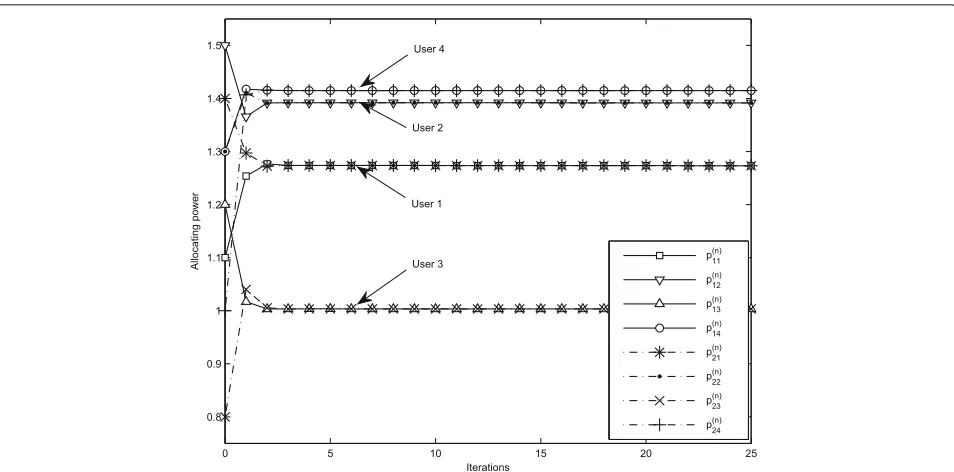
We study the convergence property of IWFA in a four-link network. Figure2shows the allocating power of four users versus iterations considering two different initial points: (1.1, 1.5, 1.2, 1.3) and (1.4, 1.3, 0.8, 1.0) under the same conditions Pmax = 25 and σ2 = 1. It can be observed that all users’ allocating power converge to the same points (1.28, 1.39, 1.00, 1.41). After several similar
Table 1Proposed iterative AO algorithm
step 1:Initialize.
Setp(0)as a vector satisfyingp(0)k ∈P,α(0)≥0 and
(2) Computeαusing variable-step projection scheme as
follows with fixedp∗k(α): α(n+1)=α(n)−
nφ(α(n)
+. step 3: Untilconvergence.
attempts, we have that the IWFA quickly converges to the unique NE from different initial points.
Figure 3 provides the results of sum rate versus the interlink distance dL. Different conditions of Pmax ∈ {20dB, 30dB} andσ2 ∈ {0.5, 1.0} are simulated, respec-tively. There are two schemes for comparison. Scheme 1 is the unaided scheme without iteration, and scheme 2 is IWFA scheme. We consider a linear topology where every transmitter-receiver link is parallel to each other. It can be seen that the sum rate increases as thedLincreasing for two schemes. Then, the IWFA method outperforms to the unaided method under all conditions. In addition, the sys-tem performance is better when the AWGN is smaller and the maximum transmit power is bigger.
Figure4 shows results of the average transmit power versus the harvest energy threshold ek. Different con-ditions of K ∈ {3, 4} and the different initial pricing α ∈ {0.5, 0.6, 0.7} are simulated, respectively. It can be observed that the average transmit power decreases as the harvest energy threshold ek increases for our proposed scheme, and the system requires less average transmit power with the increase of the number of links. We can also see that the average transmit power decreases asα increasing. In addition, the average transmit power of our proposed IWFA scheme always smaller than the unaided scheme when the number of links is the same.
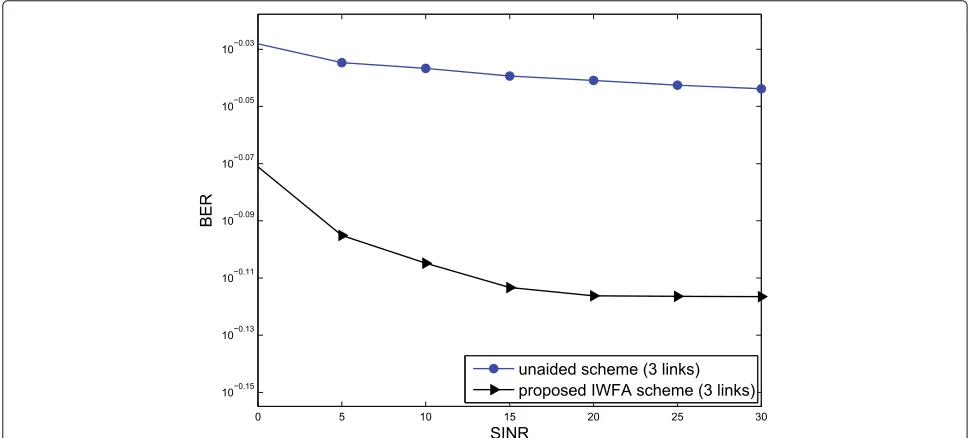
Figure 5 provide results of the average bit error rate (BER) versus SINR. As we can see, our propose IWFA scheme is always better than the unaided scheme in BER performance. The reason is that the unaided is the simplest in computing complication with no iteration involved.
4 Conclusions
In this paper, a power allocation problem was solved for a SWIPT system inK-user interference channels using the framework of game theory. We rewrote the formulated game as a variational inequality problem to analyze the NE of the game. Furthermore, we provided a distributed iter-ative algorithm with AO scheme to solve the formulated problem and update the price factor. Numerical results demonstrated that the proposed IWFA scheme can attains more sum rate and requires less transmit power than the unaided scheme under the same conditions ofPmax andσ2.
Appendix A
Proof of Proposition 1
The relationship between game and VI is usually ver-ified using the following theorem proposed in the reference [19].
Fig. 2The power allocation profile versus iterations of IWFA from two different sets of initial points. Figure2shows the allocating power of four users versus iterations considering two different initial points. The solid lines and the dotted lines represent different allocating power results for four users under different initial points
(i) The strategy setAnis closed and convex; (ii) the payoff function is convex and continuously differential for x∈An.
Now, let us prove the relationship between the game
G2 and the VI problem VI(Pk,Vk) using Theorem 2.
First, note that the strategy set Pk in (14b) is convex. Then, the payoff functionvk(pk,p−k)in (14a) is contin-uously differentiable in its feasible set. Finally, the payoff functionvk(pk,p−k) is convex in its feasible set because the logarithmic function is always concave andζkpk is a
Fig. 4The average transmit power as a function of the harvest energy threshold. Figure4shows the results of the average transmit power versus the harvest energy threshold. The different types of lines represent the proposed IWFA scheme and the unaided scheme under different conditions ofK∈ {3, 4}andα∈ {0.5, 0.6, 0.7}
linear function. Both conditions inTheorem 2are satis-fied. Thus, the problem VI(Pk,Vk) is equivalent to the formulated gameG2.
Appendix B
Proof of Proposition 2
For problem VI(Pk,sVk), the strategy set Pk is convex and compact since the items 0 ≤ pk ≤ pmaxk and
(1−βk)|hkk|2p
k+ K
j=1,j=k|hjk|2pj
≥ ek of Pk are linear functions.
It is can be observed from Eq. (17) that Vk = pkvk(pk,p−k;αk), we can prove the continuity ofVk by computing its first derivative. And we can see that its first derivative is exists; furthermore, the utility functionVkis continuous inPk.
Thus, we know that the VI problem admits at least one solution according to Theorem 1 and the NE existence is proved.
Appendix C
Proof of Proposition 3
From (17), we have that pkvk(pk,p−k) = Vk. Con-sider two different powerp(k1)andp(k2)in the strategy set. According to the mean-value theorem, we have
Then, the strongly monotonicity ofVkcan be proved as tone constant. Therefore, the Eq. (18) always hold, which completes the proof.
Abbreviations
AO: Alternating optimization; AWGN: Additive white Gaussian noise; CSI: Channel state information; EH: Energy harvesting; ID: Information decoding; IFC: Interference channels; IWFA: Iterative water-filling algorithm; MRT: Maximum ratio transmission; NCP: Nonlinear complement problem; NE: Nash equilibrium; PFPA: Proportional-fair power allocation; PS: Power splitting; RF: Radio-frequency; SINR: Signal-to-interference-noise-ratio; SOCP: Second-order cone programming; SPD: Synchronous power descending; SWIPT:
Simultaneous wireless information and power transfer; TS: Time switching; VI: Variational inequality; ZF: Zero-forcing
Acknowledgements
The authors thank the National Natural Science Foundation of China (Grants Nos. 61629101, 61471067) and National Science and Technology major projects (Grant No. 2015ZX03002008).
Funding
This work was supported by the National Natural Science Foundation of China (Grants Nos. 61629101, 61471067) and the National Science and Technology major projects (Grant No. 2015ZX03002008).
Availability of data and materials
The custom code:https://github.com/BUPT7/paper-code.
Authors’ contributions
First, we formulated a power allocation problem, designed a scheme to optimize the power allocation strategy, performed numerical simulations, and prepared the initial draft as well as the revision. Then, we modified the solution pattern, verified the mathematical derivations, checked and analyzed the simulation results, and improved the writing. All authors read and approved the final manuscript.
Competing interests
The authors declare that they have no competing interests.
Publisher’s Note
Springer Nature remains neutral with regard to jurisdictional claims in published maps and institutional affiliations.
Received: 10 November 2017 Accepted: 19 April 2018
References
1. LR Varshney, Transporting information and energy simultaneously. IEEE Intern. Symp. Inform. Theory (ISIT), 1612–1616 (2008)
2. P Grover, A Sahai, Shannon meets Tesla: wireless information and power transfer. IEEE Intern. Symp. Inform. Theory (ISIT), 2363–2367 (2010) 3. S Bi, CK Ho, R Zhang, Wireless powered communication: opportunities
and challenges. IEEE Commun. Mag.53, 117–125 (2015) 4. X Zhou, R Zhang, CK Ho, Wireless information and power transfer:
architecture design and rate-energy tradeoff. IEEE Trans. Commun. 61, 4754–4767 (2013)
5. K Huang, E Larsson, Simultaneous information and power transfer for broadband wireless systems. IEEE Trans. Signal Process.61, 5972–5986 (2013)
6. R Zhang, CK Ho, MIMO broadcasting for simultaneous wireless information and power transfer. IEEE Trans. Wireless Commun. 12, 1989–2001 (2013)
7. L Liu, R Zhang, KC Chua, Wireless information transfer with opportunistic energy harvesting. IEEE Trans. Wireless Commun.12, 288–300 (2013) 8. H Seo, BG Lee, Proportional-fair power allocation with CDF-based
scheduling for fair and efficient multiuser OFDM systems. IEEE Trans. Wireless Commun.5, 978–983 (2006)
9. S Chao, WC Li, TH Chang, Simultaneous information and energy transfer: a two-user MISO interference channel case. IEEE Signal Process. Commun., 3862–3867 (2012)
10. J Park, B Clerckx, Joint wireless information and energy transfer in a k-user MIMO interference channel. IEEE Trans. Wireless Commun.13, 5781–5796 (2014)
11. X Chen, Y Wu, C Zhong, Robust secure beamforming and power splitting for SWIPT over interference channels. IEEE Wireless Commun. Signal Process., 1–6 (2016)
12. B Xu, Y Zhu, R Zhang, Optimal power allocation for a two-link interference channel with SWIPT. Wireless Commun. and Signal Process. (WCSP), 2014 Sixth, 1–5 (2014)
14. S Timotheou, I Krikidis, G Zheng, B Ottersten, Beamforming for MISO interference channels with QoS and RF energy transfer. IEEE Trans. Wireless Commun.13, 2646–2658 (2014)
15. Q Shi, W Xu, TH Chang, Y Wang, E Song, Joint beamforming and power splitting for MISO interference channel with SWIPT: an SOCP relaxation and decentralized algorithm. IEEE Trans. Signal Process.62, 6194–6208 (2014)
16. Z Zong, H Feng, S Zhang, T Yang, B Hu, Joint transceiver design for simultaneous wireless information and power transfer in multi-user MIMO interference networks. Wireless Commun. and Signal Process. 439 (WCSP), 2014 Sixth, 1–6 (2014)
17. B Xu, Y Zhu, R Zhang, Optimized power allocation for interference channel with SWIPT. IEEE Wireless Commun. Lett.5, 220–223 (2016) 18. JS Pang, G Scutariand, DP Palomar, F Facchinei, Design of cognitive radio
systems under temperature-interference constraints: a variational inequality approach. IEEE Trans. on Signal Proc.58, 3251–3271 (2010) 19. F Facchinei, JS Pang,Finite-dimensional variational inequalities and
complementarity problems: volume I and II. (Springer, New York, 2003) 20. G Scutari, D Palomar, F Facchinei, P Jong-shi, Convex optimization, game
theory, and variational inequality theory. IEEE Signal Process. Mag. 27, 35–49 (2010)