Abstract—Human reliability studies seek to determine the trends of people to make mistakes in their performance. Currently, no methodology has a general consensus, and most of them haven’t been very attractive to the media due to the complexity of the techniques developed and the lack of information which allows implementation in a comprehensive manner. All currently known techniques are based on probability theory and only in recent years has begun to explore the possibility of applying fuzzy logic techniques for the treatment of the uncertainties involved. To date there is no unified model that allows representing the uncertainties. In this work uncertainties identified in the main present models are introduced. Different types of uncertainties are described remarking when the uncertainty is fuzzy.
Index Terms—Human reliability, Human error, fuzzy logic, uncertainties.
I. INTRODUCTION
uman error is a critical factor in catastrophic accidents such as disasters at nuclear power plants, air plane crashes, or derailed trains. Several taxonomies for human errors and methodologies for human reliability analysis (HRA) have been proposed in the literature [1]. Generally, human errors have been modeled on the basis of probabilistic concepts with or without the considerations of cognitive aspects of human behaviors.
A lot of methods and models in classical reliability theory assume that all probabilities are precise [2], that is, that every probability involved is perfectly determinable.
The completeness of the probabilistic information means that two conditions must be fulfilled:
1) all probabilities or probability distributions are known or perfectly determinable;
2) the system components are independent, i.e., all random variables, describing the component reliability behavior, are independent, or, alternatively, their dependence is precisely known.
The precise system reliability measures can always be computed if both these conditions are satisfied. However, the reliability assessments that are combined to described systems and components may come from various sources.
Manuscript received March 06, 2011; revised April 11, 2011. This work was supported in part by the Cuyo National University and CONICET.
S. S. Rivera is with the CEDIAC Institute, Eng. Faculty, Cuyo National University, Argentina (ide phone: +54 261 4135000; fax: +54 261 4380120; (e-mail: [email protected]).
P. A. Baziuk is with CEDIAC Institute, Eng. Faculty, Cuyo National University and CONICET-Argentina (e-mail:[email protected]). J. E. NúñezMcLeod is with CEDIAC Institute, Eng. Faculty, Cuyo National University and CONICET-Argentina;(e-mail: [email protected]).
In most practical applications is difficult to expect that the first condition to be met and generally the second condition is violated.
Utkin and Coolen[1]provided an insight into imprecise reliability, discussing a variety of issues and reviewing suggested applications of imprecise probabilities in reliability.
Modeling of human errors through probabilistic approaches has shown a limitation on quantification of qualitative aspects of human errors and complexity of attributes from circumstances involved [1].
Fuzzy approach could be used to estimate human error effects under ambiguous interacting environments and assist in the design of error free work environments.
To date, the existing models are not taking into account two main points of view (psychologists and engineers) at same time.
The research group having primarily psychological backgrounds defined human errors on the basis of underlying motives or dishonorable intentions.
The importance of psychological process instead of consequences for evaluating human errors was emphasized because human behavior could be an aggregated function of perception, attention, memory, and action [1].
A review [3] of the psychological literature indicates that there are three classes of models of human performance failures that are candidates to explain erroneous actions. One comes from traditional human factors where focus is on the overt behavior of the human component of a man-machine system. The second comes from a line of work which views the human as an information processing system. The third arises in work carried out in a cognitive engineering tradition and views the human-machine combination as a joint cognitive system.
Most of Human Reliability Assessment models have been based on the probabilistic background. It implies that human behavior can be defined as a finite set with exclusive membership functions. However, human performance is based on a complex and uncertain process that is better modeled from fuzzy logic approach.
To date, some old techniques have applied fuzzy logic but there is no model that addresses the many points of view and to identify existing taxonomies and uncertainties to be modeled with fuzzy logic.
In this work, the uncertainties identified are introduced and they will form part of a new comprehensive model in further research.
Fuzzy Uncertainties in Human Reliability
Analysis
Selva S. Rivera, Pedro A. Baziuk and Jorge E. NúñezMcLeod
II.HUMAN ERROR MODELS
A. Human behavior process
Numerous studies affirm that no one can speak of a serial process [4]. However, human action begins with sensory trigger (a certain event must occur to activate human behavior, this event may be external or subjective factor [5]-[6]) and ends with a manipulation of the environment as in Fig. 1.
Fig.1. Human behavior
The working model of cognition [7] is about a system within and forming part of an environment that perceives and acts on it according to its own agenda. In the case of biological organisms, this agenda is built through the development and modified by the development.
[image:2.595.307.541.128.242.2]The process in the human brain is chaotic leading to the perception and reasoning [8]-[9].The result of activation is the initiation of sensory processing which traces the ways in search of the necessary information that is sent to the perceptual system. The outcome of perceptual process is the recognition of sensory stimuli and the allocation to a perceptual category [9]-[10]-[11]-[12] as in Fig. 2.
Fig. 2. Process in human brain
B. Cognitive resources
The processes in the human brain require cognitive resources that are shared:
1) Memory: according to [13] memory is divided in two structures (short and long term memory).
2) Working memory: A special of case memory is the working memory. It is an evolution of the concept of short-term memory. It is a system responsible for storing and managing information for a brief period of seconds, after which the information is kept through a process of review, so that the short period of time may be extended as necessary [14].
3) Conscious and subconscious: In general, the resources required to do any particular task subtracted from those required for other concurrent behavior of other tasks. In practice, these resources are limited enough to assume that a single task can be consciously controlled [13]. In contrast, the subconscious seems to develop specialized procedures for tasks that are relatively independent of each other. As a result, it is possible treat the work done subconsciously as unlimited resources, so many can be performed simultaneously.
4) Attention: The brain has an intentional system independent and anatomically identifiable. Specific areas of attention in the brain are selectively activated when the organism is responsible for a task and interact with the sensory systems, semantic and engines. The concept was developed in the control model proposed by Norman and Shallice [15]. According to this model, the desired actions and automatic actions are controlled at different levels depending on the difficulty and complexity of the task.
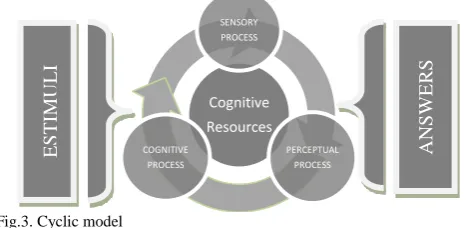
Taking into account the considerations of Rassmusen [5], activation can come from any of these three processes.
Following this model, human behavior could start for any of the three processes; the answer might be in the same way, any of the three as in Fig. 3.
Fig.3. Cyclic model
It is important to remark that by definition the perceptual process cannot enable the behavior by itself when it does it is a disease, such a hallucination. From the point of view of engineering this issue is discarded.
Traditional models take into account the human behavior as a result of a serial cognitive process. This resulted in taxonomy according to the model, of types of errors according to the process.
Rasmussen [5] is based on skill, rules and knowledge. Swain and Guttman [16] classify the errors into two types: omission and commission. Spurgin [17] makes a system-oriented classification. Payne and Altman [18] are based on taxonomy of information processing input error, associated with the perceptual process, error of meditation associated with cognitive or mental processes and output errors due to the selection and implementation of physical responses. Reason [19]-[20] is based on actions that were not planned. From the point of view of the cycle model errors are a failure or cut in the cycles.
The different models studied show different views. All provide important consideration, but none is comprehensive.
III. MODELING HUMAN RELIABILITY
The purpose of make models is to understand the phenomena of reality and maximize their usefulness. This desire is related to the relationship between three main features of any model: complexity, credibility and uncertainty. An important aspect to be taken into account in the preparation, evaluation and use of any scientific model is associated uncertainties. The uncertainty becomes very valuable when considered in conjunction with other features of the model. In general, allowing more uncertainty tends to reduce the complexity and increase the credibility of the resulting model [21].
The nature of uncertainty depends on the mathematical theory which formalizes the problem. Each mathematical theory is able to capture only certain types of uncertainty. The more general the theory more types of uncertainty captured.
Classical mathematical theories to characterize situations under uncertainty are set theory and probability theory.
From mid 60´s, have developed generalizations of these classical theories to formalize the different types of uncertainties. Currently available are well justified measures
ACTIVATION HUMAN BRAIN ANSWER
ACTIVATION SENSORY
PROCESS
PERCEPTUAL PROCESS
COGNITIVE
PROCESS ANSWER
Cognitive Resources
SENSORY PROCESS
PERCEPTUAL PROCESS COGNITIVE
PROCESS
ANSW
E
R
S
E
STI
MU
L
[image:2.595.48.286.363.403.2]of uncertainty for the relevant types not only the classical theory of probability but also sets and fuzzy sets theory, potential theory and the Dempster-Shafer theory [21]-[22].
The fuzzy sets not only provide a good representation of the magnitude of the uncertainties. They also represent vague concepts expressed in natural language providing flexibility to the models obtained.
According to Klir and Yuan [21] the uncertainties can be: 1) Fuzziness: related to the lack of well-defined edges or
borders or accuracy of a set. The measure of uncertainty in this case would be the distance between a fuzzy set and its crisp set.
2) Ambiguity:related to the lack of clarity in the choice of an alternative. The measure of uncertainty is the measure of the size of the set of possible alternatives. This may be due to non-specification (lack of certainty in the characterization of an object) or discordance (conflicting characteristics).
IV. UNCERTAINTIES IN THE CLASSICAL MODELS In the following the uncertainties identified in the main classical models are introduced.
A. Error modes models
Swain and Guttman [16] classify human errors in: 1) Omission errors: reflect failures to perform an action.
Often occur when an individual forgets the realization of something.
2) Commission errors: refer to those times when an action is performed incorrectly.
3) Sequencing errors: occur when a certain action or behavior is done out of sequence.
4) Temporary errors: reflect those times when an individual performs an action on an improper time, either too fast or too slow.
This terminology is now widely used and generally covers almost all possible types of errors. However, this classification is far from being specific and provides little or no evidence of the causes of error and associated mental limitations [23].
This simplification of human behavior doesn’t take into account the principle of minimum uncertainty [22]. This simplification leads to take into account a minor number of variables (not including mental limitations) leading to a significant increase in uncertainty. The attempt to reduce the number of alternatives (reducing ambiguity) caused a large increase in the gray area in each of the sets.
B. Error levels models
Payne and Altman [10] classify the error into three basic levels based on the information processing system:
1) Input errors that are attributable to sensory and perceptual processes.
2) Errors associated with the mediation of cognitive process.
3) Output errors due to the selection and implementation of physical responses.
Berliner et al. [11] add a level, the communication errors. This classification is not taxonomy of error in itself. It is useful to categorize specific behaviors associated with information processing activities.
With some modifications, the taxonomy can be adapted to classify such errors on several levels:
1) Failure of perception (large level) 2) Failure of search (intermediate level) 3) Failure detection (detailed level)
This classification is to find the human error part of the information processing system.
Wickens [12] proposes the concept of limited resources, cognitive and memory (including investigations of Baddeley´s working memory [24]) and attention. Also proposed that these resources are shared in the execution of a task.
The inclusion of variables attempts to reduce ambiguity in determining the type of error, but taking the behavior process as serial and therefore ignoring the effects of cognition on sensory and perceptual processes. Ambiguity becomes a disagreement or conflict in characterizing errors.
The membership of a particular type error has no clearly defined borders.
B. Rasmussen model
Rasmussen [5] notes that does not exist a one to one relationship between task performance external and internal human functions (intentions, expectations, goals and values that guide action and the search for information).
Mechanical errors and failure modes depend on mental functions and skills that are activated by external events and subjective factors.
Mental function and subjective factors cannot be observed but must be inferred from the characteristics of the task and the status of work in conjunction with the external manifestations of error.
According to Rasmussen, is possible a model of human information processingwhich should relate elements of human decision making and internal processes for which they can identify limitations and psychological mechanisms. This idea makes it impossible to observe (measure) mental function and subjective factors. These must be inferred from observations of physical behavior, one more argument considered in the second principle of uncertainty [22]: the principle of maximum uncertainty.
Rasmussen [5] in a critique of the taxonomy of Swain and Guttman, argues that this taxonomy is inadequate and simple human error should be classified in terms of human characteristics. Moreover, he argued that taxonomies should include the analysis not only for basic manual task, but also components of internal cognitive tasks and associated psychological mechanisms in both. Neither refers to the will. This significantly reduces the variables.
This model distinguishes human performance at three levels: skill-based behavior, rules and knowledge.
According to Dougherty [25], the ambiguity in the interpretation of the three levels difficult to define transitions between levels.
Dougherty also questions the validity brain of behavior based on rules and knowledge. He cites evidence from the point of view of the evolution and artificial intelligence, which suggests that the brain does not store rules (some may be in complete disagreement).
In the previous discussion the uncertainties are evident in bad-defined sets and ambiguity in the lack of certainty in the characterization of the three levels.
C. Slips, lapses, mistakes and violations model
Reason’s ideas [19]-[20] rests on the notion of intentionality, comprising two elements: an expression of the final state to be achieved and the indication of the means of achieving that objective. It distinguishes between slips and lapses, which are the error resulting from some flaws in the implementation phase and / or storage of a sequence of actions, regardless of whether the plan which guided them was adequate to achieve the objective. Lapses are potentially observable as actions not as planned. Lapses (failure of memory) can be hidden unless it becomes apparent that something was not done.
Intentional actions can proceed as planned, but failing to achieve the desired result. These errors are called mistakes.
This classification is limited to actions as they were not planned and does not rank test errors, planning and decision making. However, the types of errors can be used in a classification system that includes memory misperceptions and implementation, as part of a comprehensive classification.
Reason proposed another conceptual work which can locate the origins of the basic types of human error (Generic Error-Modelling System, GEMS).
The method borrows from the work of Rasmussen to establish three basic types of error: slips and lapses based on skills, rule-based mistakes and knowledge-based mistakes. It has the gaps in the structure.
Kirwan [27] say that much is left to the imagination and intuition of the analyst to classify and reduce errors. The use of terms difficult to understand introduces uncertainties.
This classification of modes of action left behavior that can hardly be attributed to one category or another.
D.Symbolic processing model
This model is based on artificial intelligence and cognitive engineering [28].
The symbolic processing model is the knowledge structures and mental models as determinants of human performance, including both the form or representation of knowledge and content representation. This model attempts to articulate the form and content of internal representations of knowledge based on analysis of the requirements of the tasks and analysis of human performance details to perform these tasks.
Representation, activation and use of different types of knowledge play a central role in this model. Norman [29] and Reason [20] models made the source of theoretical studies about the sources of error in terms of activation of knowledge structures or schemes inappropriate, and related empirical work in human error [30]-[31] are linked to this tradition of symbolic processing.
Symbolic processing became the dominant theoretical positions in psychology and cognitive science, and very popular in the modeling of behavior in complex dynamic environments such as nuclear power plants.
The work in this line has emerged from cognitive psychology and cognitive science have developed theories to explain human intelligent behavior, and computer science which aims to develop machines that show intelligent behavior (e.g. expert system).
This model does not result in a good model of human reliability but fuzzy neural network is the main techniques used for its implementation due to its inherent nature.
E. Expert judgment-based models
Expert judgment on tasks is modeled to evaluate human reliability. It is an empirical techniques introduced to estimate operator errors [1].
New technologies emerge every day in response to a variety of needs [32]. In research and development project portfolio selection, the agencies responsible for budget allocation must make the crucial decision of which project to fund. A quantitative, objective decision-making process necessarily avoids internal strife amongst decision-makers and contributes to a more unbiased process. The fuzzy logic approach [32] provides an alternative to clustering in choosing amongst non-dominated solutions.
Formal elicitation of expert judgment draws from the fields of cognitive psychology, decision analysis, statistics, sociology, cultural anthropology, and knowledge acquisition. It entails the use of specific procedures to identify the experts, define the technical problems, and elicit and document expert´s judgment. Expert judgment may be expressed as probabilities (either point estimates or as probability distribution functions) or fuzzy terms (for example, low, medium, high). There are some guidelines determining whether expert judgment can be better elicited in a probabilistic or fuzzy framework [33].
V.HUMAN RELIABILITY ANALYSIS
Human Reliability Analysis can be defined as a method by which human reliability is estimated. To estimate human reliability, a Human Reliability model should be formulated first [1].
Nowadays some methods have been developed with fuzzy logic approaches. However, in the current literature there is no comprehensive model that identifies the uncertainties associated.
Human error probability is the probability that an error will occur during the performance of a given task. It is associated with a level of uncertainty in order to consider imperfect knowledge and variability of human performance. The uncertainty is applied to reflect an anticipated spread of Human Error Probability across the assumed distribution. The uncertainty applied is different from a significance level in the sense of statistical confidence limits.
Performance shaping factors are described as any factors that can influence human performance. In literature, performance shaping factors is considered as distinctive and independent factors. There can be interrelationships among the factors considered. These factors are introduced in the second generation of human reliability analysis and relay on expert judgment introducing uncertainty.
Fuzzy logic based approaches in Human Reliability Analysis may provide a new direction to the analysis of human error or reliability. Compared to the conventional approaches, fuzzy approaches can be considered as a feasible way of quantifying the non-crisp, imprecise, and vulnerable information of operator performance.
VI. UNCERTAINTIES IDENTIFIED
According to [34] the paradigm described related to types of uncertainties is:
1) Uncertainty regarding the link between the observed and the universe of possible information (traditionally treated with statistical sample model).
2) The imprecision in the measurement of empirical phenomena (this causes inaccuracies in the statistics). 3) The vagueness connected with linguistic terms.
4) The total or partial ignorance concerning the values of the phenomenon in instances of specific observation (e.g. missing information), or referred to theoretical assumptions.
5) The inaccuracy resulting from the granularity of the terms used in describing the physical world (related to the general notion of linguistic variable whose grains are sets of values drawn together by not distinguishability, similarity, proximity or functionality). It refers to general cognitive process including the definition and use of models, theoretical assumptions, etc.
According to this discussion the following uncertainties are founded:
1) Randomness of the stimulus itself. There is an inherent variable in the physical phenomena that affect the various parameters of the stimuli. They are treated with statistical methods.
2) Vagueness in the language. There is a vagueness associated with the use of linguistic terms as low, high, long, short, etc. It is treated with fuzzy quantifiers. 3) Ambiguity in the cognitive resources needed to process
the stimulus. The unified theory of human reliability model requires that the error occurs when there is a discrepancy between resources needed and available. The determination of the necessary resources is ambiguous because it cannot be determined with absolute precision. It deals with fuzzy quantifiers. 4) Ignorance of the exact functioning of the process. The
uncertainty associated with the complexity of model, cognitive processes are not yet fully discovered. The way to reduce this uncertainty is through the inclusion of new discoveries in cognitive science.
5) Ambiguity and vagueness in the boundaries of the threads. There is no clear boundary between the three threads; in fact only three sub-divisions are purely arbitrary and explanatory. It deals with fuzzy quantifiers. 6) Imprecision in determining the position of the cutting cycle. One of the objectives of human reliability model is to give an explanation of the causes of human error. The determination of the cutting position in human error meets this goal and is a basis for the placement of emergency systems. The imprecision is deals with probabilistic methods and fuzzy quantifiers.
7) Randomness of cognitive resources between individuals and the actual availability. Resource variability and the actual availability depend on the performance shaping factors that deal with fuzzy and probabilistic methods. 8) Imprecision in the knowledge of resources. This is
another point of including advances in cognitive science.
9) Ambiguity in determining the resource used, related to the item 8. The description of just some of the possible cognitive resources results in blurred boundaries and imprecision in which resources are used effectively and in what degree. Fuzzy quantifiers are used for treatment. 10) Imprecision in determining the answer. Given certain
circumstances, it is possible to determine the different alternatives responses. There is an uncertainty associated with the determination of each alternative. Probabilistic methods are used for treatment.
11) Answer ambiguity. In addition to the uncertainty in the determination of the response is a fuzzyfication of borders of each alternative. Fuzzy quantifiers are used for treatment.
VII. UNCERTAINTY AND FUZZY LOGIC
In the literature [35] three types of uncertainties are well identified:
1) Probabilistic uncertainty
2) Random nature and lack of specification 3) Linguistic imprecision or vagueness
Probabilistic uncertainty expresses ignorance. Random nature expresses which of the two hypotheses is true and lack of specification is a hypothesis which specific value represents the answer. Linguistic imprecision or vagueness is called fuzzy uncertainty. It differs from probabilistic uncertainty and no specificity because it deals with situations where set boundaries are not sharply defined.
According to [35] a critical analysis of different conceptual aspects of uncertainty reveals that each type of uncertainty may have different facets. This requires finding a set of desirable axioms for characterizing total uncertainty.
VIII. CONCLUSION
In the literature there are many models from different points of view to represent human reliability. There is not a comprehensive model covering all assumptions.
Some old techniques have incorporated fuzzy approaches but they represent one of the present models.
It is necessary a new model that covers the different points of view, identify the uncertainties associated with them and facilitate the implementation of the most appropriate technique for its treatment.
In order to obtain a comprehensive model the major uncertainties have been identified. They can be one of three types of uncertainty, namely, probabilistic uncertainty, no specificity and fuzziness.
In this work two aspects are evaluated (traditional models and cyclical process model). Traditional models take human behavior as the result of a serial or quasi-serial cognitive process. In the cyclical process model, behavior is part of an interaction of neural systems and environmental. From this point of view, the errors did not belong to taxonomy, but rather to a failure or cut in this cycle. From both points of view is desirable to obtain a new comprehensive model. This new model must consider all uncertainties identified and find how the interaction between them is.
REFERENCES
[1] L.V.Utkinand and F.P.A.Coolen, ¨Imprecise Reliability: An Introductory Overview¨. Springer-Verlag Berlin Heidelberg, 2007, Computational Intelligence in Reliability Engineering (SCI), Vol. 40, pp. 261-306.
[2] B.J.Kim and R.Bishu, ¨Uncertainty of human error and fuzzy approach to human reliability analysis¨. World Scientific Publishing Company, 2006, International Journal of Uncertainty, fuzziness and Knowledge-Based Systems, Vol. 14, pp. 111-129.
[3] P.Marsden and E.Hollnagel, ¨Human interaction with technology: The accidental user¨. Acta Psychologica. Volume 91, Issue 3 SPEC. ISS., April 1996, Pages 345-358
[4] W.J.Clancey, ¨Situated cognition: stepping out of representational flatland¨. 2/3, s.l. : AI Communications, 1991, Vol. 4, pp. 109-112. [5] J. Rasmussen, ¨Human errors. A taxonomy for describing human
malfunction in industrial installations¨. Journal of Occupational Accidents, 1981, vol. 4, pp. 311-333.
[6] D.D.Woods, H.E.Pople and E.M.Roth, ¨The cognitive environment simulation as a tool for modeling human performance and reliability¨. Proceedings of the Human Factors Society, 1990, pp. 1132-1136. [7] S.Franklin, ¨The role of consciousness in memory. 2005, Brains,
Minds and Media, pp. 1-38.
[8] J.B.Crutchfield, ¨Chaos¨. 1986, Scientific American.
[9] W.J.Freeman, ¨The physiology of perception¨. 1991, Scientific American, pp. 78-85.
[10] D.Payne and J.Altman, ¨An index of electronic equipment operability¨. American Institute of Research. Pittsburgh - Pensylvania, 1962. Report AIR-C-43-1/62.
[11] D.C.Berliner, D.Angelo, and J.Shearer, ¨Behaviors, measures and instruments or performance and evaluation in simulated environments¨. Albuquerque - New Mexico, 1964. Symposium on the Quantification of Human Performance.
[12] C.Wickens, ¨Engineering Psychology and human Performance¨ (second edition). New York - Harper-Collins, 1992.
[13] Y.Miyata and D.A.Norman, "Psychological Issues in Support of Multiple Activities", User Centered System Design, New perspectives on Human-Computer Interaction, Lawrence Erlbaum Associates, 1986, pp. 265-284.
[14] A.Baddeley, ¨Memoria humana: teoría y práctica¨. Madrid : McGraw Hill, 1999.
[15] D.A.Norman and T.Shallice, ¨Attention to action: Willed and automatic control of behaviour¨. Consciousness and Self-Regulation, 4, pp. 1-18. 1986.
[16] A.D.Swain and H.E.Guttmann, ¨A handbook of human reliability analysis eith emphasis on nuclear power plant applications¨. Applied Ergonomics, 1983, vol. 16 (1), pp. 68.
[17] A.J.Spurgin, B.D.Lydell, G.W.Hannaman and Y.Lukic, ¨Human Reliability Assessment: A Systematic Approach¨. Birmingham - England, 1987. Reliability ´87 vol. 2.
[18] D. Payne and J.Altman, ¨An index of electronic equipment operability¨. American Institute of Research. Pittsburgh - Pensylvania. 1962. Report AIR-C-43-1/62
[19] J. T. Reason, ¨Actions not as planned: The price of automatization¨. [ed.] Underwood and R. Stevens. London : Willey, 1979. Vol. 1: Psychological issues.
[20] J. T. Reason, ¨Human error¨. England : Cambridge University Press, 1990.
[21] G.J.Klir and Bo Yuan, ¨Fuzzy sets and fuzzy logic¨. New Jersey : Prentice Hall, 1995.
[22] G. J. Klir, Principles of uncertainty: What are they? Why do we need them? Fuzzy Sets and Systems Vol. 74. 1995. pp. 15-31
[23] European Organization for the safety of Air navigation,¨Technical review of human performance models and taxonomies of human error in ATM (HERA)¨. 1° Ed. 2002. EATMP Stakeholders
[24] A.Baddeley and G.Hitch, ¨Working memory¨.s.l. : Academic Press, 1974. The Psychology of learning and motivation. pp. 47-89. [25] E.M.Dougherty, SRK - It just keeps a rollin’. Reliability Engineering
and System Safety, 1992, vol. 38, pp. 253-255.
[26] E.Hollnagel, ¨Human Reliability Analysis: Context and Control¨. London : Academic Press, 1993.
[27] B.A.Kirwan, ¨Guide to practical human reliability assessment¨. London : Taylor and Francis, 1994.
[28] A.Newell, and H.A.Simon, ¨Human problem-solving¨. London : NJ:Prentice Hall, 1972.
[29] D.A.Norman, ¨Categorization of action slips¨. 1981, Psychological Review, Vol. 88, pp. 1-15.
[30] D.T.McRuer, W.F.Clement and R.W.Allen, ¨A theory of human error¨. Systems Technology Inc. 1980. Technical report 1156-1.
[31] C.P.Langan-Fox and J.A.C.Empson, ¨Actions not as planned in military air-traffic control¨. 1985, Ergonomics, Vol. 28, pp. 1509-1521.
[32] S.Riddell and W.Wallace, ¨The use of fuzzy logic and expert judgement in the R&D project protfolioselection process¨. A. 2-4, 2011, International Journal of Technology Management, Vol. 53, pp. 238-256.
[33] M.A. Meyer, ¨Guidelines for eliciting expert judgment as probabilities or fuzzy logic¨. Fuzzy logic and probability applications:bridging the gap. 2002.
[34] R.Coppi, M. Gil and H. Kiers, ¨The fuzzy approach to statistical analysis¨. 2006, Computational statistics & data analysis, pp. 1-14. [35] N.R.Pal. ¨On quantification of different facets of uncertaity¨. 107, s.l.: