Page 66
WORKING PROCESS-INTEGRATED PROJECT COURSE IN COMPANIES Frank Fuchs-Kittowski, Jörn Freiheit, Juliane Siegeris
Hochschule für Technik und Wirtschaft Berlin, Wilhelminenhofstr. 75a, D-12459 Berlin, Germany
Abstract
In this paper, the concept of the project course in the career-integrated master’s programme “Professional IT Business” at the HTW Berlin is described. The concept comprises multiple elements that enable and support work-process-integrated learning (learning in real working environments). It is an innovative solution for competency development through project-oriented, work-process-integrated teaching and learning methods in cooperation between the University of Applied Sciences and companies.
Key words: project course, work-process-integrated learning, project-oriented learning, companies
1. INTRODUCTION
Project-oriented teaching and learning methods (project courses) facilitate the development of professional skills and competence (Tippelt 1979). As a result, project courses are already part of the curriculum in many study programmes (Liebehenschel 2013) and serve to strengthen the practical relevance of study programmes (Kruse 2009; Kleuker et.al. 2011).
Project courses are often carried out directly in companies (Siegeris et.al. 2015). The students experience real working environments and take on tasks in real projects, whereby they can apply their knowledge in practice and gain new experience (Lewerentz & Rust 2001; Baaken et al. 2016). In this way, the learning is shifted into real work processes (using the place of work as a learning location) and is focused on real work tasks instead of on fixed, prescribed contents/curricula. Terms such as “learning by doing” or “trainee programme” describe similar concepts in a company context. Learning in the work process, whereby the students independently fill gaps in their knowledge during the work, puts the emphasis on self-organised learning processes and competency development.
The skills that are promoted in the course depend fundamentally on the way in which the project-oriented teaching and learning sessions are organised and implemented. Three factors are especially important (Jung 2009):
the content and framework of the project the teachers and their style of mentoring
the students and their willingness to tackle the challenges presented by the project.
During the project work, a number of challenges arise for both students and teachers due to the fact that students are working on different projects and within different frameworks in their respective companies:
How can project work and learning be sensibly connected?
How can it be ensured that the learning objectives are met and that competence is developed? How can guidelines for the learning targets, tasks, and skills to be achieved within the project be
created?
How can students be adequately supported during their project work?
How can students’ performance and learning achievements in projects be compared and evaluated?
Page 67
degree programme “Professional IT Business”. In the project course, students learn as part of the work process in real-world projects (practical projects) in (their own) companies. The students organise the “learning-at-work” themselves but receive extensive personal and technical support. A process-oriented curriculum, the so-called “reference project”, provides the structure of the project course. It serves as a model for the selection of the practical project, the planning of the working and learning processes, and also the verification of the successful completion of the project course. All processes of the reference project must be verifiably mastered by dealing with them, reflecting on them, and documenting them. In this article, the essential building blocks of this concept are presented.
This article is structured as follows: after a brief introduction to the career-integrated master’s programme “Professional IT Business” and the “project course” module, the didactic concept of this module is presented. This includes a) the reference project as a process-oriented curriculum, b) the learning-at-work approach, and c) organisational and technical tools for supporting the students. An example of a process-oriented curriculum (reference project) based on a data analyst is described. A summary and outlook is given at the end of the article.
2. CAREER-INTEGRATED MASTER’S PROGRAMME “PROFESSIONAL IT BUSINESS” More than 13,000 students study in 70 different degree programmes in the areas of design, computer science, culture, technology, and business at the University of Applied Sciences Berlin (HTW Berlin), the largest university of applied sciences in eastern Germany. Seven degree programmes have a strong focus on computer science with different professional orientations.
The “Berlin Institute for Advanced Higher Education of the HTW Berlin” (BIfAW) has been set up at the HTW specifically to supervise the fee-paying master’s programmes as well as those bachelor’s and master’s programmes offered as distance learning courses, and to group the university of applied sciences’ further education possibilities (HTW Berlin 2014). The “Professional IT Business” career-integrated master’s programme is carried out under the umbrella of the BIfAW.
2.1 Curriculum of the degree programme
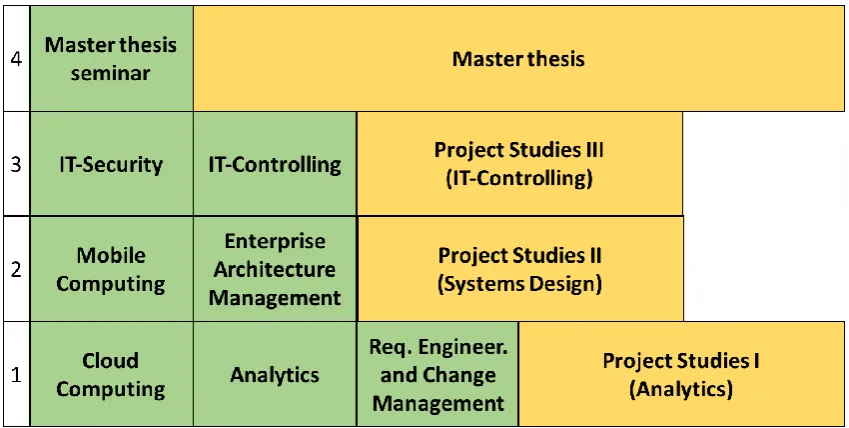
The curriculum of the degree programme (see Figure 1) has been developed since 2013 by professors in the HTW in cooperation with representatives from the companies IBM, SAP, BVG (Berliner Verkehrsbetriebe), KPMG, Bosch, and RBB (Rundfunk Berlin Brandenburg).
Page 68
Students earn 90 credit points in total in the master’s programme, 25 credit points each in the first and fourth semesters and 20 credit points each in the second and third semesters.
The courses “cloud computing”, “analytics”, and “requirements engineering and change management” are conducted in the first semester. In “cloud computing”, cloud concepts and architectures are introduced and applied. “Requirements engineering and change management” deals with the organisational and technical transition in IT companies. The “analytics” course covers methods for analysing structured and unstructured data in order to achieve business goals. This provides the basis of the course “project study I” – also to be completed in the first semester – in which a project on the topic of analytics is completed.
In the second semester, the course “mobile computing” introduces mobile, decentralised systems using modern technologies. In “enterprise architecture management”, system landscapes are designed, modelled, and analysed using, for example, UML (Unified Modelling Language) and ODP (Open Distributed Processing). “Project study II” deals thematically with the design of a system.
In the third semester, the “IT security” course examines security architectures and attack scenarios, among other things. Topics addressed in the “IT controlling” course include total-cost-of-ownership-analysis and the calculation of transaction values, return on investments, and business cases. The topic of the course “projects study III”, to be completed in the third semester, is “IT controlling”.
In the fourth semester, the main task is the preparation of the master’s thesis. This is accompanied by a master seminar.
2.2 Career-integration
Career-integrated study in the master’s degree course “Professional IT Business” is subject to a fee. A place on the course currently costs €16,500. The study fees are usually paid by the companies. These companies enable their employees to study not only by covering the costs but also by granting their employees enough freedom with their work time to pursue their studies. In order to enter the programme, students must hold a bachelor’s degree and have at least one year of professional experience, acquired following their degree.
During the semester, the students work in the companies from Mondays to Thursdays and attend courses at the University of Applied Sciences on Fridays and Saturdays (eight hours per day). The students’ work load is very high, totalling 1,125 hours per year.
The students require the support of their companies beyond just paying the fees. The companies must ensure that the students have enough time for their studies as well as place them in suitable projects. As the students could not accomplish their studies without the support of the companies, the companies are committed to the programme by contract. The companies pledge to accept a certain number of student places and to support their employees throughout their studies.
The motivation for the successful completion of the degree is high among both the students and the companies. On the one hand, the companies benefit from having highly-qualified employees and on the other hand, they use the study positions as a means of acquiring and retaining employees. The students are offered a neat solution to the typical dilemma of whether to work and earn money following their bachelor’s degree or to first complete a master’s degree.
Page 69 3. THE “PROJECT STUDIES” MODULE
In the first three semesters, each of the students carries out a project course with a different thematic focus:
Analytics (1st semester)
IT architecture design (2nd semester) IT controlling (3rd semester)
In addition to the various specialist areas, different social skills are also taught: Communication skills
Leadership skills
Negotiation and sales skills
The theme of the project course in the first semester is “analytics”. The students apply the knowledge gained in the accompanying lecture course “analytics” to a project, which is (ideally) carried out in their respective companies. In addition to the main focus of the projects, special emphasis is placed on the further development of communication skills. In particular, intercultural communication and the ability to reach a compromise are trained.
“Project study II” in the second semester deals with systems design. In addition to the main subject, leadership skills are trained, especially in the case of redesigning and transforming organisational systems.
The topic of the “project study III” in the third semester is the controlling of IT projects. It also trains negotiation and sales skills as students apply negotiation strategies as well as practise emotional selling and conscious communication.
The project courses do not require a presence at the HTW except for the introductory sessions, the interim presentations and the final examinations. Rather, it is envisaged that the students carry out the project course in and at their company.
4. DIDACTIC CONCEPT OF THE PROJECT COURSE
The concept of the project course does not only cover learning and working on a task in a company, but it also integrates real work processes and real projects: it is process and practice-oriented. This concept for the project course is based on the concept of work-process-oriented further education, as an example of a process-oriented form of extra occupational further education (Fuchs-Kittowski et al. 2001; Rohs & Mattauch 2001; Caumanns & Mattauch 2003).
The project course is therefore carried out according to the following principles: process-oriented (the learning takes place within work processes)
experience-led (work itself is a thing of learning and reflection) self-driven (the learning process is self-controlled)
participant-oriented (the work processes are unique and specific to the actual project, but the learning content is not random)
In order to systematise and support such learning processes in the workplace, in the work process, and in real-world projects, the following points were developed:
process-oriented curricula (reference projects) an approach for learning in the work process
Page 70 These are presented in the following sections.
4.1 Work processes as learning content (reference project as a curriculum)
The central component of the didactic concept is the process-oriented curricula for the different project course semesters or activity profiles (data analyst, IT architecture designer, IT controller). Knowledge and activity should be closely interconnected and relevant to real-world practices.
Educational content is usually specified according to a particular subject or subject classification. In contrast, the learning contents of the project course are defined on the basis of work processes. For each semester or profile of the project course, work processes typical of the profile are described. This places the emphasis on actions rather than specialist knowledge.
So-called reference projects have been developed as the process-oriented curricula. A reference project represents an idealised, generalised project for the given profile, based on the associated work processes. The typical work processes of a particular profile are specified in terms of abstract procedures of ideal projects. These reference processes, in turn, represent a sequence of tasks at a relatively high level of abstraction and include practically all activities characteristic of the profile in their typical order of execution. The reference processes thus represent all the activities of given profile in a sequence corresponding to real-world practice.
Each activity (activity bundle) in a reference process is further detailed in terms of sub processes. The necessary skills, knowledge, and tools are described at the level of the work performed. The processes do not only convey dry facts, but also directly enable practical work.
The reference projects are used as concrete curricula for the project courses and set fixed learning targets for each project profile. These should not (and cannot) be misconstrued as learnable facts, but instead can be understood as generalised descriptions of a project. The reference projects are the benchmark according to which the course participants carry out their own projects.
The ability of the students to successfully carry out a real project and to acquire the necessary knowledge and skills is assessed. The concrete lessons learned are determined by the performance (and the prior knowledge) of the participants. However, the reference projects define the level, complexity, and scope of the abilities and skills to be acquired.
The students and/or the companies look for a suitable “practical project” on the basis of the reference project. The practical project must be sufficiently similar to the reference project in order to be approved for the project course. The reference projects are open and neutral, allowing for a wide range of practical projects. The reference project structures the entire process of learning and working during the actual practice project.
4.2 Learning in real work processes
Page 71
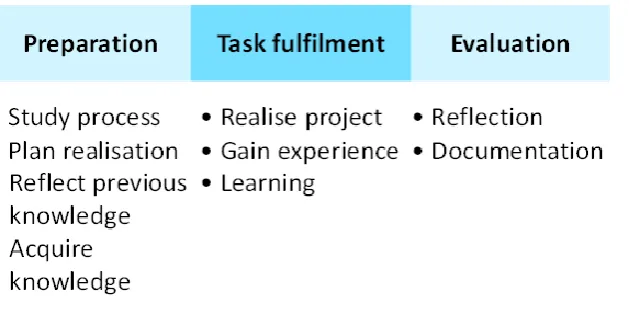
Fig. 2. The sequence of learning in the work process
The reference project structures the project course. As outlined before, it shapes: the selection of the practical project
the planning of the work and learning processes in the practical project
the means of verifying the successful completion of the project course, i.e., all subprocesses of the reference processes must be demonstrably fulfilled by individually addressing and documenting them.
During the practical project, the student must prepare, execute, and finally evaluate every step that is included in the reference processes, for example, a subprocess (see Figure 2).
In the “preparation” phase, the student plans the work process and acquires the necessary knowledge. The reference process helps with the preparation, making the students’ own work process more predictable and manageable. In this way, the students learn to have a process-oriented view of their work and to “think in terms of the processes”.
The “execution” phase deals with individual steps as well as the project as a whole. Practical work is used to learn and gain experience. The students learn “action in processes” by completing their tasks in the practical project according to the specifications of the reference processes.
Once the tasks have been completed, they are reflected upon in the “evaluation” phase, thereby securing the knowledge gained and the lessons learned. Through reflection discussions and documentation, the students not only reflect and document the individual process steps, but they also get an impression of the entire process.
Reflection discussions help students to transfer work experiences into learning outcomes and finally into competency: the participants describe their work processes, evaluate them together with the tutors (see below) by addressing such questions as “What went well or badly?”, “What was learned?”, “How was it learned?”, decide how to continue with the project course, and agree on the necessary learning steps.
The documentation is a detailed description of the concrete procedures and learning processes in the practice project. It should therefore not be compared with technical documentation or project documentation. Through writing the documentation, the students learn to describe their work, evaluate it, and communicate in a process-oriented manner.
Page 72
In all three phases, the students receive organisational and technical support.
4.3 Organisational and technical support
The students acquire the necessary knowledge during the real work process and independently organise their own working and learning process. The students are supported with respect to content and personnel through the use of modern information and communication technologies.
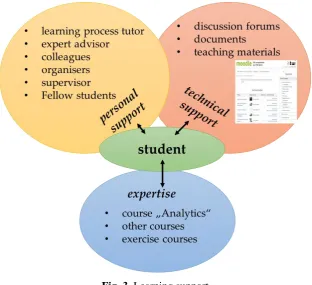
Fig. 3. Learning support
In order to support the students in relation to content, a classical lecture course is offered parallel to the project course for the respective profile in that semester (data analyst, IT architecture designer, or IT controller). The purpose is to provide the expertise necessary to carry out the project. However, as a classical lecture course (two hours of lectures and two hours of exercises per week), only selective, in-depth knowledge is conveyed (e.g., specific analysis techniques) but the full set of activities of a given profile cannot be covered (e.g., data analyst).
Furthermore, the student has access to various roles (personnel) at the University Applied Sciences and the company. The following functions must be covered:
Expert advisers are available for specialised, technical questions. These advisors include the lecturer of the accompanying course at the University of Applied Sciences and experienced colleagues in the company. The expert adviser also aids with the selection of the practical project and arranges substitute activities if certain individual activities (subprocesses) cannot be carried out.
Page 73
competencies are required in the area of the methodology of work-process-integrated learning, especially relating to reflection on learning outcomes. This role is typically performed by a lecturer from the University of Applied Sciences who may even have been specially trained.
Organisers are responsible for the smooth running of the project course. They are available to students throughout the duration of the course as the central point of contact for any problems encountered during the course, including administration of technical support. Communication (especially with and among the students) must be organised. No special qualifications or competencies are required for this role. Only the ability to organise and conduct seminars is necessary. An additional challenge compared to a traditional lecture course is the communication with the companies as well as the fact the communication with the students is predominantly in digital form due to the low attendance required at the University of Applied Sciences.
Problems and experiences can be exchanged with colleagues and other students.
Superiors provide working conditions for the students that promote learning and create a suitable learning culture in the department, in particular by encouraging openness among the employees and a willingness to pass on knowledge. In order to ensure the necessary time and space for learning processes in the projects, appropriate arrangements and agreements are made with the students’ companies and superiors as part of the admittance procedure into the programme. Additionally, each superior is sent a leaflet on “conditions conducive to learning” at the beginning of the project course, in which it is explained that the students must be provided with the necessary time and learning resources including a learning-conducive working environment, working atmosphere, and work process.
However, the students remain responsible for their own project study.
The concept presented requires extensive technical support for all parties involved. A learning and communication platform (Moodle) is currently available as technical support and provides the following components:
Support for individual learning (self-study) by providing materials and learning content as well as supporting documents (e.g., templates for the project outline and documentation).
Support for communication between participants with the aim of combining individual and collaborative learning. A discussion forum is available for this purpose, in which the students can ask questions and present their problems. Both the tutors and fellow students can answer these questions and provide supportive comments.
Support for the exchange of information through the mutual provision of activity records. The project outlines and the project plans are first examined internally by the tutors. However, the final versions following any necessary changes are made available to all students of the project course in the spirit of mutual information exchange.
The unification of the entire project as a process thus allows for a better exchange of information and experiences among the students.
5. THE “DATA ANALYST” REFERENCE PROJECT
In the reference projects, the three profiles of the project course (data analyst, IT architecture designer, IT controller) are characterised by their typical work processes and activities.
Each reference project contains:
the reference process, which is characteristic of the profile (see Figure 4)
Page 74 an illustrative example
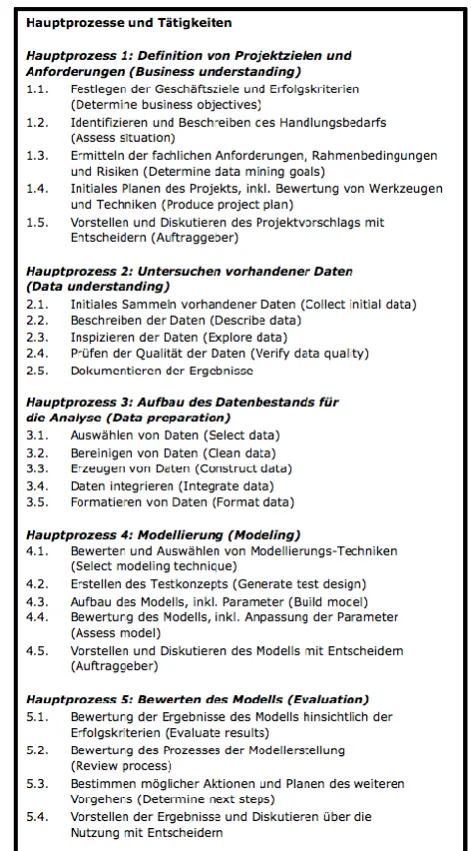
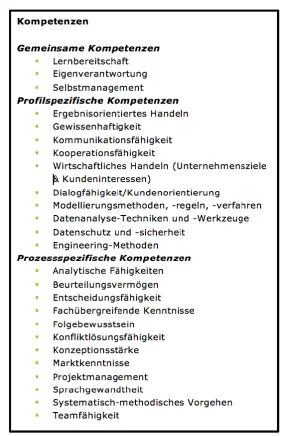
The use of reference projects as curricula is one of the fundamental tenets of the project course. Different methods can be used to create the reference projects. While the reference project for the “IT architecture designer” resulted from the analysis of a large number of project descriptions, the “data analyst” and “IT controller” reference projects could draw on existing standards. The reference project of the “data analyst” is based on the practice standard “Cross Industry Standard Process for Data Mining (CRISP-DM)” (Chapman et al. 2000). This description must still be expanded in relation to the competencies that should be developed and relevant activities in the area of communication (presentation, discussion, documenting, etc.). Figure 4 shows the main processes and subprocesses of the “data analyst” reference project.
Fig. 4. Reference process for the “data analyst” profile
Page 75
Fig. 5. Competencies in the “data analyst” profile
6. VERIFICATION AND EXAMINATIONS
Classical examinations (in the sense of knowledge surveys) clearly contradict the concept of the project course that has been presented. Nevertheless, a review must be carried out in order to assess the level of the students as both the students and the companies require a concrete certificate at the end of the course. Thereby, the evaluation process has to guarantee the integral assessment of the students, according both academic and professional profile.
The benchmark is already defined by the reference project and conformity to this is ensured by the selection of suitable practical projects. The level and success of the practical projects are demonstrated by means of the documentation prepared by the participants.
Page 76
In addition to the reflection discussions, the students reflect on their learning and work process within the context of the documentation that they prepare. This provides the basis for the exam, but it also has additional, important functions for reflecting on the learning process:
Processes: An overview of the practical project is given based on the description of the processes of the reference project (activities performed). For each subprocess, the challenge, procedure, and result of the activity, along with the methods and tools used, are described.
Key situations: This is where special situations (generally not subject-specific) that have occurred during the course of the project are described. The participants present the problem, the result or solution, and the learning outcome.
The written documentation is one of two examinations. The second is an oral exam, which also consists of two parts:
Presentation: Within the framework of a presentation, the students present their projects by describing the most important processes and key situations in order to provide evidence of the acquired competencies.
Discussion: In the discussion following the presentation, the examiners verify the execution of the project and, if necessary, examine competencies that appear to be missing or not satisfactorily proven.
Currently, the successful completion of the project course is certified by a graded performance certificate. The goal, however, is that the profiles created will be recognised in the context of the “IT specialists” and certificates can be awarded through a certification authority (e.g., DEKRA Certification GmbH).
7. EXECUTION
The project course runs for the entire duration of the respective semester (six months). The accompanying classical lecture course (consisting of lectures and exercises) takes place only during the lecture phase of the semester, i.e., it ends with the beginning of the semester recess (usually after four months). Although the project course officially begins with the introductory session in the first week of the semester, the students and their superiors at the companies are informed about the requirements in advance and are requested to find appropriate practical projects beforehand (Moltó-Aribau et al. 2015).
Page 77
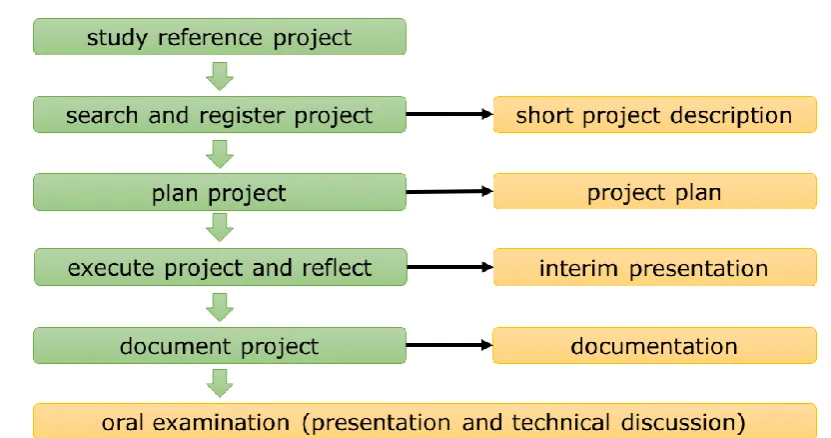
Fig. 6. Execution and verification of activities
Students are given a month to study the reference project and search for a suitable practical project (ideally in their company). At the end of this period, the students submit a project outline containing a rough description of the project, the project goals, and the organisational and operational setting. A template for the project outline is provided to the students at the beginning of the course. The tutors examine the outlines with regard to the processes specified in the reference project and can either approve the practical project as is or request revisions or changes.
Once the practical project is approved, the planning phase commences. Students can use the reference project as a guide for their planning, and define their schedule and milestones according to the main processes of the reference project. The tutors provide the students with a documentation template for the planning process.
After the project plan has been approved by the tutors, the students (formally) begin the actual execution of the project. The students continually reflect on their working and learning processes in the context of the documentation they prepare. This means that, in the ideal case, the documentation is not only produced at the end of the project, but rather continuously throughout the course of the project with the completion of each individual step.
The students reflect on their experiences in an interim presentation and in reflection discussions, which take places about 2.5 months after the beginning of the semester. In this way, problems in the learning and working process are identified and solved at an early stage, but above all, the students should become aware of gaps in their knowledge.
After the interim review, the documentation is again created continuously up to the end of the project. Once completed, the documentation is submitted (after about 5.5 months) and forms the basis of the examination. The documentation is evaluated by examiners with respect to the successful completion of processes in the reference project and the competencies acquired (the key situations also play a role for this assessment). If the documentation is evaluated positively (80% of the reference processes successfully fulfilled and 80% of the required competencies acquired), an invitation to the oral examination is issued.
Page 78
Currently, the examinations (documentation reviews and discussions) are carried out by an examiner who is competent both in the role of the respective profile as well as in the teaching methodology of work-process-integrated learning. The examiner is supported by an “assessor” (an independent witness). The examinations could alternatively be jointly performed by two examiners, one with the necessary professional and technical background and the other with experience of the teaching methodology. In this respect, an expert adviser can also be involved in an exam, or even carry out the exam alone if he/she has enough knowledge of the methodological side. Superiors are not directly involved in the examinations. However, they play an important role in the run-up, as they should indicate in the documentation produced by the students in their company whether the specified projects or steps were actually performed. Similarly, the tutors should confirm the reflection discussions and key situations with a signature.
8. SUMMARY AND OUTLOOK
In this paper, the concept for the project course in a career-integrated master’s IT programme was presented. The aim of the project course is the acquisition and promotion of professional skills and competence. As a guideline, the integrated working and learning takes place in self-guided, real projects, but with technical and personal backup.
Students in the project course learn in the work process, in real projects (practical projects), in (their) companies. The students themselves control the the process of learning-at-work, but they are extensively supported with respect to technical issues and personnel. Process-oriented curricula, so-called reference projects, define the structure of the project course. They serve as models for the selection of the practical projects, the planning of the working and learning processes, and also the verification of the successful completion of the project course. All processes in the reference project must be verifiably completed by addressing them, reflecting on them, and documenting them.
The use of reference projects as curricula is one of the fundamental tenets of the project course. The process-oriented structuring of the course has great advantages: since the processes are relatively fixed, they provide a common thread through dynamic technical and technological change. As the reference processes and sub-processes are modelled relatively abstractly and the competencies are formulated at the meta level, a wide range of suitable practical projects can be realised in the professional and entrepreneurial world. Practical projects for the project course can be identified with the help of the reference projects, as despite of the individual characteristics of the projects, their requirements are comparable to those of the reference projects.
The students are given a uniform approach to projects that can differ greatly both technologically and organisationally. This leads, first of all, to a better exchange of information and experiences among the students. Secondly, students are offered a framework in which to reflect upon their own activities, which supports and promotes a diverse set of competencies. Last but not least, the process-oriented structure enables a more objective evaluation of the practical projects, up to certification by appropriate certification authorities.
REFERENCES
Baaken, T, von Hagen, F, Orazbayeva, B & Riemenschneider, F 2016, ‚Involving Bachelor And Master Students in Industry Projects – The Triple Win Education’, Journal of International Scientific Publications - Educational Alternatives, Vol. 14, pp. 34-48.
Chapman, P, Clinton, J, Kerber, R, Khabaza, T. Reinartz, T Shearer, C & Wirth, R 2000, CRISPDM 1.0 - Step-by-step data mining guide, SPSS Inc.
Page 79
HTW Berlin 2014, Satzung für das Zentralinstitut „Berliner Institut für Akademische Weiterbildung der HTW Berlin“ (Berlin Institute for Advanced Higher Education at HTW Berlin) der Hochschule für Technik und Wirtschaft Berlin. 2014. – Amtliches Mitteilungsblatt der HTW Berlin 10/14.
Junge, H 2009, Projektstudium als Beitrag zur Steigerung der beruflichen Handlungskompetenz in der wissenschaftlichen Ausbildung von Ingenieuren‘, PhD Thesis, Technische Universität, Dortmund.
Kleuker, S & Thiesing, FM 2011, ‚Vier Jahre Software-Engineering-Projekte im Bachelor – ein Statusbericht‘, in J Ludewig & A Böttcher (eds.), Proceedings of the 12th Workshop on Software Engineering im Unterricht der Hochschulen (SEUH2011), vol. 695, pp. 40-44, <http://ceur-ws.org/Vol-695/beitrag8-kleuker-thiesing.pdf>
Kruse, E 2009, Projektstudium und Praxisbezüge im Bologna-Prozess - Reform der Reform?‘, Sozial Extra, vol. 33, no. 1, pp. 42-47.
Lewerentz, C & Rust, H 2001, ‚Die Rolle der Reflexion in Softwarepraktika‘, in H Lichter & M Glinz (eds.), Proceedings of the 7th Workshop on Software Engineering im Unterricht der Hochschulen
(SEUH2001), dpunkt.verlag, Heidelberg, pp. 73-86,
<http://www.seuh.org/SEUH7_2001/09_Lewerentz.pdf>
Liebehenschel, J 2013, ‚Software-Engineering Projekte in der Ausbildung an Hochschulen - Konzept, Erfahrungen und Ideen‘, in A Spillner & H Lichter (eds.), Proceedings of the 13th Workshop on Software Engineering im Unterricht der Hochschulen (SEUH 2013), vol. 956, pp. 27–34, <http://ceur-ws.org/Vol-956/S1_Paper3.pdf>
Mattauch, W & Caumans, J 2003, Innovationen der IT-Weiterbildung, W. Bertelsmann Verlag, Bielefeld.
Moltó-Aribau, M, Tena-Torruella, A & Vendrell, A 2015, Evaluation competency-based in Internship: especial reference to evaluation rubric and final reports, in Proceedings of the 1st International Conference on Higher Education Advances (HEAd’15), Universitat Politècnica de València, València, DOI: <http://dx.doi.org/10.4995/HEAd15.2015.411>
Rohs, M & Mattauch, W 2001, Konzeptionelle Grundlagen der arbeitsprozessorientierten Weiterbildung, ISST report, no. 59/2001, Fraunhofer ISST, Berlin.
Siegeris, J & Freiheit, J 2015, ‚Projekte in der Wirtschaft‘, in A Schmolitzky & AS Hauptmann (eds.), Proceedings of the 14th Workshop on Software Engineering im Unterricht der Hochschulen (SEUH 2015), vol. 1332, pp. 73-80, <http://ceur-ws.org/Vol-1332/paper_09.pdf>