Page 291
LIVING WITH PRECONCEPTIONS. RESPONSE TO PH AND RELATED ASPECTS OF
FIRST YEAR UNIVERSITY STUDENTS THROUGH THE POINT OF VIEW OF THEIR
HIGH SCHOOL CURRICULUM
Hector Katsikis
1, Aikaterine Kontopoulou
2, Pericles Akrivos
21
1
stLyceion of Thessaloniki, GR-546 40 Thessaloniki, Greece
2
Aristotle University of Thessaloniki, Department of Chemistry, P.O.B. 135, GR-541 24, Thessaloniki,
Greece
Abstract
A survey is contacted on a limited number of first year students at a Greek university (n=54) in
relation to their notions about pH and related aspects, following a semester of lectures and tutorials,
both of which include teaching and experimenting upon pH. The findings attempt to correlate the
assimilation of information with the school of study and with the kind of underlying background of the
students since they could, in principle, have followed different high school currliculae towards
entering the university courses. Namely, students who followed a curriculum termed “technological
direction” in high school could follow studies at the Geology department where limited knowledge
and use of pH is required at the undergraduate level, while the high school direction does not involve
any Chemistry classes at all in the final year. On the other hand, Pharmacy students are overloaded
with chemical information and can enter the department course only through a high school direction
termed “positive”, which involves a lot of lessons on equilibrium and pH.
Key words:
pH notions, university students, curriculum, preconceptions
1. INTRODUCTION
Following our previous recent studies on the misconceptions related to Chemistry in the Greek
high-school as to their origin and factors of their conservation (Katsikis et al 2015, Vandoulaki et al 2016) it
seemed reasonable to investigate the extent to which such ideas are preserved in the form of
preconceptions at the higher level of education and especially after a semester where some additional
teaching and laboratory work has been carried out on specific topics incorporated into the introductory
General Chemistry class.
In the past decades we have established a contact with various first year university students who are
obliged to study Chemistry to a varying degree depending on their course objectives and the related
education they receive within the General Chemistry class taught during their first semester of studies.
Among these, there are students in the Pharmacy department, whose curriculum is heavily based on
Chemistry and who, owing to the formation of the Greek educational system, can only take exams to
enter the Department after following the high school specific curriculum termed “positive direction”.
This direction involves several hours of Chemistry in the last grade, including equilibrium in general,
equilibria in weak electrolyte solutions and consecutively, pH and related aspects. On the other hand,
students can be admitted to the Department of Geology through either the “positive” or the
“technological” high school directions, in the latter of which Chemistry is totally absent in the last
high school grade, therefore forming within the student group two sub-groups with different cognitive
backgrounds related to chemical aspects.
Page 292
science educational program, may help towards drifting the early “alternative ideas” to a group
consisting primarily of the scientifically accepted ideas and secondarily of persisting
“preconceptions”. Such preconceptions are harder to deal with, especially at a later age since it has
been argued and to large extent proved that in many cases it does not matter how long or how
intensely somebody is taught about a specific topic (Ahtee & Varjola 1998, Bodner 1991) because the
previous inherent models are going to be retained and at the most, it will be possible to admit recently
acquired facts into a self-made and self-explanatory model based on the existing preconceptions.
Students' conceptions which are generally different from those generally accepted by the scientific
community are evaluated either by individual interviews or by questionnaires. Some multiple choice
tests were related to specified and limited content structure. The multiple choices may be constructed
either to focus on a specific topic or to span over a wide range of subjects covering the breadth of a
course (Treagust 1988). Construction of multiple choice test items is expected to contain a variety of
distracters, not all of which should be too obvious to avoid. The best choice for these distracters is to
be based on previously obtained students' answers to essay questions and other open-ended questions
and addressed underlying conceptual knowledge related to a limited content area, in the present case
pH. Ideally each multiple choice item should be followed by an additional space designed for the
reasoning provided by the student for the choice made in the previous question. Such ideas have
already been advanced as early as the 1980s (Osborne 1980, Driver 1984). Of course, given the
implication resulting from the reluctance of Greek students to undertake the task of providing lengthy
answers, this would not be possible; however we tried to use interconnected questions so as to check at
least for the sustainability of lines of thought expressed through the answer to previous questions.
1.1 The Greek secondary educational system
At the present Greek students of ages between 12 and 18, are expected to attend consecutively the
three grades of Gymnasio (junior high-school) and three grades of Lykeio (senior high-school), before
they attempt to follow an undergraduate course at some Higher level education institute through
succeeding in an entrance examination. Junior high school forms part of the compulsory educational
program while up to the first grade of senior high school the curriculum is common to all students.
The last grade of senior high school provides the means by which the specific abilities of the students
are exercised and their intentions for undergraduate university studies is promoted accordingly. In the
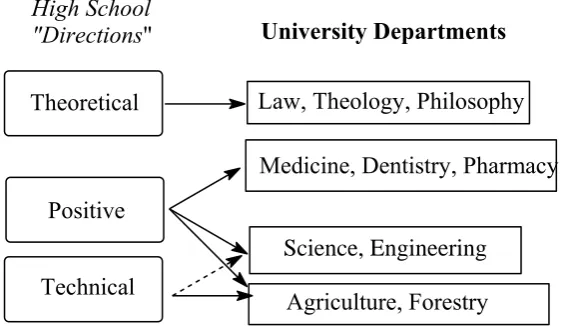
most current version of the curriculum, three ‘directions’ are formed, termed theoretical, positive and
technical respectively.
University Departments
High School
"Directions
"
Theoretical
Law, Theology, Philosophy
Agriculture, Forestry
Technical
Positive
Science, Engineering
Medicine, Dentistry, Pharmacy
Figure 1. Routes available to high school students for entering university departments, in relation to
the specific course they followed during their last year at secondary education level. The route to
Page 293
1.2 First year university studies involving General Chemistry
There are several undergraduate courses which require some introductory Chemistry classes, in most
of the cases including a series of tutorials and light to medium complexity laboratory experiments.
Among them, Pharmacy is a demanding one, since its curriculum consists of several 3-hour laboratory
periods, two of which are devoted to weak electrolytes and pH measurements, while an additional one
is related to redox reactions. Both during the pre-lab introduction and in some of the traditional
lectures, reference is made of the equilibrium in general, the equilibria related to the dissociation
(practically hydrolysis) of weak electrolytes, to the simplification of using proton instead of
hydronium ion (also a simplification itself relative to the existence of extensive H
2n+1O
npolymeric
cations, in accordance however to the existence of several “onium” salts of the formula [OR
3]Y) and
experiments are carried out for the determination of the dissociation constant, either as K
aor pK
a, of a
weak acid (acetic acid) via either the measurement of the pH of successively more diluted solutions of
the acid or of a series of buffer solutions with sodium acetate, in the course of which the theory and
equations about buffers is explained. The curriculum for the Geology department consists of 2-hour
laboratory periods, three of which are devoted to weak electrolytes and pH measurements. Indicators
and their applications both individually and in the form of universal indicator are discussed, and theory
and pH measurements related to buffer solutions and to the hydrolysis procedures in aqueous media
are discussed and measurements made utilizing electric pH meters.
2. DESCRIPTION OF THE STUDY
We carried out a small scale survey on topics covered during the first semester of studies, both at the
lecture hall and in the laboratory. The small sample size (n=54) may preclude a straightforward
generalization of the findings and the conclusions, however it can offer great insight into student
alternative conceptions and how they can evolve over time in response to instruction (Horton 2007).
The topics were chosen so as to be common to all curriculae studied and also to have some connection
with topics presented in the secondary school curriculum. Furthermore, we wanted to verify whether
actual laboratory work plays a role in formulating new ideas or modifying existing ones. As such, the
broad and interesting topic of weak electrolytes and, consequently their dissociation and pH
measurement and/or prediction, were chosen to be investigated.
The questionnaire constructed included mainly closed type questions since it has been established by
previous investigations that the students in general avoid taking time to give lengthy descriptions even
when it is evident that they can do so as inferred by their answers to related subjects presented in the
form of yes-no or true-false type answers that only need checking the appropriate box. However, due
to the fact that the topic of pH is related to concentration and to its special meaning and way of
formulation and interpretation, questions requiring short discussion as well as ones that rely on the
application of simple math are included. The population studied consists of students attending
Pharmacy and Geology departments to both of which General Chemistry, including pH definition and
measurement is taught. The first year students enter the schools following examinations taken on
several topics, including Chemistry at the high school level, where pH is also taught to some extent.
Page 294
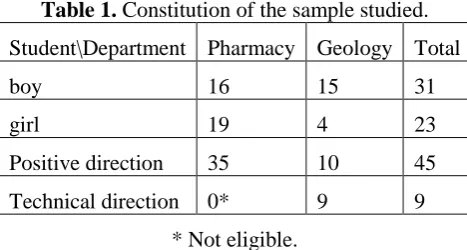
Table 1. Constitution of the sample studied.
Student\Department Pharmacy Geology Total
boy
16
15
31
girl
19
4
23
Positive direction
35
10
45
Technical direction
0*
9
9
* Not eligible.
3. RESULTS AND DISCUSSION
3.1 pH in general
The introductory question was selected to be one that would be very simple and one addressing the
core of the cognition domain treated. Its exact formulation was:
In your belief, the expression “the pH of a neutral solution is 7” is: clear but not precise, precise but
not clear, clear and precise, incomplete.
Incomplete is the word used by teachers in accordance to the distributed textbook at high school.
During the first semester of university undergraduate studies, analogous reference is made and it is
repeatedly stated that in order to have the complete definition one must make use of the temperature of
measurement. Given the circumstances, a rather high 26% of the students appear to have different
opinions, namely that it is clear but not precise (11%), precise but not clear (7.5%) or that it is all right
(7.5%). Of them 86% are boys, 43% followed the high school technical direction and only 29% are
studying Pharmacy.
At a later stage (fourth question overall) there was placed a question calling for a short comment,
asking the students to supply their personal complete version of the initial question’s expression. A
total of 22% did not even try to give the complete expression while an additional 4% provides some
irrelevant information. One holds the idea that any solution may have a pH value of 7, which might be
considered as true under some circumstances but does not respond to the question given and one
worked out the K
windicating that the neutral solution occurs when this constant is 10
-14. It should be
noted at this point that 67% of the ones not providing an answer belong to the groups that adopted a
more elaborate characterization for the statement of the initial question, than the simple and
universally indicated “incomplete”.
Following the above, and in an attempt to clarify the understanding of the nature of the neutral
solution, students were required to supply the most striking example for a neutral solution.
A total of 22% could not recall an example of a neutral solution. However it is apparent that for 58%
of this sample, it was a matter of misinterpretation of the question as they tried to figure out what
would be the property of such a solution, i.e. equality of H
+and OH
-concentrations. Of course,
distilled water holds the majority for the correct answers to this question, followed at a distance by
NaCl solutions. There are some striking cases of generalization, in the form of “non hydrolysable
salts” which point at the basic understanding of the property of a solution with ions that do not
hydrolyse and a feedback from the secondary school courses where the hydrolysis of salts is
repeatedly referred to and commented upon.
Page 295
Given a solution with a pH value equal to 7, which is the quantity of protons contained in it?
The choices provided were the values of 10
7mol, 7 mol, 10
-7mol or 1/7 mol H
+per liter.
11% of the population studied cannot provide the correct answer, being 67% attendants of Geology
and 50% previous attendants of the technical direction. Wrong assumption of the sign of the power
was provided only by two persons (4%), being both students of Geology and former technical
direction students. The complete absence of the topic in the last two years of their high school
curriculum accounts well for this observation.
The uniqueness of the pH scale calls for a closer examination, since there is not the traditional zero
point at the beginning of the scale, bearing values on either side. The notion about the pH value range
for acidic solutions is described as 0 to 7 in all the secondary education textbooks and is repeated in
the university textbooks as well. However it is defined that this applies only to normal solutions and
reference is made about the existence of pH values slightly outside this range for concentrated
solutions of strong acids. The students were asked to define the pH range which span the acidic
solutions, the possible answers provided being 0 to +∞, 0 to 7, –∞ to 7 and 7 to +∞.
A considerable 81.5% follows the trend of memorizing facts and indicates 0-7 as the appropriate scale,
however a group of 7.5% of the students believe in a scale including all positive numbers and an
additional 7.5% interpret the value of 7 as serving for an upper limit to the acidic solutions pH values
without adopting a lower limit. Of the latter, half are Pharmacy students while of the former all are
Pharmacy students. The misinterpretation holders are evenly partitioned among the two sexes. Two
students (4%) failed to recognize a familiar region in the above lot.
A further extension of this investigation was attempted via the following inquiry:
Indicate the true or false character of each of the following statements. A base, in relation to an acid
may possess
Smaller or larger pH value.
Smaller or larger molecular weight.
Smaller or larger degree of dissociation.
Smaller or larger dissociation constant.
Smaller or larger corrosive power.
Given that in general corrosion is a property discussed in textbooks only in relation to acids, the 44.5%
suggesting that a base may have a higher or lower corrosive action relative to an acid is remarkable.
Remarkable is also the almost 4% that believes a base may have a pH value in its solution lower than
the pH value of an acid solution. Both students who made this statement are boys and they belong one
to each department and one to each high school direction followed. However, a considerable 68.5%
gave all the remaining three answers giving the impression that they have distinguished the acidic or
basic reaction from other physical and chemical properties of the related compounds, like molecular
weight, degree of dissociation and dissociation constant.
3.2 Weak electrolytes
Page 296
It is appalling that even an as low as 4% gave a wrong type of reaction (in one case the neturalization
reaction of NaOH with HCl, and in the other production of a hydroxide from the acid in the form of
HA + H
2O → 2H
++ AOH) while an additional 17% failed to provide any reaction scheme at all.
Interestingly enough, one of the wrong reactions came from Pharmacy students in contradiction to
only one failing to answer the question. Another point of interest is that in several cases (all of which
were accepted as correct) the reaction was kept “minimal”, i.e. it did not include participation of water
molecule to provide for hydronium cation formation, being in line with the literal content of the
question as it was put.
Given the considerable percentage of right answers to the writing of the dissociation in water solution
of an acid, it would be expected that at least an equally large group of students would be able to
identify the chemical species responsible of the acidic behavior of such a solution. However, only 46%
was able to predict or refer to as the proton, either in the form of a “bare” cation or a “proper”
hydronium ion. An equal percentage avoided giving an answer altogether while the remaining group
of students, which is considerable given the simplicity of the formula and the extent of the reference to
the phenomenon in the standard textbook, has got some wrong idea. A few striking examples are:
“The presence of a base”, probably relating it to the neutralization.
“The reactions of the acidic hydrogen of the acid”.
“The pK value”, presumably of the acid.
“The ions present”, without describing which ions in particular.
“The salt”, in general, probably again referring to the salt formed during neutralization.
In a subsequent part of the test, the ideas about weak acids and their discrimination from strong ones is
tested. The question put is straightforward, stating that there exist strong and weak acids and requiring
the determination of a characteristic difference between them, the options being, the pH of a solution
(not referring to a specific solution or defining equal concentrations of the two solutions), the H-A
bond strength, the relative solubility of the two acids and their degree of dissociation. A common
misinterpretation of relations between properties or observables in general is the simplistic one, i.e.
“larger y requires larger x”, therefore correlation of weakness with a weak H-A bond seems a
reasonable distractor. Furthermore, solubility is erroneously related to weak electrolyte behavior
although there are numerous indications both in texts and in oral presentations about the non-existence
of such a correlation, the most striking example being provided by sparingly soluble salts and their
basic property of being strong electrolytes as members of the salt family.
A serious 18.5% of the students were completely misled, assuming the pH value of a not defined
concentration of acid or its solubility to be suitable measures for its characterization as strong or weak.
Probably they made the assumption that the solutions referred to are of identical molarity, something
that is not explicitly stated. This group of students is almost equally partitioned among the two
departments, while the boys outnumber the girls by a threefold. An additional 5.5% of the students
advance the idea that the strength of the H-A bond is the point of difference between strong and weak
acids and an additional 5.5% does not provide any answer at all.
Getting deeper in the weak acid domain, a problem requiring the writing of the dissociation equation,
the use of a formula for the dissociation constant and the ability to apply simple math skills was set. In
it, an aqueous solution of an acid having concentration of 1 M and measured pH value of 2 was
provided and the dissociation constant of the acid was required.
The simple math calculations required are known and have been worked out extensively in the class.
However, a percentage of 15% cannot work out the simple and known procedure and a further 20%
executes the computations in an erroneous way, mainly in making the proper common factor crossouts
or manipulating the powers which were kept simple just to bypass analogous difficulties.
Page 297
HA
+
H
2O
H
3O
++
A
-(aq)
Initial
C
0
0
Reacted
x
x
x
At equilibrium
C-x
x
x
Substitution to the familiar expression of the equilibrium constant,
K = [H
3O
+][ A
-]/[ HA] = x
2/(C-x)
From the pH definition it is readily deduced that x= 10
-2and therefore the above expression reduces to
K= 10
-2.10
-2/0.999 or even 10
-4/0.999
Several students proceeded to an expression of K= 10
-2and two just stopped at the previous
expression, obviously not being able to work with the simple powers involved.
In our opinion, the most complex and difficult question was the one dealing with the proposal of a
relatively simple experiment by which to discriminate between two solid substances, known to be both
weak bases, with the aim of identifying the weaker of the two. The answer is demanding in the sense
that the students have to understand the way that the experiments they carried out were designed and
the pathway which was followed in order to obtain dissociation constant values. They also have to
relate to answers given previously, i.e. the point of difference between two relatively weak electrolytes
and finally to be able to make the appropriate interchange between difference in estimated K values
and observed pH values. Only a 13% of the students were able to present a descent procedure, detailed
or not but understandably working, by which the requirement of the question would be fulfilled. They
were all but one Pharmacy students, followed of course the positive direction at high school and were
almost evenly partitioned among the two sexes (4 boys to 3 girls). More than twice as many (17 in
total) were those who did not provide any answer at all and among them only five had followed the
technical direction and only seven were Geology students. The boys were more reluctant in trying to
provide an answer to the question (10 relative to 7 girls).
An interesting proposal came in the form of an erroneous adoption of the Bronsted-Lowry theory
suggesting that one should seek not the weaker base but the stronger of the conjugate acids, without
giving further evidence of how to do this.
We also came across to an elaborate workout of the computation of the pK value based on the
dissociation reaction and the comparison of the two expressions obtained.
The most common wrong answer was to simply make a solution and measure its pH without any
indication of what solution and how to correlate pH to dissociation constant.
In some instances it was proposed to prepare a specific solution and measure its pH, not indicating the
specific solution required and what should have to follow the measurement.
Some additional proposals were:
Perform some kind of titration of same molarity solutions of the bases.
Do some sort of unspecified interaction with the same amount of an acid.
Perform some unspecified measurement in order to obtain the K
bvalues.
3.3 Neutralization
Page 298
respectively. In this respect, it may be assumed by every student that the neutralization process results
exactly in the formation of a neutral solution. However, following this definition, there are almost
everywhere lengthy descriptions about those cases in which the final solution is not exactly neutral but
either acidic or basic, depending on the hydrolysis process of the salt formed. Therefore, this strict
definition of neutralization can only be applicable in the case of strong electrolytes. On the other hand,
any statement that neutralization ends with only salt being present in solution is far from complete and
descriptive, leaving the pH of the resulting solution in unclear waters. In view of the above, it would
be interesting to check some of the answers given, which are projections of the ideas held by the
individual students. Some of these answers are as follows:
A process by which the quantity of one electrolyte is consumed by addition of the other.
A process which tends to shift pH of the solution to 7.
A reaction between acid and base resulting in the transfer of electrons from one to the other.
Obviously in these cases there has occurred a mixing the Bronsted-Lowry and Lewis concepts,
both of which are described in the lectures, although it is also described that they should not be
mixed but chosen to be applied in accordance with the data given.
The interaction of molecules of acid and base to form water.
In some instances a note is added that the interaction between the proton of the acid and the
hydroxide ion of the base are forming water. It is certainly a clear understanding but unjustified
expansion of the reaction summary presented both during lectures and in the pre-lab where in the
case of strong electrolytes, this is a proper way of visualizing the effect.
A more elaborate description included the metathesis reaction between all the ions involved in the
initial acid and base molecules.
The reaction where (at the end point?) the concentrations of protons and hydroxide ions are equal.
To clarify the underlying ideas about neutralization, a more detailed description was sought, in the
form of a series of true-false indication of statements about it. The exact formulation of the question
was:
Indicate the true or false character of each of the following statements referring to the outcome of the
neutralization of a strong acid by a strong base. The statements provided were:
a)
The solution has a pH of 0.
b)
The solution has a pH of 7.
c)
pH is meaningless for the solution.
d)
In the solution there are no H
+.
e)
In the solution there exist 10
-7mol H
+per liter.
f)
In the solution there exist 10
7mol H
+per liter.
g)
In the solution there exist as many H
+as OH
-.
h)
The solution is neutral.
Page 299
construction of a detailed titration curve. However, the formulation of the question bypasses this
obstacle by explicitly referring to strong electrolytes. It should be noted at this point that the specific
topic presents, to our opinion, a case for a breakdown of the well-known triad of learning levels
(Johnstone 1982, Gabel 1993), i.e. molecular, macroscopic and symbolic, which are required for the
true and complete understanding of chemical phenomena since the macroscopic observation of
neutralization cannot be solely related to a pH value of 7 all other factors kept null or completely
balanced. It is not even so simple to prepare some computer application (Mahaffy 2004) involving
animations, simulations, or dynamic molecular models, in order to help us visualize molecular
entieties and chemical changes accompanying the phenomenon.
To get a better insight to the
topic of neutralization, the following question was formulated as
“Irrespective of the true or false character of the above statements indicate which ones are synonyms”.
It should be reasonable, after giving the answer to the previous question to be able to group together
statements b, e, g and h, however one might like to group c and d instead, something that would be
perfectly acceptable. Interestingly enough and in view of the fact that at least two of the previous
question statements were accepted as true by the students, nobody thought of grouping together two
false statements. Five students gave no answer, twenty-two gave two answers, probably distracted by
the question and having found at least a couple of “correct” answers avoided doing a deeper research
into their own answers, thirteen form a group of three answers and fourteen gave all four correct
answers. The ones that did not give any answer at all are all attendants of the technical direction except
one who has graduated from a Greek-taught high school from abroad.
3.4 Acid behavior towards metals
The final two questions of the test are not directly related to the electrolyte domain but have some
marginal connection and furthermore refer to a simple experiment which has been carried out in the
laboratory in the framework of discussing redox reactions and specifically the reducing ability of
various metals. The first question is of qualitative character since it only asks about what is the
expected phenomenon when a strip of magnesium metal is placed in a tube with aqueous hydrochloric
acid. The second question is more demanding and requires use of the symbolic language of Chemistry
since the student has to provide an explanation of the phenomenon observed. It is not of course
required to write a chemical equation, however any logical answer in the chemical sense cannot be
complete without providing an equation. In many instances the students were misled, like in previous
questions, about the requirement of the question and in the place of the descriptive one provide a
chemical equation while in the place of the explanation they are “forced” to answer simply “because
of the above reaction”. This relates to an oversimplification of the utility of the symbolic language of
Chemistry, although during the lectures it is pointed out that a chemical reaction is what actually takes
place while chemical equation is a formal way of describing the phenomenon and that it can only be
written with confidence after both the initial reactants and final products have been isolated and
characterized. Even after the adoption of the above “amendment” in order to account for students
being careless or under excess stress, there are some significant wrong ideas which can be summarized
as follows:
The reaction is presented in a more complicated form than it should, where initially magnesium
forms hydroxide with water and in a subsequent step this hydroxide neutralizes with hydrochloric
acid.
Probably the misunderstanding has to do with the major part of the test being focused on
electrolytes and their properties, one of which is the neutralization of an acid with a base.
In several cases magnesium enters the reaction as cation and not as a neutral metal.
Page 300
There is a small but significant percentage (6%) who are sure there is not going to be any reaction at
all and a single one who believes that an unspecified reaction will take place.
3.5 Evaluation of the test
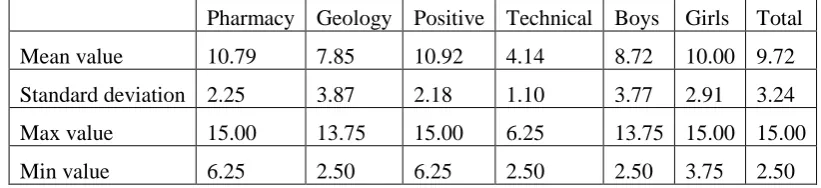
Although the population studied is small (n=54) there is some merit in trying to obtain some simple
descriptive statistics such as mean values and standard deviations. The following Table summarizes
these results.
The evaluation of the test did not take into consideration the usually adopted “negation effect” of
wrong answers in multiple choice questions since only part of the test was organized in this way and it
did not correspond to a specific topic of the test span. The scale 0-20 used in secondary education was
also adopted and in view of this, the results reported in Table 2 are rather discouraging. Only 61% of
the students, following a semester of teaching and working in the laboratory would have background
enough to pass this test, the highest mark not exceeding 15.00. The overall achievement is just
approaching the passing mark, indicating in gross terms that about half of the information offered
throughout the semester (part of which is already known from high school) is assimilated by the
students. However, in view of the results of analogous recent studies among high school students,
where to corresponding factor is only about 33% (Katsikis et al 2015) it may be concluded that
experimental work assisted by pre-lab lecturing and participation in group tutorials helps to improve
the understanding of chemical principles, at least as far as the pH topic is concerned.
Table 2. Descriptive statistics of the study. The categories reported are the ones discussed in the text.
Pharmacy Geology Positive Technical Boys
Girls
Total
Mean value
10.79
7.85
10.92
4.14
8.72
10.00 9.72
Standard deviation 2.25
3.87
2.18
1.10
3.77
2.91
3.24
Max value
15.00
13.75
15.00
6.25
13.75 15.00 15.00
Min value
6.25
2.50
6.25
2.50
2.50
3.75
2.50
Page 301
4. CONCLUSIONS
The study was carried out in the opening semester of the 2015-16 academic year, and is by no means
complete or conclusive. However, some points are clear and merit both discussion and further
investigation.
Stoicheiometry needs to be introduced to a wider extent in the secondary Greek school education
system since first year university students cannot fully operate within it even following a full semester
where chemical equations are presented and discussed.
At first glance, Chemistry classes could be a reasonable proposal for the high school technical
direction, however the “problem” introduced by the admission of the direction’s students to Science
Departments has in the meantime been amended by the Greek government and since a year ago, the
dashed line of propagation from high school to university departments in Figure 1 has been erased by
yet another alteration of the respective law.
Since at the moment fist year students in Science Departments have an almost identical starting point
concerning their background in Chemistry it seems reasonable to believe that experiments should be
planned and carried out on several possible topics covered by the General Chemistry class, especially
those that are related to solutions, i.e. concentration, equilibria, weak electrolytes and pH. In fact such
a study has already been initiated and carried out (Kontopoulou et al 2017).
REFERENCES
Ahtee, M. & Varjola, I 1998, “Students' Understanding of Chemical Reactions”
International Journal
of Science Education,
vol. 20, no. 3, pp. 305-316.
Bodner, GM 1991, “I have found you an argument: the conceptual knowledge of beginning chemistry
graduate students”
Journal of Chemical Education
, vol.
68, no 5, pp. 385-388.
Cousins, A 2007, ‘Gender Inclusivity in Secondary Chemistry: A study of male and female
participation in secondary school chemistry’,
International Journal of Science Education,
vol.
29, pp.
711-730.
Driver, R. & Easley, J 1978, “Pupils and paradigms: A review of literature related to concept
development in adolescent science students”
Studies in Science Education,
Vol. 5, pp. 61-84.
Driver, R 1984, Children's learning in science project. Centre for Studies in Science and Mathematics
Education, University of Leeds, Leeds.
Gabel, D 1993, “Use of the particle nature of matter in developing conceptual understanding”
Journal
of Chemical Education, 70
, no. 3, pp.193-194.
Gorard, S & See, BH 2009, ‘The impact of socio-economic status on participation and attainment in
science’
, Studies in Science Education
, vol.
45, pp. 93-129
Gunstone, RF, Champagne, AB & Klopfer, LE 1981, “Instruction for understanding: A case study”.
The Australian Science Teachers Journal,
Vol. 27, pp. 27-32.
Horton, C 2007, “Student Alternative Conceptions in Chemistry”,
California Journal of Science
Education,
vol. 7, no. 2, pp. 1-78.
Johnstone, AH 1982, “Macro and micro chemistry”
School Science Review,
vol. 64,
pp. 377-379.
Katsikis, H, Savvidou, E, Schizodimou, A, Akrivos, PD, Keloglou, G 2015, “Student misconceptions
in the 21st century. Chemistry related conceptions of Greek senior high school students”,
Educational
Alternatives
, vol. 13, pp. 384-394.
Page 302
P. Mahaffy, P 2004, “The future shape of Chemistry Education”,
Chemistry Education: Research and
Practice
, vol. 5, no. 3, pp. 229-245.
Osborne, R 1980, ‘Some aspects of the students' view of the world’
Research in Science Education,
vol. 10, pp. 11-18.
Treagust, DF 1988, “Development and use of diagnostic tests to evaluate students' misconceptions in
science”,
International Journal of Science Education
, vol. 10, pp. 159-169.
Vandoulaki, M, Karageorgiou, S, Katsikis, H, Akrivos, PD 2016, “Promethean response of Greek
high-school students to the Protean changes of the Chemistry curriculum”,
Educational Alternatives
,
vol. 14, pp. 199-210.