Page 303
CONTEMPORARY STATE OF EDUCATION IN STANDARDIZATION – AN IMPORTANT FACTOR FOR THE DEVELOPMENT OF THE INFORMATION SOCIETY
Tsvetelina Nakova, Rositsa Krasteva, Daniela Pavlova
University of Library Studies and Information Technologies, Sofia, Bulgaria
Abstract
This report aims to present the experience and good training practices on the subject "Standardization in Libraries" in the University of Library Studies and Information Technologies, Sofia, Bulgaria. The practice of enhancing the information competence and knowledge of students with regard to the current standards is revealed. The report also defines the main objectives of reinforced correlation between the subject and the changing economic reality of the information society, which could be used to predict the nature of its development in the context of the new global environment.
The methods applied in this research are general scientific. Primary data are collected with a questionnaire survey and being analyzed with one-factor dispersion analysis (ANOVA), descriptive statistics and correlation analysis. The monitor and logical method are also used, but this research mainly relies on theoretical methods: formalization, aggregation and abstraction. The results of approbation of new approaches in educating and the form of the examination are synthesized.
Finally, some proposals for expanding the cooperation between the institutions and the lecturers are made and for more effective education for standardization in the University environment.
Keywords: University education, standardization, quality management, intangible resources, UniBIT, BIS
Introduction
The global changes in the light of the emergence and the rapid and efficient establishment of the knowledge-based economy require not only to control information (which always has material implications), but also need a system to manage the intangible knowledge. Standardization provides an established methodology in quality management and its application not only to material – but to intangible products as well. Nowadays, in the completely different economic situation, such kind of methodology provides a significant scientific contribution, which may be introduced in future prognosis of social development.
The lack of maintenance and reasonable updating the framework legislation and education regulations related to Standardization in Bulgaria is provoking actively applied synchronization with the internationally accepted standards and the implementation of the regional best educational practices in the disciplines related to Standardization – but that’s not always the most optimal solution. This current situation requires to identify the key points in the system, to have the opportunity to make the right conclusions and changes subsequently, reflecting our specific national needs.
The importance of Standardization for the information society
Nowadays the importance of knowledge and innovation is intensively growing. They increasingly become an integral part of every day’s life. In this situation of crucial importance is to raise awareness and knowledge of the standards and their distribution as a powerful instrument for the application of the new technologies in organizations of the material and non-material fields, including in the information exchange. In the context of the EU, the standardization could be seen as a way to build regulatory capacity and as a form of co-regulation [1].
Page 304
activates the industry of knowledge products, but the possibilities of mathematical measurement and analysis – previously familiar – declined dramatically. The standardization method of quality control, however, can effectively be applied, on the basis of approved quality indicators instead of mass adopted quantitative ones.
The purpose of the standard is the achievement of a comprehensive compatibility, high quality and efficiency. [2] [3] And as long the quality is a relative value, it is essential as a real criterion in determining the practical cost of objects or the degree of their effectiveness – historical and especially in present time. In this case matters the fact that there is no unit of measurement, taking into account the value of quality. A complete quality management system is imposed.
Where there is not possible to consider an objective measurement, the only security that could be achieved to ensure the availability of quality, is compliance with a specific producing methodology, guaranteed by the proven in time methods of Standardization.
Standardization imposes competitive edge even in the changing economic situation and certainly requires clarification of the methods for creation and application of the standards in the Republic of Bulgaria – related with the collaboration and coordination between consumers, manufacturers and academics. In addition to determine the relevance of this issue, its scientific and practical activity, this research aims to outline the need and consider a range of questions about the main problems related to Standardization in Bulgaria.
Knowledge of Standardization and specific standards in all areas of human activity are not only useful, but also necessary in the direct employment of specialists and managers in all organizational structures. Moreover, the timely training of students in Standardization will prepare them for future challenges and will save them a lot of efforts, time and resources to achieve and implement the requirements, rules, standards, approaches, methods, etc., established by the highest qualified specialists at international, European and national level. [4]
Bulgarian Institute for Standardization and its database access
The Bulgarian Institute for Standardization (BDS) is the National Standards Body. BDS develops and approves Bulgarian standards and participates as an active and full member in the work of the European and international standardization organizations. Taking into account the principles of standardization – equal footing, transparency and consensus, BDS makes efforts to balance the interests of all stakeholders both in private and public sectors which means clearly established balanced participation in the national standardization process of producers, traders, suppliers, consumers, research and academic establishments, conformity assessment bodies, state bodies and other public organizations. [5]
Standards are documents, developed by consensus based on the consolidated results of science, technologies and experience. [5] The subject "Standardization in Libraries" in the University of Library Studies and Information Technologies (UniBIT) stimulates the excellence in research and innovative scientific achievements in the field of library and information science with its partnerships and international common criteria. This discipline is able to provide the strategic advantage of the graduated specialists and contribute the discoveries and global share of knowledge and information volumes. Providing access to the content of the standards and the creation of Internet-based education system are just some of the factors providing effective and quality education in standardization of students from the relevant subjects, which will gain full knowledge of specific standardized objects.
Page 305
In view of the fact that the complete standards text’s access of all kinds: international, European and national is against payment, as the world practice is, the free access to full texts of Bulgarian standards through BIS is extremely useful for both the students of UniBIT and all interested university lecturers and employees.
Education in Standardization at the University of Library Studies and Information Technologies (UniBIT) – Sofia
There are trends in science that privilege certain areas of knowledge in particular moments of the development of society. This report aims to present one (for the moment) unpopular area of knowledge in a specific context (UniBIT in the Republic of Bulgaria): which is going to manifest as a crucial element of future global development.
For almost 20 years subjects related to Standardization have been taught at UniBIT. The University trains students in the following professional areas and specialties:
- Professional field "Public Communications and Information Sciences”, specialties: “Library Science and Bibliography”; “Library and Information Management”; “Print Communications”; “Information Funds of Cultural Heritage”; “Archiving and Documentary”; “Information Resources of Tourism”; “Communications and Information”; “Public Policies and Practices”;
- Professional field "Informatics and Computer Science”, specialties: “Information Technology”; “Information Brokerage”; “Information Security”; “Computer Science”; “Information Technology in the Court Administration”;
- Professional field “National Security”, specialties “National Security and Cultural-Historical Heritage”, “National Security” (UniBIT, 2018).
In all three professional fields are delivered lectures on Standardization-related disciplines. [6] Standardization-related disciplines are taught in all three professional directions.
The experience of our current educational activities on Standardization in the UniBIT indicates that appropriate curricula in Standardization should be structured in two parts:
- General part to ensure to the students’ basic knowledge on standardization and its general principles, methods, objects, levels of development of standardization and types of standards. This part provides knowledge needed in a knowledge-based and innovative economy for the purpose, structure and standards as a concept; for the technology of developing and updating standards; for the technical committees as core structures, with standards developing functions, responsible for the condition and development of Standardization as well; for the institutional arrangements to ensure of Standardization at international, European and national level; for the provisions laid down by law, regulation or administrative basis of Standardization; for the certain IT infrastructure of Standardization and databases for different types of standards; for the navigation in this IT infrastructure, e.g. directories established by international standard classification and terms of use and dissemination of information;
- Profiled part – adapted to the relevant science courses ("Library Science and Bibliography" or "Library and Information Management”). This part provides knowledge about the content by reference to the specific standards in force, but also to be developed and updated standards at national, international and European level.
Competencies and benefits of Standardization training
Page 306
experience of training in Standardization at UniBIT and to outline the benefits of fruitful cooperation with the Bulgarian Institute for standardization as well.
The study was implemented on the principle of a systematic random selection as the rules of scientific statistic research request, with stratification against 50% of students learned subjects related to Standardization last semester (representative sample, called in statistic “cross section”, sufficient to verify the results as presentative for all students in this professional field).
The grossing up of the study comprehend 106 persons, students in full-time and part-time training. The questionnaire is composed of 10 questions, that will not be considered in depth. This report presents the most important results of the study, analyzed with one-way analysis of variance.
In statistics, one-way analysis of variance (abbreviated one-way ANOVA) is a technique that can be used to compare means of two or more samples (using the F distribution). This technique can be used only for numerical response data, the "Y", usually one variable, and numerical or (usually) categorical input data, the "X", always one variable, hence "one-way". [7]
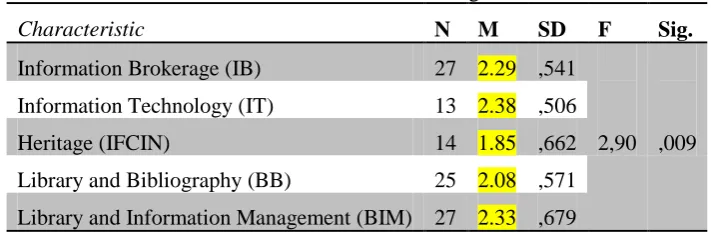
The results were obtained by single factor dispersive analysis [see Table 1]. There is a statistically significant difference between the responses of the students from the professional field “Information Funds of Cultural Heritage” (IFCIN) and all the other students.
In relation to the statistical indicator of averages M (Mean) the presented in Table 1 results indicate that the library specialists and library managers realize high-importance of applying standards in the library activity. This fact can be used as a good basis for conducting trainings on the application of specific library standards.
Overall, the students’ knowledge of all types of standards could be considered as very good.
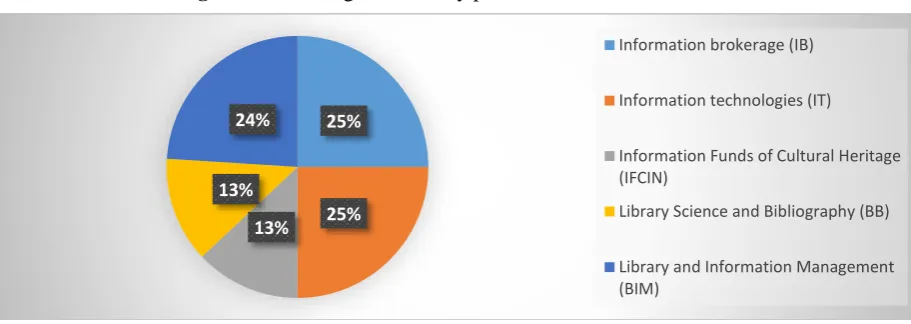
The percentage division by professional field of respondents is presented in Figure 1.
Figure 1. Percentage division by professional field of students
In the following compilation of the questionnaire was used a 5-degree Likert scale, at which: 0 means “no”; not at all"
1 – „to a small extent“ 2 – „partly“
3 – „to a large extent“
4 – „to a very large extent“ (Look at the marked in yellow results). 25%
25% 13%
13% 24%
Information brokerage (IB)
Information technologies (IT)
Information Funds of Cultural Heritage (IFCIN)
Library Science and Bibliography (BB)
Page 307
Table 1. Self-assessment of students’ knowledge of Standardization
Characteristic N M SD F Sig.
Information Brokerage (IB) 27 2.29 ,541
2,90 ,009 Information Technology (IT) 13 2.38 ,506
Heritage (IFCIN) 14 1.85 ,662
Library and Bibliography (BB) 25 2.08 ,571 Library and Information Management (BIM) 27 2.33 ,679
The questions in the questionnaire are formulated in accordance with the sub-objectives of the study. In response to the first of them "What do you know about Standardization?" respondents have the opportunity themselves to assess the measure of their knowledge on issues affecting Standardization. The majority – 58.5% were of the opinion that are familiar with the issues; 31,1% indicate that they are well aware, and 10.4% have low degree of knowledge on Standardization.
Since the data is organized in ordinal scale range, the correlation coefficient rank Pearson was used. This coefficient is obtained by dividing the covariance of the two variables by their standard deviations. [8] Self- assessment of respondents is established by the correlation coefficient of Pearson – there is a relatively high correlation (r = 0.51). The level of its significance was noted in the legend to the Table 2.
Table 2. Correlation between students’ self-assessment and their real knowledge of Standardization
No. Questions 1 2
1 Self-assessment of the students’ knowledge of Standardization * 0. 51** 2 Real students’ knowledge of Standardization *
** Significant at level 0.01.
The current educational activities included in the curricula in Standardization, is valued by students as very high (24.5%) and high (60.4%). Without an opinion on the subject are 14.2%, and only one student is of the opinion that the subject topics and issues are not up to date.
This report also aims to present a good educational practice, applied in the summer classes of the academic 2017 – 2018 year. This practice is covered in the lectures of "Standardization in Libraries" where the following further standardization activities are provided: working with the full text of the specified library standards. The aim is to clarify and specifies the optimization requirements of existing practices and its synchronization with the international library activities. Applying standards will help the future professional class of librarians and library managers with the ability to implement the principles of communication in the information society based on standardized model to reach the knowledge.
Page 308 Conclusion
The following proposals can be made for expanding and more effective education in standardization in University environment:
- For the formation and implementation of a successful national policy for university training in standardization, it is appropriate to set up an expert body (or named otherwise), for example: National Council with representatives of university lecturers on standardization to the relevant national standardization body, Ministry of Education or other appropriate institution.
- Design and implement an information portal with Web site, providing communication and information on the training in standardization, both for the students and the lecturers in the universities and other categories of higher schools;
- Appropriate forums must be organized on a regular basis: conferences, seminars, round tables, etc. to discuss good practices of training in Standardization.
Acknowledgment
This publication is realized under the project "Standardization of activities and processes: foundations for involvement and fulfillment in library-community centers ", funded by the University of Library Studies and Information Technologies under the MES Regulation on the terms and procedure for evaluation, planning, allocation and spending of the state budget for financing the scientific or artistic activity inherent to the state universities, 2018.
References
1. Borraz, O. (2007). Governing standards: The rise of standardization processes in France and in the EU. Governance, 20, 57–84. doi:10.1111/j.1468-0491.2007.00344.x
2. Botzem, S., & Dobusch, L. (2012). Standardization cycles: A process perspective on the formation and diffusion of transnational standards. Organization Studies, 33, 737–762. doi:10.1177/0170840612443626
3. Brunsson, N. (1999). Standardization as organization. In M. Egeberg & P. Lægreid (Eds.), Organizing political institution: Essays for Johan P. Olsen (pp. 109–128). Oslo: Scandinavian University Press.
4. Krasteva, Rositsa. Standartization in library, archive and information volumes. Sofia: New Civilization, 2015. 167 p.
5. Bulgarian Institute for Standardization, viewed 23.07.2018, <http://www.bds-bg.org/>.
6. University of Library Studies and Information Technologies, Information System Standards UNIBIT, viewed 23.07.2018, <https://www.unibit.bg/news/important-info/is-standards>.
7. Wikipedia, 2018. Analysis of variance, Wikipedia, 18 July 2018, viewed 23.07.2018, <https://en.wikipedia.org/wiki/Analysis_of_variance>.