Page 98
PEDAGOGICAL ETHICS AT THE UNIVERSITY Eva Kralova
Institute of Medical Physics, Biophysics, Informatics and Telemedicine, Comenius University, Faculty of Medicine in Bratislava, Slovak Republic
Abstract
The personal interaction of teacher and student and observance of ethical principles in their communication are currently actual problem in the teaching process, including university study. In order to map the situation in the application of ethical principles and pedagogical tact in the teaching we realized long-term pedagogical survey in acad. years 2009/2010, 2016/2017, 2017/2018 (65/131/105 respondents, respectively). Respondents - students of the 1st year of Comenius University in Bratislava Faculty of Medicine evaluated the level of ethical principles observance and pedagogical tact during teaching and the quality of mutual communication teacher-student and student-teacher. We analyze the results of this survey in this paper.
Keywords: ethical principles in university education, pedagogical tact, mutual communication teacher-student, student-teacher
INTRODUCTION
The level, course and outcomes of the teaching process are substantially influenced by the teacher´s personality and pedagogical tact, which is an important part of professional ethics code. Teacher´s pedagogically tactful behavior towards students is positively reflected in educational outcomes, creates an optimal atmosphere for mental work, motivates and thus brings positive effect.
The application of ethical principles in relation to the participants of the teaching process plays a significant role. Both the level of ethics in relations between teacher and student and in the communication teacher-student / student-teacher are important. They also have an impact on the student´s motivation to study, especially with regard to the study of less popular science subjects at study programs not focused on the natural sciences, e.g. medicine study, and thus bring positive effect.
In the possible individual differences of teachers´ pedagogic tact can be distinguished general features according to which teacher´s behavior towards each student can be denoted as pedagogically tactful or tactless. [Kralova & Martauzova 2017]
Table 1. General characteristic of teacher pedagogical tactful and tactless behavior [modified by Stepanovic 1971]
Teacher is tactful when: Teacher is tactless when:
1 he behaves to students equally (regardless of gender, benefit, origin, etc.)
he prefers some students, has “lovers”, “drives” on some students
2
he respects the student's personality, expresses the student's respect and attention
he underestimates the student, is disregard, inattentive (for example, does not follow his answer), degrades, smiles and insults student
3
he has a positive relationship with the student, he does not show his possible sympathy and antipathy
he has a negative, i.e. the hostile relationship to the student, he makes clear he does not like him, he does show his antipathy
4
he expresses a proper degree of trust for students, does not disappoint students´ confidence and does not rely on their trust
Page 99 5
he expresses a reasonable interest in the personal problems and difficulties of the students, does not reject the applicants for help, willingly advises him/her and helps
personal problems and the student´s difficulties are indifferent to him, he does not show interest in them, rejects the student´s request for advice or help without listen and consider it, indicates the
unwillingness to help and give advice to student´s
6
he uses both positive and negative pedagogical measures in a balanced way, he can appreciate the student
he uses mainly negative pedagogical measures, the offense, the failure of the student always punishes, but the success, he does not recognize the positive act
7
he penalizes students´ offense only after appropriate examination, consideration, uses appropriate and educational effect in view of the seriousness of the offense and his / her individual specificity
he punishes, unreasonably, inappropriately or benevolently, prior to investigating, regardless of the motivation and importance of the offense and the educational effect, uses inappropriate
punishments
8
he does not dissuade students, encourages them in case of failure, is appropriate respectful
he disgusts the students, in case of failure is vicious, does not want to hear the student´s reasons, is a cruel and respect less “stickler”
9
he tries to know the individual personality of the student and to communicate with him on an individual basis
he does not seek to know the student, he overlooks student´s individual peculiarities
10 he can forgive the student for his offense after the student improves
he does not forget the student´s offense, he still reminds him it, does not want to see any improvement
11
he preserves the appropriate pedagogical distance from students, but without haughtiness
he is with the student in a very friendly, benevolent relationship, losing his authority or behaves haughtily, officially
12 he puts only reasonable demands on students
puts disproportionate demands on students (high or low demands)
13 he is fair in assessing and marking he is unfair in assessing and marking
14
when examining, he takes into account the mental state of mind of the students (e.g. jitters) and influences it positively; does not create “typical circumstances of exam”
he does not take into account the individual characteristics of the student during examination and his/her mental state and behavior (nervousness, impatience, etc.), moreover influences it negatively; creates “typical circumstances of exam”
15 he knows how to control his reactions he can not control his reactions, is moody, nervous, pours out his anger on students, explodes
16
he has a positive relationship to his profession and subject, consciously fulfills duties and uses working time efficiently
he has a routine relationship to his profession and subject, he shows it publicly, is inaccurate, neglects his duties towards students
17
he acts openly, honestly; keeps the word, the promise; he himself respects what he asks the students
he pretends, he acts indecisively, dishonestly, he does not keep the word, promises; he himself does not respect what he asks the students
18 he behaves naturally, decently, is exemplary for students
Page 100 19
he respects the opinions and attitudes of the students, bad views are regulated through justification and arguments
he does not respect students´ opinion and attitudes, suppresses them and forced students´ his own opinions
20 he does not obviate problems, but resolves them flexibly
He postpones problem solving, is indecisive, hesitant
MATERIALS AND METHODS
In order to map the situation in the application of ethical principles and pedagogical tact we realized in acad. years 2009/2010, 2016/2017 and 2017/2018 a pedagogical survey (65/128/105 respondents, respectively) using anonymous questionnaire. Respondents – students of the 1st year of Faculty of Medicine Comenius University in Bratislava evaluated the level of ethical principles, pedagogical tactful and tactless behaviour in the teaching process and the quality of mutual communication teacher-student/student-teacher.
Respondents answered the next questions:
1. Express your opinion on the level of application of ethical principles in the relationship teacher-student/student-teacher at the university.
2. Evaluate the level of pedagogical tactful and tactless behaviour of teacher at the university (practical teaching/lectures).
3. Evaluate the quality of teacher-student communication at the university.
Respondents expressed their attitudes on the score scale from 0 (negative rating) to 10 (positive rating), subsequently their attitudes were categorized into 5 categories (negative, moderately negative, neutral, slightly positive, and positive).
RESULTS
Respondents rated next statements:
1.1 Express your opinion on the level of application of ethical principles in the relationship teacher-student / student-teacher at the university (acad. years 2009/2010, 2016/2017 and 2017/2018, respectively)
Average score of the level of ethical principles application in the relationship teacher-student / student-teacher in respective acad. years:
2009/2010 – 6.48 (neutral) / 6.90 (slightly positive),
Page 101
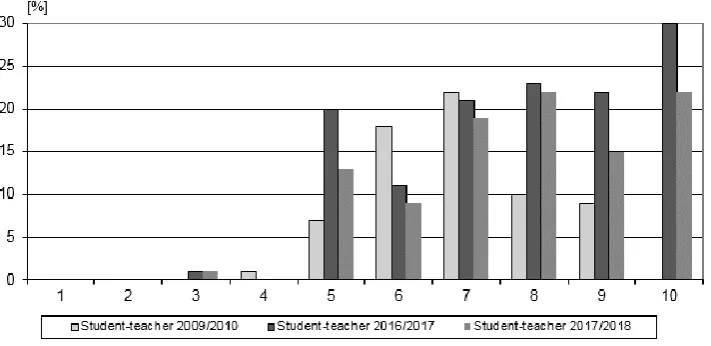
Figure 1. Comparison of the level of application of ethical principles in the teacher-student communication at the university (acad. years 2009/2010, 2016/2017 and 2017/2018).
Figure 2. Comparison of the level of application of ethical principles in the student-teacher communication at the university (acad. years 2009/2010, 2016/2017 and 2017/2018).
The graphical and statistical evaluation of the level of ethical principles application in the teacher-student (Figure 1) and teacher-student-teacher (Figure 2) relationship in three acad. years (2009/2010, 2016/2017 and 2017/2018) showed the level of ethical principles in the teacher-student communication has shifted to higher average scores (6.48 → 7.70 → 7.96). The same statement is true for the student-teacher communication (6.90 → 7.73 → 7.78).
1.2 Evaluate the level of pedagogical tactful and tactless behaviour of teacher at the university (lectures / practical teaching)
Average score of the level of pedagogical tactful and tactless behaviour of teacher during lectures / practical teaching in respective acad. years:
• 2009/2010 – 6.08 (neutral) / 6.95 (slightly positive),
• 2016/2017 – 7.15 (slightly positive) / 7.83 (slightly positive),
• 2017/2018 – 7.00 (slightly positive) / 8.13 (slightly positive).
Page 102
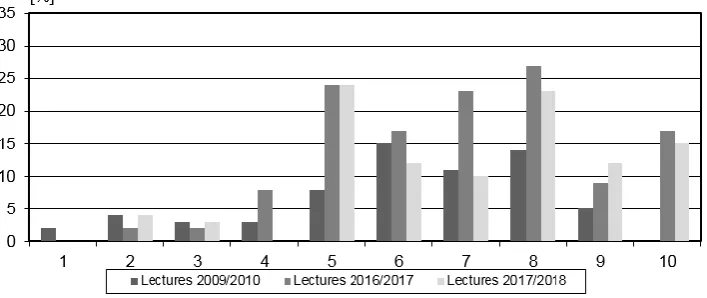
Figure 3. The level of pedagogical tact at lectures and practical trainings at university (acad. year 2017/2018).
In our opinion, this fact is resulting from the specific and different nature of these two forms of teaching and better opportunity for individual contact of teacher with the student during practical training. This is true for all evaluated academic years. (Figure 4, Figure 5)
Page 103
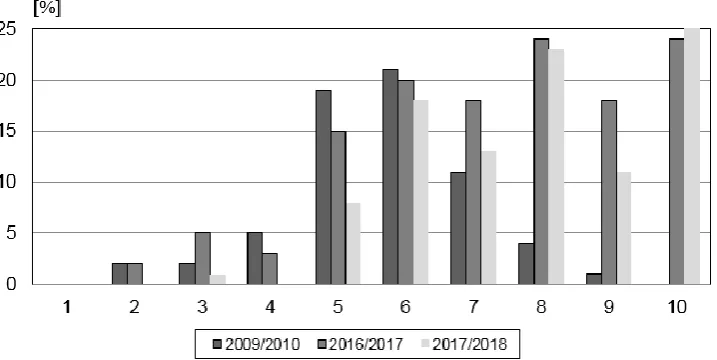
Figure 5. The level of pedagogical tact at practical trainings at university (acad. years 2009/2010, 2016/2017, 2017/2018).
The graphical and statistical evaluation of the level of pedagogical tactful and tactless behavior of teacher at the lectures (Figure 4) and at the practical training (Figure 5) in three acad. years (2009/2010, 2016/2017 and 2017/2018) showed the level of pedagogical tactful and tactless behavior of teacher has shifted to higher average scores at lectures (6.08 → 7.15 → 7.00). The same statement is true for the practical training (6.95 → 7.83 → 8.13).
1.3 The quality of mutual communication teacher-student at university was evaluated by respondents in acad. years 2009/2010, 2016/2017 and 2017/2018.
Average score of the quality of mutual communication teacher-student in respective acad. years:
• 2009/2010 – 5.68 (neutral),
• 2016/2017 – 7.33 (slightly positive),
• 2017/2018 – 7.89 (slightly positive).
In acad. years 2016/2017 and 2017/2018 was observed a significant shift of the average score to higher values compared to acad. r. 2009/2010 (Figure 6)
Page 104 DISCUSSION
We found out a positive tendency in application of ethical principles in the university study, satisfying pedagogical tact and higher quality of teacher-student communication that could positively affect the study outcomes.
Levels of application of ethical principles in the relationship teacher-student and student-teacher were evaluated in all acad. years as neutral or slightly positive.
Results also showed slightly positive responses concerning both application of pedagogical tactful behavior of teachers in the teaching process (lectures / practical trainings).
Teacher-student communication was also evaluated as slightly positive in last two acad. years.
In the same time, we believe that the ethics at the university will also influence the ethical behavior of medicine absolvents to the patients in the future.
Obtained results could be also explained by the facts that in the time interval between evaluated academic years took place:
• significant personnel changes in the teaching staff;
• objectified requirements in both theoretical and practical teaching (protocols, i.e. records from experimental measurements were electronised);
• objectified evaluation of the results of the teaching process by introducing a test form of continuous and final examination in electronic form;
• emphasis of the teaching has been shifted to practical training, which makes it possible to deal with difficult issues in smaller study groups, individually and create platform for closer interaction between the teacher and the student.
The work of a university teacher is demanding to meet the expectations of the educational institution, legislation and students. Therefore, it is necessary for a university teacher to be continuously educated in all areas of his/her profession, which creates assumptions for the optimal performance of his/her work.
The teacher should be the holder of the culture relations that he/she requires from students, he/she should be principled but also tolerant, demanding not only for students, but also for his/her own pedagogical performance and, last but not least, the friendly and respectful personality of the students. The attitudes and relations of the university teacher to the students are always reflected in the student´s relations to the teacher himself. [Balazsiova 2017]
ACKNOWLEDGEMENT
Contribution was supported by GP KEGA Ministry of Education, Science, Research and Sport of the SR 003UK–4/2016.
REFERENCES
[1] Kralova, E & Martauzova, L, 2017, ´Ethical aspects of university education´, ICERI 2017 Proceedings. Valencia: IATED Academy, p. 7325-7328.
[2] Stepanovic, R, Stefanovic, J & Grac, J, 1971 ´Vybrané kapitoly z pedagogiky vysokých škôl I.´ (Selected chapters from pedagogy of high schools). (Textbook). Bratislava : UK, 77 p. 25/S/71.
![Table 1. General characteristic of teacher pedagogical tactful and tactless behavior [modified by Stepanovic 1971]](https://thumb-us.123doks.com/thumbv2/123dok_us/95067.1509950/1.595.75.529.570.770/general-characteristic-teacher-pedagogical-tactless-behavior-modified-stepanovic.webp)