Page 25
SCIENCEMOTION: OR WHEN TECHNOLOGY DISPLAYS FEELINGS Amina Ovcina Cajacob, Yvonne Herzig Gainsford
HTW Chur, University of Applied Sciences, Pulvermühlestrasse 57, 7004 Chur, Switzerland
Abstract
The shortage of young STEM scientists is a major social problem. Seemingly STEM careers are not particularly worthwhile for young people. As has been demonstrated in the study “STEM – Engineering careers in the Media”, funded by the Gebert Rüf Foundation, one of the reasons for this is the complexity which this topic is presented in the media. The current preferences in media usage by the target group would tend to encourage an entertaining and emotional mediation of the STEM topics via suitable me-dia. This publication is a continuation of the STEM study, again financed by the Gebert Rüf Foundation. It examines which video formats are particularly suitable for bringing STEM themes to young people, which aspects are of importance in a video message, and which are relevant design elements. To answer these questions, a laboratory experiment was carried out upon 120 test subjects, who had to evaluate seven different videos.
Key words: STEM, engineering careers, young people, media usage, videos, laboratory experiment
1. INTRODUCTION
The project “sciencEmotion” is a continuation of the project “STEM – Engineering careers in the Me-dia”. The role of the media in the context of STEM (Science, Technology, Engineering, Mathematics) was first discussed through the project “STEM – Engineering careers in the Media”. The results of various project studies clearly show that the STEM topic for the examined youth target group (12 to 21-year-olds) is presented with high complexity in the media. Media image should be much more oriented on the actual preferences of media usage of the target group. From these findings, the following proce-dure results: The complex professional images of various STEM careers are to be brought to the target group in an amusing, emotional and interactive manner over the suitable media. Through interlinking technical topics with everyday themes (through stories), “sciencEmotion” complements already existing projects and platforms. On the basis of previous studies, the goal of this project is to develop conceptual and production guidelines for video production as online tutorials for various project partners (associa-tions and companies as well as marketing and communication). An interactive and mobile video plat-form is developed for the youth target group. The target of the platplat-form is to entertain and inspire youth for technical projects, topics and careers.
2. AIM OF THE STUDY
The project “sciencEmotion” starts with carrying out a laboratory experiment upon the target group: 12- to 21-year olds. A report from the Federal Assembly (Eidgenössisches Departement des Innern 2010) shows that the determination of interests and occupational orientation already occurs towards the com-pletion of compulsory schooling. The missing attractiveness of STEM occupational groups for the 15-year-olds, leads to the current prevailing skills shortage. (Wunsch 2014) The experiment builds on the previous quantitative surveys (STEM – Engineering careers in the Media) and with further analysis upon the following questions: Which information and communication requirements does the target group have, and which video formats are actually appropriate to fulfil the same? The experiment investigates the influence of the emotionality of the video message content on the attitude and behaviour of the recipients. It also examines in what sense the media reception interacts with the content.
Page 26
address the target group as best as possible? What is the meaning of such elements as emotion, interac-tivity and protagonists for a video message? Summarized, the following question can be asked: Which information and communication requirements on career themes does the target group have, and which video formats are currently appropriate to meet these needs?
3. THEORETICAL GROUNDS OF THE STUDY
Emotional processes are crucial to the attitude and behaviour of consumers (Homer & Yoon 1992, pp. 25-28). In the Cognition Emotion Model (CEM) (Kroeber-Riel, Weinberg & Gröppel-Klein 2009, pp. 634-36.) an importance in the interplay of emotional and cognitive reactions for the advertising effect is emphasized. While arguments trigger cognitive responses, the peripheral hints are more likely to be responsible for the emotional effects. The influence of the emotions on the attitude is considered domi-nant. According to Mau, Schulz & Silberer (2008, p. 25), videos of consumers who describe the video with positive attributes are recommended rather than by consumers who connect negative attributes with the video. The attitude towards a video clip thus has a strong influence on the forwarding intention. Accordingly, in this study, influencing factors are investigated, which determine the attitude towards a video message. According to Mau, Schulz & Silberer (2008, p. 22) influencing factors can be divided into the following areas: characteristics of the sender, the recipient properties, stimulus design as well as physical and social environment of the recipient. Young people in particular strive for positive feel-ings and rewarding experiences (Kroeber-Riel, Weinberg & Gröppel-Klein 2009, p. 139). Positive emo-tions arise by approaching or even reaching their personal goals (e.g. entertainment).
According to the Cognition Emotion Model (CEM) it can be summarized that emotions can have a positive influence on the attitude to the viral brand message. In this study this is the starting point of the hypotheses formation on the effect of emotional content. As Brown et al. (2005, pp. 131-32) emphasize, in particular for young consumers, entertainment and stimulation are important. Furthermore, the results of the study “STEM – Engineering careers in the Media“ serve as an important basis for the formation of the hypotheses formulated at the beginning of the experiment.
3.1. Relationship between humour and power of recall
One of the hypotheses (H2) investigates whether there is a direct connection between humorous videos and the ability to memorize content. The current state of research suggests this assumption. It has been proven that impressions that move a person emotionally have priority in processing and storage in the brain. (Pfeiffer 2003)
3.2. Information vs. Infotainment
Memory capacity was also examined comparing humorous sentences with factual statements. In the experiment by Stephen R. Schmidt, the persons under testing received a list of sentences, partly funny, partly not. They had time to read the sentences, then had to resolve mathematical tasks and then to write down all the sentences they could still remember. This experiment was carried out in six different vari-ations. The result: Persons under the test could remember the humorous sentences better. However, this could only be observed by mixing the sets. If only humorous or only factual sentences were presented, the memory capacity decreased. Therefore, it can be concluded that laconic points should be used very selectively in order to anchor an issue more strongly in the memory of the recipients. (Schmidt 1994) 3.3. Humour improves the memory
Page 27 3.4. Usage of humour in the advertising industry
The effectiveness of humour is a major research topic in advertising. Strick et. al (2009), from the Uni-versity of Nijmegen concluded with their study, that the brands are better remembered when they are advertised in a humorous way. They demonstrated to the test persons two fictional magazines: One of the magazines contained funny cartoons, the other contained more serious sketches. Subsequently, the students should evaluate products advertised in the fictional magazines. The best evaluations were given to those ads that had been placed near funny cartoons.
That funny advertising gets more attention, is undisputed. But the whole concept also has its downside: The joke, which draws attention to advertising, can simultaneously distract from other, humour-free aspects of the advertising message. Therefore one subsequently remembers less. For every advertise-ment also contains neutral, important information, for example the product name. The recipients tend to focus on the humorous part of the advertising and pay less attention to the neutral content. However, Hansen (2011) found in his study that nevertheless an unconscious familiarity has been established. This often also contributes to the purchase decision. In addition, humour triggers positive emotions, which are then associated with the product or the brand. In the Nielsen survey 2015 humorous advertising is at the top of the ranking of the most popular ads in Europe and North America. (The Nielsen Company 2015).
The fact, that in the case of humorous advertising the brand doesn’t stick to the memory well is also called vampire effect. Researchers from the Dutch University in Twente have investigated how this could be counteracted. They found out, that complex humour, such as satire or a surprising dissolution of contradictions, provides more pleasure than banal humour. Whether or not humour has brand refer-ence, has no influence on whether it is well received or not. Spots with humour without brand reference can increase the attention but, at the same time, also create a vampire effect thus reducing advertising effect. Conclusion: The best advertising effects are spots with complex, brand-specific humour. 3.5. Storytelling
Storytelling as a narrative method is defined and used differently, depending on the context. For exam-ple, journalistic storytelling focuses on the news value, whilst corporate storytelling works with emo-tional stories. As a rhetorical technique, storytelling combines message value and emoemo-tionality while working as a transmedial, narrative concept, with the instruments and methods used in the world of literature or in the film industry. Products and brands are embedded in stories that are highly emotional. (Sammer 2014, pp. 36-41) Storytelling is a powerful tool for a wide range of areas. Especially in today's stimulus and information overflow, stories can ensure that information is given enough attention. Not the facts or arguments reach people the most, but well-told stories. (Sammer 2014, pp. 213-15) 3.6. Suspense
Aristotle already knew: A good story needs a hero (protagonist), a place and an action. The narrative of the story can be divided into the beginning, middle and conclusion. It is held together by the build-up of suspense which, as a kind of “schedule“, ensures that the recipients follow the events attentively and with interest and that their expectations are maintained. If the story is transparent, the curiosity is not aroused, the recipient quickly loses interest. (Kleine Wieskamp 2016, pp. 77-89)
4. METHOD 4.1. Experiment
Page 28
Manipulation of the experimental conditions to determine the influence of one or more independent variables on a dependent variable (causal analysis)
Measure of the nature of relationship between two variables, possibly by specifying the mathematical function that describes the context
In order to obtain as accurate results as possible, the qualitative experiment is more suitable than the quantitative survey. (Zimmermann 1972, p. 37) The experimental situation must be defined, so that the causal relationship can be filtered out. One either creates this situation artificially (laboratory research) or finds it in nature (field research). In this experiment, the situation may not be sought in nature. There-fore, a laboratory experiment is carried out. The advantage of the laboratory experiments is that the number of potential disturbance variables can be reduced. In an artificial environment, independent var-iables are much easier to control. That means there are tailor-made conditions.
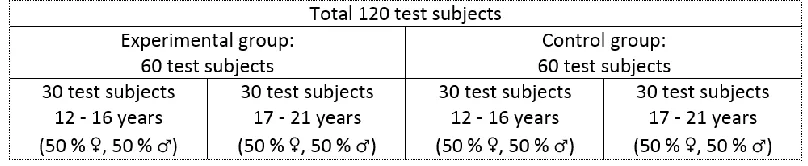
Table 1. Allocation of the test subjects
4.2. Random sampling/Selection procedure
Individual iterations of the experiment were carried out between 17 May 2016 and 13 July 2016. As participation in the experiment demanded personal commitment, all who completed the questionnaires received a cinema voucher as a gift. A total of 120 young people and young adults from Switzerland watched the videos and answered questions. Each age category between 12 and 21 years was covered by six male and six female participants. Exact date of birth during the experiment was decisive for the assignment to an age category.
4.3. Experiment/Setting
The test subjects were received by the experiment leaders at the site, and assigned to the designated room. The experimental and control groups watched the videos separately.
Both groups were initially informed about the progress of the experiment, but detailed information was received at the end, in order not to interfere with their impartiality. Each video was followed directly by the questions, which usually took no more than 5 minutes to answer. As a whole, an experiment took about 40 to 50 minutes. Experimental and control videos were shown in the same thematic order. This order was changed after half of the procedures for both groups, in order to ensure that the sequence did not affect the results. The emotional expressiveness of the videos was manipulated by showing the test subjects either a high or low emotional video in the respective context. A pre-test was performed to select suitable videos. One single video is not based on a hypothesis and has been reviewed and evalu-ated by both groups. Here, the aim was to evaluate the design elements such as liveliness, colours, or speed of the image sequence.
4.4. The structure of the questionnaire
Page 29
one video (2A/2B), two knowledge questions about the subject of laser technology were presented be-fore viewing the video and after, bebe-fore filling in the questionnaire. At the end of each questionnaire, the test subjects had the opportunity to express in their own words, what had pleased them and/or what had disturbed them.
5. HYPOTHESES AND THE INVESTIGATED VIDEOS
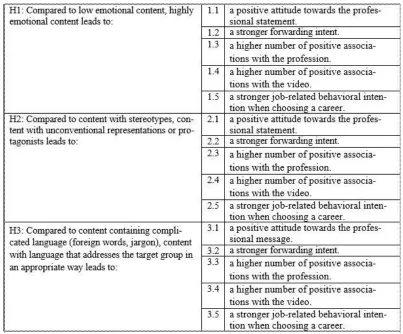
A total of six hypotheses were defined, which are divided into content-related and design-related deter-minants.
Page 30
Table 3. Hypotheses about design-related determinants
5.1. Hypothesis 1
Compared to low emotional content, highly emotional content leads to...
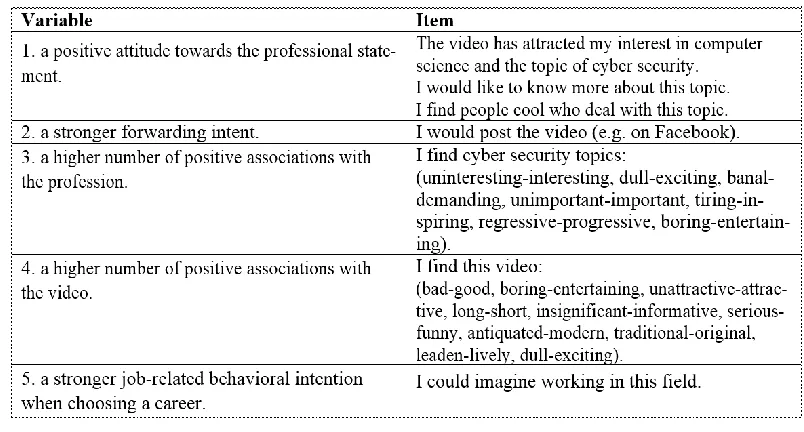
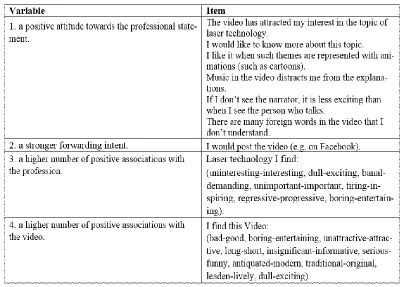
Table 4. Operationalization of the variables (1)
Page 31
form usually a good build-up of suspense is missing. A video without storytelling does not correspond to the everyday media consumption of the target group. For this reason storytelling was used as stimulus for the experimental group. The videos of both groups were held in English, the topic is the same in both videos, namely cyber security.
Video 1A for the experimental group (storytelling) link to the video
Video 1B for the control group (video in a simple narrative form) link to the video Video 2A for the experimental group (infotainment) link to the video
Video 2B for the control group (objective information transfer) link to the video Video 3A for the experimental group (humour) link to the video
Video 3B for the control group (without humour) link to the video 5.2. Hypothesis 2
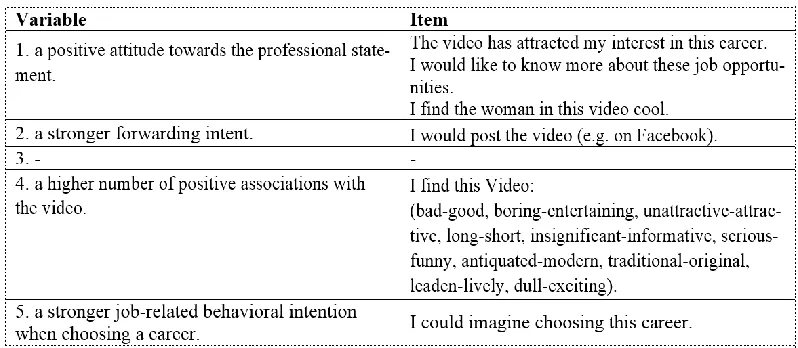
Compared to content with stereotypes, content with unconventional representations or protagonists leads to...
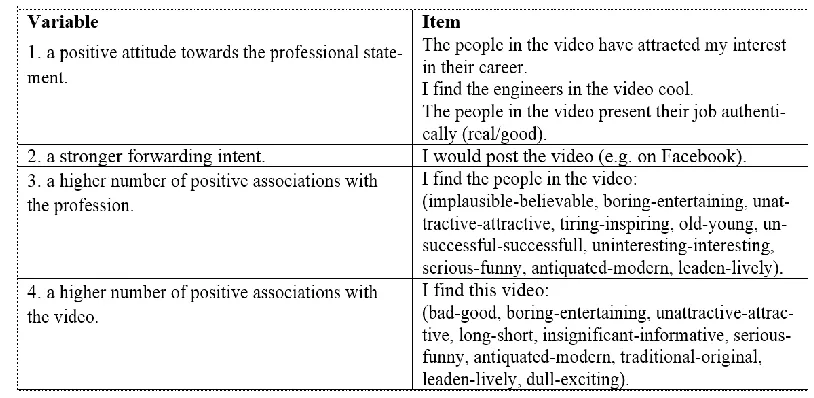
Table 5. Operationalization of the variables (2)
Video 4A for the experimental group (unconventional protagonists) link to the video Video 4B for the control group (stereotypes) link to the video
Page 32 5.3. Hypotheses 3, 5 and 6
(H3) Compared to content containing complicated language (foreign words, jargon), content with lan-guage that addresses the target group in an appropriate way leads to...
(H5) Compared to real video content (images), exclusively animated video content (images) leads to... (H6) Compared to videos with a visible narrator, videos with off-text lead to...
Table 6. Operationalization of the variables (3)
Video 5A for the experimental group (understandable language, animated content, off-text) link to the video
Video 5B for the control group (complicated language, animated content, off-text, music) link to the video
Page 33 5.4. Hypothesis 4
Compared to the videos without possibility of intervention, interactive videos lead to...
Table 7. Operationalization of the variable (4)
Comment on hypothesis 4: Since the main focus here is on the design-related determinant, the subject of “career” was not questioned with the semantic differential.
Video 6A for the experimental group (interactivity) link to the video
Video 6B for the control group (without possibility of intervention) link to the video
The interactivity in the video of the experimental group is shown by the fact that the viewers can influ-ence the course of the story. It is necessary to make certain decisions. The recipients can deal with the occupations in a playful and active way, their attention is attracted. Nowadays, it becomes more and more difficult to place good videos on YouTube and other social media channels in such a manner that they get the desired audience. It is even more difficult to maintain the attention of the recipient. If the first step is done by clicking the video, it is about entertaining the recipient with the content and message of the video. The recipient decides in seconds whether the video is of interest or boring.
In an interactive video, navigational elements (button, mouse over) are available to the recipients, for example, to influence the information flow or the story. Not only the possibility of interactivity, but also other aspects have an influence on the attention of the recipient. A simple and clear design can help that a video will continue to be watched. If buttons are used, they should be clearly recognizable. The pro-tagonist can point them out, for example, with his voice or gestures. Finally, the appearance of the video must also be coherent, the protagonist and the design must fit together.
5.5. Video for both groups
Video 7 (online not available anymore) was shown in the experiment but wasn’t part of it, and the content has nothing to do with technical careers. A start-up company is shown, coloured, with fast image sequences and somewhat shrill. Both groups evaluated the video to gain more information about design elements of videos that are well received by the target audience.
5.6. Self-evaluation of English language knowledge
Page 34 6. INTERPRETATIONS
The review of the six hypotheses which were formulated at the beginning of the experiment “sciencE-motion” has revealed some conclusive results, which are summarized below.
Emotional content, according to the first hypothesis (H1), gets better received in the target group than content that does not address emotional levels. In the experiment, the term “emotional content” describes the three determinants of storytelling, humour and infotainment. Storytelling as a method seems to be a suitable means to arouse the interest of young people in a topic so they want to find out more about it. However, this applies more to the male subjects. The question arises whether the female participants felt less inspired by the content of the experimental video, which tells the story of a cyber-attack. Nev-ertheless, both sexes find people cool who deal with this topic.
Emotional content leads to a more positive overall rating of the video. However, the postulate by Mau, Schulz & Silberer (2008) can’t be confirmed. Although storytelling as a method works, it only leads to a higher forwarding intent to a very limited extent. The fact that the hypothesis (H1) has been rejected for the variable expressions “demanding”, “important” and “progressive” indicates, that storytelling is able to entertain and attract interest, but it does not necessarily mean that the topic is given a high value. It is also possible that the English language has a significant influence on the perceived information content of the video. Also, in the evaluation of the video itself, the hypothesis was rejected, amongst other things, for the variable expression “informative”. This result is to be seen against the background, that the experiment participants have classified their English skills as rather mediocre. Therefore, it is also not surprising, that for both videos the English language was repeatedly criticized. Both videos were rated as too long. Attention is given to an exciting story, but not indefinitely. If the recipients have to concentrate on a foreign language, patience will soon be overused.
While the hypothesis for the determinant storytelling can be confirmed in many areas, the determinant infotainment is somewhat different. The results of both groups show no great differences. In both groups interest in laser technology was aroused strongly, whether the information was given factual and rather dry or in an entertaining way. However, the male participants were affected to a greater degree than the female ones. And yet – only a small number of test subjects would try to find out more about the topic. Most likely, the younger, male participants would do this. Also the people who are engaged in the topic of laser technology are not evaluated particularly positively. A large part of the answers lie in the middle section. Even worse evaluated gets the idea of dealing with the subject. As was shown above the videos do not create a strong desire to be shared, not with the peers and not with anybody else.
Now one might assume that a well-known, popular figure such as Luke Skywalker from the Star Wars films would be well received by the target groups. But this is not the case; large numbers of the experi-mental group, whose video is designed with this element, reject this style.
Page 35
information about the company. Humour can arouse interest, but humour can, as has been already pointed out, lead to the content being secondary.
In the design of videos, the determinants storytelling, infotainment and humour can be important instru-ments to effectively address the recipients. Skilful storytelling attracts interest, increases the suspense and can be inspiring. Also infotainment can make a video more stimulating. However, care must be taken not to exaggerate with the entertainment factor; there is the risk that the content will no longer be taken seriously. However, content that is mediated in a factual manner is given higher significance. This is also reflected in the stimulus humour. It seems as if ease, wit and tension appeal to the test subjects but at the same time, the content conveyed is taken less seriously. This agrees with the statement by Schmidt (1994) that humour should only be used in a targeted manner. The challenge in designing vid-eos will be to bring entertainment and fun into a balanced relationship with information content so that the target groups not only amuse themselves, but also gain knowledge and insights that lead them in the right direction. The length of the video is also important. Simply stated: “Short is better than long”. In the design of the videos it can’t be assumed that the distribution is supported by the recipients themselves – this is rejected by the majority. This also has consequences for the manner in which the videos are put into circulation.
For the second hypothesis (H2), one video with unconventional protagonists was compared to a video, which is characterized by stereotypes. It becomes apparent that persons and videos, which confirm com-mon stereotypes, are less well received than representations, which break apart the comcom-mon clichés. This is especially true where the male participants of the control group are concerned. The “cool” per-formers in the experimental video are well received.
Despite that the stereotypical performers get judged as more authentic. That seems to be a contradiction to the findings mentioned above. But this result could also be seen as a confirmation of the stereotypical thinking: “That’s what engineers are like”. The unconventional protagonists on the other hand are more likely to be denied credibility and success by the test subjects.
The fact, that the hypothesis for the variable expression “informative” can’t be confirmed, could again be related to the English language issue, as already shown above.
Again the audience doesn’t necessarily feel a strong forwarding intent for the videos. However, in the experimental group quite a few test subjects would post the video. This can be seen as an indication that the video is well received.
Hypothesis (H3) was used to determine whether a target-group-oriented language leads to a greater positive evaluation of the video. A good third of the control group said that there were many foreign words in the video that they didn’t understand. The usage of foreign words and technical terms, which are not explained in a more detailed way, led to the fact that the subject of laser technology was less interesting for the test subjects and they wouldn’t be likely to get more information. Language seems to have a greater influence on the male participants. The female participants expressed less trouble with the technical terms. Whether this result is due to a higher linguistic competence of the female participants can’t be confirmed. Also the female participants of the control group tend to prefer animated presentations of such topics. Perhaps, one might suppose, the element “language” was less important as the depiction in the video appeared to be of a cute type.
Not many test subjects would post the video, participants of the experimental group would do so a little more often than the control group. The reason could be: What one doesn’t understand, one doesn’t want to disseminate.
Overall, the ratings of the topic are quite close to each other in both groups. While the hypothesis (H3) was rejected for the evaluation of the video, it was accepted for the video itself. It is clear that compli-cated language is not suitable in addressing the target groups.
Page 36
more likely to arouse the interest in the profession that was presented in the video. That wasn’t the case, as the video of the control group managed to create a higher interest in the profession. This video also was evaluated more positively in nearly every aspect. The experimental video was only judged to be funnier. On the other hand, more participants of the experimental group would try to get more infor-mation about the job opportunities, and the protagonist of the experimental video got evaluated a little better.
For once more test subjects of the control group would post the video. Overall, however, the possibility of interactive influence on the course of the story seems to be less significant in the evaluation of the videos. The ratings of both videos are quite similar. But nevertheless, a great majority of the experi-mental group likes the fact that they can determine the course of the story themselves. This option was rather rejected by the male participants.
The findings presented here might indicate that interactive elements need to be planned well. Interac-tivity at any price is not enough to impress the audience. The story behind it must also be right. Further-more, many test subjects of the control group stated that they liked their video very much. The fact that environmental issues are the focus has been received very positively, which indicates a pronounced environmental awareness. This shows that the content of the video should not be underestimated. De-sign-related elements are important, but only if they convey content that is of interest to the target groups.
Animations, music and off-text are the other design-related elements, which were examined in the ex-periment. The results suggest that all three elements are well received by the recipients. The fact that the animations in the experimental video are judged more positively could be down to the combination of the animations with a difficult technical language as it occurs in the control video. Music does not seem to be a particular issue; it is not perceived as disturbing or distracting by the control group in which it was examined. However, it must be taken into account that taste in music is very different. Therefore, this design-related element must be used very specifically.
The fact that the narrator is not seen didn’t have any particularly negative effect on the suspense of the story for either group. As the two voices were quite different it seems that this element can be regarded as unproblematic.
Fast image sequences are a design-related element that is well received by the recipients. It appears they want to be entertained, an image setting that is too long doesn’t appeal to them. Also, a lively narration and vibrant colours meet the needs of the target group. Caution is required where the video’s design is seen as more important than the information content. The test subjects notice this imbalance. The design can attract the attention, but the information mediation must not be disregarded.
This experiment has shown, that videos are a useful tool to promote the STEM topics to the target group but only if they are designed in a well-adjusted form.
REFERENCES
Brown, TJ, Barry, TE, Dacin, PA & Gunst, RF 2005, ‘Spreading the word: Investigating antecedents of consumers’ positive word-of-mouth intentions and behaviors in a retailing context’, Journal of the Acad-emy of Marketing Science, vol. 33, no. 2, pp. 123-38.
Eidgenössisches Departement des Innern, Eidgenössisches Volkswirtschaftsdepartement 2010, Mangel an MINT-Fachkräften in der Schweiz: Ausmass und Ursachen des Fachkräftemangels in MINT (Math-ematik, Informatik, Naturwissenschaften und Technik), viewed 15 July 2016, <https://biblio.parlament.ch/e-docs/352650.pdf> .
Page 37
HTW Chur 2012a, Ingenieurberufe in den Medien: Wahrnehmung und Attraktivität von Ingenieurber-ufen für potentielle Studienbewerber, viewed 23 September 2016, <http://www.htwchur.ch/uploads/media/MINT_Studie_12_16.pdf>.
HTW Chur 2012b, Ingenieurberufe in den Medien: Wahrnehmung und Attraktivität von Ingenieurber-ufen für potentielle Studienbewerber, viewed 23 September 2016, <http://www.htwchur.ch/uploads/media/MINT_Studie_II_17_21.pdf>.
Homer PM & Yoon SG, 1992, ‘Message Framing and the Interrelationships Among Ad Based Feelings, Affect, and Cognition’, Journal of Advertising, vol. 21, no. 1, pp. 19-32.
Kaplan, R & Pascoe, G 1977, ‘Humorous lectures and humorous examples: Some effects upon compre-hension and retention’, Journal of Educational Psychology, 69(1), pp. 61-65.
Kleine Wieskamp P 2016, Storytelling: Digital – Multimedial – Social. Formen und Praxis für PR, Mar-keting, TV, Game und Social Media, Carl Hanser Verlag, München.
Kroeber-Riel W, Weinberg P & Gröppel-Klein A 2009, Konsumentenverhalten, Vahlen, München. Mau, G, Schulz, S & Silberer, G 2008, ‘Determinanten des Weiterempfehlens im viralen Marketing’, Transfer – Werbeforschung und Praxis, 53. Jg., Nr. 2, pp. 18-30.
Pfeiffer, C 2003, Medienverwahrlosung als Ursache von Schulversagen und Jugenddelinquenz?, viewed
20 May 2016,
<http://www.bauberufe.eu/images/doks/Medienverwahrlosung.pdf>.
Sammer, P 2014, Storytelling. Die Zukunft von PR und Marketing. O’Reilly Verlag, Köln.
Schmidt, S 1994, ‘Effects of humor on sentence memory. (APA, Hrsg.)’, Journal of Experimental Psy-chology: Learning, Memory, and Cognition, 20(4).
Staden C & Howe, F 2013, Digitale Medien und Internet in der Berufsorientierung, bwp@ Spezial, viewed 5 May 2017, <http://www.bwpat.de/ausgabe/ht2013/fachtagung-02/staden-howe>.
Stolz, R 2015, Stell dir vor – die Firma ist frauenfreundlich und keiner merkt’s, viewed 26 April 2016, <http://www.zeit.de/karriere/beruf/2015-10/fachkraeftemangel-frauen-technische-berufe>.
Strick, M, van Baaren, R, Holland, R & van Knippenberg, A 2009, ‘Humor in Advertisements Enhance Product Liking by Mere Association. (APA, Hrsg.)’, Journal of Experimental Psychology, 15(1), p. 35-45.
The Nielsen Company 2015, Vertrauen in Werbung Weltweit, viewed 30 May 2016, <http://www.niel- sen.com/content/dam/nielsenglobal/de/docs/Nielsen_Global_Trust_in_Advertising_Report_DIGI-TAL_FINAL_DE.pdf>.
Wunsch, PD 2014, und Fachkräftebedarf der Schweiz bis 2060, Abteilung Arbeits-marktökonomie, Wirtschaftswissenschaftliche Fakultät Basel, Basel.