Page 108
INFORMATION COMMUNICATION TECHNOLOGIES DURING MUSIC LESSON: TEACHERS’ PERSPECTIVE
Jolanta Abramauskienė
Lithuanian University of Educational Sciences, Faculty of Education, Department of Music, Vilnius, Lithuania
Abstract
The article analyses possibilities of application of information communication technologies (ICT) during music lessons. The results of the conducted research are presented: the frequency of using ICT by music teachers is revealed; the purpose of using ICT is discussed; the preparation of music teachers and their abilities to use ICT are determined; the most proven means of ICT are compared and positive and negative factors of applying ICT during music lessons are presented. The research data allow to state that teachers apply various ICT means and computer programs but not all the potential of information technologies is employed.
Key words: information communication technologies, music lesson, attitude of music teachers
1. INTRODUCTION
Today information and communication technologies (ICT) have stopped being an innovation but they provide new opportunities in the process of education. Many researchers (Lawless & Pellegrino 2007, Haris, Mishra & Koehler 2009, Lei 2009, Dagienė & Žilinskienė 2011, Beilefeldt 2012 et al.) state that the use of ICT enhances the efficiency of the education process. Girdzijauskienė, Gudynas et al. (2010) believe that ICT is an integral part of modern life, and, if used appropriately, can improve the quality of teaching and learning. The application of ICT can enrich study programmes, develop innovative pedagogy, and create more efficient organizational structures and links with the external world (Paulionytė & Grabauskienė et al. 2010). Compared with the traditional means, ICT have obvious advantages in the visualization of teaching material, experimentation, cooperation, consolidation and evaluation of knowledge, search for information, encouragement of learners’ independence, and enhancement of learning motivation etc. (Ignatova & Kurilovas 2012, Kontvainas & Radčenko 2013 et al.). At international level it has been acknowledged that ICT accessibility and their application contribute to improvement of the quality of life, reduce social exclusion and increase possibilities of individual’s engagement, whereas their inaccessibility creates social, economic and political barriers (The World Summit on the Information Society (WSIS), 2014). In addition, compared to the situation a couple of decades ago, schools are in a much better position to implement information and communication technology in their classrooms. Many teachers now are more experienced and willing to use computer technology in their classroom instruction, and information and communication technology is more affordable compared to a decade ago (Cheung & Slavin 2013).
Page 109
be used. ICT tools are not always favourably assessed. There still are sceptical and cautious attitudes to teaching by means of ICT. Juteikienė and Motekaitytė (2009) believe that the variety of technologies causes chaos and one’s inability to correctly choose and use them can bring such negative results as the decline of literacy, absence of critical thinking, and distortion of reality. Fuchs and Woessmann (2004) conducted a research whose results show that a computer in children’s room determines worse grades at school since school learners conceive the computer as a toy, a game, not as a source of knowledge. Thus the role of ICT in the process of education is controversial and a professional application of ICT is an aspiration that requires significant endeavours.
In Lithuania the application of ICT in musical education has been analysed by the following researchers: Girdzijauskienė & Rimkutė-Jankuvienė (2008), Žalys (2013) et al. In other countries this issue was considered by Rudolph (2004), Brown (2007), Burns (2008), Watson (2011), Lagerlöf, Wallerstedt & Pramling (2014), Fernandeza, Garcíab & Fernandeza (2017) et al. The conducted studies theoretically and practically analyse the role of ICT in music, the integration of technologies in primary school musical education, the use of technologies for the development of creativity, etc. However, there has been no research that fully reveals the possibilities of applying ICT in the process of musical education.
These are essential factors seeking to clarify the main peculiarities of ICT application during music lessons. Such research would allow identifying efficient ways of modern ICT application teaching music and improving teacher professional development. Having taken into account the aforesaid, information communication technologies during music lessons was chosen the object of the research.
2. AIMS AND METHODS OF THE RESEARCH
The aim of the research is to clarify the attitude of music teachers towards possibilities of applying information communication technologies during music lessons.
The research methods: analysis of scholarly literature sources, questionnaire survey, qualitative and quantitative research data analysis. Following the analysis of scientific literature and the requirements for questionnaires (Kardelis 2005), the author designed a questionnaire form, which consisted of open and close-ended questions.
The characteristics of the respondents. The questionnaire survey of music teachers was carried out in 2016. The sample included 76 music teachers from various schools of Lithuania, who studied in the professional development programs organised in the Professional Competence Development Institute of Lithuanian University of Educational Sciences. The average working experience of the respondents equalled 19 years. 88.9 % of the respondents were graduates from higher university studies, 5.6 % ‒ from non-university higher education studies and 5.6 % of the teachers indicated “other“, when asked about their educational background. One fifth (20.0 %) of the respondents had teacher’s qualification, 54.3 % were senior teachers and 25.7 % were teachers-methodologists.
The research ethics. The research was conducted observing the rights of the respondents and the principles of ethics. The respondents participated in the research on voluntary basis; the anonymity and confidentiality were guaranteed. The written questionnaire did not require any personal data or any other information to prevent possibilities of identifying the respondents.
3. THE RESEARCH RESULTS AND DISCUSSION
Page 110
performance, recording and analysis. In most cases the computer helps to record and notate music: in notes, matrix, list, various schemes or form of sound waves (General Curriculum of Computer Music Technologies for School Students Learning according to Secondary Education Curriculum, 2007). The functions of ITC performed in the process of education may be classified and they may be applied as: teaching and learning aids, a learning environment, a means of communication, a therapeutic support aid, a diagnostic tool and a tool for performance of administration assignments, etc. (Dudzinskienė & others, 2010).
Seeking to investigate possibilities of using ICT during music lessons, the following groups of questions were singled out: how frequently ICT are used by music teachers; what are ICT used for; preparation of music teachers to apply ICT; the most proven means of ICT application, positive and negative factors of ICT application. Thus, the first group consisted of the questions, which allowed revealing the frequency of ICT application for educational goals (Table 1).
Table 1. Frequency of use of ICT for teaching (%)
Use of ICT Frequently Sometimes Seldom Never
Use of computer during music lessons 55.8 20.6 11.8 11.8
Search for methodological material on the internet 67.6 17.7 5.9 8.8
Creation of material for music teaching (presentations, etc.) 52.9 23.5 8.9 14.7
Communication with colleagues in virtual space (e-mail, Skype, etc.) 29.4 29.4 23.5 17.7
Preparation of presentations for conferences and other events 21.6 32.4 29.4 16.6
Development of methodological materials 38.2 29.4 23.5 8.9
Use of services of education portals (e-school, etc.) 17.1 40.0 25.8 17.1
Professional development at distance (Moodle or virtual learning environment, etc.) 4.1 16.7 12.5 66.7
The analysis of the respondents’ answers showed that more than half of the music teachers use the computer during music lessons for educational goals (55.8 %), search for methodological materials (67.6 %), preparation of material for teaching music (52.9 %) and development of methodological materials (38.2 %). The music teachers (40.0 %) sometimes use services of education portals and 32.4 % of them sometimes prepare presentations for conferences and other events employing ICT. However, more than two thirds (66.7 %) of music teachers pointed out that they never involve in professional development using distance learning (e.g. Moodle or any other virtual environment). As it can be seen from the aforesaid, the internet is most frequently applied means during music lessons. The music teachers use it preparing material for teaching music, communicating but they are not very well familiar with possibilities and ways of distance learning. Current ICT level and their variety create a range of various possibilities of distance learning: from correspondence to virtual classes. At present distance learning is most frequently provided using various internet means: virtual learning environment, video conferences, open education resources, Web 2.00 technologies and applications, three-dimensional virtual world, etc. (Vaičiūnaitė 2012). Over several last years a big number of the projects of teacher distance learning, financed by the European Fund, have been implemented; however, there are no data on efficiency of such activities. The use of distance learning or its methods in music education would expand possibilities of applying contemporary learning methods, would improve accessibility of learning as well as its attractiveness and would increase possibilities of individual expression. Such ICT forms should be presented to music teachers during professional development events.
Page 111
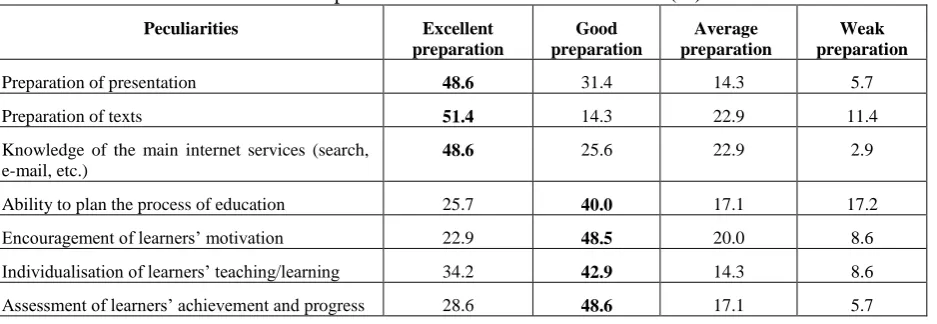
divide the process of creation into stages and to achieve outcomes over a short period of time (General Curriculum of Computer Music Technologies for School Students Learning according to Secondary Education Curriculum 2007). Therefore, efficient ICT application and use in the process of education to great extent depend on a music teacher. ICT competences obtained by the teacher become of utmost importance. They are directly related to teacher professional development, education modernisation and change, whereas higher results are achieved by the school learners taught by specialists, who have mastered information technologies and are concerned about their professional development (Gerulis & Bukantaitė 2007). Thus, good computer literacy has to be an absolute necessity for today’s teacher because more and more possibilities based on ICT are introduced. Several statements have been formulated to evaluate the level of music teachers’ preparation to use ICT.
Table 2. Preparation of music teachers to use ICT (%)
Peculiarities Excellent
preparation
Good preparation
Average preparation
Weak preparation
Preparation of presentation 48.6 31.4 14.3 5.7
Preparation of texts 51.4 14.3 22.9 11.4
Knowledge of the main internet services (search, e-mail, etc.)
48.6 25.6 22.9 2.9
Ability to plan the process of education 25.7 40.0 17.1 17.2
Encouragement of learners’ motivation 22.9 48.5 20.0 8.6
Individualisation of learners’ teaching/learning 34.2 42.9 14.3 8.6
Assessment of learners’ achievement and progress 28.6 48.6 17.1 5.7
Following the obtained research data (Table 3), it can be stated the teachers possess an excellent ability to write texts on computer (51.4 %) as well as to prepare presentation and use the main internet services (48.6 %). Almost half of the music teachers point to their good preparation to plan the process of education, to encourage learners motivation for learning, to individualise school students’ teaching/learning and to evaluate their achievements and progress. The problem is observed evaluating the mean values because the computer literacy of almost one third of the respondents is insufficient. They possess average abilities to prepare texts (22.9 %) and to use the main internet services (22.9 %). The variant of the response “average“ is assigned to problematic issues based on the tendency tested by social research that the respondents tend to subjectively better evaluate own qualities than they really are. It is interesting to compare these distributions with the results of the research on the computer literacy of Lithuanian teachers conducted in 2010. Tamošiūnas (2010) investigated the computer literacy of teachers working with 5th-12th formers. The results showed that more than half of the teachers (65 %) acquired the standard level of computer literacy, i.e., it is good. More frequently individual over 45 years old marked their computer literacy as low and the number of such respondents was twice as high in the group of teachers with the working experience over 20 years. This research revealed that ITC skills of a small number of the respondents are underdeveloped. However, there should be no individuals with low abilities to use computer nowadays.
Page 112
The efficiency of ICT employment for development and education of school students depends on teacher’s attitude towards ICT, his/her enthusiasm, wish to learn and improve and not only on the computer literacy competence acquired by him or her. The expansion of ICT use is hardly possible if teachers insufficiently evaluate the importance of their potential. Thus, it is important to clarify how teachers see efficiency of information communication technologies.
Table 3. Positive factors of ICT use (%)
Factors Totally agree Agree Almost agree Disagree
Diversification in curriculum of music teaching/learning 58.5 18.1 11.7 11.7
Increase in motivation for learning music 55.9 23.5 5.9 14.7
Enhancement of practical musical skills 35.3 32.4 17.6 14.7
Increase in choice of possibilities for music learning 47.1 29.4 8.8 14.7
Facilitation of individualisation of music learning 32.4 35.3 11.8 20.5
Facilitation of linking of themes of music subject with life 41.2 35.3 5.9 17.6
Facilitation of integration of several study subjects 38.2 29.4 11.8 20.6
Time saving 52.7 29.1 2.9 15.3
Professional development 52.9 26.5 5.9 14.7
According to the teachers, the use of ICT provides the process of music education with a big number of possibilities: diversification in study subject of music (58.5 %), more efficient use of time (52.7 %), strengthening of motivation for learning (55.9 %) as well as professional development (52.9 %). Over one fifth (20.6 %) of the respondents do not approve of the benefits of ICT regarding integration of several study subjects and individualisation of music learning. The respondents also distinguished “other” factors such as more efficient work and easier work for teachers.
Page 113
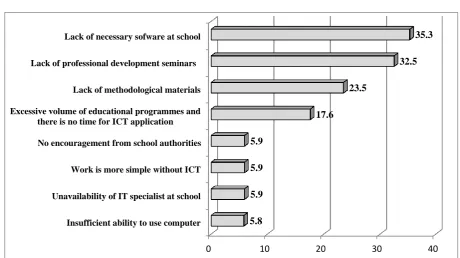
NB: some respondents marked several variants
Figure 1. Negative factors of ICT use (%)
As it can be seen from the data obtained during the research (Fig. 1) more than one third of music teachers think that schools lack necessary software and the number of professional development courses is not enough. A considerable proportion of teachers also indicated the shortage of methodological materials and excessive volumes of content of educational programmes, which results in absence of time for application of ICT in the process of teaching music. Several teachers mentioned that school authorities do not support use of ICT, work is less complicated without ICT or that their computer literacy is not sufficiently developed. The respondents singled out “other” factors as well: shortcomings and failures of software; see no problems if ICT are used moderately.
Attempts were made to identify, what ICT means are applied by music teachers during music lessons. The answers of the respondents to this open question more clearly revealed possibilities for ICT application. Most frequently in the classroom the teachers apply: computer, music player, multimedia, interactive board, telephone with phonograms, video and audio records and song phonographs. During the research it was revealed that most frequently teachers use computer networks and necessary software for work. The most popular programs include: Google Chrome, PowerPoint, Sibelius, Youtube, music encyclopaedias, various music teaching programs, music creation and animated film creation programs, phonogram and karaoke creation programs, sound editing and CD recording programs. It should be noted that a big number of ICT means and programs were not mentioned, which means that possibilities of information communication technologies have not been fully employed. It is possible that appropriate software is not available or competences of music teachers are not sufficient.
Having evaluated the research data, it can be stated that ICT play a major role during music lessons and have a significant influence on the process of education: planning as well as diversifying the content of music teaching/learning, etc. Perhaps not all the music teachers are successful in applying ICT in education; however, teaching needs, new requirements necessitate the use of ICT in professional activities. Their use is innovative and useful but requires from teachers interest as well as improvement of possessed knowledge and abilities.
0 10 20 30 40
Insufficient ability to use computer Unavailability of IT specialist at school Work is more simple without ICT No encouragement from school authorities Excessive volume of educational programmes and
there is no time for ICT application Lack of methodological materials Lack of professional development seminars
Lack of necessary sofware at school
5.8 5.9 5.9 5.9
17.6 23.5
Page 114
4. CONCLUSIONS
Changes occurring in society and development of ICT necessitate a new look into the process of music education. There appear obvious advantages visualising teaching material, collaborating, consolidating and assessing knowledge, searching for information, encouraging self-dependence, evoking motivation for learning, etc. ICT application in the process of education open up new opportunities: music may be recorded, created, edited and composed using ICT. These technologies allow playing various instruments, to teach music theory, to train ear for music, to search for new information using internet resources. It is possible to use ICT in various spheres of music activities: teaching singing, playing, rhythmic or listening to music compositions. ICT have a significant impact on music teachers’ subject-specific competences and supplement their professional activity.
The research data revealed that more than half of music teachers use computer during music lessons, search for methodological material on the internet and prepare material for music teaching. However, more than two thirds of music teachers have never upgraded their professional qualification employing distance methods. It is appropriate to publicise the benefits of such methodology for professional development. More than half of music teachers evaluate their skills to prepare textual material, presentation and to use the main internet services as excellent. Almost half of music teacher indicate a good preparation for planning of the process of teaching, encouragement of school students’ motivation for learning and assessment of learners achievements and progress. According to the teachers, application of ICT provides learners with a big range of possibilities for variations in teaching music as a subject, more efficient time management, enhancement of music learning motivation and professional development. The use of ICT in education is usually impeded by lack of necessary software and professional development seminars. According to the respondents, there is a shortage of methodological material and the volumes of the programs are excessive. The research data allow to state that teachers apply various ICT means and computer programs but not all the potential of information technologies is employed.
REFERENCES
Beilefeldt, T 2012 'Guidance for technology decisions from classroom observation', Journal of Research on Technology in Education, vol., 44, no. 3, pp. 205-223.
Brown, RA 2007, Computers in music education, Routledge, New York.
Bukantaitė, D & Gerulis, S 2007, Technologinio muzikinio raštingumo koncepcija, Kauno J. Naujalio muzikos gimnazija, Kaunas.
Burneikienė, N, Jarienė, R, Jašinauskas, L, Motiejūnienė, E, Neseckienė, I & Vingelienė S 2005, Informacinių komunikacinių technologijų taikymo ugdymo procese galimybės, Švietimo plėtotės centras, Vilnius.
Burns, AM 2008, Technology integration in the elementary music classroom, Hal Leonard Corporation, USA.
Cheung, ACK & Slavin, RE 2013, ‘The effectiveness of educational technology applications for enhancing mathematics achievement in K-12 classrooms: A meta-analysis’, Educational Research Review, vol. 9, pp. 8-113.
Dagienė, V & Žilinskienė, I 2011, 'Understanding of learning activities in the digital context', Pedagogika, vol.102, pp. 94–103.
Dudzinskienė, R, Kalesnikienė, D, Paurienė, L & Žilinskienė, I 2010, Inovatyvių mokymo(si) metodų ir IKT taikymas, Book 2, Ugdymo plėtotės centras, Vilnius.
Page 115
Fuchs, T & Woessmann, L 2004, Computers and student learning: bivariate and multivariate evidence on the availability and use of computers at home and at school, CESifo, Munich, viewed 2 June 2017, <http://www.cesifo-group.de/portal/page/portal/DocBase_Content/WP/WP-CESifo_Working_Papers/wp-cesifo-2004/wp-cesifo-2004-11/cesifo1_wp1321.pdf>
Girdzijauskienė, R & Rimkutė-Jankuvienė, S 2008, 'The development of senior form pupils' creative skills in music activity through information communication technology', Kūrybos erdvės, vol. 8, pp. 8– 19.
Girdzijauskienė, R, Gudynas, P, Jakavonytė, D & Jevsikova, T 2010, Inovatyvių mokymo(-si) metodų ir IKT taikymas, Book 1, Ugdymo plėtotės centras, Vilnius.
Harris, J, Mishra, P & Koehler, M 2009, 'Teachers’ technological pedagogical content knowledge and learning activity types: Curriculum-based technology integration reframed', Journal of Research on Technology in Education, vol. 41, no. 4, pp. 393–416.
Ignatova, N & Kurilovas, E 2012, 'ICT based teaching and learning personalization trends in the context of Lithuanian education', Pedagogika, vol. 106, pp. 21–29.
Juteikienės, V & Motekaitytė, V 2009, Efektyvus žiniasklaidos naudojimas vidurinio lavinimo švietimo įstaigose. Informacinių technologijų taikymas švietimo sistemoje: E-studijų patirtis, aktualijos ir perspektyvos. Kauno kolegija, Kaunas, pp. 18–21.
Kardelis, K 2005, Mokslinių tyrimų metodologija ir metodai, Judex, Kaunas.
Kompiuterinių muzikos technologijų bendroji programa mokiniams, besimokantiems pagal vidurinio ugdymo programą, Approved by the Order of the Minister of Education and Science of the Resspublic of Lithuania No. ISAK-1790 of 6 September 2007.
Kontvainas, R & Radčenko, M 2013, 'Geography teacher approach to using virtual learning environmentin education ofgeography', Pedagogika, t. 109, pp. 118–125.
Lagerlöf, P, Wallerstedt, C & Pramling, N 2014, 'Playing, new music technology and the struggle with achieving intersubjectivity', Journal of Music, Technology & Education, vol. 7, no. 2, pp. 199-216.
Lawless, K & Pellegrino, J 2007, 'Professional development in integrating technology into teaching and learning: Knowns, unknowns, and ways to pursue better questions and answers', Review of Educational Research, vol., 77, no. 4, pp. 575–614.
Lei, J 2009, 'Digital natives as Preservice Teachers: what Technology Preparation is Needed? Journal of Computing in Teacher Education, vol. 25, no. 3, pp. 87-97.
Paulionytė, J, Grabauskienė, V, Žemgulienė, A, Schoroškienė, V & Makarskaitė-Petkevičienė, R 2010, IKT ir inovatyvių mokymo (si) metodų taikymo pradiniame ir specialiajame ugdyme pasiūla, taikymo praktika ir perspektyvos Lietuvoje ir užsienyje, Švietimo aprūpinimo centras, Vilnius.
Rudolph, T 2004, Teaching music with technology, GIA Publications, Chicago.
Tamošiūnas, T 2010, Mokslinio švietimo būklės tyrimo IKT ir inovatyvių mokymo(si) metodų taikymo pradiniame ir specialiajame ugdyme būklė Lietuvoje ir užsienyje 2000 – 2010 metais ataskaita,
viewed 8 June 2017,
<http://www.esparama.lt/es_parama_pletra/failai/ESFproduktai/2010_svietimo_bukles_tyrimo_ataskai ta.pdf>
The general programmes for lithuanian schools of primary and basic education 2008, Švietimo aprūpinimo centras, Vilnius.
Vaičiūnaitė, D 2012, Nuotolinis mokymasis: mokymosi galimybių išplėtimas, Švietimo problemos analizė, Vilnius.
Page 116
World summit on the information society (WSIS) +10 2014, viewed 8 June 2017, <http://www.itu.int/net/wsis/implementation/2014/forum/inc/doc/outcome/362828V2E.pdf>