Maximum Likelihood Turbo Iterative Channel
Estimation for Space-Time Coded Systems
and Its Application to Radio Transmission
in Subway Tunnels
Miguel Gonz ´alez-L ´opez
Departamento de Electr´onica y Sistemas, Universidade da Coru˜na, Campus de Elvi˜na s/n, 15071 A Coru˜na, Spain Email:[email protected]
Joaqu´ın M´ıguez
Departamento de Electr´onica y Sistemas, Universidade da Coru˜na, Campus de Elvi˜na s/n, 15071 A Coru˜na, Spain Email:[email protected]
Luis Castedo
Departamento de Electr´onica y Sistemas, Universidade da Coru˜na, Campus de Elvi˜na s/n, 15071 A Coru˜na, Spain Email:[email protected]
Received 31 December 2002; Revised 31 July 2003
This paper presents a novel channel estimation technique for space-time coded (STC) systems. It is based on applying the max-imum likelihood (ML) principle not only over a known pilot sequence but also over the unknown symbols in a data frame. The resulting channel estimator gathers both the deterministic information corresponding to the pilot sequence and the statistical information, in terms of a posteriori probabilities, about the unknown symbols. The method is suitable for Turbo equalization schemes where those probabilities are computed with more and more precision at each iteration. Since the ML channel estimation problem does not have a closed-form solution, we employ the expectation-maximization (EM) algorithm in order to iteratively compute the ML estimate. The proposed channel estimator is first derived for a general time-dispersive MIMO channel and then is particularized to a realistic scenario consisting of a transmission system based on the global system mobile (GSM) standard performing in a subway tunnel. In this latter case, the channel is nondispersive but there exists controlled ISI introduced by the Gaussian minimum shift keying (GMSK) modulation format used in GSM. We demonstrate, using experimentally measured channels, that the training sequence length can be reduced from 26 bits as in the GSM standard to only 5 bits, thus achieving a 14% improvement in system throughput.
Keywords and phrases:STC, turbo equalization, turbo channel estimation, maximum likelihood channel estimation, GSM, sub-way tunnels.
1. INTRODUCTION
Recently, the so-called Turbo codes [1,2,3] have revealed themselves as a very powerful coding technique able to ap-proach the Shannon limit in AWGN channels. A Turbo code is made up of two component codes (block or convolutional) parallely or serially concatenated via an interleaver. This sim-ple coding scheme produces very long codewords, so each source information bit is highly spread through the trans-mitted coded sequence. At reception, optimum maximum likelihood (ML) decoding can be carried out by considering the hypertrellis associated with the concatenation of the two
component codes. Obviously, such a decoding approach be-comes impractical in most situations. The key idea behind Turbo coding is to overcome this problem by employing a suboptimal, but very powerful, decoding scheme termed it-erative maximum a posteriori(MAP) decoding [3,4]. Basi-cally, the method relies on independently decoding each of the component codes and exchanging in an iterative fashion the statistical information, that is, the a posteriori probabili-ties about symbols, obtained in each decoding module.
modulation scheme. This technique exploits the fact that ISI can be viewed as a form of rate-1, nonrecursive coding. So, whatever coding scheme is used, if an interleaver is located prior to the channel, the overall effect of coding and ISI can be treated as a concatenated code and therefore, itera-tive MAP decoding can be applied. Luschi et al. [6] present an in-depth review of this technique and further improve-ments can be found in [7,8,9,10]. In general, iterative MAP processing can be applied to a variety of situations where the overall system can be viewed as a concatenation of modules whose input/output relationship can be described as a (hid-den) Markov chain. Several works have appeared in the last years exploiting this idea. For instance, G¨ortz [11], Garcia-Frias and Villasenor [12], and Guyader et al. [13] worked on the problem of joint source-channel decoding and Zhang and Burr [14] addressed the problem of symbol timing re-covery.
In practical receivers, where the channel impulse re-sponse has to be estimated, it is convenient to have chan-nel estimators capable of benefiting from the high perfor-mance of Turbo equalizers [15,16,17]. Moreover, second-and third-generation mobile stsecond-andards consider the trans-mission of pilot sequences known by the receiver for channel estimation purposes. In theglobal system mobile(GSM) stan-dard, this sequence is 26 bits long, which represents 17.6% of the total frame length (148 bits) [18]. Such a long train-ing sequence is necessary if classical estimation techniques, such as least squares (LS), are used. Employing more re-fined channel estimators, such as the one presented in this paper, we can dramatically decrease the necessary length of the training sequence and therefore increase the overall sys-tem throughput. In [19], an ML-based channel estimator is presented where the ML principle is applied not only to the pilot sequence, but also to the whole data frame. Since the in-volved optimization problem had no analytical solution, the expectation-maximization (EM) algorithm [20] was used for iteratively obtaining the solution.
Also, wireless communications research has been very in-fluenced by the discovery of the potentials of communicating through multiple-input multiple-output (MIMO) channels, which can be carried out using antenna diversity not only at reception, as classical space-diversity techniques have been doing, but also at transmission. MIMO techniques have the advantage to provide high data rate wireless services at no extra bandwidth expansion or power consumption. Telatar [21] calculated the capacity associated with a MIMO chan-nel that in certain cases grows linearly with the number of antennas [22]. More recent progress in information theoret-ical properties of multiantenna channel can be found in [23]. Although MIMO channel capacity can be really high, it can only be successfully exploited by proper coding and modulation schemes. The term space-time Coding (STC) [24,25] has been adopted for such techniques. Special ef-forts have been made in code design [24,26] and several de-coding approaches have been developed for these codes. In both fields, the Turbo principle has been applied in profu-sion. Turbo ST codes designs can be found in [27,28,29] and various Turbo decoding schemes are exposed in [30,31].
As in single-antenna systems, practical ST receivers must perform the operation of channel estimation. Having effi -cient and robust estimators is crucial to guarantee that the system performance degradation due to the channel estima-tion error is minimized. In this paper, we present a novel channel estimation technique that gathers both the deter-ministic information corresponding to the pilot sequence and the statistical information, in terms of a posteriori prob-abilities, about the unknown symbols. The method is suit-able for Turbo equalization schemes where those probabili-ties are computed with more and more precision at each it-eration. We derive the channel estimator for general MIMO time-dispersive channels and analyze its performance in a multiple-antenna communication system based on the GSM standard operating inside subway tunnels.
The main motivation for developing a multiple-antenna GSM-based communication system is the following. GSM is, by far, the most widely deployed radio-communication system. Since 1993, its radio interface (GSM-R) has been adopted by the European railway digital radio-communic-ation systems. Due to the conservative nature of its market, it is expected that railway radio-communication systems will employ GSM-R for the long-term future. For this reason, when subway operators wish to deploy advanced, high data rate, digital services for security or entertainment purposes, it is very likely that they will prefer to increase the capac-ity of the existing GSM-R system rather than switch to an-other radio standard. STC and Turbo equalization are very promising ways of achieving this capacity growth [32]. In this specific application, we will show that the proposed it-erative MLMIMO channel estimation method has large ben-efits over traditional channel estimation approaches.
The rest of the paper is organized as follows.Section 2 presents the signal model andSection 3describes the Turbo equalization scheme for STC systems. Next, inSection 4, we derive the ML channel estimator for a general time-dispersive MIMO channel. Since direct application of the ML principle leads to an optimization problem without closed-form solu-tion, the EM algorithm is applied for computing the actual value of the solution, resulting in the so-called ML-EM es-timator. The application of the proposed channel estimator to a STC GSM-based system operating in subway tunnels is detailed inSection 5.Section 6presents the results of com-puter experiments for both the general case and experimen-tal measurements of subway tunnel MIMO channels. Finally, Section 7is devoted to the conclusions.
2. SIGNAL MODEL
sN(t;bN)
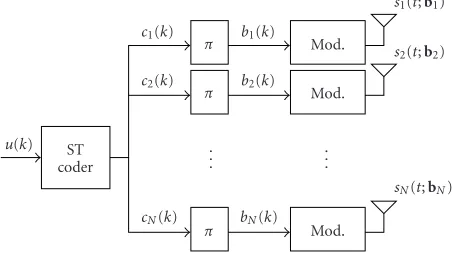
Figure1: Transmitter model.
trellis codes [24,25] to elaborate our simulation results. Each component ofc(k) is independently interleaved to produce a new symbol vectorb(k)=[b1(k) b2(k) · · · bN(k)]T and these are the symbols that are afterwards modulated (wave-form encoded) to yield the signals si(t;bi)i = 1, 2,. . .,N that will be transmitted along the radio channel. Without loss of generality, we will assume that the modulation format is linear and that the channel suffers from time-dispersive multipath fading with memory length m. It is well known that at reception, matched-filtering and symbol-rate sam-pling can be used to obtain a set of sufficient statistics for the detection of the transmitted symbols. Using vector nota-tion, this set of statistics will be grouped in vectors x(k) =
[x1(k) x2(k) · · · xL(k)]T,k = 0, 1,. . .,K−1, whereLis the number of receiving antennas andKis the number of to-tal transmitted symbol vectors in a data frame. Elaborating the signal model, it can be easily shown that the sufficient statisticsx(k) can be expressed as
x(k)=Hz(k) +v(k), (1)
where matrixH =[H(m−1) H(m−2) · · · H(0)] rep-resents the overall dispersive MIMO channel with memory lengthm. Each submatrix
H(i)=
contains the fading coefficients that affect the symbol vector b(k−i). Vectorz(k) results from stacking the source vectors b(k), that is,
z(k)=[bT(k−m+ 1) bT(k−m+ 2) · · · bT(k)T]. (3) Finally, the noise componentv(k) is a vector of mutually in-dependent complex-valued, circularly symmetric Gaussian random processes, that is, the real and imaginary parts are zero-mean, mutually independent Gaussian random pro-cesses having the same variance. We will also assume that the noise is temporally white with varianceσ2
v.
3. ST TURBO DETECTION
Figure 2 shows the block diagram of an ST Turbo de-tector. The MAP equalizer [4] computes L[b(k)|x] which˜ are the a posteriori log-probabilities of the input sym-bols b(k) based on the available observations ˜x =
[xT(0) xT(1) · · · x(K−1)]T. Due to its time-dispersive nature, it is convenient to represent our MIMO channel by means of a finite-state machine (FSM) having 2N(m−1)states.
This FSM has 2N transitions per state which implies that there is a total number of 2Nmtransitions between two time instants. Letek=(sk−1,b(k),s(k),sk) be one of the 2Nm pos-sible transitions at time k of this FSM. This transition de-pends on four parameters: the incoming statesk−1, the
out-going statesk, the input symbol vectorb(k), and the output symbol vector without noises(k)=Hz(k). It is important to point out that the incoming state is determined by them−1 previous symbol vectors, that is,sk−1=(b(k−m+ 1),b(k−
m+ 2),. . .,b(k−1)). On the other hand, the outgoing state is a function of the previous state and the current input sym-bols, that is,sk= fnext(sk−1,b(k)). For a better description of
the MAP equalizer, we are going to introduce the notation b(k)=Lin(ek) ands(k)=Lout(ek) to represent the input and output symbol vectors associated to the transitionek, respec-tively. Note that the output vector does not depend on the outgoing statesk, so we will slightly change our notation and write
Thea posteriorilog-probabilitiesL[b(k)|˜x] can be recursively computed by means of the Bahl-Cocke-Jelinek-Raviv (BCJR) algorithm [3,4] which is summarized in the sequel. The first stage when computing the a posteriori log-probabilities is noting that
L b(k)|x˜=L b(k), ˜x+hb, (5)
wherehb is the constant that makesP[b(k)|˜x] a probability mass function and
Decision L[u(k);I]
L[u(k);O] L[c(k);O] MAP
ST DEC −
L[u(k);I] L[c(k);I] π
π−1
− L[b(k)|x˜] L[b(k)]
Channel estimator
L[z(k)|˜x] ˆ
H MAP ST EQ x(k) MF
Figure2: Receiver model.
with
L x(k)|s(k)= −1
σ2
v
x(k)−Hz(k)2
, (9)
˜
x−k = xT(0) xT(1) · · · xT(k−1), (10) ˜
x+k = xT(k+ 1) xT(k+ 2) · · · xT(K−1). (11) Note that the noise varianceσ2
v is needed in (9). Our simu-lation results assume this parameter as known. However, it could be estimated and, in particular, it can be considered as another parameter to be estimated by the ML estimator described inSection 4, as shown in [33], for the case of a de-cision feedback-equalizer (DFE) instead of a MAP detector. The computation of the quantities αk[s], γk[ek], and βk[s] can be carried out recursively by first performing a forward recursion
αk−1 sk−1
=log
b(k),sk−2:
fnext(sk−2,b(k−1))=sk−1
expαk−2 sk−2
+L b(k−1)
+L x(k)|s(k)
(12)
with initial valuesα0[s=0]=0 andα0[s=0]= −∞, and
then proceeding with a backward recursion
βk sk
=log
b(k+1),sk+1:
fnext(sk,b(n+1))=sk+1
expβk+1 sk+1
+L b(k+ 1)
+L x(k+ 1)|s(k+ 1) (13)
using as initial values βK−1[s = sK−1] = 0 and βK−1[s =
sK−1]= −∞.
Similarly, the decoder has to compute thea posteriori log-probabilities of the original symbolsL[u(k);O] from their a priori log-probabilitiesL[u(k);I] =log(0.5) and the a pri-ori log-probabilitiesL[c(k);I] which come from the detector. Again, the BCJR algorithm applies [3,4]. It also computes thea posteriorilog-probabilities of the transmitted symbols
L[c(k);O] using
L c(k);O
=log ek:Lout(ek)=c(k)
expαk−1 sk−1
+γk sk
+βk sk
, (14)
whereL[c(k);I] is utilized as branch metric. These computed log-probabilities are then fed back to the detector to act as thea priorilog-probabilitiesL[b(k)]. As reflected inFigure 2, note that it is always necessary to subtract thea priori compo-nent from the computed log-probabilities before forwarding them to the other module in order to avoid statistical depen-dence with the results of the previous iteration.
4. MAXIMUM LIKELIHOOD CHANNEL ESTIMATION
Channel estimation is often mandatory when practically im-plementing ST detection strategies, unless we deal with some kind of blind processing techniques. In this section, we will present a novel channel estimation method that will enable us to take full advantage from the Turbo detection scheme presented in theSection 3.
When developing our channel estimation approach, we will exploit the fact that transmitted data frames in most practical systems contain a deterministic known pi-lot sequence of length M for the purpose of estimating the channel at reception. For instance, in GSM, this se-quence is M = 26 bits long [18]. Let ˜bf = [˜bTt b˜T]T denote the overall data frame, which includes ˜bt = [bT
t(0) bTt(1) · · · bTt(M−1)]T as the training sequence and ˜b = [bT(M) bT(M+ 1) · · · bT(K−1)]T as the in-formation sequence. Analogously, ˜xf = [˜xTt ˜xT]T are the observations corresponding to one data frame, where ˜xt = [xtT(0) xTt(1) · · · xTt(M−1)]T represents the pilot se-quence and ˜x = [x(M) x(M+ 1) · · · x(K−1)]T corre-sponds to the information sequence. The ML estimator is thus given by
H=arg max
H f˜x|b˜t;H(˜x), (15)
where f˜xt|˜bt;His the probability density function (pdf) of the
(the channel matrix H). Although, this is a problem with-out closed-form solution, the EM algorithm [20] can be em-ployed to iteratively solve (15). The EM algorithm relies on defining a so-called “complete data” set formed by the ob-servable variables and by additional unobob-servable variables. At each iteration of the algorithm, a more refined estimate is computed by averaging the log-likelihood of the complete data set with respect to the pdf of the unobservable vari-ables conditioned on the available set of observations. Us-ing the EM terminology, we define the union of the observa-tions (which are the observable variables) and the transmit-ted bit sequence (which are the unobservable variables) ˜xe= [˜bT
f x˜Tf]Tas the complete data set, whereas the observations ˜
xf are the incomplete data set. The relationship between ˜xe and ˜xf must be given by a noninvertible linear transforma-tion, that is, ˜xf =T˜xe. It can be easily seen that in our case, this transformation is given byT=[0L(M+K)×N(M+K)IL(M+K)].
With these definitions in mind, the estimate of the channel at thei+ 1th iteration is obtained by solving
whereEf{·}denotes the expectation operator with respect to the pdf f(x). Expanding the previous expression, we have
where the last equality follows from the fact that, as far as we assume AWGN, the pdf of the observations conditioned on the transmitted symbols f˜x|b˜;Hiis Gaussian. This leads to the
following quadratic optimization problem:
with the closed-form solution1
1Since the expectation operator is linear, the derivation leading to (19)
follows, step by step, the usual optimization procedure to find the LS es-timate of a linear system given a set of noisy observations (see, e.g., [34]). Such a procedure includes the calculation of the gradient with respect to the system coefficients and then solving for the points where the gradient van-ishes. Hence, solving (17) is tedious, since derivatives have to be computed for the coefficients in matrixH, but conceptually straightforward.
where
Note that for computing (22) and (23), it is necessary to know the probability mass function pz(k)|x˜;Hi. Towards this
aim, we take benefit from the Turbo equalization process be-cause
mass function andL[ek, ˜x] is the joint log-probability of the transitionekand the set of available observations. Notice that this quantity has already been computed in the Turbo equal-ization process (see (7)). This fact makes the proposed chan-nel estimator very suitable to be used within a Turbo equal-ization structure.
5. APPLICATION TO AN STC SYSTEM FOR SUBWAY
ENVIRONMENTS
Figure 1can be useful again for modeling the STC trans-mitter under consideration (for the sake of clarity, we refer the reader to Appendix Afor a detailed description). This model can be summarized as follows. Each component of b(k) is independently modulated using the GMSK modula-tion format. GMSK is a partial response continuous phase modulation (CMP) signal and thus a nonlinear modulation format. Nevertheless, it can be expressed in terms of its Lau-rent expansion [38,39,40] as the sum of 2p−1PAM signals,
where pis the memory induced by the modulation. For the GMSK format in the GSM standard,p=3 but the first PAM component contains 99.63% of the total GMSK signal energy [39,40], so we can approximate the signal radiated by theith antenna as jai(k−1)bi(k) are the transmitted symbols which belong to a QPSK constellation,bi= {bi(k)}∞k=−∞is the bit sequence to
be modulated, andh(t) is a pulse waveform that spans along the interval [0,pT], where p is the memory of the modu-lation. It is demonstrated in [38] that the transmitted sym-bolsai(k) are uncorrelated and have unit variance. In order to simplify the detection process at the receiver, we will as-sume that a differential precoder is employed prior to mod-ulation, that is,di(k)=bi(k−1)bi(k) because we have then ai(k)=jai(k−1)di(k)= jkbi(k).
Considering that the transmission channel inside subway tunnels suffers from flat multipath fading [35], the signal re-ceived at thelth antenna is
yl(t)=
where hliis the fading observed between the ith transmit-ting antenna and the lth receiving antenna and nl(t) is a continuous-time complex-valued white Gaussian process with power spectral densityN0/2.
The received signalsyl(t) are passed through a bank of fil-ters matched to the pulse waveformh(t) and sampled at the symbol rate in order to obtain a set of sufficient statistics for the detection of the transmitted symbols. Becauseh(t) does not satisfy the zero-ISI condition, a discrete-time whitening filter [41,42] is located after sampling. In addition, the ro-tation jkinduced by the GMSK modulation is compensated by multiplying the received signal by j−k, resulting in the fol-lowing expression for the observations:
xl(k)=
wherevl(k) represents the complex-valued AWGN with vari-ance σ2
v and f(m) = [0.8053,−0.5853j,−0.0704] is the equivalent discrete-time impulse response that takes into
ac-count the transmitting, receiving, and whitening filters, and the derotation operation. Using vector notation, the output of the whitening filters after the derotation can be expressed as
Equation (28) can be rewritten in the form of (1) as
x(k)= f(0)H f(1)H f(2)H
However, this signal model for the observations does not em-phasize that the ISI comes from the GMSK modulation for-mat instead of the time-dispersion of the multipath channel. As a consequence, we prefer to rewrite (28) as
x(k)=HB(k)f+v(k), (31)
where
B(k)=b(k) b(k−1) b(k−2),
f=[0.8053,−0.5853j,−0.0704]T. (32) 5.1. ML channel estimation for STC GSM-like
systems with flat fading
Estimating the channel according to (30) and directly apply-ing the method described in the previous section is highly inefficient because we have to estimate an unnecessarily large number of parameters. In addition, this way we do not take into account the knowledge at reception of the controlled ISI introduced by the modulator, given by f(m). Equation (31) is preferable because it enables us to formulate the estima-tion of only the unknown channel coefficientshli, as it is ex-plained in the sequel. Again, we assume that the transmitted data frames contain a known pilot sequence of lengthM. The ML estimator of the channel is given by
H=arg max
H fx˜|b˜t;H(˜x). (33)
This is a problem without closed-form solution, so we will apply the EM algorithm in a similar way to the general case explored in Section 4. We define the complete and incom-plete data sets as ˜xe =[˜bTf x˜Tf]T and ˜xf, respectively. Both sets are related through the linear transformation ˜xf =T˜xe, whereT=[0L(M+K)×N(M+K)IL(M+K)]. Using the latter
the EM method as
Making similar manipulations to those made for the time-dispersive MIMO channel, we arrive at the following opti-mization problem:
which is also a quadratic optimization problem whose solu-tion is
Again, we take benefit from the Turbo equalization process because
mass function andL[ek, ˜x] is a quantity already computed in the Turbo equalization process.
6. SIMULATION RESULTS
6.1. Rayleigh MIMO channel
Computer simulations were carried out to illustrate the per-formance of the proposed channel estimator.Figure 3plots the BER after decoding obtained for a 2×2 STC system over a nondispersive channel. Data are transmitted in blocks of 218 bits out of which the pilot sequence occupiesM = 10 bits. The performance curves for both the LS method and when the channel is perfectly known are also shown for comparison. Note that there is no iteration gain when the channel is known because there is no ISI and, therefore, no “inner coding” for the Turbo processing. Nevertheless, this is not true when the ML-EM channel estimator is used because the channel is reestimated at each iteration of the Turbo equalization process. The ST encoder is a rate 1/2 full diversity convolutional binary code with generating matrix
0 0.5 1 1.5 2 2.5 3 3.5 4 4.5 5
Figure3: Performance results for ST coded data over a nondisper-sive channel.
G =[46, 72] in octal representation [26]. The independent interleavers are 20800 bits long each. The modulation format is BPSK and each channel coefficient is modeled as a zero-mean, complex-valued, circularly invariant Gaussian ran-dom process. Consequently, their magnitudes are Rayleigh distributed. We have also assumed that the channel coeffi -cients are both temporally and spatially independent, having variance σ2
h = 1/2 per complex dimension. The signal-to-noise ratio (SNR) is defined as
SNR=E
where Tr{·}denotes the trace operator. The channel changes at each transmitted block.Figure 3shows that, even if its re-sult for the first iteration is very poor, the ML-EM channel es-timator outperforms the classical LS method from the fourth iteration.
The bad performance obtained by the ML-EM estimator at the first iteration comes from the fact that the Turbo equal-izer is using an uninformative initial estimate of the channel. Specifically, (19) can be viewed as an LS estimator, where the correlation matrices Rxz,t andRz,t have been modified by the addition of the matricesRxzandRz, respectively. In the first iteration, these matrices are computed by assuming that pz(k)|˜x;Hiis a uniform probability mass function
(there-fore, independent of the initial channel estimateH0) in (22)
1 2 3 4 5 6 7 100
10−1
10−2
10−3
10−4
10−5
10−6
SNR (dB)
BER
KC 2nd,3rd iterations KC 1st iteration
EM 8th iteration EM 6th iteration LS 3rd iteration EM 4th iteration LS 1st iteration
EM 3rd iteration EM 1st iteration
Figure4: Performance results for ST coded data over a dispersive channel with memorym=2.
equalization structure to lie in its convergence region, both the EM algorithm and the Turbo iterative process help in re-ducing the error rate.Figure 3also shows that at the eighth iteration, the performance is very close to the optimum, that is, known channel case. Only 0.5 dB separates the two curves at a BER of 10−4.
Figure 4shows the results (BER after decoding) obtained when a time-dispersive MIMO channel with memorym=2 is considered. The simulation parameters are the same as in Figure 3. In particular, note that, again, each channel coef-ficient has varianceσ2
h = 1/2 per complex dimension. It is apparent that at the fourth iteration, the ML-EM estimator performs very similar to the LS method, which does not im-prove significantly through the iterations. At the eighth iter-ation, the performance of the ML-EM estimator is again very close to the known channel case.
6.2. GSM-based transmission over subway tunnel MIMO channels
The performance of the proposed GSM-based transmission system with a Turbo STC receiver in subway tunnel environ-ments has also been tested through computer simulations. The channel matricesH result from experimental measure-ments (carried out within the framework of the European project “ESCORT”) of the MIMO channel impulse response present in a subway tunnel. The experimental setup con-sisted of four transmitting antennas, each one having a 12 dBi gain, located at the station platform, and four patch antennas located behind the train windscreen. The complex impulse responses were measured with a channel sounder having a bandwidth of 35 MHz by switching successively the anten-nas and stopping the train approximately each 2 m. From the whole set of 4×4 measured subchannels, only those corre-sponding to the furthest antennas were picked up for con-structing a 2×2 system. In [35], it was demonstrated that the mean capacity of the measured channel is less than the
ca-0.5 1 1.5 2 2.5
100
10−1
10−2
10−3
SNR (dB)
MSE
M=5, 6 8th iteration
M=4 8th iteration
M=5, 6 4th iteration
M=4 4th iteration
M=4, 5, 6 1st iteration
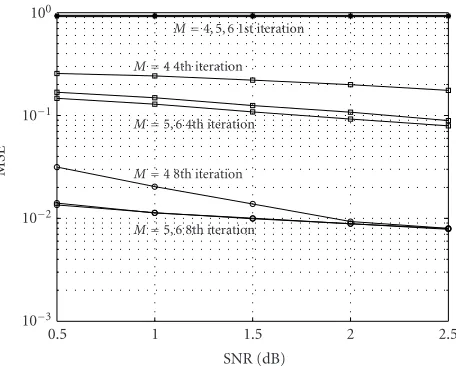
Figure5: MSE for several lengths of the training sequence.
pacity of Rayleigh fading channels, this difference being more remarkable in the case of a 4×4 system.
The ability of our channel estimation technique to com-bine the deterministic information of the pilot symbols and the statistical information from the unknown symbols, thanks to the ST Turbo detector, enables us to considerably reduce the size of the training sequence in GSM systems. Indeed, by means of computer simulations, we have deter-mined the minimum length of the training sequence for the considered GSM-based MIMO system. Figure 5 shows the channel estimation mean square error (MSE) for several val-ues of the training sequence length (M = 4, 5, and 6 bits). The channel code is the same as in the previous simulations. The interleaver size is 20800 bits and the frame length is 148, as established in the GSM standard. There is a significant dif-ference in the estimation error between usingM=4 bits and M =5 bits, whereas the gap betweenM =5 andM =6 is very small. This points out thatM =5 bits is the minimum length for the training sequence. This assumption can also be corroborated inFigure 6, where the SER at the output of the decoder is plotted versus the required SNR.
Next, we compare the results obtained with the proposed estimator using a training sequence of M = 5 bits and those obtained with classical LS using a training sequence ofM = 26 bits (the length standardized in GSM). The re-sults obtained when the receiver perfectly knows the channel are also plotted for comparison. As it is shown inFigure 7, the proposed method (ML-EM) withM = 5 bits performs better than the LS withM =26 bits beyond the sixth itera-tion, achieving a performance very close to the known chan-nel case beyond the seventh iteration.
7. CONCLUSIONS
0.5 1 1.5 2 2.5
Figure6: SER versus SNR at the output of the decoder for several lengths of the training sequence.
Turbo ST receivers. We formulate the ML estimation prob-lem that takes into account the deterministic symbols cor-responding to the training sequence and the statistics of the unknown symbols. These statistics can be obtained and suc-cessively refined if an ST Turbo equalizer is used at reception. This full exploitation of all the available statistical informa-tion at recepinforma-tion renders an extremely powerful channel esti-mation technique that outperforms conventional approaches based only on the training sequence. Since the involved op-timization problem has no closed-form solution, the EM al-gorithm is employed in order to iteratively obtain the solu-tion. The main limitation of our approach is that the com-putational complexity of the channel estimator grows expo-nentially with the number of transmitting antennas and the channel memory size, hence it is only practical for a moder-ate size of the transmitter antenna array. Note, however, that this complexity is inherent to the problem of optimal detec-tion and estimadetec-tion in MIMO systems.
The method has been particularized for a realistic sce-nario in which an STC system based on the GSM standard transmits along railway subway tunnels. Simulation results show how our channel estimation technique enables us to di-minish the training sequence length up to only 5 bits, instead of the 26 bits considered in the GSM standard, thus achieving a 14% increase in the system throughput.
APPENDICES
A. SIGNAL MODEL OF AN STC GSM SYSTEM
The transmitter model depicted in Figure 1is valid for an STC GSM system. The signal radiated byith antenna is given by [38,40]
Known channel 1st, 3rd iterations
ML-EM 6, 7, 10th iterations LSM=26 1th, 3rd iterations
ML-EM 5th iteration
ML-EM 1st iteration
Figure7: Performance comparison between ML-EM (M=5 bits), LS (M=26 bits), and known channel.
where g(t) is the convolution between a Gaussian-shaped pulse and a rectangular-shaped pulse centered at the origin [43,44], that is,
whereBis the 3 dB bandwidth ofu(t). It is possible to derive a closed-form expression forg(t) given by [38,40]
g(t)= 1
−0.5 0 0.5 1 1.5 2 2.5 3 3.5 0.4
0.35 0.3 0.25 0.2 0.15 0.1 0.05 0
t
(a)
0 0.5 1 1.5 2 2.5 3
0.5 0.45 0.4 0.35 0.3 0.25 0.2 0.15 0.1 0.05 0
t
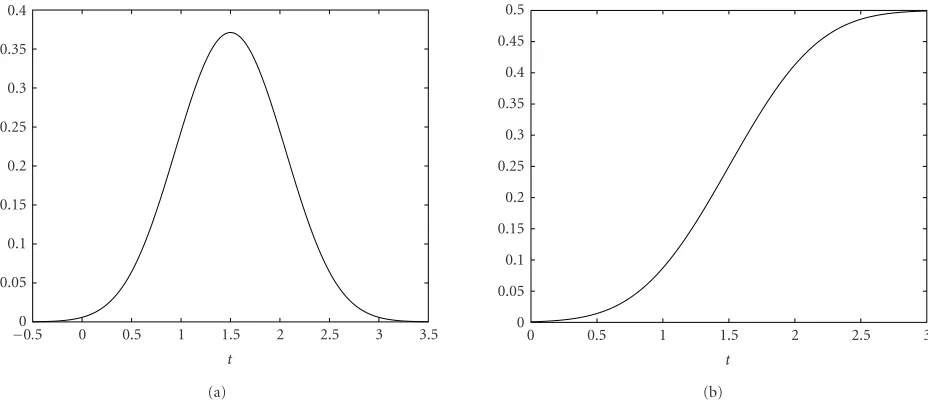
(b) Figure8: (a) Shifted GMSK pulse,g(t−1.5T), forp=3. (b) GMSK phase pulse,q(t).
of simplifying subsequent analysis, we redefineg(t)≡g(t−
p/2T), so it is limited to the interval [0,pT], where pis the number of symbol periods where the signal has significant values. For GSM (B = 0.3), a value of p = 3 is reasonable [40], as it can be verified inFigure 8, that plot the properly shifted versions ofg(t) andq(t) whenB=0.3.
Since GMSK is a partial response CPM, it can be ex-pressed in terms of its Laurent expansion [38,39,40], formed by the sum of 2p−1PAM signals, wherepis the memory
in-duced by the modulation. Since in GSM, the first PAM com-ponent contains 99.63% of the total GMSK signal energy [39,40], we can approximate the signal radiated by theith antenna by
si
t;bi
≈
2Eb T
∞
k=−∞
ai(k)h(t−kT), (A.8)
where ai(k) = jai(k −1)bi(k) are the transmitted sym-bols, which belong to a QPSK constellation, are uncorre-lated and have unit variance [38]. In order to simplify the detection process at the receiver, we will assume that a dif-ferential precoder is employed prior to modulation, that is, di(k) = bi(k−1)bi(k) because then we have ai(k) = jai(k−1)di(k)= jkbi(k). The pulse waveformh(t) is equal toC(t−3T)C(t−2T)C(t−T), whereC(t)=cos(πq(|t|)). Figure 9ashows that it takes significant values over the inter-val [0.5T, 3.5T] because the actual and the linearized GMSK waveforms are shifted by half a symbol period.
In order to detect the transmitted symbols, si(t;bi) is passed through a filter matched to the pulse waveformh(t) and then sampled at the symbol rate. The output of the matched filter is given by
ri(t)=ai(t)∗h(t)∗h∗(−t) +n(t)∗h∗(−t)
=ai(t)∗Rh(t) +g(t),
(A.9)
where
ai(t)=
2Eb T
∞
k=−∞
ai(k)δ(t−kT) (A.10)
andRh(t) (seeFigure 9b) denotes the autocorrelation func-tion ofh(t). After sampling, we have
ri(k)≡ri(t=kT)=ai(k)∗Rh(k) +g(k), (A.11)
where the autocorrelation function of g(k) is Rg(k) = (N0/2)Rh(k). Clearly, the noiseg(k) is colored becauseh(t) does not satisfy the zero-ISI condition. Since it is more comfortable to perform detection assuming white noise, a discrete-time whitening filter [41,42] is located after sam-pling
W(z)= 1
F∗z−1, (A.12)
whereF∗(z−1) comes from the factorization of the
autocor-relation functionRh(k)=F(z)F∗(z−1). This expression for the whitening filter leads to an overall system response given byF(z). InAppendix B, we demonstrate that the maximum phaseF(z) polynomial is given by
F(z)=
r2
ρ1ρ2
1−ρ1z−1
1−ρ2z−1
=0.8053 + 0.5853z−1+ 0.0704z−2,
(A.13)
0 0.5 1 1.5 2 2.5 3 3.5 4 1
0.9 0.8 0.7 0.6 0.5 0.4 0.3 0.2 0.1 0
t
(a)
−3 −2 −1 0 1 2 3 1
0.9 0.8 0.7 0.6 0.5 0.4 0.3 0.2 0.1 0
t
(b) Figure9: (a) Pulse shape,h(t). (b) Autocorrelation function,Rh(t).
in the following expression for the observations:
xl(k)= N
i=1
hli p−1
m=0
f(m)bi(k−l) +vl(k)
=
N
i=1
hlisi(k) +vl(k),
(A.14)
where vl(k) is AWGN with variance σv2 and f(m) = [0.8053 −0.5853j −0.0704] is the equivalent discrete-time impulse response that takes into account the transmitting, receiving, and whitening filters, and the derotation oper-ation. Using vector notation, the output of the whiten-ing filters after the derotation can be expressed as in (28), where x(k) = [x1(k) x2(k) · · · xL(k)]T, s(k) = [s1(k) s2(k) · · · sN(k)]T, and is as in (29).
B. COMPUTATION OF THE DISCRETE-TIME
WHITENING FILTER
First, it is important to note that there are 2pchoices ofF(z) that satisfy the desired factorization Rh(z) = F(z)F∗(z−1). The different choices yield filters 1/F∗(z−1) that have the
same magnitude but different phase response. One possible choice is to select F∗(z−1) so that it is a minimum phase,
that is, with all its roots inside the unit circle. In this way, 1/F∗(z−1) is a realizable causal and stable discrete system.
The problem of this selection is that the overall impulse re-sponseF(z) will be the maximum phase and anticausal, and the resulting ISI will be difficult to compensate. To overcome this limitation, we chooseF∗(z−1) to be the maximum phase
and thus the whitening filter 1/F∗(z−1) will be stable only if
it is considered anticausal. Nevertheless, anticausal filters can be implemented if a sufficient large delay is introduced. The advantage of this approach is that now the overall impulse responseF(z) is causal and minimum phase.
Considering thatRh(t) takes significant values only over the interval [−2, 2] (seeFigure 9b), we have
Rh(k)=
r−2,r−1,r0,r1,r2
=r2∗,r1∗,r0,r1,r2
= {0.0567, 0.5127, 0.9963, 0.5127, 0.0567}. (B.1) As mentioned before, note thath(t) contains 99.63% of the actual GMSK total energy becauseRh(0) = 0.9963. The Z-transform ofRh(k) is
Rh(z)=r−2z2+r−1z+r0+r1z−1+r2z−2 (B.2)
that we can express as
Rh(z)=r2
z−1 ρ∗1
z−1 ρ2∗
1−ρ1z−1
1−ρ2z−1
. (B.3)
Forcing|ρ1|,|ρ2| ≤ 1 in order that the resulting whitening
filter exists and be stable, we have ρ1 = −0.1522 andρ2 =
−0.5746. Taking into account thatρ1andρ2are real valued,
we arrive at
F(z)=
r2
ρ1ρ2
1−ρ1z−1
1−ρ2z−1
(B.4)
and thus the whitening filter is given by
W(z)= 1
F∗z−1 = !
ρ1ρ2/r2
1−ρ1z
1−ρ2z
(B.5)
whose inverseZ-transform is
w(k)=wk
0
k=−∞=
!ρ
1ρ2/r2
ρ2−ρ1
ρ−k+1 2 −ρ−1k+1
. (B.6)
Since{|wk|}−∞k=0is a strictly decreasing series, we can consider
that|w−20|<10−4, we can implementw(k) as an anticausal
FIR filter:
w(k)≈w−19,w−18,. . .,w−1,w0
=0.0001,−0.0001, 0.0002,−0.0004, 0.0007,
−0.0013, 0.0022,−0.0038, 0.0066,−0.0115, 0.0201,−0.0349, 0.0608,−0.1058, 0.1839, 0.3189, 0.5473,−0.9025, 1.2417.
(B.7)
ACKNOWLEDGMENT
This work has been supported by the European Commission under Contract no. IST-1999-20006 (ESCORT project) and by Ministerio de Ciencia y Tecnolog´ıa of Spain and FEDER funds from the European Union under Grant no. TIC2001-0751-C04-01.
REFERENCES
[1] C. Berrou and A. Glavieux, “Near optimum error correcting coding and decoding: turbo-codes,”IEEE Trans. Communica-tions, vol. 44, no. 10, pp. 1261–1271, 1996.
[2] J. Hagenauer, E. Offer, and L. Papke, “Iterative decoding of binary block and convolutional codes,” IEEE Transactions on Information Theory, vol. 42, no. 2, pp. 429–445, 1996. [3] C. Heegard and S. B. Wicker,Turbo Coding, Kluwer Academic
Publishers, Boston, Mass, USA, 1999.
[4] S. Benedetto, D. Divsalar, G. Montorsi, and F. Pollara, “A soft-input soft-output APP module for iterative decoding of con-catenated codes,” IEEE Communications Letters, vol. 1, no. 1, pp. 22–24, 1997.
[5] C. Douillard, A. Picart, P. Didier, M. J´ez´equel, C. Berrou, and A. Glavieux, “Iterative correction of intersymbol interference: turbo-equalization,” European Transactions on Telecommuni-cations, vol. 6, no. 5, pp. 507–511, 1995.
[6] C. Luschi, M. Sandell, P. Strauch, et al., “Advanced signal-processing algorithms for energy-efficient wireless communi-cations,” Proceedings of the IEEE, vol. 88, no. 10, pp. 1633– 1650, 2000.
[7] X. Wang and R. Chen, “Blind turbo equalization in Gaussian and impulsive noise,” IEEE Trans. Vehicular Technology, vol. 50, no. 4, pp. 1092–1105, 2001.
[8] C. Laot, A. Glavieux, and J. Labat, “Turbo equalization: adap-tive equalization and channel decoding jointly optimized,”
IEEE Journal on Selected Areas in Communications, vol. 19, no. 9, pp. 1744–1752, 2001.
[9] Z. Yang and X. Wang, “Turbo equalization for GMSK sig-naling over multipath channels based on the Gibbs sampler,”
IEEE Journal on Selected Areas in Communications, vol. 19, no. 9, pp. 1753–1763, 2001.
[10] B. L. Yeap, T. H. Liew, J. H´amorsk´y, and L. Hanzo, “Compara-tive study of turbo equalization schemes using convolutional, convolutional turbo, and block-turbo codes,” IEEE Transac-tions on Wireless CommunicaTransac-tions, vol. 1, no. 2, pp. 266–273, 2002.
[11] N. G¨ortz, “On the iterative approximation of optimal joint source-channel decoding,” IEEE Journal on Selected Areas in Communications, vol. 19, no. 9, pp. 1662–1670, 2001. [12] J. Garcia-Frias and J. D. Villasenor, “Joint turbo decoding and
estimation of hidden Markov sources,” IEEE Journal on Se-lected Areas in Communications, vol. 19, no. 9, pp. 1671–1679, 2001.
[13] A. Guyader, E. Fabre, C. Guillemot, and M. Robert, “Joint source-channel turbo decoding of entropy-coded sources,”
IEEE Journal on Selected Areas in Communications, vol. 19, no. 9, pp. 1680–1696, 2001.
[14] L. Zhang and A. Burr, “APPA symbol timing recovery scheme for turbo-codes,” inProc. 13th IEEE International Symposium on Personal, Indoor, and Mobile Radio Communications Con-ference, Lisbon, Portugal, September 2002.
[15] M. C. Valenti and B. D. Woerner, “Iterative channel estima-tion and decoding of pilot symbol assisted turbo codes over flat-fading channels,” IEEE Journal on Selected Areas in Com-munications, vol. 19, no. 9, pp. 1697–1705, 2001.
[16] C. Komninakis and R. D. Wesel, “Joint iterative channel esti-mation and decoding in flat correlated Rayleigh fading,”IEEE Journal on Selected Areas in Communications, vol. 19, no. 9, pp. 1706–1717, 2001.
[17] K.-D. Kammeyer, V. K¨uhn, and T. Petermann, “Blind and nonblind turbo estimation for fast fading GSM channels,”
IEEE Journal on Selected Areas in Communications, vol. 19, no. 9, pp. 1718–1728, 2001.
[18] A. Mehrotra,GSM System Engineering, Artech House, Boston, Mass, USA, 1997.
[19] A. O. Berthet, B. S. ¨Unal, and R. Visoz, “Iterative decoding of convolutionally encoded signals over multipath Rayleigh fad-ing channels,” IEEE Journal on Selected Areas in Communica-tions, vol. 19, no. 9, pp. 1729–1743, 2001.
[20] G. J. McLachlan and T. Krishnan, The EM Algorithm and Ex-tensions, John Wiley & Sons, New York, NY, USA, 1997. [21] I. E. Telatar, “Capacity of multi-antenna Gaussian channels,”
European Transactions on Telecommunications, vol. 10, no. 6, pp. 585–595, 1999.
[22] G. J. Foschini, “Layered space-time architecture for wireless communication in a fading environment when using multi-element antennas,” Bell Labs Technical Journal, vol. 1, no. 2, pp. 41–59, 1996.
[23] A. Grant, “Rayleigh fading multi-antenna channels,”
EURASIP Journal on Applied Signal Processing, vol. 2002, no. 3, pp. 316–329, 2002.
[24] V. Tarokh, N. Seshadri, and A. R. Calderbank, “Space-time codes for high data rate wireless communication: perfor-mance criterion and code construction,” IEEE Transactions on Information Theory, vol. 44, no. 2, pp. 744–765, 1998. [25] A. F. Naguib, N. Seshadri, and A. R. Calderbank,
“Increas-ing data rate over wireless channels,” IEEE Signal Processing Magazine, vol. 17, no. 3, pp. 76–92, 2000.
[26] A. R. Hammons Jr. and H. El Gamal, “On the theory of space-time codes for PSK modulation,”IEEE Transactions on Infor-mation Theory, vol. 46, no. 2, pp. 524–542, 2000.
[27] X. Lin and R. S. Blum, “Improved space-time codes using serial concatenation,” IEEE Communications Letters, vol. 4, no. 7, pp. 221–223, 2000.
[28] H.-J. Su and E. Geraniotis, “Space-time turbo codes with full antenna diversity,” IEEE Trans. Communications, vol. 49, no. 1, pp. 47–57, 2001.
[29] Y. Liu, M. P. Fitz, and O. Y. Takeshita, “Full rate space-time turbo codes,” IEEE Journal on Selected Areas in Communica-tions, vol. 19, no. 5, pp. 969–980, 2001.
[30] S. Lek, “Turbo space-time processing to improve wireless channel capacity,” IEEE Trans. Communications, vol. 48, no. 8, pp. 1347–1359, 2000.
[32] M. Gonz´alez-L ´opez, A. Dapena, and L. Castedo, “MAP space-time receivers for GSM in subway tunnel environments,” in
Proc. 11th European Signal Processing Conference, Toulouse, France, September 2002.
[33] M. Gonz´alez-L ´opez, J. M´ıguez, and L. Castedo, “Decision feedback Turbo equalization for space-time coded systems,” inProc. IEEE 28th Int. Conf. Acoustics, Speech, Signal Process-ing, Hong Kong, China, April 2003.
[34] C. W. Therrien,Discrete Random Signals and Statistical Signal Processing, Prentice-Hall, Englewood Cliffs, NJ, USA, 1992. [35] M. Gonz´alez-L ´opez, A. Dapena, and L. Castedo, “Space-time
coding for GSM systems in subway tunnel environments,” in
Proc. IEEE 27th Int. Conf. Acoustics, Speech, Signal Processing, Orlando, Fla, USA, May 2002.
[36] J. Baudet, M. Gonz´alez-L ´opez, D. Degardin, et al., “Perfor-mance of space time coding in subway tunnel environments,” inProc. IEE Technical Seminar on MIMO Communication Sys-tems: from Concept to Implementation, pp. 2/1–2/6, London, UK, December 2001.
[37] ESCORT, “Enhanced diversity and space-time coding for metro and railway transmission,” Final Tech. Rep. D 6021, France, 2002.
[38] U. Mengali and A. N. D’Andrea, Synchronization Techniques for Digital Receivers, Plenum Press, New York, NY, USA, 1997. [39] N. Al-Dhahir and G. Saulnier, “A high-performance reduced-complexity GMSK demodulator,” IEEE Trans. Communica-tions, vol. 46, no. 11, pp. 1409–1412, 1998.
[40] N. Al-Dhahir and G. Saulnier, “A high-performance reduced-complexity GMSK demodulator,” Tech. Rep. 96CRD107, GE Global Research, Niskayuna, NY, USA, 1996.
[41] J. G. Proakis, Digital Communications, McGraw-Hill, New York, NY, USA, 3rd edition, 1995.
[42] J. Kurzweil,An Introduction to Digital Communications, John Wiley & Sons, New York, NY, USA, 2000.
[43] J. M. H. R´abanos, Comunicaciones M´oviles GSM, Fundaci ´on Airtel M ´ovil, Madrid, Spain, 1999.
[44] J. D. Laster, Robust GMSK Demodulation using demodulator diversity and BER estimation, Ph.D. thesis, Virginia Polytech-nic Institute and State University, Blacksburg, Va, USA, 1997.
Miguel Gonz´alez-L ´opezwas born in Santi-ago de Compostela, Spain, in 1977. He re-ceived his Ingeniero en Inform´atica (M.S.) degree from Universidade da Coru˜na in 2000, where he is currently working to ob-tain his Ph.D. degree. His research interests include the application of the Turbo princi-ple to channel estimation/equalization and coding on graphs, with special focus on their generalization to MIMO systems and their implementation issues.
Joaqu´ın M´ıguezwas born in Ferrol, Gali-cia, Spain, in 1974. He obtained his Licen-ciado en Inform´atica (M.S.) and Doctor en Inform´atica (Ph.D.) degrees from Universi-dade da Coru˜na, Spain, in 1997 and 2000, respectively. Late in 2000, he joined the De-partamento de Electr ´onica y Sistemas, Uni-versidade da Coru˜na, where he became an Associate Professor in July 2003. From April 2001 through December 2001, he was a
Vis-iting Scholar in the Department of Electrical and Computer En-gineering, the State University of New York at Stony Brook. His
research interests are in the field of statistical signal processing with emphasis on the topics of Bayesian analysis, sequential Monte Carlo methods, adaptive filtering, stochastic optimization, and their ap-plications to multiuser communications, smart antenna systems, target tracking, and vehicle positioning and navigation.
Luis Castedo was born in Santiago de Compostela, Spain, in 1966. He received his Ingeniero de Telecomunicaci ´on (M.S.) and Doctor Ingeniero de Telecomunicaci ´on (Ph.D.) degrees, both from Universidad Polit´ecnica de Madrid (UPM), Spain, in 1990 and 1993, respectively. From 1990 to 1994, he was with the Departamento de Se˜nales, Sistemas y Radiocomunicaci ´on at the UPM, where he worked in array