e-ISSN: 2278-7461, p-ISSN: 2319-6491
Volume 6, Issue 5 [May. 2017] PP: 32-39
Effect of Inter Layer on Penetration, Sliding and Sticking
Characteristics in Rotary Friction Welding of Inconel 600 and
SS 304 Dissimilar Materials
B.Abhijith
1and A. Chennakesava Reddy
21PG student, Department of Mechanical Engineering, JNTUH College of Engineering, Kukatpally, Hyderabad –
500 085, Telangana, India
2
Professor, Department of Mechanical Engineering, JNTUH College of Engineering, Kukatpally, Hyderabad – 500 085, Telangana, India
Abstract:-
Nickel based alloys have excellent resistance in extremely stressful environments, such as those found in pressure vessels, rocket engines, gas turbines, and other aircraft structures. Inconel 600 has good mechanical strength in the range from cryogenic temperatures to 1200°C. In some circumstances, it is to be welded with stainless steel structures. Together, Inconel 600 and SS 304 have poor weldability. In the present work, the enhancement of weldability of Inconel 600 and SS 304 has been attempted by inserting a third inter layer in between them. Rotary friction welding was used to weld Inconel 600 and SS 304 dissimilar materials. The feasibility of using inter layer between Inconel 600 and SS 304 has been carried out using finite element analysis to assess the penetration, sticking and sliding characteristics at the interfaces along with deformation properties. Taguchi’s deign of experiments was employed to find the significant major parameters of rotary friction welding. The salient conclusion of the present work is that penetration, sticking and sliding characteristics are greatly affected by the frictional pressure.Keywords:
-
Inconel 600, SS 304, rotary friction welding, penetration, sticking, sliding, forging pressure, finite element analysis.I.
INTRODUCTION
Use of dissimilar materials has increased significant thoughtfulness for structural applications in various engineering fields, such as power plants, aerospace, chemical and nuclear industries. Several dissimilar materials such as UNS C23000 Brass and AISI 1021 Steel [1], 2024Al Alloy and AISI 1021 Steel [2], 2024Al Alloy and UNS C23000 Brass [3], AA2024 and Zr705 alloy [4], AA7020-T6 and Ti-6Al-4V Alloy [5], 1050 Mild Steel and 1050 Aluminum [6], Mild Steel and Austenite Stainless Steel [7], AA2024 Alloy and SS304 Stainless Steel [8], AA7020 and Zr705 Alloy [9], 316 Stainless Steel and AA1100 Alloy [10], and 405 Ferritic Stainless Steel and 705 Zr Alloy [11] have been tested using rotary friction welding process. The important input parameters in the rotary friction welding process are size of the rods/ tubes, frictional pressure, forging pressure, heating time, coefficient of friction, rotation speed, and composition and structure of the materials to be welded are to be considered. The friction between the surfaces makes possible a rapid temperature rise in the bonding interface, causing the mass to deform plastically and flows depending on the application of pressure and centrifugal force, creating a flash. In recent past, the incompatible dissimilar materials are started welding using third interface material [12-15]. In particular, there is a strong demand for dissimilar joining of nickel based super alloy to stainless steel. Very recently, the hot tensile deformation behaviors of friction welded dissimilar joints of Inconel 600 with AISI 410 martensitic stainless steel [16]. In that, the micro structural characteristics and micro hardness variations were also carried out to understand the deformation behavior of friction welded dissimilar joints of Inconel 600 and AISI 410 martensitic stainless steel. It is found that the percentage of elongation of the dissimilar joints is influenced by test temperature.
Many researchers have adopted non-linear finite element analysis to identify the parameter influence on different responses of the friction welding process.Three-dimensional non-linear finite element model and characterization of friction welding on UNS S31803 duplex stainless steel joints [17]. The present work was aimed at rotary friction welding of Inconel 600 to SS304 with third interlayer material using finite element analysis.
II.
FINITE
ELEMENT
MODELING
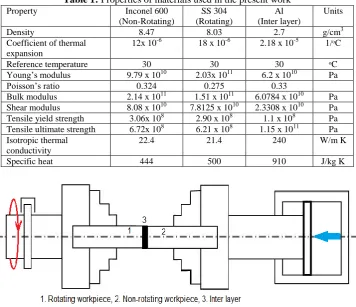
non-rotating materials in the rotary friction welding process were, respectively were SS 304 and Inconel 600. The rotary friction welding process with inter layer material is shown in Fig. 1. The process parameters for rotary friction welding process were chosen at three levels as summarized in Table 2. The orthogonal array (OA), L9 was preferred to carry out experimental and finite element analysis (FEA) as given in Table 3. Forging pressure was 1.5 times of frictional pressure. The forging time was considered same as that of frictional time.
Table 1: Properties of materials used in the present work
Property Inconel 600
(Non-Rotating) SS 304 (Rotating) Al (Inter layer) Units
Density 8.47 8.03 2.7 g/cm3
Coefficient of thermal expansion
12x 10-6 18 x 10-6 2.18 x 10⁻⁵ 1/ᵒC
Reference temperature 30 30 30 ᵒC
Young’s modulus 9.79 x 10¹⁰ 2.03x 10¹¹ 6.2 x 10¹⁰ Pa
Poisson’s ratio 0.324 0.275 0.33
Bulk modulus 2.14 x 10¹¹ 1.51 x 10¹¹ 6.0784 x 10¹⁰ Pa Shear modulus 8.08 x 10¹⁰ 7.8125 x 10¹⁰ 2.3308 x 10¹⁰ Pa Tensile yield strength 3.06x 10⁸ 2.90 x 10⁸ 1.1 x 10⁸ Pa Tensile ultimate strength 6.72x 10⁸ 6.21 x 10⁸ 1.15 x 10¹¹ Pa Isotropic thermal
conductivity
22.4 21.4 240 W/m K
Specific heat 444 500 910 J/kg K
Fig. 1 Rotary friction welding process with inter layer
Table 2: Process parameters and levels
Parameter Symbol Level–1 Level–2 Level–3 Frictional pressure, MPa A 40 60 80 Rotating speed, rpm B 1500 1800 2000
Frictional time, sec C 4 6 8
Table 3: Orthogonal Array (L9) and control parameters
Trial No. A B C
1 1 1 1
2 1 2 2
3 1 3 3
4 2 1 2
5 2 2 3
6 2 3 1
7 3 1 3
8 3 2 1
9 3 3 2
alloy rod stationary and the SS 304 rod in rotation. The coefficient of friction 0.2 was applied at the interfaces between Inconel 600 and Al inter layer and SS 304 alloy and Al inter layer. The convection heat transfer coefficient was applied on the surface of three materials. The heat flux calculations were imported from ANSYS APDL commands and applied at the interface of three materials to be welded. The temperature distribution was estimated. The thermal analysis was coupled with the static structural analysis. For the structural analysis, the rotating (SS 304) rod was brought to stationary and the forging pressure was applied on the Inconel 600 alloy rod along the longitudinal axis. The Inconel 600 alloy rod was allowed to move in the axial direction. The contact analysis was also carried out to determine the depth of penetration and sliding of the material at the interfaces.
Fig. 2 boundary conditions of finite element modeling.
III.
RESULTS
AND
DISCUSSION
The statistical Fisher’s test was carried out to find the significance of process parameters at 90% confidence level in the present work.
3.1 Influence Of Process Parameters On Temperature Distribution
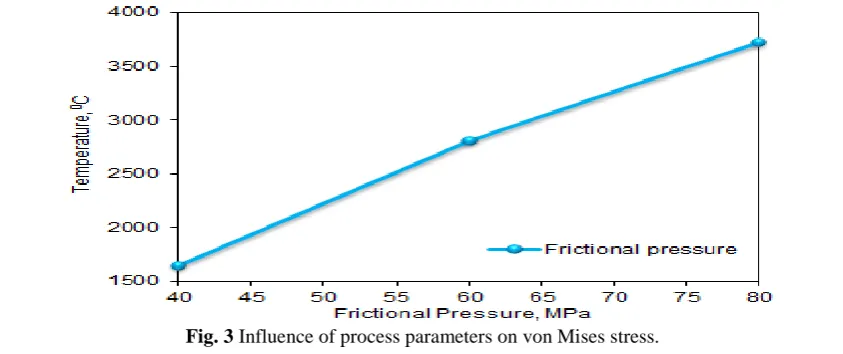
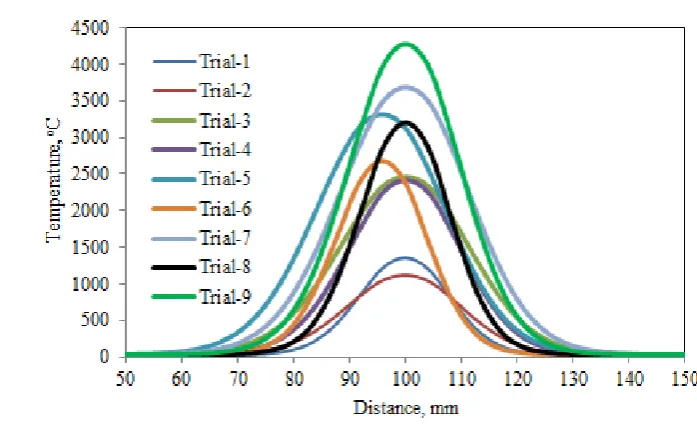
Table – 4 gives the ANOVA (analysis of variation) summary of temperature distribution data. The Fisher’s ratio at 90% confidence is 3.46. The frictional pressure is only the significant parameter which could influence 71.88% of total variation in the temperature distribution. All other process parameters are insignificant. As seen from Fig. 3 the temperature generated due to friction increases with the frictional pressure. The welding conditions of trial 9 would generate the highest temperature (20204275oC) and trial 2 would produce the lowest temperature (1129oC) in the rods (Fig. 4).
Table 4: ANOVA summary of the effective stress.
Source Sum 1 Sum 2 Sum 3 SS v V F P
A 4942.10 8408.00 11155.20 6462464.70 2 3231232.35 18.01 71.88 B 7453.80 7641.50 9410.00 776615.78 2 388307.89 2.16 9.15 C 7221.70 7824.40 9459.20 893580.51 2 446790.25 2.49 10.52
e - - - 358739.03 2 179369.51 - 8.45
T 19617.60 23873.90 30024.40 8491400.01 8 - - 100.00
Note: SS is the sum of square, v is the degrees of freedom, V is the variance, F is the Fisher’s ratio, P is the
percentage of contribution and T is the sum squares due to total variation.
Fig. 4 Effect of frictional pressure on temperature distribution.
3.2 Influence Of Process Parameters On Equivalent Stress
The ANOVA summary of the equivalent stress is given in Table 5. The major contribution is attributed to frictional pressure (A) only and rest of the parameters are insignificant. The equivalent stress induced in the materials increases with an increase in the frictional pressure as shown in Fig. 5. It can also be observed from Fig. 6 that the tensile stresses are induced in the Inconel 600 and SS 304; whereas the compressive stresses are developed at the interfaces between Inconel 600 and Al inter layer and SS 304 and Al inter layer. The tensile stresses induced in the SS 304 are higher than those induced in the Inconel 600. The maximum stresses in all nine trials, respectively, 400 MPa, 455 MPa, 544 MPa, 832 MPa, 729 MPa, 827 MPa, 1055 MPa, 870 MPa and 960 MPa as shown in Fig. 7. The highest and lowest effective stresses are, respectively, 1055 MPa and 400 MPa induced for trial conditions of 7 and 1 as shown in Fig. 7.
Table 5: ANOVA summary of equivalent stress
Source Sum 1 Sum 2 Sum 3 SS v V F P
A 1398.94 2386.75 2885.48 381589.04 2 190794.52 36.26 89.18 B 2286.35 2053.84 2330.98 14762.15 2 7381.07 1.40 3.55
C 2096.25 2246.85 2328.07 9224.17 2 4612.09 0.88 2.22
e - - - 10523.64 2 5261.82 - 5.06
T 5781.54 6687.44 7544.53 416099.00 8 - - 100.00
Fig. 6 Linearized maximum principle stress induced in weld rods.
Fig. 7 Equivalent stress values of different trials.
3.3 Influence Of Parameters On Bulk Deformation
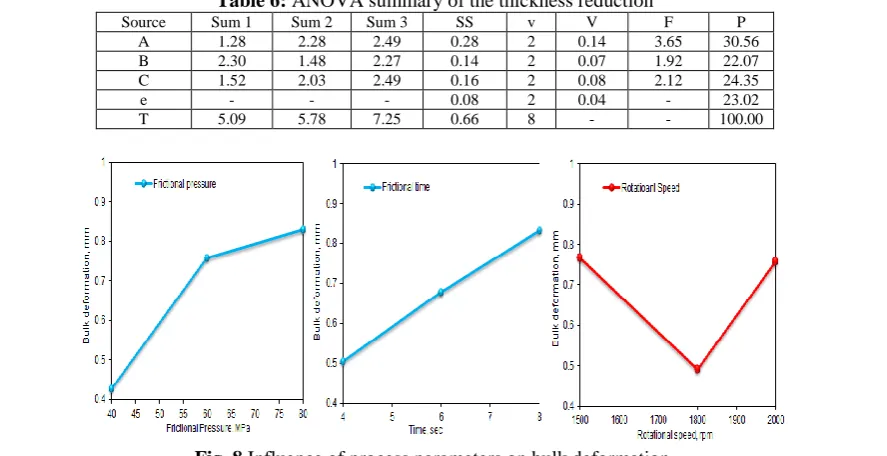
The ANOVA summary of the bulk deformation is given in Table 6. As the Fisher’s ratio at 90% confidence is 3.46, the frictional pressure is only the significant parameter that influences the variation in the bulk deformation of the materials. Since the Fisher’s ratio of rotational speed and frictional time are less than the test value, they have less influence on the bulk deformation. As seen from Fig. 8, the bulk deformation increases with an increase in the frictional pressure. Even though the frictional time is insignificant, the bulk deformation increases with an increase in the time. The bulk deformation was high for the lower and upper limits of the rotational speed.
Table 6: ANOVA summary of the thickness reduction
Source Sum 1 Sum 2 Sum 3 SS v V F P
A 1.28 2.28 2.49 0.28 2 0.14 3.65 30.56
B 2.30 1.48 2.27 0.14 2 0.07 1.92 22.07
C 1.52 2.03 2.49 0.16 2 0.08 2.12 24.35
e - - - 0.08 2 0.04 - 23.02
T 5.09 5.78 7.25 0.66 8 - - 100.00
Fig. 9 Influence of process parameters on penetration.
3.4 Penetration, Sliding And Sticking
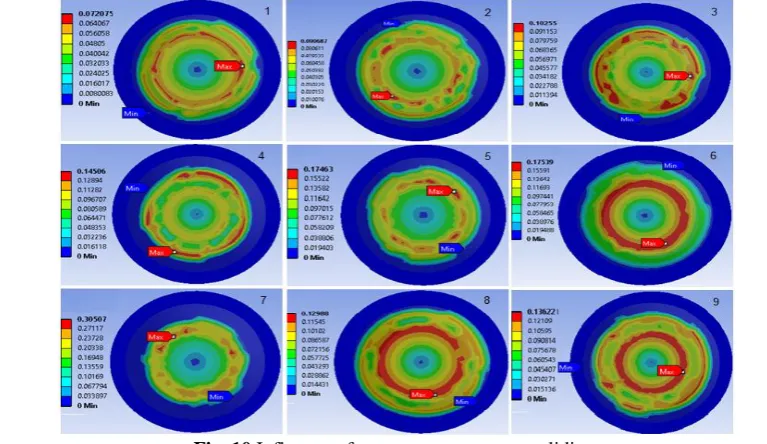
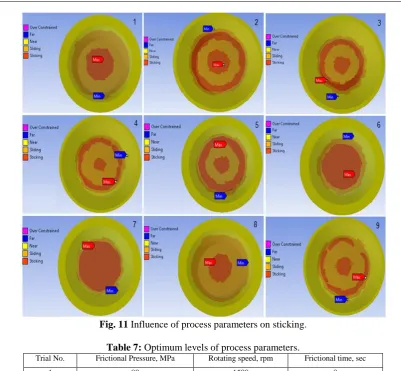
The penetration of Al inter layer at the interface between Inconel 600 and SS304 is shown in Fig. 9. The maximum penetration is found with trial 7, the minimum penetration is with trial 1. The spread of Al inter layer at the interface between Inconel 600 and SS304 is shown in Fig. 10. The maximum and minimum spreading are observed, respectively, trials 7 and 1. As seen from Fig. 11, the sticking Al inter layer is excellent with trial 7 and is poor with trial 1. Penetration, sliding and sticking indicate the flow of inter layer material along the interface between Inconel 600 and SS304. High values penetration, sliding and sticking lead to the development of very high value of equivalent stress (1055 MPa) at the interface between Inconel 600 and SS304 with trial 7 as shown in Fig. 7. The next best trial is found be 6 wherein the penetration, sliding and sticking are second to trial 7. The interaction between Al inter layer with either Inconel 600 or SS 304 is firstly by sliding and then by sticking, makes a shear surface at the interfaces. The amount of flash (the metal pushed out both at the outer diameter also decreased rapidly with increasing penetration, and sticking. The optimum levels of process parameters in the present are given Table 7.
Fig. 11 Influence of process parameters on sticking.
Table 7: Optimum levels of process parameters.
Trial No. Frictional Pressure, MPa Rotating speed, rpm Frictional time, sec
1 80 1500 8
IV.
CONCLUSIONS
The rotary friction welding of Inconel 600 and SS 304 dissimilar materials with an inter layer material in between them could successfully executed with the finite element analysis software code of ANSYS workbench. Among all the process parameters considered in the present work, the frictional pressure would only influence penetration, sliding and sticking at the interfaces between Inconel 600 and SS 304 dissimilar materials. Because of enhanced penetration, sliding and sticking, the equivalent stress was raised to a maximum value of 1055 MPa.
ACKNOWLEDGEMENTS
The author acknowledges with thanks University Grants Commission (UGC) – New Delhi for sectioning R&D project.
REFERENCES
[1]. Raviteja, A., Reddy, A. C. Finite Element Analysis of Friction Welding Process for UNS C23000 Brass and AISI 1021 Steel, International Journal of Science and Research, 4(5), 2015, pp. 1691-1696, 2015. [2]. Kumar, T.S., Reddy, A. C., Finite Element Analysis of Friction Welding Process for 2024Al Alloy and
AISI 1021 Steel, International Journal of Science and Research, 4(5), 2015, pp.1679-1684.
[3]. Srija, V., and Reddy, A. C., Finite Element Analysis of Friction Welding Process for 2024Al Alloy and UNS C23000 Brass, International Journal of Science and Research, 4(5), 2015, pp. 1685-1690.
[4]. Reddy, A. C., Evaluation of parametric significance in friction welding process for AA2024 and Zr705 alloy using finite element analysis, International Journal of Engineering Research & Technology, 5(1), 2016, pp. 84-89.
[6]. Reddy, A. C., Fatigue Life Prediction of Different Joint Designs for Friction Welding of 1050 Mild Steel and 1050 Aluminum, International Journal of Scientific & Engineering Research, 6(4), 2015, pp. 408-412.
[7]. Reddy, A. C., Fatigue Life Evaluation of Joint Designs for Friction Welding of Mild Steel and Austenite Stainless Steel, International Journal of Science and Research, 4(2), 2015, pp. 1714-1719.
[8]. Reddy, A. C., Weldability of Friction Welding Process for AA2024 Alloy and SS304 Stainless Steel using Finite Element Analysis, International Journal of Engineering Research and Application, 6(3), 2016, pp. 53-57.
[9]. Reddy, A. C., Evaluation of Parametric Significance in Friction Welding Process for AA7020 and Zr705 Alloy using Finite Element Analysis, International Journal of Emerging Technology and Advanced Engineering, 6(2), 2016, pp. 40-46.
[10]. Lekhana, Y., Nikhila, A., Bharath, K., Naveen, B., Reddy, A. C., Weldability Analysis of 316 Stainless Steel and AA1100 Alloy Hollow Tubes using Rotational Friction Welding Process, International Journal of Science and Research, 5(5), 2016, pp. 622-627.
[11]. Koundinya, K., Reddy, A. C., Simulation of Joint Design on Weldability of Dissimilar Materials: 405 Ferritic Stainless Steel and 705 Zr Alloy by Friction Welding Process, International Journal of Scientific & Engineering Research, 7(6), 2016, pp. 261-265.
[12]. Sassani, F., Neelam, J. R., Friction Welding of Incompatible Materials, Welding research Suplement, November 1988, pp. 264-270.
[13]. Koundinya, K., Reddy, A. C., Interface Material for Enhancement of Weldability between Dissimilar Materials: 405 Ferritic Stainless Steel and 705 Zr Alloy by Friction Welding Process, International Journal of Science and Research, 5(6), 2016, pp. 1366-1370.
[14]. Ambroziak, A., Korzeniowski, M., Kustron, P., Friction welding of dissimilar metal joints with intermediate layers, Journal of Achievements in Materials and Manufacturing Engineering, 21(2), 2007, pp.37-40.
[15]. Muralimohan C. H, Muthupandi, V., Sivaprasad, K., Properties of Friction Welding Titanium-stainless Steel Joints with a Nickel Interlayer, Procedia Materials Science, 5, 2014, pp. 1120-1129.
[16]. Gobu, N., Mahadevan, K., Hot tensile deformation behaviours of friction welded dissimilar joints of Inconel 600 with AISI 410 martensitic stainless steel, International Journal of Advanced Engineering Research and Technology, 4(1), 2016, pp.10-19.
[17]. Mohammed, A. M., Kulkarni, A.S., Sathiya, P., Finite element modelling and characterization of friction welding on UNS S31803 duplex stainless steel joints, Engineering Science and Technology, an International Journal, 18(4), 2015, pp. 704-712.