R E S E A R C H
Open Access
Reduced-dimension space-time adaptive
processing based on angle-Doppler
correlation coefficient
Ruiyang Li
*, Jun Li, Wei Zhang and Zishu He
Abstract
Traditional space-time adaptive processing (STAP) is a strategy for clutter suppression in airborne radar, which requires a large number of computational complexity and secondary data. In order to address the problem,
reduced-dimension (RD) STAP is generally used. We propose a novel RD STAP through searching the best channels as the auxiliary channels to cancel the interference. Based on the estimation of the clutter Fourier basis vectors offline, a parameter named angle-Doppler correlation coefficient(ADC2)is constructed to evaluate the capability of each auxiliary channel in clutter suppression, and the best sets of RD channels can be selected. The proposed algorithm can achieve the best detection performance with the fixed number of auxiliary channel. When the degrees of freedom (DOF) are restricted to a small value, only one auxiliary channel is needed to guarantee the SINR loss less than 3 dB. Therefore, the requirement of the training sample can be reduced, which makes the proposed approach more suitable for the heterogeneous clutter environments.
Keywords: Airborne radar, Space-time adaptive processing, Reduced-dimension, Clutter covariance matrix
1 Introduction
Space-time adaptive processing (STAP) plays an impor-tant role in the areas of airborne radar and sonar systems, which collect signals linearly from an array to detect weak targets within severe clutter and jamming environments [1, 2]. The clutter-plus-noise covariance matrix (CCM) is employed to calculate the filter weights for clutter sup-pression. It has been long known that increasing the number of degrees of freedom (DOF) enables excellent detection performance, but since the computational com-plexity and the number of samples for estimation CCM are limited, it is difficult to be implemented in practical work [3]. In recent years, a large amount of productive works have been studied aiming at STAP with few DOF and secondary data and provide a better detection per-formance in heterogeneous clutter and strong jammer environment, including the knowledge-aided radar, the multiple-input multiple-output radar, and the jamming suppression in complex environment [4–6].
*Correspondence: [email protected]
School of Electronic Engineering, University of Electronic Science and Technology of China (UESTC), 611731 Chengdu, People’s Republic of China
The foremost theory of STAP is to adjust the space-time filter weights to maximize output signal-to-interference-plus-noise ratio (SINR) adaptively with DOF as less as possible. Therefore, the dimensionality reduction and rank reduction techniques are explored extensively and addressed in the literature. When it comes to reduced-dimension (RD) STAP, some typical suboptimal approaches like the factor approach [7], the joint domain localized (JDL) [8], and the space-time multiple-beam (STMB) [9] have been proposed, which employ a fixed dimension reducing transformation prior to the process-ing. Lately, a modified RD STAP was proposed by select-ing auxiliary channels near the clutter ridge [10]. However, none of the traditional RD STAP can select auxiliary channels adaptively. A multistage multiple-beam (MSMB) technique is proposed in [11, 12], based on the principle of selecting auxiliary channels to cancel the interference components in the main channel clearly. But it is not appropriate for engineering applications because a large amount of calculation is needed.
On the other hand, reduced-rank (RR) STAP
approaches make use of data-dependent transformations, such as the principal components (PC) inverse [13], the
cross-spectral metric (CSM) [14], and multistage Wiener filter (MSWF) [15, 16]. However, the performance of the RR STAP algorithm aforementioned drops rapidly when the processing DOFs decrease less than the clutter rank. For the purpose of reducing the DOF during interference processing, a reconfigurable array beamforming approach is proposed in [17], and [18] extends this approach to an antenna-pulse selection strategy. According to the authors described in [19], a thinned STAP method is pro-posed and generates even better SINR loss performance for slow-moving target compared to the full configuration STAP, but the SINR will never exceed the full one because of the decreased amount of antenna and pulse.
In this article, a novel RD STAP approach consisting of an auxiliary channel selection strategy based on a param-eter referred to as ADC2 is proposed. To construct the mode of CCM offline, the clutter Fourier basis can be achieved by the geometry of airborne array, and the ampli-tude of each basis can be calculated by estimating the ratio of clutter to noise utilizing a least squares method. Furthermore, ADC2 will be formulated after a serious transformation of CCM, which is in direct proportion to detection performance. The best channels will be found
by selecting the maximum ADC2 in both angular and
Doppler domains, and the general transformation matrix will be derived. We process the radar data in the local-ized region after RD processing, so that a sub-optimal detection performance and low calculated amount can be achieved.
The paper is organized as follows. In Section 2, we for-mulate the signal mode and review the STAP approach in the transform domain. We transform the clairvoyant CCM and derive the ADC2parameter in Section 3. The principle of selecting auxiliary channels is presented in Section 4. The contrastive simulations and performance analysis are provided in Section 5. Finally, we conclude this paper in Section 6.
2 Signal mode and reduced-dimension processor 2.1 Detection performance of airborne radar
In airborne radar system travelling at velocityvp, let us
suppose the antenna array has a side-looking uniform lin-ear arrays, consisting ofN-spaced antennas and transmits
Mpulses in one coherent processing interval. Under the signal absence hypothesisH0and signal presence hypoth-esisH1, theNM×1 received signalxcan be expressed as
H0:x=c+n
H1:x=αs+c+n, (1) wherec+ndenotes the interference matrix which is com-posed of clutter and noise components, respectively, and has a complex Gaussian distribution with zero mean and covariance matrix R. s is the target space-time steering vector with an unknown complex amplitudeα
s=sd⊗ss, (2)
where ⊗ denotes the Kronecker product and sd andss
are the temporal steering vector and spatial steering vec-tor, respectively. The adaptive matched filter (AMF) [20] detector under the assumption is given by
sHR−1x2
whereτ is the threshold with a constant false alarm prob-ability. According to [21], the probability distribution of detection statistic is chi-square distribution
TsH0∼ 12χ22
Ts|H1 ∼ 12χ222|α|2sHR−1s, (4) whereχ2
2denotes the chi-square distribution whose DOF is 2. In case of target present, the non-centrality param-eter is 2|α|2sHR−1s. Note that the detection probability is a monotone-increasing function of the non-centrality parameter. In case of target present, a method for compar-ing detection performance of radar systems is proposed by evaluating its non-centrality parameter. As a consequence, we can draw a conclusion that maximizing the parameter |α|2sHR−1sleads to better detection performance. 2.2 RD STAP processor
According to the RD STAP algorithm, the received sig-nal after matched filtering should be transformed to the angle-Doppler domain firstly; the transform vector of the
nth angular channel and themth Doppler channel is
T(m,n)=sd
the spatial frequency and Doppler frequency of the target. sd
fdm
is the temporal steering vector with the Doppler frequency fdm = fdt + m/M, and ssfsn is the spatial
steering vector with the spatial frequencyfsn =fst+n/N
respectively. so that each angular-Doppler channel which corresponds to the steering vector above will be used to form each col-umn of the transform matrixT, and the first column ofT corresponds to the detected channel which can be written as follows:
for detecting target signals embedded in the interference, and the auxiliary channels receive the interference and are correlated to those in the main channel. Assume that the dimension of receiving data after dimension reduced isD; thus, the transform matrix can be formed by arranging the main channel followed byD−1 auxiliary channels.
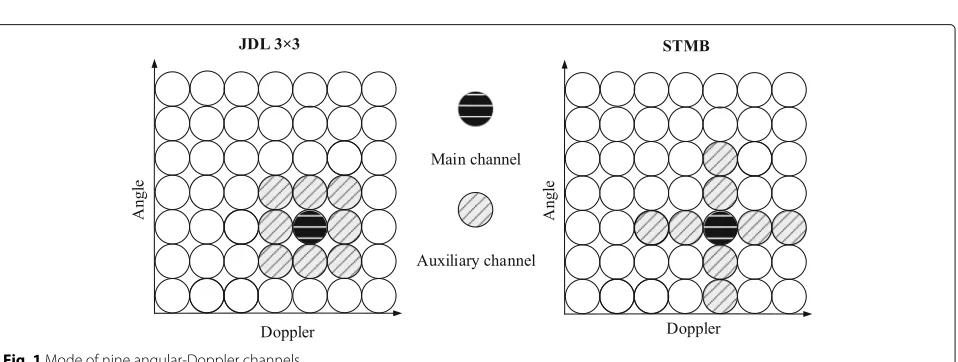
Consequently, many RD approaches are provided to select only few channels to achieve a good detection per-formance. The difference among RD STAP algorithms is that different column sets ofTare selected. For the JDL approaches [8], the auxiliary channels are selected around the detection channel as a localized processing region, which has different sizes such as 3×3, 5×3, or other else. One kind of the STMB approach [9] selects auxiliary channels near the detected one in four different direc-tions. These two modes of eight auxiliary channels are illustrated in Fig. 1. It is easy to see that the transform matrix of the two approach have the same dimension. However, a fixed sets of RD channels is not optimal in practice. Hence, we have to seek a new approach which not only selects auxiliary channels adaptively but also achieves better performance with dimension as lower as possible.
3 Angle-Doppler correlation coefficient based on CCM estimation in the transform domain 3.1 A prior mode of CCM
Suppose that all components of received signal x are mutually uncorrelated. The CCM of one range cell is the sum of the clutter and noise covariance matrices
R=E(c+n) (c+n)H=Rc+σn2INM, (8)
whereσn2is the noise power,Rc∈CNM×NMrepresents the
clutter covariance matrix whose clutter rank is estimated to be [22]
Nr= N+γ (M−1). (9)
Note that rounds up to the next integer. The clut-ter energy is concentrated about a line on the normalized space-time plane with the slopeγ = 2vpTr/d, wheredis
the inner space of antennas andTris the pulse repetition
interval. Through eigen decomposition, the clutter covari-ance matrix can be expressed in terms of its eigenvalues and eigenvectors as follows:
Rc= Nr
j=1
λjejeHj , (10)
where λj and ej are the jth eigenvalue and the
corre-sponding eigenvector ofRc. However, it is not applicable
in practice for the reason that the estimation of clutter eigenvectors requires training data to make eigen decom-position and is computationally complex. For the clutter intensity heavy enough, the Fourier basis is also defined in [23] to span the clutter subspace and can be used to con-struct CCM offline, whose number is approximate to the clutter rank
Rc= Nr
i=1
ε2
ivivHi =VIIVHI , (11)
where vi is called the Fourier basis with
volt-age coefficients εi, composes the Fourier matrix
VI =
v1,v2,· · ·,vNr
∈ CNM×Nr, and arranges
each power coefficient into a diagonal matrix
I = diag
ε2
1,ε22,· · ·,εN2r . Therefore, the clutter sub-space can be spanned by either clutter basis vectors or eigenvectors; each eigenvector can be obtained by a linear
combination of Fourier basis, i.e.,ej= Nr
i=1η
j ivi.
In order to construct the CCM offline, we can estimate the Fourier basis instead of eigen decomposition. Based on the known angle of flight and antenna, the trajectory of the clutter spectrum can be deduced. For a side-looking
array, the clutter ridge is a straight line which concen-trates most of the clutter energy, and the Brennans rule [24] implies that there are at mostNrclutter eigenvalues
larger than the noise floor. An approximate set of Fourier basis of clutter subspace is given as follows:
vi=ej2πmf
i
d⊗ej2πnfsi,i=1, 2,· · ·,N
r, (12)
where the Doppler frequency and spatial frequency of each Fourier basis arefdi = 4vpλTr · Ni
r,f
i
s = 2λd · Nir by dividing the clutter spectrum intoNrbasis averagely.
Assume that the received data in the cell under test isx with target absent, which can be written using the Fourier basis as
Given the collection of space-time Fourier basis, then the major objective is to estimate the voltage of each Fourier basis. A least squares estimate ofεIsatisfies [25]
min
is a vector composed by complex scalars. As a consequence, the set of the clutter Fourier basis is achieved and receiving data is required. In the sample deficient case, the proposed method pro-vides a more effective approach for CCM estimating, using the a priori knowledge of the clutter basis. In some practical scenarios, VI should be represented by
eigen-vectors through decomposition, because the characteriza-tion of clutter subspace and clutter rank may be inaccu-rate. Therefore, the proposed representation of CCM is applicative especially under the condition of few samples, which leads to a more accurate selection of RD channels.
3.2 Angle-Doppler correlation coefficient
The RD processing which can transform the radar received dataxby a subset of the transform matrix defined in Eq. 5 yields a vectorxT =THDx∈CD×1in the transform
domain where TD ∈ CNM×D denotes the matrix
com-posed byDselected columns ofT. Similarly, the CCM in the transform domain can be expressed as follows:
RT =THDRTD. (15)
Substituting Eqs. 8 and 11 into Eq. 15, it has
RT=THD
The columns of TD are orthogonal to each other and
have the effect of concentrating energy. Assume that the RD matrix consists ofDcolumns, by replacingTHDTDin
(16) withNMID, we can derive
RT=VTIVTH+NMσn2ID=VTIVHT +σT2ID∈CD×D,
(17)
whereVT = THDVI ∈ CD×Nrdenotes the clutter Fourier
basis matrix in the transform domain andσT2 =NMσn2is the noise power with a gain ofNMby RD processing. The matrix inversion lemma yields
R−1T = σ12
1/εN2r arranged by the ratio of concentrated noise power to each power of Fourier basis.
As discussed in Section 2, the detection performance is directly related to the parameter |α|2sHR−1s. In the domain of RD transformation, the desired signal and CCM have been dimension reduced, which has the follow-ing form: be inferred from Eq. 19 that the detection performance depends on two factors: the signal-to-noise ratio and the following term:
a=sHTID−VT(I+VHTVT)−1VHT sT (20)
Since the number of auxiliary channels is fixed, the opti-mal performance can be achieved by changing the form of sT andVT to maximize the ADC2, i.e., selecting the
appropriate auxiliary channels.
However, the expression given in Eq. 20 is not in a convenient form for auxiliary channel selection; a con-cise formula in terms of matrix determinants is derived as follows:
The middle term in Eq. 20 is denoted withGT and is
expressed as:
GT =VHTVT+I (21)
By embedding the desired signal in the clutter-plus-noise cross-correlation matrix, GT ∈ CNr×Nr in the
whererss = sHTsT = (NM)2denotes the self-correlation
of the desired signal in the transform domain. Further-more, due to the fact thatTTH = NMINM, utilizing the
determinant of block matrix results in
|GsT| =|GT|
It is evident that
sHTVT
Substituting Eq. 24 into Eq. 20, the ADC2can be simpli-fied as
a= |GsT|
|GT|
(25)
It will be shown that the more DOF exists, the more computing times is necessary for calculating the ADC2.
From the analysis above, the detection performance can be expressed as a function of RD matrix which is decided by the selected auxiliary channels. In the next section, an approach for finding the most appropriate auxiliary channels is provided, utilizing the ADC2.
4 The best channels in the transform domain 4.1 The flow of selecting the best channels
As discussed already, different RD matrix corresponds to a different output of ADC2, the main goal of maximizing the ADC2is to achieve the optimum RD matrix. However, we cannot select the best angular-Doppler channels at one time, for the reason that there are so many combinations of auxiliary channels which are used to compose the RD matrixT.
Therefore, we select the best channels step by step. First of all, only the desired signal is already known to set as the main channel, that is set ass. Assume that the current number of selected optimal channels isd, naturally, there ared−1 auxiliary channels. We denotead(m,n) as the
dth ADC2corresponding to each angular-Doppler chan-nel to evaluate the effect of clutter cancellation and can be represented as
which could be inferred from Section 3 with the fact that
V(Td)(m,n)=THd(m,n)VI,s(Td)(m,n)=THd (m,n)s steps. Before the selection of the next auxiliary channel, the influence of the current RD channels should be con-sidered through updating the RD matrix, and then select-ing the next optimal channel by evaluatselect-ing each transform vectorsd
that corresponds to each angular and Doppler frequency, which has the form
Td(m,n)=
Note that the first transform vector corresponds to the desired signal, i.e.,T1 = s. Then, we select the channel with maximumad(m,n)as the current optimal channel,
so that the transform matrix ofdth step is achieved and denoted byTd. For adding the effect of the former selected
channels, the ADC2should be updated until the optimal channel selection progress is finished.
After the RD matrixTd withDauxiliary channels has
been achieved, the transformation of the received signalx by the operationTddefined in Eq. 5 yields a lower
dimen-sional vectorxT. The CCM in the transform domain can
be obtained by 15; therefore, the weight vector in the transform domain is given by
wT =μR−1T sT, (29)
whereμ=sTR−1T sT
−1
is a non-zero constant that does not affect the output SINR.
Comparing the proposed methods with MSMB pre-sented in [14], both of them select auxiliary channels adaptively in the RD STAP. We summarise the compu-tational complexities (Fig. 2) of the step that selects the
dth channel: for MSMB, the computational complexity is about
OJ4+J3+(d+1)J2+Jd+d2, (30)
where J = NM is the dimension of received data, and
there exists a time-consuming eigen decomposition of MSMB at the beginning of this algorithm. While the computational complexity of the proposed method is
OJNr3+Nrd2+Nr2d
+J2(Nr+1)
. (31)
We can see that the proposed method is calculated much easier than MSMB. However, because of the increased step of channel selection, the computational complexity of the proposed method is higher than the RD STAP of fixed channels, but better performance is achieved.
4.2 Prediction for the possible location of auxiliary channels
0 5 10 15 20 25 30 35 40
Number of RD channels
Ratio of computational complexity
Fig. 2Comparison of computational complexity between two adaptive RD methods
weighted summation of the interference components in auxiliary channels, which can be expressed as
xT =THDx=[s,TD−1]Hx∈CD×NM (32) All the columns of TD−1 correspond to the orthogo-nal channels which are orthogoorthogo-nal to the desired sigorthogo-nal, i.e.,THD−1s=0. In order to facilitate the analysis, assume that only one clutter Fourier basis with voltage is taken into consideration, the vectors of the signal and clutter components in the transform domain, respectively, are
sT =
is already known due to the prior estimation of clutter basis, and β = THD−1v ∈ C(D−1)×Nr depends on the
Table 1Basic radar system parameters
Symbol Description Value
N Number of antenna elements 16
M Number of pulses 16
fc Carrier frequency 1200 MHz
fr Pulse repetition frequency 2400 Hz
d Space between antenna elements 0.5 m
vp Radar platform velocity 150 m/s
H Platform altitude 5000 m
R Detection range 100 km
CNR Clutter-to-noise ratio 50 dB
Fig. 3Output SINR loss of each RD method
closeness of clutter basis and the selected channels. Sub-stituting Eq. 32 into Eq. 20, the expression of ADC2can be written as Eq. 34, we can infer that the ADC2is directly proportional toβHβand inversely proportional toβ0, which means that the inner product ofβplays a driving role to the detection performance. Furthermore, we can draw a conclusion that
−0.5 0 0.5
number of auxiliary channels=1 number of auxiliary channels=3 number of auxiliary channels=5 number of auxiliary channels=8
0 5 10 15 20 25 30 35 40 −25
−20 −15 −10 −5 0
Number of freedom
Output SINR(dB)
Principal−Comonpents(PC) Cross−Spectral Metrix(CSM) Multistage Wiener Filter(MSWF) Proposed Method
Fig. 5Output SINR loss of RD processors as a function of number of freedom for testing Doppler channel 4
the more transform vectors similar to clutter basis are, and the better detection performance is achieved. This further demonstrates the conclusion in [10], and a more reason-able explanation and flexible method of channel selection is proposed.
In addition, the power ofβ0plays a blocking effect on the detection performance, which is easy to understand by slow-moving target detection: when the radial velocity of target is low, the clutter power becomes bigger because the target gets closer to the clutter ridge and then leads to a larger power ofβ0. So that the correctness of ADC2can be further proved.
5 Simulations
In this section, we illustrate the validity of the effectiveness of the proposed method by presenting the simulation
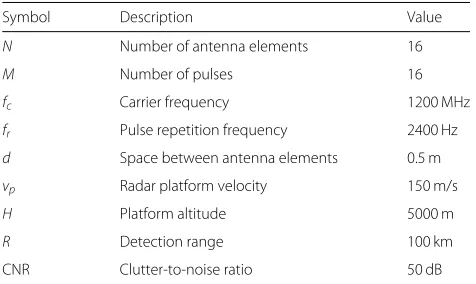
results. The basic parameters used in the following sim-ulations are listed in Table 1. It is assumed that the receiving noise after matched filtering is Gaussian white noise whose power is calculated according to the thermal noise. In all simulations, we assume that the target is in broadside, that is, it has an azimuth of 0◦.
Firstly, we describe the calculation ratio of the proposed method to MSMB [11, 12] as a function of the number of RD channels, using the formula provided in Eqs. 30 and 31. It is obvious that the proposed method has less com-plexity, especially in the scenario that RD channels is less and further confirms that the proposed method is more applicable in the sample deficient cases.
Figure 3 shows the SINR performance of the three RD
STAP methods, the JDL3×3 approach, STMB approach,
and the proposed approach, respectively. The normalized Doppler frequency sweeps over the range [−0.5, 0.5], and the best channels are calculated at each frequency point. It is clear to see that the proposed RD approach shows better capability of suppressing clutter than the other two, even if they have the same dimension of RD matrix. In detail, they exhibit similar performance when the veloc-ity of target is low, but the proposed approach generates better SINR output compared to the two stationary RD approaches when the target is away from the clutter ridge. Under the condition that there is no target ambiguity in Doppler, we can infer that a larger performance gap will be generated when the velocity of target becomes larger.
In the second experiment, we evaluate the performance of the proposed approach for different numbers of auxil-iary channels, which is a partial enlarged picture exhibited in Fig. 4. We can conclude that the proposed method has a slight output SINR improvement as the number of auxiliary channels increases. By detailed observation, the proposed approach with only one auxiliary channel
can achieve a SINR loss about less than 3 dB, and a little performance improvement is achieved for eight auxiliary channels compared with three auxiliary channels. As a result, an excellent performance can be achieved by using only few channels to cancel the interference, then compu-tational amount and the secondary data used to estimate the CCM can be decreased.
We illustrate the relationship between the output SINR loss and the number of freedom with a fixed testing Doppler channel 4, i.e., the normalized Doppler frequency is 3/16. The results, shown in Fig. 5, compare the proposed method with the RR approach such as PC inverse algo-rithm [9], the cross-spectral metric algoalgo-rithm (CSM) [10], and the multistage Wiener filter algorithm (MSWF) [11], as a function of Wiener filter order (adaptive DOF). One can see that the PC and CSM approaches have poorer con-vergence property to the optimal SINR and lower SINR while the MSWF has better convergence performance, and the proposed approach has the fastest convergence rate. On the other hand, in the case that the DOF is low, that is, only few auxiliary channels are selected, the output SINR of the proposed approach is less than 3 dB, while the other approaches cannot achieve the same performance and result in poorer clutter suppression. Only when the DOF of the MSWF, CSM, and PC reaches 11, 20, and 31, respectively, can they achieve the same performance as the proposed approach, while the proposed approach exhibits good performance with no restriction on DOF. Therefore, it is certain that the proposed approach pro-duces a desirable detection performance and less amount of calculation.
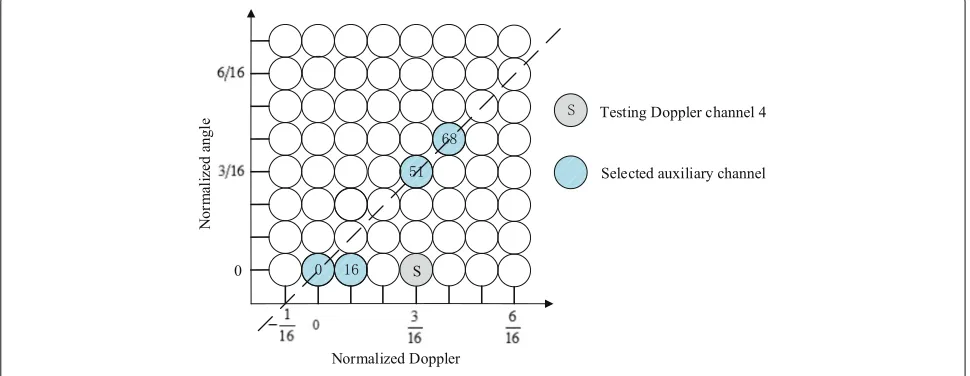
Last but not the least, the location of the four best chan-nels are shown in Fig. 6, where the solid circles correspond to the RD channels and the diagonal denote the clutter ridge. The serial number of auxiliary channels is labeled according to the rules as follows:N(m−1)+n−1 denotes themth Doppler channel and thenth angular channel, and the smaller number ofnandmmeans the channel is closer to the frequency of 0, both in the angular and Doppler domains. It can be seen that the auxiliary channels are mainly distributed in the area around the mainlobe and sidelobe, which have the same Doppler frequency or the same angle with the target. Hence, the conclusion derived before can be verified.
6 Conclusions
Reduced-dimension STAP is frequently employed in air-borne radar systems to detect moving targets in the presence of fixed clutter, which is widely used in practi-cal engineering application. In this paper, we proposed a
novel RD STAP methodology. A parameter named ADC2
is formulated to characterize the non-centrality parameter of AMF detector which has a direct impact on detec-tion performance. Through estimating the Fourier basis
offline, we select the auxiliary channels in the field of angular-Doppler corresponding to the largest value of ADC2, so that the upper bound of performance will be achieved when the DOF is fixed. The performance of the proposed strategy was validated by simulations, which exhibited its advantage on target detection performance compared with some other RD and RR approaches. Fur-thermore, the location of the best auxiliary channels in the transform domain is predicted and verified by the simulation results.
Acknowledgements
The authors would like to thank the anonymous reviewers and the editors for the insightful comments and suggestions. This work was supported by the National Natural Science Foundation of China (no. 61371184 and no. 61401062).
Competing interests
The authors declare that they have no competing interests.
Received: 5 April 2016 Accepted: 2 September 2016
References
1. LE Brennan, IS Reed, Theory of adaptive radar. IEEE Trans Aerosp Electron Syst.9(2), 237–252 (1973)
2. R Klemm,Principles of space-time processing. (IEE Press, London, 2002) 3. IS Reed, JD Mallett, LE Brennan, Rapid convergence rate in adaptive
arrays. IEEE Trans Aerospace Electron Syst.10(6), 853–863 (1974) 4. P Douglas, O Gregory, Knowledge-aided STAP processing for
ground-moving target indication radar using multilook data. EURASIP J Adv Signal Process, 1–16 (2006)
5. H Li, Y Li, Z He, MIMO radar clutter mitigation based on joint beamforming and joint domain localized proecessing. EURASIP J Adv Signal Process, 1-10 (2013)
6. S Chen, L Kong, J Yang, Adaptive clutter nulling approach for heterogeneous environments. Circuits, Systems, Signal Process.34(3), 987–1000 (2015)
7. RC Dipieto, inPaper presented at the 25th Asilomar Conference,. Extend factored space-time processing technique for airborne radar, (Pacific Grove, 1992), pp. 425–430
8. H Wang, L Cai, On adaptive spatial-temporal processing for airborne surveillance radar systems. IEEE Trans. Aerospace Electron. Syst.30(3), 660–670 (1994)
9. Y Wang, J Chen, Z Bao, Y Peng, Robust space-time adaptive processing for airborne radar in nonhomogeneous clutter environments. IEEE Trans. Aerospace Electron. Syst.39(1), 70–80 (2003)
10. C Luo, Z He, J Li, W Zhang, W Xia, A modified dimension-reduced space-time adaptive processing method. 2014 IEEE Radar Conference, 724–728 (2014)
11. W Zhang, Z He, J Li, H Liu, Y Sun, A method for finding best channels in beam-space post-Doppler reduced-dimension STAP. IEEE Trans. Aerospace Electron. Syst.50(1), 254–264 (2014)
12. W Zhang, Z He, J Li, H Liu, Multiple-input-multiple output radar multistage multiple-beam beamspace reduced-dimension space-time adaptive processing. IET Radar, Sonar Navigation.7(3), 295–303 (2013) 13. IP Kirsteins, DW Tufts, Adaptive detection using a low rank approximation
to a data matrix. IEEE Trans. Aerospace Electron. Syst.30(1), 55–67 (1994) 14. JS Goldstein, IS Reed, Reduced rank adaptive filtering. IEEE Trans. Signal
Process.45(2), 492–496 (1997)
15. JS Goldstein, IS Reed, LL Scharf, A multistage representation of the Wiener filter based on orthogonal projections. IEEE Trans. Inform. Theroy.44(7), 2943–2959 (1998)
17. X Wang, E Aboutanios, M Amin, MG Amin, Reconfigurable adaptive array beamforming by array selection. IEEE Trans. Signal Process.62(9), 2385–2396 (2014)
18. X Wang, E Aboutanios, M Amin, Reduced-rank STAP for slow-moving target detection by antenna-pulse selection. IEEE Signal Process. Lett.
22(8), 1156–1160 (2015)
19. X Wang, E Aboutanios, M Amin, Slow radar target detection in heterogeneous clutter using thinned STAP. IET Radar, Sonar Navigation.
10(4), 726–734 (2016)
20. FC Robey, DR Fuhrman, EJ Kelly,et al, A CFAR adaptive matched filter detector. IEEE Trans. Aerospace Electron. Syst.28(1), 208–216 (1992) 21. TA Schonhaff, AA Giordeno,Detection and Estimation Theory and its
applications. (Prentice Hall, Upper Saddle River, 2006) 22. J Ward,Space-time adaptive processing for airborne radar. Lincoln
Laboratory Tech. Rept (1994)
23. Y Wu, J Tang, Y Peng, On the essence of knowledge-aided clutter covariance estimate and its convergence. IEEE Trans. Aerospace Electron. Syst.47(1), 569–585 (2011)
24. R Klemm, J Ender, in1990 IEEE International Radar Conference. New aspects of airborne MTI, (1990), pp. 335–340
25. WL Melvin, GA Showman, An approach to knowledge-aided covariance estimation. IEEE Trans. Aerospace Electron. Syst.42(3), 1021–1042 (2006)
Submit your manuscript to a
journal and benefi t from:
7Convenient online submission
7Rigorous peer review
7Immediate publication on acceptance
7Open access: articles freely available online
7High visibility within the fi eld
7Retaining the copyright to your article