Yajvender Pal Verma
Member IEEE
and Ashwani KumarMember IEEE
Abstract: The power system restructuring has introduced competitiveness among different market players in electricity market and as a result transmission lines have to operate near to their thermal limits. System operators have a challenge to ensure reliable and secure transmission of power under these conditions. In this paper a rescheduling based congestion management solution is proposed for hybrid electricity market containing hydro-thermal units. The objective of the problem is to minimize the congestion management cost by suitably rescheduling the generation of hydro and thermal units based on their up and down generation cost bids. The hydro units having the least cost and fast start up time have been used to alleviate the congestion by considering the non-concave piece-wise linear performance curves for them. The bilateral transactions between different entities have also been considered while rescheduling of the generators for congestion management. The proposed model has been tested on modified IEEE-24 bus system. It can be observed that presence of hydro units reduces the overall congestion management cost and reactive power requirement.
Index Terms- Congestion, Hybrid Market, Bilateral Transaction, Rescheduling.
I. INTRODUCTION
he continuous rise in the demand for energy and huge growth of renewable energy generation sources are putting burden on our existing transmission infrastructure. The transmission lines capability to transmit the electric power is limited by many factors such as voltage limit, MVA limit, stability limits etc. The power system is said to be congested when any of these parameters reach to its limit. In addition, the deregulation of power sector has created a competitive environment among all the market players and the large number of market players has made the operation of power system more complex [1]. The congestion situation may also prevent the market players to have bilateral contracts that can impact the prices of the electricity. Thus, independent system operators (ISO) have an important and challenging task to establish coordination among various market players and ensure a secure and reliable power flow on highly burdened transmission infrastructure [2].
Few approaches have been reported in the literature to alleviate the congestion problem which include reactive power compensation (FACTS devices), rescheduling of generation, demand re-adjustment etc. A comprehensive literature survey has been presented on conventional congestion management techniques in [3-4].
Manuscript received March 15, 2014; revised April 12, 2014.
Yajvender Pal Verma is with the department of Electrical & Electronics Engineering at University Institute of Engineering and Technology, Panjab University Chandigarh India.( Phone: +911722534990; fax: +91-172-2547986; e-mail:yajvender_verma@ yahoo.com).
Ashwani Kumar is with the department of Electrical Engineering at NIT Kurukshetra India. (e-mail: [email protected]).
There are two broad approaches by which the congestion is managed; one is technical and the other is financial. The rescheduling based congestion management falls under the category of financial approach and the method like reactive power support through FACTS devices is a technical approach. Congestion management approach based on rescheduling has been applied by various authors for different market structures considering different issues of the competitive electricity market [5]. A congestion management method based on real and reactive power congestion distribution factor-based zones and generator's rescheduling has been proposed by [6]. Sensitivity based congestion management methods have been presented in [7]. Kumar et al. have proposed distribution factor-based generators' rescheduling for congestion management [8]. In literature, FACTS devices have been used extensively to alleviate the congestion [3] [9].
The congestion management techniques have been applied to various market structures. The most common market structure which has been studied is the pool market. But, post de-regulation the bilateral market model is the most favored structure. The congestion management problem has been solved in bilateral market model in [1] [10]. The detailed modeling how different market players deal in open access bilateral market model has been presented in [11]. There are few case studies to show congestion management applied in bilateral market, but they have ignored the secure bilateral transactions during the congestion management studies.
Hydro units have been used along with thermal units to manage the congestion in a pool market structure [12]. Generally the duration for the congestion management is taken on per hour basis and the characteristics (variations in reservoir level, head etc.) of the hydro units are used to increase or decrease the generation to reduce the congestion in this short interval. The hydro generation entity can also carry out self scheduling of generated energy in day-ahead market to maximize their profit. Moreover, the Market Clearing Price (MCP) is decided by scheduling the thermal generating units only and the hydro units are considered to be the price takers which maximize their revenue by bidding power at a price close to but lesser than system marginal price [13].
This paper discusses the implementation of the congestion management approach based on rescheduling of the generators for a hybrid electricity market. The secure bilateral transactions between different entities have been incorporated through transition matrix T. The bids are submitted by thermal and hydro generating units to ISO for congestion management. The optimization problem incorporates the operational constraints of the thermal and hydro units. The availability of water during the congestion decides the participation of hydro units in congestion management. Water discharge and the availability of water
Congestion Management in Hybrid Electricity
Market for Hydro-Thermal System
during congestion management have been modeled in the problem. The optimization problem has been formulated as mixed-integer non-linear programming congestion management problem and solved using CONOPT solver of GAMS [14] with its interface to MATLAB [15]. It is ensured that the rescheduling of generators keep the operational parameters like voltage, angle and reactive power within the limits.
The rest of the paper is structured as follows: Section 2 discusses the modeling of secure bilateral transaction in hybrid electricity market. Section 3 gives the rescheduling based congestion management model formulation. Simulation studies, results and discussions have been covered in Section 4 and section 5 carries the conclusions.
II. BILATERAL TRANSACTION MODELING IN HYBRID
ELECTRICITY MARKET
The power sector carries out many activities which include generation, transmission, distribution, supply and metering etc. Traditionally it has vertically integrated power companies. Many electricity market structures have been implemented in different countries around the world however; Pool and Bilateral Contracts Model are the two main market arrangements. The pool model is a centralized form of trading electricity with competition focused on generators with minimal input from the buyers whereas the bilateral model is more market-oriented which encourages more interactions between the generators and buyers. The two market models differ from each other on many aspects such as scheduling and dispatch, handling imbalances and constraints on transmission line capacity that may affect the system stability. The most preferred practical system that will be adopted in future is the hybrid electricity market in which pool will exist simultaneously with bilateral and multilateral transactions. The market participants not only can bid in to pool but also can have bilateral agreements with each other. Therefore, this model offers more flexibility for transmission access. California market model is the most common example of this type of market. Based on the concept of bilateral market model, the deviations from the proposed transactions have to be minimized. This results in a new transaction matrix which ensures the secure transaction during rescheduling of generation. The objective function is:
Minimize 𝑏𝑖𝑗 𝑇𝑖𝑗 − T𝑖𝑗0 2 𝑗
𝑖 (1)
Subject to: The real and reactive power balances equations are given by (2) and (3) respectively. 𝑃𝑖 = 𝑃𝑔𝑖+ 𝑃𝑖− 𝑃𝑑𝑖 = 𝑉𝑁𝑗 𝑖𝑉𝑗𝑌𝑖𝑗𝑐𝑜𝑠 𝛿𝑖− 𝛿𝑗− 𝜃𝑖𝑗 ∀ 𝑖 = 1.2 … … … . 𝑁 (2)
𝑄𝑖 = 𝑄𝑔𝑖+ 𝑄𝑖− 𝑄𝑑𝑖 = 𝑉𝑁𝑗 𝑖𝑉𝑗𝑌𝑖𝑗𝑠𝑖𝑛 𝛿𝑖− 𝛿𝑗− 𝜃𝑖𝑗 ∀ 𝑖 = 1.2 … … … . 𝑁 (3)
The power balance equations for generation and demand using bilateral transaction matrix 𝑇 ≅ 𝐺𝐷 for hybrid market model are given by (4)-(7) 𝑃𝑑𝑏 = 𝐺𝐷j 𝑖𝑗 (4)
𝑃𝑔𝑏 = 𝐺𝐷i 𝑖𝑗 (5)
𝑃𝑔 = 𝑃𝑔𝑏 + 𝑃𝑔𝑝 (6)
𝑃𝑑 = 𝑃𝑑𝑏+ 𝑃𝑑𝑝 (7)
The power flow equations for the bilateral power is given as 𝑃𝑓𝑏 = 𝐷𝐹 𝑃𝑔𝑏 − 𝑃𝑑𝑏 (8)
The power flow equations for the pool power is given by (9) 𝑃𝑓𝑏𝑝 = 𝐷𝐹 𝑃𝑔𝑝− 𝑃𝑑𝑝 (9)
The net power flow is given by (10) 𝑃𝑓 = 𝑃𝑓𝑏 + 𝑃𝑓𝑝 (10)
Each generator can generate between its generation capacities only. The real and reactive power generation capacities of thermal and hydro generators are given (11) and (12). 𝑃𝑔𝑖𝑚𝑖𝑛 ≤ 𝑃𝑔𝑖 ≤ 𝑃𝑔𝑖𝑚𝑎𝑥 ; ∀ 𝑖 ∈ 𝐺 (11)
𝑃𝑖𝑚𝑖𝑛 ≤ 𝑃𝑖 ≤ 𝑃𝑖𝑚𝑎𝑥 ; ∀ 𝑖 ∈ 𝐻 (12)
The reactive power limits of the units must also be abided and specified by (13) and (14) for thermal and hydro units respectively. 𝑄𝑔𝑖𝑚𝑖𝑛 ≤ 𝑄𝑔𝑖 ≤ 𝑄𝑔𝑖𝑚𝑎𝑥 ; ∀ 𝑖 ∈ 𝐺 (13)
𝑄𝑖𝑚𝑖𝑛 ≤ 𝑄𝑖 ≤ 𝑄𝑖𝑚𝑎𝑥 ; ∀ 𝑖 ∈ 𝐻 (14)
The voltage and angle limits on the lines are incorporated as given by (15) and (16) respectively. 𝑉𝑖𝑚𝑖𝑛 ≤ 𝑉𝑖 ≤ 𝑉𝑖𝑚𝑎𝑥 (15)
𝛿𝑖𝑚𝑖𝑛 ≤ 𝛿𝑖 ≤ 𝛿𝑖𝑚𝑎𝑥 (16)
The transaction limits between the seller bus-𝑖 and buyer bus-𝑗 is given by (17) 𝐺𝐷𝑖𝑗𝑚𝑖𝑛 ≤ 𝐺𝐷𝑖𝑗 ≤ 𝐺𝐷𝑖𝑗𝑚𝑎𝑥 ≤ 𝑚𝑖𝑛 𝑃𝑔𝑖𝑚𝑎𝑥, 𝑃𝑑𝑗 (17)
The MVA limit for the lines are expressed by (18) 𝑀𝑉𝐴𝑖𝑗 ≤ 𝑀𝑉𝐴𝑚𝑎𝑥𝑖𝑗 (18)
The line voltage variations have been allowed between 1.05 p.u to 0.95 p.u. III. RESCHEDULING BASED CONGESTION MANAGEMENT The aim of the congestion management problem formulation is to minimize the congestion cost in a power system containing hydro and thermal units subject to equality and inequality operational constraints of these units without violating the bilateral transactions between them. The objective function of congestion management cost contains the up and down cost bids components and the power of the hydro and thermal generating units. The optimization problem can be stated mathematically as: Minimize 𝐶𝐶 = 𝐶𝑔𝑖𝑢𝑝∆𝑃𝑔𝑖𝑢𝑝 𝑖∈𝑔 + 𝐶𝑔𝑖𝑑𝑜𝑤𝑛∆𝑃𝑔𝑖𝑑𝑜𝑤𝑛 + 𝐶𝑖 𝑢𝑝 ∆𝑃𝑖𝑢𝑝 𝑖∈ + 𝐶𝑖𝑑𝑜𝑤𝑛∆𝑃 𝑖𝑑𝑜𝑤𝑛 (19)
Subject to the following constraints: (i) Equality Constraints 𝑃𝑖 = 𝑉𝑁𝑗 𝑖𝑉𝑗𝑌𝑖𝑗𝑐𝑜𝑠 𝛿𝑖− 𝛿𝑗 − 𝜃𝑖𝑗 ∀ 𝑖 = 1.2 … … … . 𝑁 (20) 𝑄𝑖 = 𝑉𝑁𝑗 𝑖𝑉𝑗𝑌𝑖𝑗𝑠𝑖𝑛 𝛿𝑖− 𝛿𝑗− 𝜃𝑖𝑗 ∀ 𝑖 = 1.2 … … … . 𝑁 (21) The real and reactive power injections at each bus are given by the equation (20) and (21). The net generation change (up plus down) during congestion management should be zero and is given by (22) ∆𝑃𝑁 𝑔𝑖𝑢𝑝 𝑖 − ∆𝑃𝑁𝑖 𝑔𝑖𝑑𝑜𝑤𝑛 + ∆𝑃𝑖 𝑢𝑝 𝑁 𝑖 − ∆𝑃𝑁𝑖 𝑖𝑑𝑜𝑤𝑛 = 0 ; ∀ 𝑖 ∈ 𝑁 (22) The rescheduled generation on generator 𝑖 is equal to day-ahead schedule and the up and down generation by that unit during congestion management and that is given by (23).
𝑃𝑔𝑛𝑖 = 𝑃𝑖0+ ∆𝑃𝑔𝑖 𝑢𝑝
- ∆𝑃𝑔𝑖𝑑𝑜𝑤𝑛 + ∆𝑃𝑖 𝑢𝑝
The injected real and reactive power can thus be given by (24) and (25) respectively.
𝑃𝑖 = 𝑃𝑔𝑛𝑖 − 𝑃𝑑𝑖 (24)
𝑄𝑖 = 𝑄𝑔𝑖+ 𝑄𝑖− 𝑄𝑑𝑖 (25)
The performance of the hydro units have been modeled through piece–wise linear non-concave curves with the help of binary variables 𝑢𝑖 and 𝑣𝑖𝑙 as discussed in [14]. The first
variable denotes the status of hydro generating unit. The variable 𝑢𝑖 is equal to 1, if the unit is committed during
congestion management. The variable 𝑣𝑖𝑙 is 1, if the water
discharge of the 𝑖 th unit exceeds the limit in 𝑙th block. Being a short term congestion management solution the head variations effect on the hydro unit performance can be neglected.
𝑃𝑖0 + ∆𝑃𝑖 𝑢𝑝
− ∆𝑃𝑖𝑑𝑜𝑤𝑛 = 𝑃𝑖𝑚𝑖𝑛𝑢𝑖+ 𝐿𝑙=1𝑞𝑖𝑙 𝑟𝑖𝑙 ; (26)
∅𝑖= ∅𝑖𝑚𝑖𝑛 + 𝐿𝑙=1𝑞𝑖𝑙 ; ∀ 𝑖 ∈ 𝐻 (27)
The ∆𝑃𝑖𝑢𝑝 and ∆𝑃𝑖𝑑𝑜𝑤𝑛 generation in hydro units is
dependent upon the minimum power generation 𝑃𝑖𝑚𝑖𝑛 and
the power generated by water discharge 𝑞𝑖𝑙 in total block
period of L.
(ii) Inequality Constraints: The system is subjected to many inequality constraints on thermal and hydro generating units. The rescheduled real power on hydro as well as on thermal units must remain within the limits as given by (28) and (29).
𝑃𝑔𝑖𝑚𝑖𝑛 ≤ 𝑃𝑔𝑖0 + ∆𝑃𝑔𝑖 𝑢𝑝
− ∆𝑃𝑔𝑖𝑑𝑜𝑤𝑛 ≤ 𝑃𝑔𝑖𝑚𝑎𝑥 ; ∀ 𝑖 ∈ 𝐺 (28)
𝑃𝑖𝑚𝑖𝑛 ≤ 𝑃𝑖0 + ∆𝑃𝑖 𝑢𝑝
− ∆𝑃𝑖𝑑𝑜𝑤𝑛 ≤ 𝑃𝑖𝑚𝑎𝑥 ; ∀ 𝑖 ∈ 𝐻 (29)
The reactive power limits of the units must also be abided and specified by (30) and (31) for thermal and hydro units respectively.
𝑄𝑔𝑖𝑚𝑖𝑛 ≤ 𝑄𝑔𝑖0 ≤ 𝑄𝑔𝑖𝑚𝑎𝑥 ; ∀ 𝑖 ∈ 𝐺 (30)
𝑄𝑖𝑚𝑖𝑛 ≤ 𝑄𝑖0 ≤ 𝑄𝑖𝑚𝑎𝑥 ; ∀ 𝑖 ∈ 𝐻 (31)
The voltage and angle limits on the lines are incorporated as given by (32) and (33) respectively.
𝑉𝑖𝑚𝑖𝑛 ≤ 𝑉
𝑖≤ 𝑉𝑖𝑚𝑎𝑥 (32)
𝛿𝑖𝑚𝑖𝑛 ≤ 𝛿𝑖≤ 𝛿𝑖𝑚𝑎𝑥 (33)
The water discharge for the hydro units should also be within the limits as given by (34)
∅𝑖𝑚𝑖𝑛𝑢𝑖 ≤ ∅𝑖 ≤ ∅𝑖𝑚𝑎𝑥 (34)
The power is limited by the water contents allocated to the generators, but the available water must be able to meet at least the day-ahead schedule of power generating unit.
𝑀∅𝑖 ≤ 𝑊𝑖; ∀ 𝑖 ∈ 𝐻 (35)
Here, 𝑀 is a conversion factor to convert m3/s into H m3/h.
𝑊𝑖 is the water contents allocated by hydro generator
company at 𝑖 𝑡 bus during congestion management for rescheduling. The power flow through the congested transmission lines should be limited to their MVA limit as given by (36)
𝑃𝑖𝑗2+ 𝑄𝑖𝑗2 ≤ 𝑆𝑖𝑗𝑚𝑎𝑥 2
(36) The power balance equations for generation and demand using bilateral transaction matrix 𝑇 for hybrid market model are used as given by (4)-(7).
IV. SIMULATION STUDIES
The simulation studies have been conducted on modified IEEE-24 bus test system where a case of congestion has been created on the three most sensitive transmission lines. The hydro generating units were introduced in addition to already existing thermal plants on the bus system. Day-ahead schedule and incremental and decremental cost bids
data for the hydro and thermal plants are given in [12]. The cost bids of the companies for making up and down change in generation have been fixed considering the marginal locational prices obtained from the power flow solution. The IEEE-24 system consists of eleven generators at bus 1, 2,7,8,13,16,18,21,22, and 23. The generator number 8, 13 and 18 have been modeled as the units of hydro generation companies and the remaining generating units belong to thermal generation companies. The voltage limits for the buses have been assumed between 0.95 p.u to 1.05p.u. Table I gives the data of the hydro units (i.e. maximum and minimum MW and MVAR capacity limits, maximum water available, water discharge limit during congestion etc.).
TABLEI HYDRO UNITS DATA
Bus No.
𝑃𝑚𝑎𝑥 (MW)
𝑃𝑚𝑖𝑛 (MW)
𝑄𝑚𝑎𝑥 (MVAR)
𝑄𝑚𝑖𝑛 (MVAR)
𝑊𝑓 (𝐻𝑚3/ )
∅𝑚𝑖𝑛 (𝑚3/ 𝑠)
∅𝑚𝑎𝑥 (𝑚3/ 𝑠)
8 500 40 35 -5.0 1.4 10 100
13 590 81 54 -1.0 2.5 20 200
18 400 68 68 -50 1.5 10 120
A Congestion Case in Three Lines with Hydro Units
In this case study, three sensitive transmission lines which are vulnerable to congestion have been considered. These are line (15-16), (14-16) and (6-10). The base power flows on these lines were 226.33 MVA, 332.84 MVA and 124.15 MVA respectively. These lines were made congested by reducing their line flow limits to 150 MVA, 300 MVA and 100 MVA from 500 MVA, 500 MVA and 175 MVA respectively. The rescheduling based congestion management problem was then solved. The day-ahead 𝑃𝑔
and new generation schedules 𝑃𝑔𝑛 were obtained and the
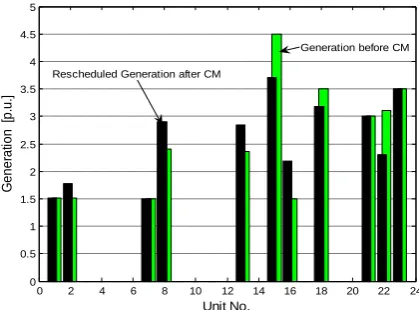
[image:3.595.306.550.227.301.2]same have been depicted in the Fig.1. It has also been observed that the location of congested line decides the up and down generation change of the generators. Initially, the congestion was not considered in line (6-10) and it was observed that the unit number 2 did not participate in the congestion management at that time. When congestion was considered on the line (6-10), it became economical to reschedule the generation of the generating unit 2 along with other units. In this case the cost of congestion management for three lines with secure bilateral transaction is 4019.62 $/hr. Figure 2 shows the pool and bilateral power generation and demand along with up and down power by different units participating in congestion management for three above mentioned congested lines.
Fig. 1 Day-ahead and after congestion management generation schedule
0 2 4 6 8 10 12 14 16 18 20 22 24 0
0.5 1 1.5 2 2.5 3 3.5 4 4.5 5
Unit No.
G
e
n
e
ra
tio
n
[
p
.u
.]
Rescheduled Generation after CM
[image:3.595.317.527.621.776.2]Fig. 2 Pool and bilateral power in 3-line congestion
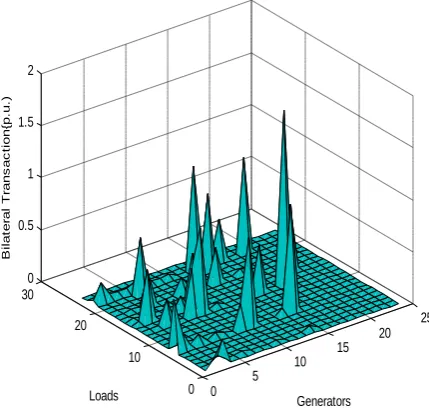
A new bilateral transaction matrix GD is obtained by solving the objective function under the constraints given by the equation 1 which is shown in Fig.3. This transaction matrix ensures the secure bilateral transactions during the congestion cost optimization problem.
Fig.3 Secure bilateral transaction pattern during congestion management
The secure bilateral transaction tends to fix the power flow and as a result the scheduling cost of the generating units during congestion management is affected. However, the locations of congested lines change the up and down rescheduling of generators and the congestion cost as a result. The hydro units do participate in congestion management during three line congested case. The hydro units’ characteristics curves have been assumed piece wise linear in three blocks with slopes 0.4 MW/m3/s, 0.8 MW/m3/s, 0.5 MW/m3/s respectively with each block having maximum discharge limit of 30 m3 /s , 60 m3 /s and 30 m3 /s for generating unit 8 ,13 and 18 respectively. The total water contents allocated to different units during congestion management are 1.5𝐻𝑚3/𝑠, 2.5 𝐻𝑚3/𝑠 and 1.4
[image:4.595.57.272.347.551.2]𝐻𝑚3/𝑠 respectively.
Fig. 4 Effect on reactive power generation with bilateral contract
Out of their maximum generation limits during congestion management the hydro units 8 and 13 up their generation by 50.2 MW and 47.8 MW respectively whereas, the unit 18 decreases its generation by 32.4 MW. Table II shows the results for hydro units after congestion management. The water discharge corresponding to three blocks along with the reactive power generation and maximum discharge have been given. The congestion management process adjusts the bus voltages and major changes take place in the proximity of the congested lines. Figure 4 shows the reactive power flow on various buses during and without Bilateral Contract. The reactive power is very significant in power system as it affects the voltage profile of the buses. It has been observed that the reactive power requirement in the buses having hydro units is slightly lower.
TABLEII
HYDRO GENERATORS PARAMETERS FOR CONGESTION CASE
Bus No.
∆𝑃𝑢 (MW)
∆𝑃𝑑 (MW)
𝑄𝑔 (MVAr)
𝜙 (m3/s)
𝑞1 (m3/s)
𝑞2 (m3/s)
𝑞3 (m3/s)
8 50.2 - 56.41 98.56 30 30 28.56
13 47.8 - 54.10 168.12 60 60 28.12
18 - 32.4 132.10 91.78 30 30 21.78
B Congestion Case in Three Lines without Hydro Units
In this case, the role of hydro units in the congestion management is studied. It has been assumed that no hydro units are participating in the congestion management. The comparison of participation of thermal units in rescheduling their generation during congestion management with and without hydro units is depicted in the Table III. Figure 5 shows the voltage profile at various buses during congestion management with and without participation of the hydro units. The cost of congestion goes up when there is no participation from the hydro units in congestion management and the congestion management cost without the participation of hydro unit is 4716.02 $/hr and it is 4019.62 $/hr when hydro units participate in the congestion management. There is an increase of 696.4 $/hr when no hydro units participate in congestion management. The overall increase in the day-ahead schedule is of 57.4 MW without the participation of hydro units. Thus, hydro units do have an influence on the overall cost and can be used in 0
0.5 1 1.5 2 2.5 3 3.5
1 3 5 7 9 11 13 15 17 19 21 23
Pow
e
r
[p
.u
.]
Bus Number
Pgb
Pdp
Pgp
Pdb
0
5 10
15 20
25
0 10 20 30
0 0.5 1 1.5 2
Generators Loads
B
il
a
te
ra
l
T
ra
n
s
a
c
ti
o
n
{p
.u
.)
0 5 10 15 20 25
-1 -0.5 0 0.5 1 1.5
Bus No
R
e
a
ct
ive
P
o
w
e
r
[p
.u
.]
Q with no Bilateral Power
[image:4.595.304.552.463.544.2]the congestion management problem economically. The use of hydro unit in congestion management can be helpful in the successful integration of renewable sources to the system due to their proximity renewable sources like wind in remote areas. This ability of hydro unit can be exploited to manage the congestion without installing additional lines from these areas when there is significant penetration of RESs.
TABLEIII
GENERATION SCHEDULE WITH AND WITHOUT HYDRO UNITS
PARTICIPATION IN PER UNIT
Unit No
With Hydro Without Hydro Units
𝑃𝑔 𝑃𝑔𝑛 ∆𝑃𝑔𝑢 ∆𝑃𝑔𝑑 𝑃𝑔𝑛 ∆𝑃𝑔𝑢 ∆𝑃𝑔𝑑
1 1.52 1.52 - - 1.52 -
-2 1.52 1.776 0.256 - 1.80 0.28
-7 1.5 1.5 - - 2.03 0.53
-8* 2.4 2.902 0.502 - 2.4 -
-13* 2.36 2.838 0.478 - 2.36 -
-15 4.5 3.7 - 0.80 3.7 - 0.80
16 1.5 2.188 0.688 - 1.865 0.365
-18* 3.5 3.176 - 0.324 3.5 -
-21 3.0 3.0 - - 2.61 - 0.39
22 3.1 2.3 - 0.80 2.3 - 0.80
23 3.5 3.5 - - 4.5 0.8
-Fig. 5 Bus Voltage pattern during congestion management with and without hydro units
V. CONCLUSION
In this paper, the congestion management method based on rescheduling has been used for a system containing hydro and thermal units considering their operational constraints in a hybrid market structure. The performance of hydro units have been included using piece-wise linear characteristics curves for them. They can be used for congestion management by rescheduling them by predicting the short term water availability. The generation has been rescheduled to manage the congestion in multi-line congestion situations keeping bilateral transactions intact. The secure bilateral transactions and the location of congested lines affect the amount of congestion and the cost of congestion for the entities under bilateral contract. The reactive power balance ensures the voltage limits during rescheduling of generation during congestion management. The hydro units with low operating cost and quick start up time can play an important
role in reliable integration of renewable sources and cost optimization due to their locational proximity and ability to respond effectively during congestion.
REFERENCES
[1] H.Y.Yamina and S.M. Shahidehpour, “Congestion management coordination in the deregulated power market,” Electric Power
Systems Research, Vol.65, no.2, pp.119-127, 2003.
[2] S.C.Srivastava, and P.Kumar, “Optimal power dispatch in deregulated market considering congestion management,”
International Conference on Electric Utility Deregulation and
Restructuring and Power Technologies, DRPT 2000,pp. 53-59.
[3] A.Kumar, S.C. Srivastava, and S.N.Singh, “Congestion management in competitive power market: a bibliographical survey,” Electric
Power Systems Research, Vol.76, no.1, pp.153-164, 2005.
[4] E. Bombard, P.Correia, M, Gross, and M.Amelin “Congestion-management schemes: a comparative analysis under a unified framework,” IEEE Transactions on Power Systems, Vol.18, no.1, pp.346-352, 2003.
[5] Y.R.Sood, N.P.Padhy, and H.O.Gupta, “Wheeling of power under deregulated environment of power system-a bibliographical survey,”
IEEE Transactions on Power Systems, Vol.17, no.3, pp. 870-878.
2002
[6] A.Fattahi, and M.Ehsan, “Sensitivity Based Re-dispatching Method for Congestion Management in a Pool Model,” International Journal
of Emerging Electric Power Systems, Vol.3, no.2, pp.1077, 2005,.
[7] S. Dutta, and S.P.Singh, “Optimal rescheduling of generators for congestion management based on particle swarm optimization,”
IEEE Transactions on Power Systems, Vol. 23, no.4, pp.1560-1569,
2008.
[8] A.Kumar, S.C. Srivastava, and S.N.Singh, “A zonal congestion management approach using ac transmission congestion distribution factors,” Electric Power Systems Research, Vol.72, no.1, pp.85-93, 2005.
[9] S.N.Singh, and A.K. David, “Optimal location of FACTS devices for congestion management,” Electric Power Systems Research, Vol.58, no.2, pp.71-79, 2001.
[10] J.W.Cheng, F.D.Galiana, and D. T. McGillis, “Studies of bilateral contracts with respect to steady-state security in a deregulated environment of electricity supply,” IEEE Transactions on Power Systems, Vol.13, no.3, pp.1020-1025,1998.
[11] F.D.Galiana, and M.Ilic, “A mathematical framework for the analysis and management of power transactions under open access,” IEEE Transactions on Power Systems, Vol. 13, no.2, pp. 681-687, 1998.
[12] K.Singh, N.P.Padhy, and J.Sharma, “Congestion management considering hydro–thermal combined operation in a pool based electricity market,” International Journal of Electrical Power & Energy Systems, Vol.33, no.8, pp.1513-1519, 2011.
[13] A.J.Conejo, J.M.Arroyo, J.Contreras, and F.A.Villamor, “Self-scheduling of a hydro producer in a pool-based electricity market,” IEEE Transactions on Power Systems, Vol.17, no4, pp.1265-1272, 2002.
[14] A. Brooke, D.Kendrick, A.Meeraus, R.Raman, and R.E.Rosenthal, GAMS: A User’s Guide. Washington DC: GAMS Development Corporation 1998.
[15] Simulink 7 User’s Guide, The Math works Inc., Mar, 2008.
2 4 6 8 10 12 14 16 18 20 22 24 0.94
0.96 0.98 1 1.02 1.04 1.06
Bus No
V
o
la
ta
g
e
[p
.u
.]
[image:5.595.50.290.168.537.2]