Page 105
ASSESSING SPECIFIC NEEDS OF BUSINESS ADMINISTRATION STUDENTS IN PROFESSIONAL ENGLISH COURSE DESIGN
Tatjana Sinkus
Latvia University of Agriculture, Jelgava, LV-3001, Latvia
Abstract
This article describes a needs analysis conducted on the stage when the teacher planned and developed a professional English course for the students of Business Administration in high school. In order to investigate the importance of professional English language knowledge in the sphere of entrepreneurship and to identify in what specific situations entrepreneurs use English in regular work situations in Latvian context, business experts, owners of companies were interviewed. Then, Latvian specialists in Business Administration participated in a questionnaire which aim was to investigate the importance and prevalence of business administrators’ duties performed at work in English. The author also investigated the opinion of Latvian business administrators on what should be the main focus of professional English course: what are the most important language areas and which of the skills should be given priorities in order to perform duties in the foreign language at work after graduating. Afterwards, the author investigated students’ particular needs, wants and expectations for the professional English course. Finally, analyzing the results of the centralized examination for the period of three consecutive years, student English language level at the beginning of the studies in high school was determined. The conclusions of the findings are presented in the end of the article. The results of the data obtained can provide a basis for the ESP course developers.
Keywords: needs analysis, ESP, syllabus design, business administration
1. INTRODUCTION
Any professional English course must be based on the paramount concern of ‘what learners need to do with English’ (Dudley-Evans & St.John, 1998) as well as the knowledge, skills and competences required for this purpose. Needs assessment or needs analysis is considered as ‘a crucial feature’, ‘the defining characteristic of ESP courses’ Basturkmen (2013) and ‘the cornerstone of ESP syllabus development’ Hutchinson and Waters (1987).
In professional English courses students are introduced to specific texts, vocabulary and terminology, involved in communicative situations and cases that are relevant for a particular professional sphere and the issues the students are likely to deal with in their future working career. Edwards (2000) stresses the importance of this ‘immediate transferability of the newly acquired knowledge to the course participants’ working environments’ so that they ‘would be able to immediately use what they had learned to perform their jobs more effectively’.
In the studies of business administration, a professional English course should also be planned and developed based on the careful assessment and analysis of specific needs, necessities and expectations of the students. Moreover, the opinion of business experts and specialists in entrepreneurship and business administration should be examined and taken into account by the teacher designing the syllabus.
2. MATERIALS AND METHODS
Thus, the main purposes of the specific needs assessment in the present research were:
Page 106
2) to explore the importance and prevalence of business administrators’ duties performed at work in English;
3) to find out about the opinion of Latvian business administrators on what should be the main focus of professional English course: what are the most important language areas and which of the skills should be given priorities in the professional English course in Business Administration Studies in high school in order to perform duties in the foreign language at work after graduating;
4) to examine future entrepreneurs’ particular needs, wants and expectations for the professional English course;
5) to determine student English language level at the beginning of the studies in high school.
In order to obtain the necessary data the author of the research involved the following respondents: 5 business experts were interviewed, 23 specialists in business administration participated in a questionnaire; and 75 1st year students of Latvian University of Agriculture and Baltic International Academy took part in a questionnaire. The author of the research also defined the level of English language analyzing the results of the centralized examination for the period of three consecutive years.
The detailed description of the stages of the conducted needs assessment follows below.
3. RESULTS
3.1. The first stage of needs assessment
The first stage of the research aimed to investigate the importance of professional English language knowledge in the sphere of entrepreneurship and to identify in what specific situations entrepreneurs use English in regular work situations in Latvian context. Therefore, Latvian business experts were interviewed.
The interviewees are regarded experts in the sphere of entrepreneurship as they are educated, experienced and successful business owners and employers and their opinion is helpful in understanding of the Latvian and international market situation. The researcher suggested that the business experts can provide the most useful, accurate and reliable information about specific kinds of tasks that are carried out within entrepreneurship sphere in Latvia, as well as about the professional foreign language required in this field. Therefore, the author conducted a face-to-face interview with five business experts running different Latvian companies.
The questions developed for the interview with five business experts were divided into several major groups: personal data, facts about the company the business experts run, the importance of using English and specific entrepreneurial situations in which the English language is required. The face-to-face interview questions are listed in appendix 1.
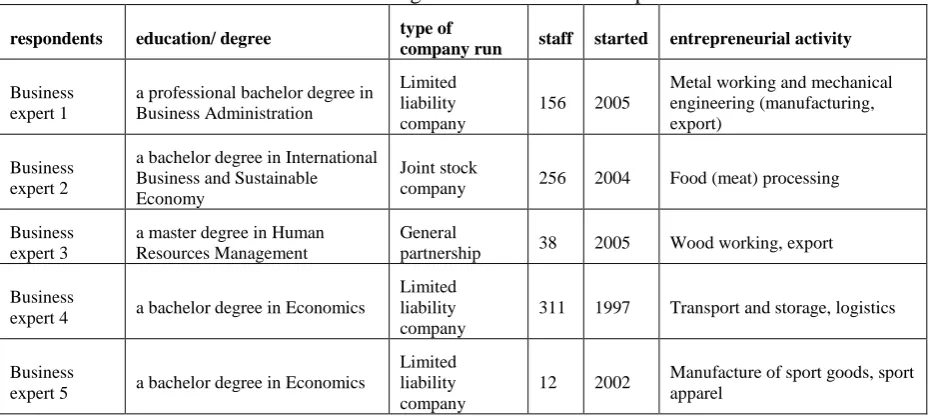
Firstly, the respondents were asked about their backgrounds: their education and working experience, as well as about the company they run. They were three women and two men, ranging in age from 38 to 63. All of the respondents had a higher education: one expert had a professional bachelor degree in Business Administration, one expert had a bachelor degree in International Business and Sustainable Economy, one expert had a master degree in Human Resources Management and two experts had a bachelor degree in Economics. Furthermore, the majority of the respondents acknowledged the necessity of constant individual growth and engaged in life-long learning events, such as personal and professional development courses, professional and general English language courses, training programmes, as well as took part in conferences, forums and annual exhibitions.
Page 107
Table 1. The background of the business experts respondents education/ degree type of
company run staff started entrepreneurial activity
Business expert 1
a professional bachelor degree in Business Administration
Limited liability company
156 2005
Metal working and mechanical engineering (manufacturing, export)
Business expert 2
a bachelor degree in International Business and Sustainable Economy
Joint stock
company 256 2004 Food (meat) processing
Business expert 3
a master degree in Human Resources Management
General
partnership 38 2005 Wood working, export
Business
expert 4 a bachelor degree in Economics
Limited liability company
311 1997 Transport and storage, logistics
Business
expert 5 a bachelor degree in Economics
Limited liability company
12 2002 Manufacture of sport goods, sport apparel
All business experts emphasized the importance of professional English knowledge in regular work situations. During the interview all respondents highlighted a great necessity to be able to communicate freely in English as they and their employees had to work with foreign partners, colleagues and customers on a daily basis.
The interviewees mentioned that the reasons for the English language knowledge for the entrepreneurs arise from the fact that since the local market is limited, Latvian entrepreneurs are interested in accessibility to larger markets and international business activity and trade contacts require a good command of English which has become the universal language of business and trade.
The respondents also explained what aspects of professional English are required and described various situations that involved them and their staff in communication in English with foreign colleagues, such as dealing with investors, participating in meetings and giving presentations about products and services, gathering information on the market or studying laws of a foreign country, as well as reading news and articles related to entrepreneurship, dealing with complaints, writing business letters, etc.
Thus, all respondents agreed that the knowledge of English was beneficial for their business in general. Some of the respondents mentioned that English was a basic skill to get a job and also to perform their every day job duties.The majority of the respondents mentioned that a good command of English is essential for improving their future career development. One business expert stated that the ability to communicate in English fluently was very important to get new study and training opportunities. Another interviewee added that English gave advantage to stand out and gain a positive recognition at work.
Throughout the interviews, several aspects of the English language knowledge were given a special attention by the business experts. They emphasized that a social talk in English is very important as it helps to build positive relationships with foreign colleagues. Good personal relationships with business partners not only affect the common work but also help to deal with problems when they occur. Therefore, entrepreneurs should be able to discuss general interest subjects in the foreign language such as hobbies, movies, theatre, sports, books, food, travel, etc. They should be able to talk about immediate environment, the situation, the weather, how the person arrived, ask and answer questions, as well as compliment, in other words to show that they are open and friendly.
Page 108
to be aware of the latest news in the world as well as to be ready to present their personal opinion about various issues.
Grammar accuracy and pronunciation were also addressed as significant in business communication by the experts. They mentioned, for instance, that even though colleagues have a shared understanding of what is discussed during a business meeting poor grammar and bad pronunciation can hinder intercultural communication, moreover, it can lead to misunderstandings and even disrespect.
During the interviews, the importance of being aware of cultural differences was highlighted by the majority of the experts as well. They stressed the idea that each culture has a different set of values, business ethics and expected etiquette. Not knowing the differences in the country that the company is doing business in can lead to inefficientcommunication.
As an example, one expert mentioned that there are cultural differences in gift-giving, some objects considered thoughtful gifts in one culture are completely inappropriate in others. Another expert stated that cultures may vary in degrees of formality. For instance, he talked to Polish business partners informally, in a friendly manner. In the case of Swedish business partners, on the contrary, he communicated formally, especially in writing, using carefully chosen words, expressions, and specific grammar structures to convey respect and politeness.
Thus, learning about local history, customs, holidays, language and other information before a business trip provides the entrepreneur with ideas to talk about, shows respect and establish a rapport with a business partner. By recognizing that different cultures respond to formality differently, express themselves differently, entrepreneurs can market, sell, negotiate with people in other cultures successfully.
Afterwards the respondents were interviewed about the English language use at work. The interviewees identified specific communicative situations in which English is required within regular working environment and explained them in detail. The respondents listed a variety of situations that were different from one another, often overlapping, depending on the type of the company and various job responsibilities within the experts’ companies.
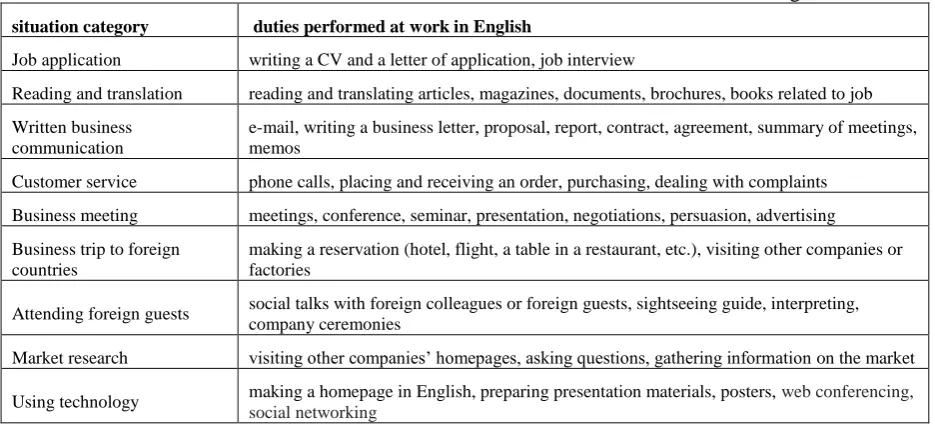
However, most of the situations that the interviewees identified were taken into consideration by the author of the research with the aim to create a questionnaire that involved as many various business duties performing which the English language is required as possible. The identified communicative situations were categorized by the author of the research as shown in table 2 below.
Table 2. Communicative Business Situations Identified in the Interview and Categorized situation category duties performed at work in English
Job application writing a CV and a letter of application, job interview
Reading and translation reading and translating articles, magazines, documents, brochures, books related to job Written business
communication
e-mail, writing a business letter, proposal, report, contract, agreement, summary of meetings, memos
Customer service phone calls, placing and receiving an order, purchasing, dealing with complaints Business meeting meetings, conference, seminar, presentation, negotiations, persuasion, advertising Business trip to foreign
countries
making a reservation (hotel, flight, a table in a restaurant, etc.), visiting other companies or factories
Attending foreign guests social talks with foreign colleagues or foreign guests, sightseeing guide, interpreting, company ceremonies
Market research visiting other companies’ homepages, asking questions, gathering information on the market
Page 109 3.2. The second stage of the needs assessment
Having conducted the face-to-face interview with the business experts and identified communicative situations in which English is required within working entrepreneurial environment, the author of the present paper, in the second stage of the research, investigates how often these duties are performed and how important they are for business administrators in every day work. The author creates and conducts a questionnaire with 23 employees of Latvian enterprises who are the specialists in business administration.
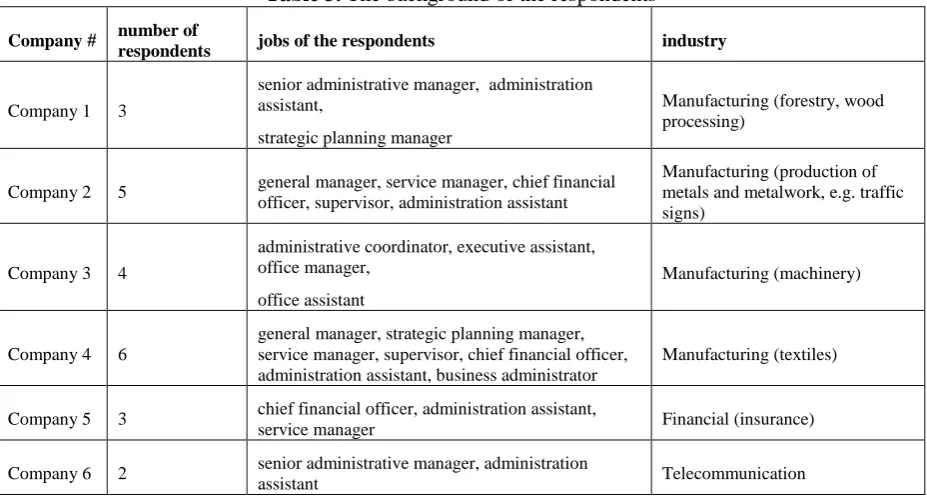
The respondents were 17 male and 6 female business administrators ranging in age from 25 to 57(M = 41). They had worked in their companies for an average of 3 years. In order to ensure that the study results were not biased to certain types of companies six different Latvian companies were selected for the study. Taking into account the fact that the English language use is limited in certain Latvian companies, only the business administrators who are required to use English at work on a daily basis were included. Thus, from each company, two to six employees participated in the questionnaire. Considering company types, there were four manufacturing companies (specializing in various areas), one financial company and one telecommunication company. The background of the respondents is presented in table 3 below.
Table 3. The background of the respondents Company # number of
respondents jobs of the respondents industry
Company 1 3
senior administrative manager, administration assistant,
strategic planning manager
Manufacturing (forestry, wood processing)
Company 2 5 general manager, service manager, chief financial officer, supervisor, administration assistant
Manufacturing (production of metals and metalwork, e.g. traffic signs)
Company 3 4
administrative coordinator, executive assistant, office manager,
office assistant
Manufacturing (machinery)
Company 4 6
general manager, strategic planning manager, service manager, supervisor, chief financial officer, administration assistant, business administrator
Manufacturing (textiles)
Company 5 3 chief financial officer, administration assistant,
service manager Financial (insurance)
Company 6 2 senior administrative manager, administration
assistant Telecommunication
Page 110
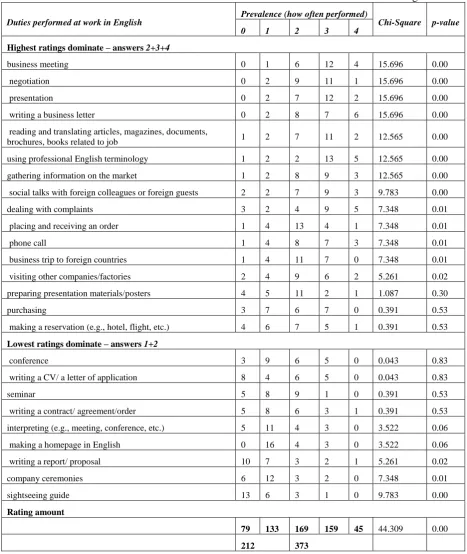
Table 4. The Prevalence of Business Administrators’ Duties Performed at Work in English
Duties performed at work in English Prevalence (how often performed) Chi-Square p-value
0 1 2 3 4
Highest ratings dominate – answers 2+3+4
business meeting 0 1 6 12 4 15.696 0.00
negotiation 0 2 9 11 1 15.696 0.00
presentation 0 2 7 12 2 15.696 0.00
writing a business letter 0 2 8 7 6 15.696 0.00
reading and translating articles, magazines, documents,
brochures, books related to job 1 2 7 11 2 12.565 0.00 using professional English terminology 1 2 2 13 5 12.565 0.00 gathering information on the market 1 2 8 9 3 12.565 0.00 social talks with foreign colleagues or foreign guests 2 2 7 9 3 9.783 0.00
dealing with complaints 3 2 4 9 5 7.348 0.01
placing and receiving an order 1 4 13 4 1 7.348 0.01
phone call 1 4 8 7 3 7.348 0.01
business trip to foreign countries 1 4 11 7 0 7.348 0.01 visiting other companies/factories 2 4 9 6 2 5.261 0.02 preparing presentation materials/posters 4 5 11 2 1 1.087 0.30
purchasing 3 7 6 7 0 0.391 0.53
making a reservation (e.g., hotel, flight, etc.) 4 6 7 5 1 0.391 0.53 Lowest ratings dominate – answers 1+2
conference 3 9 6 5 0 0.043 0.83
writing a CV/ a letter of application 8 4 6 5 0 0.043 0.83
seminar 5 8 9 1 0 0.391 0.53
writing a contract/ agreement/order 5 8 6 3 1 0.391 0.53 interpreting (e.g., meeting, conference, etc.) 5 11 4 3 0 3.522 0.06
making a homepage in English 0 16 4 3 0 3.522 0.06
writing a report/ proposal 10 7 3 2 1 5.261 0.02
company ceremonies 6 12 3 2 0 7.348 0.01
sightseeing guide 13 6 3 1 0 9.783 0.00
Rating amount
79 133 169 159 45 44.309 0.00
212 373
According to the results of the questionnaire the respondents most often are involved in such professional English communicative situations as business meetings and networking with industry peers, negotiating contracts and deals, giving presentations about goods and services and various business letter writing.
Page 111
with foreign colleagues or foreign guests; dealing with complaints; placing and receiving an order; phone calls, business trip to foreign countries.
3.3. The third stage of the needs assessment
During the 3rd stage of the research the author investigates the opinion of Latvian business administrators (the background of the respondents is presented in table 4 in the previous section of the research) on what should be the main focus of professional English course: what are the most important language areas and which of the skills should be given priorities in the professional English course in Business Administration Studies in high school in order to perform duties in the foreign language at work after graduating. The author administers a questionnaire with 23 business administrators. The results of the interview are summarized in the table 5 below.
Table 5. Language areas/skills which should be given priority in professional English course
language areas/skills number of responses (%)
Speaking skills 20 (86%)
Actual experience/situations to practice performing everyday working duties in English 18 (78%) Business correspondence/writing skills 8 (34%) Learning professional vocabulary/terminology/business expressions 13 (56%)
Studying cultural aspects 11 (47%)
Listening skills 6 (26%)
Reading skills 7(30%)
Presentation skills 15 (65%)
Negotiation skills 19(82%)
Skills needed for meetings 16 (69% )
Ability to express ideas clearly 7 (30%)
Improving pronunciation 5 (21%)
Improving grammar accuracy 6 (26%)
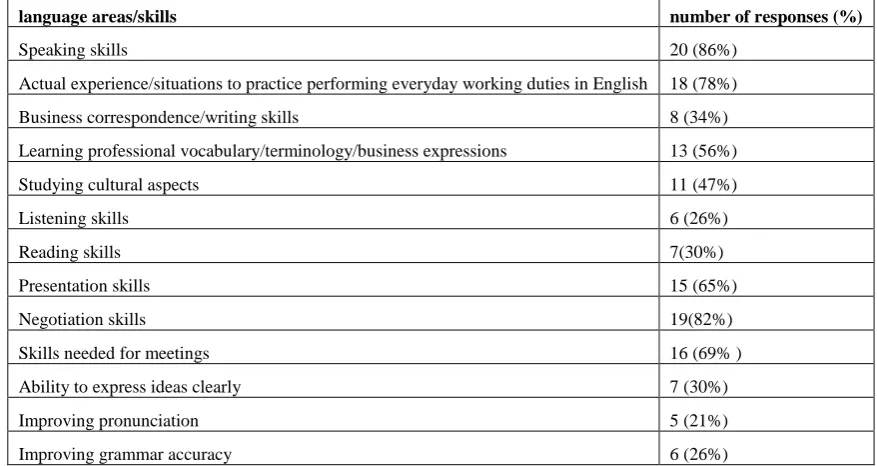
The majority of the respondents stressed the importance of speaking skills development (86%) as well as the improvement of skills needed to communicate in such professional situations as negotiations (82% of respondents), meetings (69 % of respondents) and presentations (65% of respondents). Most respondents (78%) also highlighted the need for actual experience and practicing situations related to everyday working duties performance in English. 56% of respondents mentioned Learning professional vocabulary/terminology/business expressions, 47% of respondents stressed that studying cultural aspects of the foreign language is beneficial for their work. 34% of respondents regarded learning business correspondence and developing writing skills as the most important for a job.
30% of respondents, however, emphasized the importance of reading skills focus. Ability to express ideas clearly in English was mentioned by 30% of respondents as well, 26% of respondents mentioned listening skills and grammar accuracy importance. 21% of respondents emphasized improvement of pronunciation as the most necessary area in professional English course.
3.4. The fourth stage of the needs assessment
Page 112
entrepreneurship, ranging in age from 18 to 27, 48 female, 27 male. The demography of the respondents is described in the table 6 below.
Table 6. The Demography of Respondents
study programme institution name number of respondents Business Studies Latvia University of Agriculture 8
Entrepreneurship and Business Management Latvia University of Agriculture 8 Business Management Latvia University of Agriculture 12 European Economy and Business The Baltic International Academy 15 Entrepreneurship (Business Administration) The Baltic International Academy 32
Questionnaire Future Entrepreneurs Opinions is presented in Appendix 3. The analysis of the results is depicted in the table 7 below.
Table 7. The Analysis of Results
Questions
Rating:4- the highest; 1- lowest
p Chi-square Mo Me
4 3 2 1
Number of answers
Learning how to deal with customers 67 6 1 1 0.00 67.213 4 4 Learning how to give presentations in English 66 7 1 1 0.00 67.213 4 4 Learning skills needed for business meetings 56 13 5 1 0.00 52.920 4 4 Talking about your job, professional duties 45 21 7 2 0.00 43.320 4 4 Describing your company 36 28 9 2 0.00 37.453 4 3 Reading business letters, correspondence 38 23 7 7 0.00 29.453 4 4 Learning how to negotiate in English 45 14 11 5 0.00 24.653 4 4
Listening to the news 14 33 15 13 0.03 4.813 3 3
Visiting foreign companies 31 15 17 12 0.05 3.853 4 3 Advertising your company 18 27 18 12 0.08 3.000 3 3
Describing products 34 11 27 3 0.08 3.000 4 3
Learning how to communicate with official visitors 18 24 30 3 0.30 1.080 2 3 Writing business letters 26 15 19 15 0.42 0.653 4 3
English for agreements 10 31 25 9 0.42 0.653 3 3
Talking about product improvement 16 24 29 6 0.56 0.333 2 3
Telephoning 9 31 34 1 0.62 0.242 2 3
Practice explaining business terms in English 2 6 34 33 0.00 46.413 2 2
Talking about taxes 3 6 27 39 0.00 43.320 1 1
Page 113
Discussing contemporary theories in management 14 10 42 9 0.00 9.720 2 2 Learning how to make appointments 10 15 27 23 0.00 8.333 2 2 Talking about money matters 4 23 28 20 0.02 5.880 2 2 Discussing corporate policy 15 13 28 19 0.03 4.813 2 2 Learning how to interview in English 3 26 33 13 0.05 3.853 2 2 Talking about product development 8 25 28 14 0.30 1.08 2 2 Talking to clients/ dealing with foreign visitors to the Office 16 18 39 2 0.42 0.653 2 2 Discussing company benefits 23 12 36 4 0.56 0.333 2 2
The results of the questionnaire show that most students in their professional English course would like to learn how to deal with customers, give presentations in English, learning English skills needed to participate in business meetings, talking about job and professional duties, learning to describe their company, reading business letters, and learning how to negotiate in English.
3.5. The fifth stage of the needs assessment
During the 5th stage of the research the author focuses on determining student English language level at the beginning of the studies.
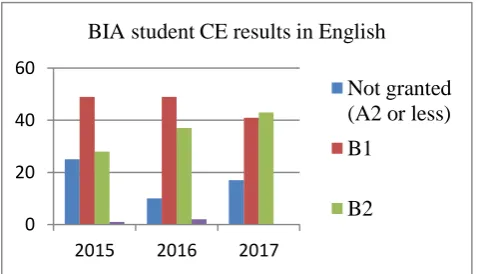
In order to determine student common English language level at the beginning of the studies in LUA (Latvian University of Agriculture) and BIA (Baltic International Academy), the Enrollment Commission available information in these two high schools was summarized about matriculated students’ secondary school centralized examination results from year 2015 to year 2017. See figures 1 and 2 below.
Figure 1. Latvian Agriculture University student centralized examination results on the period from 2015 to 2017 (according to LUA enrollment commission protocols).
Figure 2. Baltic International Academy student centralized examination results on the period from 2015 to 2017 (according to BIA enrollment commission protocols).
0 50 100 150
2015 2016 2017
LUA student CE results in English
Not granted (A2 and less)
B1
B2
0 20 40 60
2015 2016 2017
BIA student CE results in English
Not granted (A2 or less)
B1
Page 114
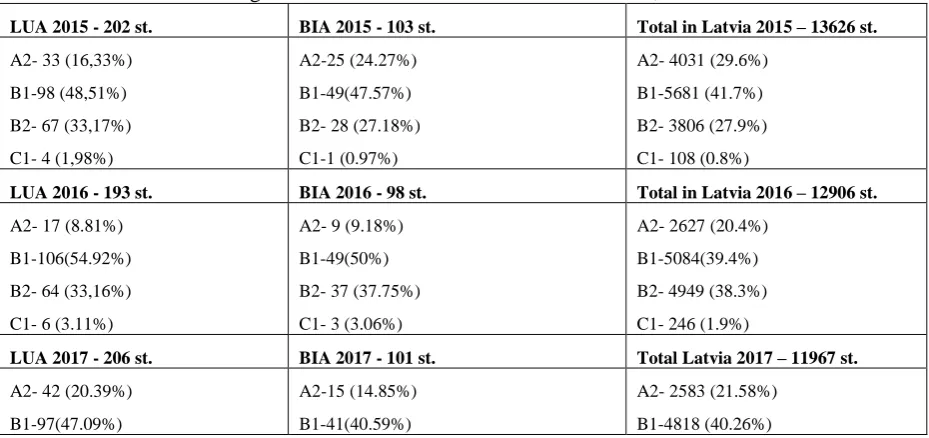
According to the summarized information, centralized examination results remain very similar within the period of three consecutive years. The majority of the 1st year students who enrolled LUA (average 50.17% and 32.46%) and BIA (average 46.05% and 35.83%) had B1 and B2 level correspondingly. The minority of the 1st year students who enrolled LUA (average 2.18%) and BIA (average 2%) had C1 level.
Comparing two high schools matriculated students centralized examination results with the results of centralized examination in whole Latvia on the period from year 2015 to year 2017 (see figure 3 and table 1 below) it can be observed that the major difference is between the proportion of level ‘A2 or less’. Common English centralized examination average results on the period of three years in Latvia show that 25.2% of Latvian secondary school graduates had Level ‘A2 or less’, while the proportion of LUA matriculated students who had Level A2 was 15.17%, and the proportion of the students who enrolled BIA with level A2 was 16.1% of the total number of matriculated students.
Figure 3. English Centralized Examination results in Latvia according to State Education Content Center (VISC) on the period from 2015 to 2017.
The information about English CE results in LUA, BIA and the whole country on the period from 2015 to 2017 is summarized in table 8 below:
Table 8. Common English Centralized Examination results in LUA, BIA and total in Latvia LUA 2015 - 202 st. BIA 2015 - 103 st. Total in Latvia 2015 – 13626 st. A2- 33 (16,33%)
B1-98 (48,51%) B2- 67 (33,17%) C1- 4 (1,98%)
A2-25 (24.27%) B1-49(47.57%) B2- 28 (27.18%) C1-1 (0.97%)
A2- 4031 (29.6%) B1-5681 (41.7%) B2- 3806 (27.9%) C1- 108 (0.8%)
LUA 2016 - 193 st. BIA 2016 - 98 st. Total in Latvia 2016 – 12906 st. A2- 17 (8.81%)
B1-106(54.92%) B2- 64 (33,16%) C1- 6 (3.11%)
A2- 9 (9.18%) B1-49(50%) B2- 37 (37.75%) C1- 3 (3.06%)
A2- 2627 (20.4%) B1-5084(39.4%) B2- 4949 (38.3%) C1- 246 (1.9%)
LUA 2017 - 206 st. BIA 2017 - 101 st. Total Latvia 2017 – 11967 st. A2- 42 (20.39%)
B1-97(47.09%)
A2-15 (14.85%) B1-41(40.59%)
A2- 2583 (21.58%) B1-4818 (40.26%) 0
1000 2000 3000 4000 5000 6000
2015 2016 2017
Common English CE results in Latvia
Not granted (A2 and less)
B1
B2
Page 115 B2- 64 (31,07%)
C1- 3 (1.46%)
B2- 43 (42.57%) C1- 2 (1.98%)
B2-4391(36.69%) C1- 175 (1.46%) LUA: Average for the period of 3
years
BIA: Average for the period of 3 years Latvia: Average for the period of 3 years
A2- 92 (15,17%) B1-301(50.17%) B2- 195 (32.46%) C1- 13 (2.18%)
A2- 49 (16.1%) B1-139(46.05%) B2- 108 (35.83%) C1- 6 (2.0 %)
A2- 9241 (24.3%) B1-15583(40.4%) B2-13146 (34.2%) C1- 529 (1.1%)
Thus, average results for the period of three study years from 2015-2017 in LUA, BIA and in the whole country indicate that the majority of students after they pass the national school leaving examination and enter the first year of high school equivalent to the B1 and B2 level in the Common European Framework of Reference for Languages. Thus, the author has come to the conclusion that the professional English course target population mostly has B1-B2levels.
4. CONCLUSIONS
Having assessed the specific needs of business administration students in professional English course, on the basis of interviews and questionnaires results about business experts and business administration specialists’ opinions, as well as students’ needs analysis results, in accordance with the level of the English language and taking into account own pedagogical experience, the researcher has come to the conclusion - a professional English course for the students of business administration should include:
1) general English knowledge and skills;
2) the academic / scientific English basic knowledge;
3) business English skills acquisition and development;
4) business terminology and profession-related English language skills and knowledge.
The need to include general English language knowledge and skills in Business/professional English course content arises from the students' general English proficiency level starting their studies in LUA/BIA. Students’ general English knowledge can be concluded from the English centralized exam results.
In order to improve student general English language knowledge and skills, a professional English course content should include: reading, listening, writing and conversational skills development so that the students could understand the basic assumption, find information necessary to understand the opinions, facts, arguments, etc., as well as to be able to express their opinion and take part in business meetings, negotiations and discussions; grammar revision; everyday life situations related to hobbies, traveling; daily life and social topics discussion, etc.
Introduction of Academic English into the Professional English course content derives from the academic environment, and the necessity of academic English competence acquisition and development in the study process. These include: public speaking; making and giving presentations; expressing opinion; giving definition, classification, argumentation, evaluation skills’ development and improvement; writing a scientific article, writing and presentation of a report; writing summary and annotation; scientific content article reading, etc.
Page 116
Professional English communication skills is an important requirement for business administration specialists, which mainly means the ability to participate in in such every day work situations as business meetings and networking with international partners with the aim of reaching a mutually beneficial agreement for a company, negotiating contracts and deals, giving presentations and sharing information to promote product or services to potential consumers about goods and services, various business letter writing, participating in business meetings, etc.
Business interests are maintained during communication, though it should not create an impression that the objections and concerns of a partner are ignored. Misunderstandings or communication gaps should be avoided and immediate feedback should be obtained between the entrepreneurs with the knowledge of cultural differences, degrees of formality and appropriateness in various situations since it is essential for their business success.
Another significant part of a professional English course is terminology. In order to acquire and improve it the course content should include: vocabulary building, learning the terminology; reading and translation of business-related articles and publications, finding the necessary information; report and research paper writing on professional topics, etc. Depending on the program, specific student group foreign language knowledge, interests and needs these aspects of professional English course should be varied by extending or narrowing the amount of learning.
In order to reach the aims of the Professional English language course, which is common for all bachelor study programs and faculties where students are supposed to study English, it is very important to continue developing foreign language knowledge, skills and competence description, which conforms a study program curriculum and intended volume of professional English competence development.
REFERENCES
1. Dudley-Evans, T, St John M 1998, Developments in English for Specific Purposes. Amulti-disciplinary approach. Cambridge University Press, p.5.
2. Basturkmen, H 2013, Needs Analysis and Syllabus Design for Language for Specific Purposes. In C. A. Chapelle (Ed.) The Encyclopedia of Applied Linguistics. Blackwell, unpaginated.
3. Edwards, N 2000, Language for business: effective needs assessment, syllabus design and materials preparation in a practical ESP case study. English for Specific Purposes, 19, 291–296.
Page 117 Appendix A
Questions for the face-to-face interview with business experts Section 1: Personal Data
Tell about yourself, your education, courses.
What is your working experience?
Section 2: Company
How long have you been running your firm/company?
Tell about your company: its type, business activity?
Section 3: English use at work
What are the reasons to study the English language for the entrepreneur?
Is English important in regular work situations?
What aspects of English are required for the entrepreneur?
When do you need to speak English at work?
Who do you speak English with?
What duties do you and your employers perform in the English language?
Appendix B
Questionnaire for specialists in business administration The Prevalence of Business Administrators’ Duties Performed at Work in English
How often do you perform the following duties in English at work?
(Please circle the number on the right column)
0- Never
1- Rarely
2- Sometimes
3- Often
4- Every day
Business English duties performed at work prevalence
0 1 2 3 4 A. Job application
a. writing a CV/ a letter of application b. job interview
B. Reading and translation (articles, magazines, documents, brochures, books related to job) C. Written business communication
a. e-mail
b. writing a business letter, proposal, report, contract, agreement D. Customer service
Page 118 b. placing and receiving an order
c. purchasing
d. dealing with complaints E. Business meeting a. conference, b. presentation c. negotiations d. seminar
F. Business trip to foreign countries
a. making a reservation (hotel, flight, a table in a restaurant, etc.) b. visiting other companies or factories
G. Attending foreign guests/ social talks with foreign colleagues or foreign guests H. Market research/ gathering information on the market
I. Using technology (making a homepage in English, preparing presentation materials, posters, web conferencing, social networking)
Appendix C
Questionnaire for the 1st year students of Business Administration
What would you like to learn? Indicate your attitude toward the following topic areas by circling the appropriate numbers.
1 – I don’t need this at all.
2 – This is OK.
3 – I think I need it
4 – I need this very much.
1. Talking to clients/ dealing with foreign visitors to the office. 1 2 3 4
2. Telephoning. 1 2 3 4
3. Writing business letters. 1 2 3 4
4. Describing your company. 1 2 3 4
5. Advertising your company. 1 2 3 4
6. Talking about innovations in entrepreneurship 1 2 3 4
7. Talking about taxes. . 1 2 3 4
8. Listening to the news. 1 2 3 4
9. Reading business letters, correspondence. 1 2 3 4
10. Talking about currency transactions. 1 2 3 4
11. Talking about your job, professional duties. 1 2 3 4
12. Learning how to deal with customers. 1 2 3 4
13. Learning how to communicate with official visitors. 1 2 3 4
Page 119
15. Practise explaining business terms in English. 1 2 3 4
16. Learning how to make appointments. 1 2 3 4
17. Learning how to give presentations in English. 1 2 3 4
18. Discussing a business plan. 1 2 3 4
20. Talking about money matters 1 2 3 4
21. Participating in business meetings 1 2 3 4
22. Talking about product improvement 1 2 3 4
23. English for agreements 1 2 3 4
24. Learning how to interview in English 1 2 3 4
25. Discussing corporate policy 1 2 3 4
26. Discussing company benefits 1 2 3 4
27. Talking about product development 1 2 3 4
28. Describing products 1 2 3 4
29. Discussing contemporary theories in management 1 2 3 4