e-ISSN: 2278-7461, p-ISSN: 2319-6491
Volume 6, Issue 4 [April 2017] PP: 53-63
Performance Characteristics of Solar Chimney integrated with
Evaporative Cooling Technique for Building Natural Ventilation
Abdalla Gomaa, Wael I.A. Aly, Mahmoud Abdelmagied
Department Of Refrigeration and Air-Conditioning Technology, Faculty Of Industrial Education, Helwan University, 11282 Cairo, Egypt.
ABSTRACT:-In the present study,the integration betweena solar chimney and evaporative cooling as a type of passive cooling technique for building coolingwereinvestigated experimentally.Thetechniques were usedas an alternativetodecrease the energy consumption ina buildingby using hybrid system of the solar chimney and evaporative cooling. The experimentswere conducted to a tested room of 8m x 5m x 3m and the solar chimney of 3m x 1m x0.3m air gab.Six spray nozzlesusing aquifer pumped water were located at the inlet tower.The performance of the solar chimney at different summer times with aquifer spray water as an evaporative cooling was the main point of interest. The effect of the solar chimneyinclination angle,day and year months on the room temperature and ventilatedair change per hourduring solar radiation hours was studied.The experimental runs were carried out at inclination angles ranged from 15o to 45o during solar radiation hoursranged from 9AM to 5PMaccording to Atlas Egypt. The results indicated that the using of solar chimney and evaporative cooling is very effective way in natural ventilation method of technique. An accepted room temperatureof 25.5oCand 4 times per hour air change were obtained in September withinclination angle of 45owithoutinternal equipment load.
Key words:Solar chimney; Evaporating cooling;Aquiferwater.
NOMENCLATURE
Aarea, m2
ACH air changes per hour Cpspecific heat, kJ/kg.oC Cd discharge coefficient
Dchimney gap, m
Dhhydraulic diameter (4A
w p
), m
ggravity acceleration (9.81), m/s2 I solar radiation intensity, W/m2 i specific enthalpy, kJ/kg
ifgvaporization latent heat, kJ/kg
k thermal conductivity,W/m.oC L length of the chimney, m
m mass flow rate, kg/s .
V ventilation rate, m3/s
R.H relative humidity, % ttemperature,oC
T temperature,K
Tmmean temperature (
2
s f
T T ),K
vvelocity, m/s V volume, m3
wwide of the chimney, m wpwetted perimeter, m
Greek symbols
αabsorptivity ∆ difference εemissivity efficiency, %
θchimney inclination angle, Radians µ dynamic viscosity, kg/m.s ρ density of air, kg/m3
τtransmissivity of glass
ω humidity ratio, (kg/kg. dry air)
Subscripts
a air
chim.chimney f film i inlet/inside ooutlet/outside r ratio s surface v vapor
I.INTRODUCTION
byitsdrybulb temperature andrelativehumidity.Numerical simulation of cooling performance of wind tower (Baud-Geer) in hot and arid region was studied by Kalantar [2] the results indicate that the evaporative cooling is very effective in a hot and dry region. The temperature decreases considerably, if the wind towers are equipped with the water vaporization system. This causes the air becomes heavier and a natural motion of air through downside of wind tower to be produced. Chunglooetal.[3] investigated experimentally the performance of a solar chimney and water spraying system placed on the roof. They reported that the system performed well in high ambient temperature. The performance of integrated evaporative cooling system driven by solar energy was studied by Miyazakia et al. [4] The results showed that the system was capable of coping with the radiative cooling load as much as 40–50 W/m2 without a severe increase of the ceiling temperature.Chen [5] investigated the thermal analysis of a wet porous evaporative plate for building cooling. A mathematical model was developed to analyze the influences of ambient conditions and the porous plate thickness on the cooling performance of the porous evaporative plate. the results presented that with decreasing in ambient relative humidity and an increasing in ambient temperature, more cooling of the porous evaporative plate can be supplied for the inside of room. Abdallah et al. [6]developed an integration of direct evaporative cooling tower with a solar chimney in multi-zone thermal ventilation model. The simulation was done using commercial couple multi-zone airflow under COMIS-TRNSYS software to assess natural ventilation and indoor thermal comfort. The results show that the system generates 130.5m3/h under the effect of solar radiation only and minimum 2 ACH without pressure coefficient which is considered the minimum requirement of ACH.
A parametric investigation of using the solar chimney with new cooling tower in a single room for new Assiut city, Egypt climate was studied by Abdallah et al. [7] the parametric study of the integrated system in phase two were studied to achieve high performance with new compact small design especially for the hottest days in the summer season. The result showed that the system achieved nearly 80 % acceptable comfort range with optimum ventilation rate 414m3/h for the hottest day.A study of vaulted roof assisted evaporative cooling channel for natural cooling of one floor buildings was studied by Haghighi et al. [8] The results indicated that the air inside the building will be ventilated efficiently at wind velocity is higher than 0.4m/s, As the wind velocity or the ambient air temperature increases, thermal comfort was achieved at lower values of relative humidity. The maximum allowable values for relative humidity of the ambient air to meet thermal comfort conditions are calculated based on the adaptive thermal comfort standards.
Benhammouet al. [9] analyzed the performance of an earth to air heat exchanger assisted by a wind tower for passive cooling of buildings in arid and hot climate. The results showed that the wind tower dimensions (height, cross section) have not an important impact compared to the pipe dimensions (length, diameter). The results also found that a tower with a total height of 5.1m and a cross section area of 0.57m2 can generate an air flow rate of 592.61m3/h. Furthermore, it has been also observed that the daily cooling potential reached a maximum of 30.7kW/h corresponding to a pipe length of 70m. Alemu et al. [10] developed an integrated model incorporating passive airflowcomponents into coupled multizone ventilation and building thermal model. This model allows an assessment of a combination of passive features such as solar chimney and windinduced earthair tunnel for bothnatural and hybrid ventilation systems at the design stage.As the author knowledge, a few of papers had been shown the cooling potential ofhybrid the solar chimney and aquifer water in passive cooling and natural ventilating. So the present study aims to investigate experimentally the integration between solarchimney and evaporative cooling using aquifer water for building natural ventilation.Theeffected parameters were chimney inclination angles, solar radiation intensity during daylight hours and at different year times. The study carried out in hot arid climate condition of Cairo–Egyptas a case study.
II.EXPERIMENTAL APPARATUS
12- Drain
10- Chimney air leaving 6-Aquifer water line 2-Nozzles 1- Outside air inlet
2
4
7 5 3-Inlet tower
4-Rotameter
7-Pump 5- Valve
8
9
8-Chimney air inlet 9- Solar chimney
11 11- Room
3 m
3 m
θ
0.3 m
1 3 9
10
0.5 m
6
12
8 m 0.75 m 0.75 m
1.8 m
1.8 m 0.75 m
Solar radiation mesurement
Velocity mesurment Thermocouples
Relative humidity mesurement
22 m down
Fig. (1) Schematic diagram for the experimental set up.
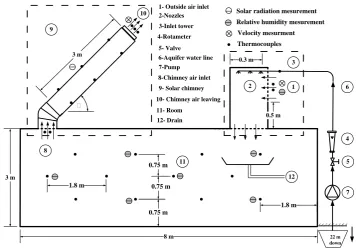
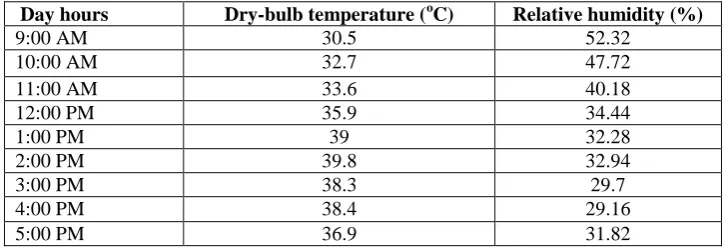
A roof solar chimney of3m long, 1m width and 0.3m air gab was connect to the room through a roof opening by stainless steel duct with dimensions of 0.3m x 0.8m. The chimney was positioned to geographic south direction at inclination angle of θ. The purpose of the chimney is to pull air from the room depending on buoyancy effect. The solar chimney upper face is a clear glass (0.004m thickness) of transmissivity (τ=0.78) and absorptivity (α=0.15) at zero incident radiation angle. The bottom face of the solar chimney is a mild steel of (0.0012m thickness) as absorber wall;the absorber wall bottom was thermally insulated by a glass wool thermal insulation of 0.025m thick. Details of the physical parameters and the range of experimental conditionswere given in table (1) and table (2) respectively. A sample of the average outside air conditions ofdry-bulb temperature and relative humidity for experiments run from 5 to 25 of July was given inTable (3).The temperatures of the inlet air tower, aquifer water, solar chimney air inlet and outlet openings, glass surface and absorber surface were measured by pre-calibrated K-type thermocouples. Also, twelve thermocouples were fixed at different positions to measure the average room air temperatures as shown in figure (1). All thermocouples that used in this study were 0.8mm diameter. The thermocouple wires were connected to the digital device with accuracy of ±0.1%. An anemometer was installed at the exit of the solar chimney with an accuracy of ±0.25% and 0.1m/s minimum reading to measure the air velocity. The solar radiation intensity was measured by a solar power meter device installed on the solar chimney to measure the global solar radiation in W/m2 with accuracy of ±0.1% and 1W/m2 minimum reading. Digital hygrometer with accuracy of ±0.1% was used to measure the relative humidity at the following positions;
1.At inlet air to the tower
2.At six positions inside the tested room as shown in the figure (1) and hence the average was taken. The measuring parameters were air temperature, air velocity, solar radiation, and relative humidity.
The experiment location is presented in Cairo, Egypt with latitude of (30.13o), longitude (31.4o), and time zone GMT+2. Also the solar radiation intensity and air temperatures are measured according to ASHRAE recommendation.
Table (1) Experimental setup physical dimensions
Parameter Dimension Unit
Room air inlet openingArea 0.18 m2
Room air outlet openingArea 0.24 m2
Length of chimney 3 m
Width of chimney 1 m
Air gab of chimney 0.3 m
Glass coverL x W x H 3 x 1 x 0.004 m3
Absorber plate (Mild steel) L x W x H 3 x 1 x 0.0012 m3
Chimney air inlet 0.8 x 0.3 m2
Chimney air outlet opening 1 x 0.3 m2
Inlet tower dimension L x W x H 0.6 x 0.3 x 1 m3
Spry nozzle outlet diameter 0.001 m
Table (2) Experimental conditions for the present work.
Table (3) Average inlet air conditions from5 to 25 of July.
Day hours Dry-bulb temperature (oC) Relative humidity (%)
9:00 AM 30.5 52.32
10:00 AM 32.7 47.72
11:00 AM 33.6 40.18
12:00 PM 35.9 34.44
1:00 PM 39 32.28
2:00 PM 39.8 32.94
3:00 PM 38.3 29.7
4:00 PM 38.4 29.16
5:00 PM 36.9 31.82
III.UNCERTAINTY ANALYSIS
The experimental error analysis indicates the implication of error of the measured parameters on the uncertainty of the results. The uncertainty analysis of the various calculated parameters are estimated according to Holman
[12], Given W1, W2, W3,…, Wn uncertainties in the independent variables (X1, X2, X3,…Xn) and WR is the
uncertainty in the result at the same odds, then the uncertainty in the result can be given as; The uncertainties of the experimental parameters are given in Table (4).
1
2 2
2 2 2
1 2 3
1 2 3
...
R n
n
R R R R
W W W W W
X X X X
(1)
Table (4) Accuracy and Uncertainty of measuring devices.
Instruments Unit Accuracy (%) Uncertainty (%)
Rotameter kg/s ±0.5 ±0.5
Thermocouple K-type oC ±0.1 ±0.11
Anemometer m/s ±0.25 ±6.28
Variables Range Number of
runs
Chimney inclination angles 15o- 22.5o- 30o- 37.5o- 45o 5
water mass flow rate, Kg/s 0.017 1
Day hours 9 Am-5 Pm 9
Solar power meter W/m2 ±1 ±0.11
Digital Hygrometer % ±0.1 ±0.12
ACH - - ±6.29
Chimney efficiency % - ±6.7
Heat dissipationrate W - ±6.68
IV.DATA REDUCTION
The solar chimney efficiency can be determinedas [13]:
. , . ,
. f p C h i m o C h i m i /
C h i m m C t t I A
g
(2)
Air mass flow rate in chimney due to stack height can be as[14]:
.,
., 2
.,
2 s in ( )
(1 )
f C h im i d C h im o o
r C h im i
g L T T
m C A
A T
(3)
Where Ar is the ratio between the chimney air outlet cross section areaAo and its inlet cross section area Ai.
In natural ventilation the mean air temperatures in solar chimney can be calculated as[13]:
., .,
0 .7 5 0 .2 5
f C h i m o C h i m i
T T T (4)
The coefficient of discharge Cd was taken as 0.57 as suggested byAnderson[15].The velocity of air in the
chimney can be calculated as:
.,
o
C h i m o o
m v
A
(5)
The room air change per hour can be calculated as:
3 6 0 0
r o o m
x V A C H
V
(6)
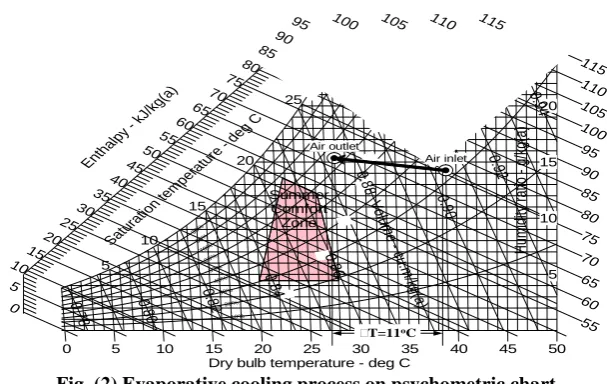
The energy balance equation for the heat dissipation from the air to evaporated water in the inlet tower is expressed as[1]:
, , , ,
a o a o a i a i v f g
m
i
m
i
m
i
(7)Where iis the specific enthalpy which can be calculated as [1]:
1 . 0 0 5 2 5 0 1 . 1 1 . 8 6
Fig. (2) Evaporative cooling process on psychometric chart.
V.RESULTS AND DISCUSSION
The performance characteristics of the solar chimney with evaporative cooling were investigated as the effect of chimney inclination angleand the effect of year times on the system performance;
5.1. Effect of Chimney Inclination Angle
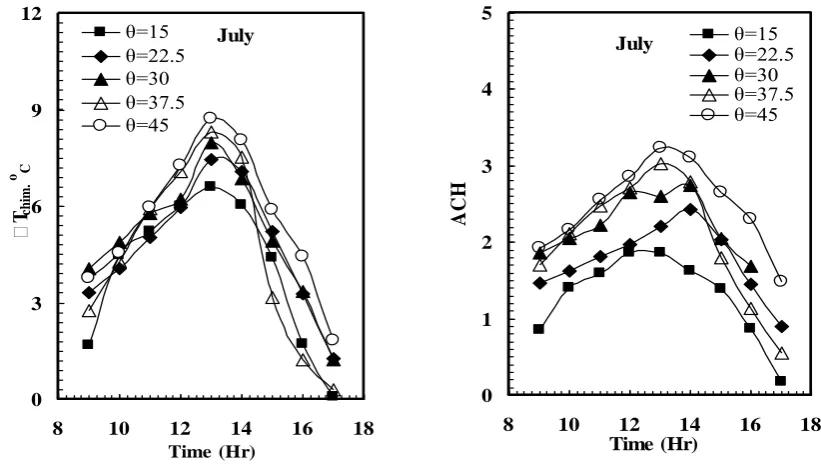
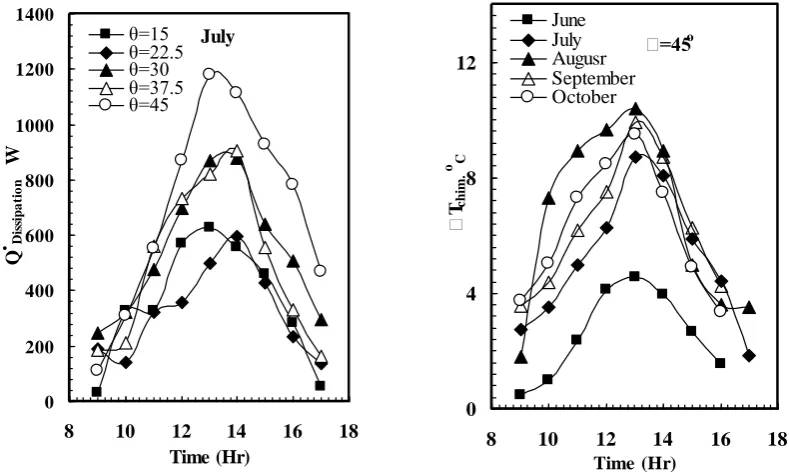
Figure (3) illustrates the effect of the chimney inclination angle on the chimney air temperature difference. It shows the relation between the chimney air temperature differences versus day time at different solar chimney inclination angles ranged from 15o to 45o at July. It can be seen that there are significant effects of the solar chimney inclination angle on the air temperature difference during day time. Also the chimney air temperature difference increases with increasing in chimney inclination angle from 15o to 45o by approximately (32%) at 1PM. The temperature difference increases according to the buoyancy-driven flow effect which induced due to the incident solar radiation upon the cavity of solar chimney.The relation between the room air changes per hour and day time at different chimney inclination angles ranged from 15o to 45o at July were presented in Fig. (4). It is noted that the room air changes per hour increases with the increase in day time hours and reached a maximum value of 3.23 at 1PM. Due to change the inclination angle from 15o to 45o the room air changes per hour increases by approximately (73.4%) at 1PM. According to equation (3) as the temperature difference increases, the buoyancy-driven flow effect increases which led to increase in the air velocity output from the solar chimney and consequently the ACH.As the solar chimney inclination angle increases, the stack height (L sin θ) increases and henceincreases the air mass flow rate, velocity and consequently the ACH.Figure (5) presented theeffect of chimney inclination angle (15oto 45o) on solar chimney efficiency at July. It can be shown that the chimney efficiency increases with increasing in day time hours till 1PM then reduced after noon time. At certain time of 1PM and chimney inclination angle of 45o the chimney efficiency reached to maximum value of approximately 52%. This can be attributed toincreasing in air temperature differences through the chimneythat resultsinincreasing in the heat transfer rate relatively to incident solar radiation upon the cavity of solar chimneytill middle day then decreases.
The effect of the evaporative cooling on the room air temperature during day time can be illustrated inFig. (6).It can be noticed the reduction in room air comparing to outside air temperature atdifferent chimney inclination angles(15o to 45o) during day time at July. At a certain time of 1PM the room temperature decreases than outside air temperature by approximately (49%) when chimney inclination angle was 45o. This can be attributedto decreasing the thermal content of outside air due to direct contact with Aquifer water through inlet tower which applying evaporative cooling and decreasing the air temperature.Figure (7) demonstrate the variation of air temperature differences through the inlet tower during day time hours at different chimney inclination angle (15o to 45o) at July. It can be noticed that the air temperature difference through the inlet air tower increases during day time hours and reach to maximum value of 9.7oC at 1PM at chimney inclination angles of 45oC then slightly deceases after noon time. This can be attributed to reduction in heat content of air due to occurring evaporative cooling through inlet air tower. Figure (8) describes the variation of air relative humidity at both outside and inside positions during day time hours due to using evaporating cooling at July. It can be noticed that there is a significant effect of using evaporative cooling on increasing room relativehumidity at all chimney inclination angles. When aquifer water evaporated due to evaporativecooling occurring, the partner air carried the water vapor to the tested room which results in increasing the vapor content in air
Enthalpy - kJ/kg(a)
Saturation temperature - deg C Hum
idi ty r at io - g/ kg( a)
Pressure: 101325 Pa
Dry bulb temperature - deg C
0 5 10 15 20 25 30 35 40 45 50
5 10 15 20 10% 20% 30% 40% 50% 60% 70% 80% 90%
0.78 0.80 0.82
0.84 0.86
0.88 Volume - cu.m/kg(a) 0.90 0.92 0.94 0 5 10 15 20 25 30 35 40 45 50 55 60 65 70 75 80 85 90
95 100 105 110 115
55 60 65 70 75 80 85 90 95 100 105 110 115 5 10 15 20 25 Summer Comfort Zone Air inlet Air outlet
0 10 20 30 40 50 60 70 80 90 100
8 10 12 14 16 18
Time (Hr)
θCh
im
.
%
θ=15 θ=22.5 θ=30 θ=37.5 θ=45
July
25 30 35 40 45
8 10 12 14 16 18 Time (Hr)
T
o C
θ=15 θ=22.5 θ=30 θ=37.5 θ=45 T outside
July 0
3 6 9 12
8 10 12 14 16 18
Time (Hr)
θT
ch
im
.
o C
θ=15 θ=22.5 θ=30 θ=37.5 θ=45
July
andhence increasing the relative humidity. At a certain time (1PM) the relative humidity of room at inclination angle of 45o is higher than the outside air relative humidity by approximately (98.8%).
Fig. (3) Chimney air temperature difference Fig. (4) Air change per hour versus day versus day time at different inclination angles. time at different inclination angles.
Fig. (5) Chimney efficiency versus day timeFig. (6)Air outside and inside temperature at different inclination angles.versus day time at different inclination angles.
Figure (9) shows the relation between the heat dissipation rates through inlet tower during day time hours at different solar chimney inclination angle (15o to 45o) at July. It can be shown that the heat dissipationrate of the entering air to inlet tower increases with increasing in day hours and reached to maximum value of 1180W at solar chimney inclination angle of 45o at 1PM in 25th of July then decrease after noon time. Due to
0 1 2 3 4 5
8 10 12 14 16 18 Time (Hr)
ACH
θ=15 θ=22.5 θ=30 θ=37.5 θ=45
0 2 4 6 8 10 12
8 10 12 14 16 18
Time (Hr)
θT
In
le
t
to
w
er
o C
θ=15 θ=22.5 θ=30 θ=37.5 θ=45
July
0 200 400 600 800 1000 1200 1400
8 10 12 14 16 18 Time (Hr)
Q
• D
is
si
p
a
ti
o
n
W
θ=15 θ=22.5 θ=30 θ=37.5 θ=45
July
0 4 8 12
8 10 12 14 16 18
Time (Hr)
θT
ch
im
.
o C
June July Augusr September October
θ=45o
Fig. (7) Inlet tower air temperature diff. Fig. (8) Average relative humidity versus versus day time at different angles.daytime at different inclination angles.
Fig. (9) Inlet tower heat dissipation rate versus Fig. (10) Chimney air temperaturedifference day time at different inclination angles.versusday time at different year times.
increasing in temperature differences between outside air temperature and aquifer water the evaporative coolingrate increases through inlet tower and hence increasing air temperature difference and consequently the heatdissipation rate.The effect of change the year times on chimney performance is point of interest in this work. Figure (10) shows the effect year months which reflect to sun angle with summer season on chimney air temperaturedifference at inclination angle of 45o. It can be noted that there are significant effects of the year times on chimney air temperature difference during day time in which the maximum values is observed at 1PM and then tended to reduce slightly. The maximum value of air temperature difference occurs at 1PM in August month. This value is approximately (152%) higher than the value at June month. this can be attributed to change in solar radiation intensity due to solar angle change from June to August months intensity and produce the increase in both ΔTchim.
0 10 20 30 40 50 60 70 80 90 100
8 10 12 14 16 18
Time (Hr)
R
H
%
θ=15 θ=22.5 θ=30 θ=37.5 θ=45 RH outside
0 1 2 3 4 5
8 10 12 14 16 18 Time (Hr)
ACH
June July August September October
θ=45o
0 10 20 30 40 50 60 70 80 90 100
8 10 12 14 16 18
Time (Hr)
θCh
im
n
.
%
June July August September October
θ=45o
5.2. Effect of Year Times on the system performance
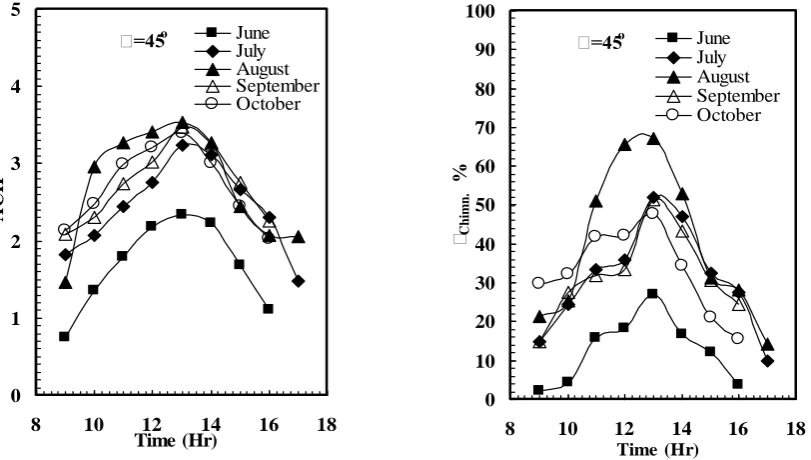
Figure (11) describe the variation of the room air changes per hour during day time at different year times and at chimney inclination angle of 45o. It is noticed that the room air changes per hour increases with the increasing in day time hours and reached to maximum value at 1PM at the maximum solar radiation intensity, also the air changes per hour increasesduring change in year times from June to October. At a certain time (1PM) the air changes per hour during August month is higher than that of June month by approximately (51.5%). This can be attributed to increasing in solar radiation intensity due to change in year times from June month to August month that results in increasing the air temperature difference and hence produce the increase the buoyancy driven force and consequently increase chimney air outlet velocity and ACH. A variation of chimney efficiency is presented in Fig. (12) during different year times andat chimney inclination angle of 45o, the figure exposed that the chimney efficiency increaseswith increase in solar radiation during day time hours; it means that chimney efficiency is afunction of solar radiation and highest chimney efficiency occurred at peak summermonths(August month) at 1PM of the day. At a certain time (1PM) the chimney efficiency atAugust month is higher than that of June month by approximately (153.1%).
Fig. (11)Air change per hour versus day Fig. (12)Chimney efficiency versus day time at differentyear times.time at different year times.
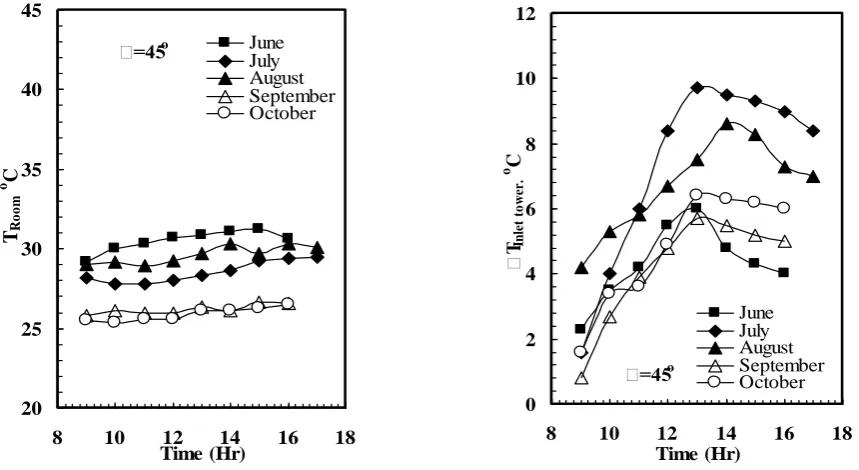
The effect of the evaporative cooling on the room air temperature during day time hours was illustrates in figure (13). It can notice that there is a significant effect of different year times from June to October and at chimney inclination angle of 45o on room air temperature. At a certain time (1PM) the room air temperature in October month decreases than that in June month by approximately (15.4%).Figure (14) shows the relation between air temperature differences through the inlet tower during day time hour at different year times and at solar chimney inclination angle of 45o. It can be clearly notice that the inlet tower temperature difference increase during day time hours and reach to maximum value of 9.4oC in 25th of July at 1PM then deceases slightly after noon time. Also it can be seen the increasing in inlet tower temperature differences during year months due to change in outside climate condition.
0 2 4 6 8 10 12
8 10 12 14 16 18 Time (Hr)
θT
In
le
t
to
w
er
.
o C
June July August September October
θ=45o
20 25 30 35 40 45
8 10 12 14 16 18 Time (Hr)
TR
o
o
m
o C
June July August September October
θ=45o
0 300 600 900 1200 1500
8 10 12 14 16 18
Time (Hr)
Q
• Dis
si
p
a
ti
o
n
W
June July August September October
θ=45o
0 10 20 30 40 50 60 70 80 90 100
8 10 12 14 16 18
Time (Hr)
R
H
R
o
o
m
%
June July August September October
θ=45o
shown that the heat dissipation rate increases during day time hours and reached to maximum value of 1180W at1PM in 25th of July then decrease after noon time, also there are significant effect of year months on
Fig. (13)RoomairtemperatureversusdayFig.(14)Inlettowerairtemperature difference timeatdifferentyear time. versus day time at different year time.
Fig. (15)Room relative humidity versusFig. (16)Inlet tower heat dissipation rate day time differentyear times.versus day time different year times.
VI.
CONCLUSION
A new passive cooling system of hybrid between solar chimney and evaporative coolingwith aquifer water was experimentally investigated. The system presented as one of apractical alternatives to the conventional air conditioning systems to decrease energy consumption in building. The study was carried out at chimney inclination angles varied from 15o to 45o during different year times of June to October. The room air change per hour and room temperature difference were examined during daylight hours; the main conclusions are summarized as follow:
The solar chimney inclination angles have a significant effect on the buoyancy-driven flow induced from inlet tower which achieved of air charge per hour = 3.5.
There is an acceptable room air temperature (in average T = 8oC) due to the use evaporative cooling with solar chimney hybrid system.
The maximum temperature difference through inlet air tower of 9.4 oC was obtained at 1PM at 25th of July which was due to the effect of evaporative cooling.
For all cases the best solar chimney efficiencywas achieved at inclination angle of 45o.
At a certain time of 1PM the air changes per hour at inclination angle of 45owas higher than that at 15o by approximately 73.4% in July month.
At a certain time of 1PMthe rate of heat dissipation due to evaporative cooling through inlet tower in July is higher than that June by approximately (198.2%).
The solar chimney and evaporative cooling system is more effective for reducing the room air temperature with less energy consumption in buildings however the increase in room relative humidity is expected.
REFERENCES
[1] ASHRAE, Handbook of Fundamentals, SI edition, ASHRAE Inc., Atlanta, GA, USA, 2005.
[2] V. Kalantar, Numerical simulation of cooling performance of wind tower (Baud-Geer) in hot and arid region, Renew. Energy. 34 (2009) 246–254.
[3] S. Chungloo, Limmeechokchai, Application of passive cooling system in the hot and humid climate: the case study of solar chimney and wetted roof in Thailand, Build. Environ. 42 (2007) 3341-3351.
[4] T. Miyazakia, A. Akisawa, I. Nikai, The cooling performance of a building integrated evaporative cooling system driven by solar energy, Energy and Build. 43 (2011) 2211–2218.
[5] W. Chen, Thermal analysis on the cooling performance of a wet porous evaporative plate for building, Energy Conversion and Management. 52 (2011) 2217–2226.
[6] A.S.H. Abdallah, H.Yoshino, T. Goto, N. Enteria, M.M. Radwan. M.A. Eid, Integration of evaporative cooling technique with solar chimney to improve indoor thermal environment in the New Assiut City, Egypt, Int. J. Energy and Environ.Engin. (2013) 4:45.
[7] A.S.H. Abdallah, H.Yoshino, T. Goto, N. Enteria, M.M. Radwan, M.A. Eid, Parametric investigation of solar chimney with new cooling tower integrated in a single room for New Assiut city, Egypt climate, Int. J. Energy Environ.Engin. (2014) 5:92.
[8] A.P. Haghighi, S.S. Golshaahi, M. Abdinejad,A study of vaulted roof assisted evaporative cooling channel for natural cooling of 1- floor buildings, Sustainable Cities and Society. 14 (2015) 89–98. [9] M. Benhammou, B. Draoui, M. Zerrouki, Y. Marif, Performance analysis of an earth-to-air heat
exchanger assisted by a wind tower for passive cooling of buildings in arid and hot climate, Energy Conversion and Management. 91 (2015) 1–11.
[10] T.A. Alemu, W. Saman, M. Belusko,A model for integrating passive and low energy airflow components into low rise buildings, Energy.Build. 49 (2012) 148–157.
[11] A. Gomaa, W.I.A.Aly, M. Abdelmagied, Experimental and Numerical Investigation Using Solar Chimney for Building Ventilation, J.Eng.Res. 153 (2017) 16 –32.
[12] J.P. HolmanExperimental Method for Engineers, Eighthedition, McGraw-Hill Book Company. New York, pp. 62–65, 2001.
[13] J. Hirunlabh, W. Kongduang, P. Namprakai, J. Khedari,Study of natural ventilation of houses by a metallic solar wall under tropical climate, Renew. Energy. 18(1999) 109–119.
[14] N.K. Bansal, R. Mathur, M.S. Bhandari, Solar chimney for enhanced stack ventilation,Build. Environ. 28 (1993) 373–377.