e-ISSN: 2278-7461, p-ISSN: 2319-6491
Volume 5, Issue 07 [Aug. 2016] PP: 15-20
A Study on the Temporal Pattern of Segments in Sundanese
Maolin Wang
College of Chinese Language and Culture / Institute of Applied Linguistics, Jinan University, Guangzhou, China,
Abstract:- In this study, the temporal pattern of segment in various syllable structure in Sundanese is investigated, and it is found that, due to the initial strengthening mechanism, the initial consonant of the first syllable is significantly longer than that of the following consonant, and coda is also longer than the second consonant of the syllable. Vowels in open syllable are longer than those in closed syllable. Sundanese is sensitive to syllable weight to some extent, with segments in heavy syllables longer than those of the light syllables. Due to final lengthening mechanism, segments in the final position of a syllable or a word are longer than the preceding ones.
Keywords: Consonant, duration, syllable, vowel
I.
INTRODUCTION
The temporal properties of speech have been studied for a variety of languages, including English, Swedish, and Dutch. Early studies generally dealt with segmental duration in a linear model, for example, Klatt [1] argued that, for each phonetic segment, there is an inherent duration, and that the duration of a certain segment is affected by a number of rules as a function of the context where the segment occurs. Later studies in phonological theory have given research on duration a new perspective [2-4]. These new approaches also show that, in addition to the intrinsic segment length, levels of the prosodic boundaries, like syllable, foot, and phrase, may also affect phonetic duration. They argue that there is no need to make reference to syllable structure, since it falls out from the patterns of gestural coordination [5].
Since phonological theories explicitly make reference to the patterns of timing, it is of necessary for detailed investigation on the mapping between phonological and phonetic timing. The difference between words with short and long-vowel has frequently been described as syllable contact, noted as ‘checked’ vs. ‘free’ vowels or ‘close’ vs. ‘loose’ contact [6]. These terms stand for the notion that long and short vowels differ in the way of the transition from the vowel into the subsequent consonant. It is argued that contact is loose if the maximum intensity of the vowel decreased before the onset of the subsequent consonant. When the subsequent consonant onset occurs near the maximum point of the vowel, contact is close. It is proposed that long vowels exhibit loose contact, while short vowels have close contact. In short-vowel words, the onset of the postvocalic consonant occurs earlier than in long-vowel words, and this makes the consonant longer in duration compared to consonants following long vowels. An account concerning the close and loose contact would have to be linguistically universal, predicting that consonants after short vowels are longer in all languages with vowel length contrast.
compared the phonetic realization of quantity in Northern Estonian and Northern Finnish in selected word structures, and found that besides cross-language differences in the durational realization of the quantity contrast, it was also observed that the patterns of accentual lengthening in the two languages are highly consistent with predictions of the timing framework.
The present study will investigate the effect of syllable structure on the temporal pattern of segments in Sundanese. It is aimed to display the durations of vowels and consonants in various syllable structures. Statistic analysis will be done on the durational pattern.
II.
METHODOLOGY
2.1. Studying materials
In Sundanese, there are six common syllable structures, as are listed below, CV: bulu (feather) lini (earthquake);
CVC: tas (bag) rok (skirt)
CCV: kridit (credit) jepretan (slingshot); CVV: panonpoe (the sun) leutik (small) CVVC: haneut (warm) laleur (fly) VC: niup (to blow) es (ice)
The length of syllable is variable in Sundanese. In a word may, there may be one syllable, like ‘cai’ (water); two syllables, like ‘langit’ (sky), or three syllables, like ‘guludug’ (thunder). In this study, only segments durations of three-syllable words are investigated. The durations of consonants and vowels are investigated separately, i.e., consonants, vowel of the first syllable are analyzed first, and then those of the second and third syllable are analyzed.
2.2. Procedure and measurements
This study aims to investigate the temporal pattern of segments of three-syllable words in Sundanese, so durations of consonants and vowels of each syllable are investigated. The end points of each segment are marked on the software of Praat [17]. An ANOVA is performed for the comparison of the durations of consonants and vowels of various structures of a specific syllable, and S-N-K test is done for further analysis. Statistic is done in SPSS.
III.
RESULT
3.1. Consonant of the first syllable
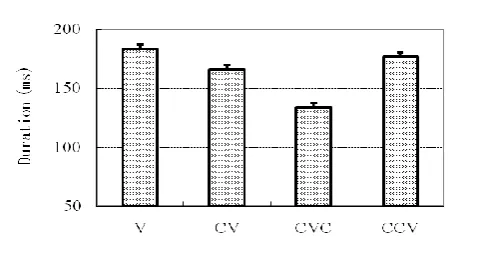
Fig. 1. Duration of consonants of the first syllable
3.2. Vowel of the first syllable
In Fig. 2, the average durations of vowels of various syllable structures of the first syllable are shown, and ANOVA result displays that significant difference exists for the duration values: F(3, 412) = 6.69, p < 0.001. It is demonstrated from further S-N-K test result that, similar to that of consonant, the duration values fall into two subsets, with vowel in the CVC structure shorter than the other cases, and no significant difference is found for vowel durations in the V, CV and CCV structure.
Fig. 2. Duration of vowels of the first syllable
3.3. Consonant of the second syllable
Fig. 4. Duration of vowels of the first syllable
3.5. Consonant of the third syllable
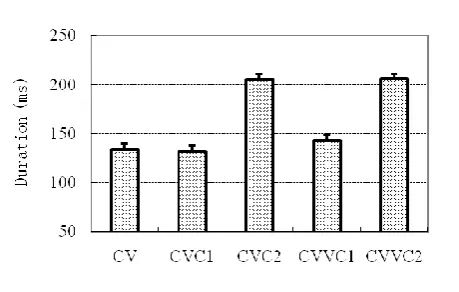
In Fig. 5, the average durations of consonants of various syllable structures of the third syllable are shown, where CVVC1 and CVVC2 refer to the consonants at the initial and coda position respectively. ANOVA result displays that significant difference exists for the duration values: F(4, 684) = 97.2, p < 0.001. It is demonstrated from further S-N-K test result that, the duration values fall into two subsets, with consonants in the CVC2 and the CVVC2 structures longer, and those shorter in the CV, CVC1 and CVVC1 structures. However, there is no significant difference between the CVC2 and the CVVC2 structures, nor are there significant differences among the CV, CVC1 and CVVC1 structures.
Fig. 5. Duration of consonants of the third syllable
3.6. Vowel of the third syllable
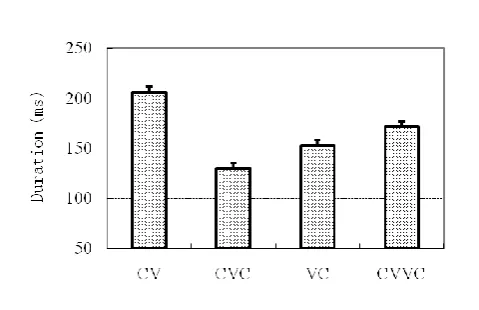
Fig. 6. Duration of vowels of the third syllable
IV.
D
ISCUSSIONResults from the previous section shows that, for consonant
of the first syllable, among the structures of CV, CVC, CCV, consonant in the second position of the CCV structure is significantly shorter than the other cases. The reason for this is that, when a consonant occurs in the initial position of a syllable, there is no preceding segment, which leaves enough room for the segment to be lengthened due to the initial strengthening mechanism. This is the case with the first consonant in all the three structures. When a consonant is at the last position of a syllable, as there is no following segment in that syllable, this leaves much room for the last consonant to be prolonged. However, when a consonant is in the inter-segmental position of a syllable, there is no much room for it to be lengthened, therefore, consonant at the second position of the CCV structure is shorter than the other cases.Regarding vowel of the first syllable, result reveals that the duration of vowel in the CVC structure is shorter than vowels in the V, CV and CCV structure. The reason is similar to that for consonant. In the CV and CCV structure, there is no segment after the vowel in the syllable, so there is enough room for the vowel to be lengthened. In the V structure, there is no preceding or following segment in the syllable, so the vowel is also capable to be lengthened. On the contrary, in the CVC structure, there are consonants both before and after the vowel in the syllable, there is not much room for it to be prolonged, therefore, vowel in the CVC structure is shorter than the other structures.
As for the consonants of the second syllable, it is shown that they are longer in the CVC2 and the CVV structure, and shorter in the CV and the CVC1 structure. It is known that, in world languages, there are some language which are identified as quantity language, i.e., there are heavy and light syllables in these languages. A typical light syllable has only one mora, while a heavy syllable has two moras. A heavy syllable is normally longer than a light one. In Sundanese, CV structure is a light syllable, while CVV structure is a heavy syllable. As a heavy syllable is generally longer than a light one, the consonant will also be affected, that is, the consonant in CVV structure will be longer than that of the CV structure. For the CVC structure, the temporal pattern is that coda is longer than onset. Therefore, consonants in the CVC2 and the CVV structure are longer than those in the CV and the CVC1 structure.
In regard to vowels of the second syllable, results display that they are the longest in the CVV structure, the shortest in the CVC structure, and intermediate in the CV structure. The reason for this pattern is obvious. The CVV structure is a heavy syllable, which is normally longer than the light syllable. Therefore, the duration of VV is longer than those in the CV and CVC structure. In the CVC structure, there are segments both preceding and following the vowel in the syllable, leaving little no room for it to be prolonged, so it is shorter than that in the CV structure. As a result, the vowel is the longest in the CVV structure, the shortest in the CVC structure, and intermediate in the CV structure.
the V, CV and CCV structure, which means that the effect of syllable structure is limited in some cases. It is shown that Sundanese is to some extent sensitive to syllable quantity, with segments longer in the CVV structure than those in the CV structure. For consonants in the CVC structure in the second syllable, coda is longer than onset, which is an instance of final lengthening. Due to the effect of final lengthening, consonants are comparatively long in the coda position of the CVC and CVVC structures in the third syllable, and vowel is the longest in the CV structure in the third syllable.
VI.
ACKNOWLEDGEMENTS
The research reported here is partially supported by the Innovation Fund of Jinan University, No. 15JNLH004.
REFERENCES
[1] Klatt, D. H. Linguistic uses of segment duration in English: Acoustic and perceptual evidence, Journal of the Acoustical Society of America, 1976, 59, pp. 1208–1221.
[2] Clements, G. N. and Keyser, S. CV Phonology: A Generative Theory of the Syllable. Cambridge: MIT Press, 1983.
[3] Hyman, L. A Theory of Phonological Weight. Dordrecht: Foris, 1985.
[4] Hayes, B. Compensatory lengthening in moraic phonology, Linguistic Inquiry, 1989, 20, pp. 253–306. [5] Browman, C. P. and Goldstein, L. Gestural syllable specification in English. In Producing speech:
Contemporary issues, in F. Bell-Berti and L. J. Raphael (eds), New York: AIP Press, 1995, pp. 19–33. [6] Jakobson, R. Die Betonung und ihre Rolle in der Wort-und Syntagmaphonologie, Selected Writings, The
Hague: Mouton, 1962, 1, pp. 117–136.
[7] Nooteboom, S. G. Production and Perception of Vowel Duration. Doctoral dissertation, University of Utrecht, 1972.
[8] Nooteboom, S. G. and Cohen, A. Spreken en verstaan. Assen: van Gorcum, 1984.
[9] Jongman, A. and Sereno, J. A. On vowel quantity and post-vocalic consonant duration in Dutch, Proceedings of the XIIth International Congress of Phonetic Sciences, 1991, vol. 2, pp. 294–297. [10] Kuijpers, C. T. L. Temporal Coordination in Speech Development. Doctoral thesis, University of
Amsterdam, 1993.
[11] Fischer-Jorgensen, E. Sound duration and place of articulation, Zeischrift fur Phonetik, 1964, 17, pp. 175–207.
[12] Port, R. Linguistic timing factors in combination, Journal of the Acoustical Society of America, 1981, 69, pp. 262–274.
[13] Heuven, V. van. Linguistic versus phonetic explanation of consonant lengthening after short vowels: A contrastive study of Dutch and English. In J. J. Ohala, T. M. Nearey, B. L. Derwing, M. H. Hodge and G. W. Wiebe (eds), Proceedings of the International Conference on Spoken language Processing, vol. 2, 1992, pp. 1275–1277.
[14] Braunschweiler, N. Voicing and vowel length in spoken German: production and perception experiments to determine the acoustic Schlu, MA thesis, University of Konstanz, 1994.
[15] Suomi, K., Meister, E., Ylitalo, R. and Meister, L. Durational patterns in Northern Estonian and Northern Finnish, Journal of Phonetics, 2013, 41, pp. 1–16.
[16] Jongman, A. Effects of vowel length and syllable structure on segment duration in Dutch, Journal of Phonetics, 1998, 26, pp. 207–222.