Page 153
PSYCHO-SOCIAL SITUATION OF CHILDREN LEARNING IN SPORT-CLASS IN POLAND
Barbara Głasek
Cardinal Stefan Wyszyński University in Warsaw, Poland
Abstract
In this paper I tried to thoroughly present the psychosocial situation of children attending primary schools in Warsaw, to the sports-orientated classes. In the first chapter I reviewed literature related to the education of children and adolescents gifted in sport. In chapter two, I present my own research program. It contains research objectives, research questions, research methods and characteristics of the research group. In chapter three, I analyze empirical material. The results summarize the conclusions. The results of my research in future may be useful for further refining the sports training system in classes with extended physical education.
Key words: psycho-social situation, children, sport, Poland
INTRODUCTION
Sport occupies a very significant position in the contemporary world. The sports event caters to the hedonistic needs of many sports fans. Spectators expect hitting further records which are now approaching the limits of human capabilities.
This ruthless international competition forces us to continue pushing down the age of sports specialization. The increased acceleration of young people and the previously unknown level of development of qualified sport are additional factors. All these rationales necessitates the optimization of the sports training system. The basis is an adequate and effective selection. It allows to find and attract talented youngsters to do the sport and at the same time to relatively ensure its development conditions at early age. Proper selection makes it possible to use often too modest funds.
In all sports disciplines, the "master model", that has been developed, presents a set of most useful qualities a young trainee should possess. The optimum age to start a sport specialization is also determined. Most of the disciplines are done during school periods but there are also disciplines such as figure skating, gymnastics (art, sports, acrobatics) and swimming which children should begin to train even during pre-school.
In most cases, parents decide on whether their child does sport or not. It depends on their awareness and willingness whether they will offer the possibility to do sports for their children. In the initial stage the financial situation of the family is often decisive. Parents at the early stage usually pay for classes. If there are more children in the family, these expenses are significant. Many parents are unable to guarantee their children's participation in such lessons because of the fees and lack of the need to bring the child to a sports facility. Such a child, when it starts attending to sport classes much later, has a little chance to catch up the lost time. Of course, the incomparably easier access to sport activities that are being organized for children from large urban agglomerations.
Mieczkowski and Chojnacki defined the concepts of early specialization and "child training" as "long-term, comprehensive, planned and targeted pedagogical process, supported by established dosage rates, intensity and frequency of activities, taking into account the physiological and physiological characteristics of the child in order to avoid physical and mental stress” (Chojnacki , Mieczkowski 1971, p. 141).
Page 154
research that make it possible to accurately predict the possibilities of the child, as well as the direction of development of individual sports disciplines.
Observing the development tendencies of competitive sport, it must be stated apart from the extinction and popularization of the sport, the direction of its further evolution depends on the use of science and technology. Among the leading teaching methods are medical, natural, social and pedagogical sciences. The methodology and practice of the training has not been known before. There are also more and more effective organizational solutions in the sport training system.
Many researchers agree that the basis for achievement in qualifying sports is to create the right conditions for young athletes to develop. To look constantly for more and better organizational opportunities to reconcile the normal development of young people with ever-increasing demands for high performance. We should remember that training in some disciplines starts at the age of 3-4. The beginning of systematic sports training for most athletes mostly coincides with taking a new, student role for a child. This period is extremely important and in many cases it is the decisive factor in its educational path.
Many professionals agree that properly chosen sports specialization not only does not pose a threat to the child but can also help in its proper development. It also makes it possible to succeed in sport in adulthood.
There have been many changes since the beginning of the sport classes in Poland. Initial actions were experiments. Indeed, many authors emphasize it. In the early years of their existence it required a big effort to obtain the volunteers. After forty-five years of classes in Poland with extended physical education programs, we are still trying to improve them. An experience gained during the relatively long history of these facilities has allowed them to more accurately construct their curricula. It is getting better with connecting seemingly divergent tasks - good general education and sports training. Greater attention is paid to humanization, even personalization of the learning process.
In this paper I tried to thoroughly present the psychosocial situation of children attending primary schools in Warsaw, to the sports-orientated classes. In the first chapter I reviewed literature related to the education of children and adolescents gifted in sport. In chapter two, I present my own research program. It contains research objectives, research questions, research methods and characteristics of the research group. In chapter three, I analyze empirical material. The results summarize the conclusions. The results of my research in future may be useful for further refining the sports training system in classes with extended physical education.
1. EDUCATING YOUNG ATHLETES - LITERATURE REVIEW 1.1 European traditions of education through sport
At the beginning of the debate on the sport we should return to the 80s and 90s of the nineteenth century, when the French baron Pierre de Coubertin began searching for ways to reform the education system of the time. His aim was to include bodily education in school curricula and give him the appropriate rank. For this purpose he has traveled extensively throughout Europe and the United States. It was particularly influenced by his experience in England at Rugby School, where he observed ways of practicing the educational role of sport. Another very important place for him was Greece, where among its ruins he tried to find ancient ideas. Particularly close to him was the idea of kalokagathia, that is to educate wise and beautiful (efficient) people. So inspired, he quickly began intensive activities aimed at restoring to mankind the beautiful tradition of the Olympic Games. The CITIUS -ALTIUS-FORTIUS password (faster, higher, stronger) to this day marks the direction of development of the whole sport.
Page 155
262 D.S.S. (46,570 pupils), of which 132 in the Russian FSRR, in 1953 was to constitute 78.5% of the total number of schools operating in the USSR (Barański 1958, p. 654 – 662).
Hanna Łubińska presents methods and means of work used in Soviet sports schools. It emphasizes the important role of the trainer, who should be a model for his students. It should first and foremost influence through authority and impeccable personal pattern. Through his attitude he should shape the morale of young athletes of sport. The program of sports classes according to the author should be based on the latest achievements of science. It recommends that general subjects should be targeted at the best possible efficiency so that good working time arrangements allow for the achievement of a sports championship (Łubińska 1979, p. 47 – 52).
1.2 Development the system of training young people who are athletic in Poland
The positive impact on the creation of extended physical education programs in Poland has had positive experiences in this field in the neighboring countries of the USSR, the GDR and the CSRS. Similarly, our country had seen great educational and sports opportunities. Ways to acquire a wide range of sports facilities and methods of effective selection had been searched.
The first attempts at combining school education with sport activities in Poland date back to the 1960s. They were taken in 1961 in Bielsko-Biala (so-called "snow class"), in 1965 in Łódź and two years later in Wrocław (1967). They were preceded by scientific research conducted by the Physical Culture Research Institute to evaluate the impact of the extended physical education curriculum on students. Under the agreement signed on 18 June 1968 between the Ministry of Education and Higher Education and the Main Committee of Physical Culture and Tourism, it was possible to create classes with an extended program and an increased number of hours of physical education. The first sports classes were established in 1968 in general secondary schools in Wroclaw, Tychy and Zielona Góra. Shortly thereafter, other regions were established in Bydgoszcz, Szczecin and Warsaw (Przewęda 1977, p. 542 – 548).
The document which unified the organizational assumptions of classes of extended physical education was the Order of the Minister of Education and Training No. KF - 1 - 401 - 1/74 dated 25 June 1974. It introduced standardized curricula and hours for all classes in a given discipline.
In 1977, under the ordinance No. KF-1-401-3 / 77, the system of training sports-gifted young people was refined. It consisted of:
- schools with extended physical education, being the basis for selection to sports classes; - sports schools with traditional classes in addition to sports classes;
- sports championship schools.
Jolanta Stępień as the two main motives for the creation of sports classes in the seventies of the twentieth century gives the aspiration to complement the staff of competitive sports and to fill the gaps in physical culture. The first tendency is particularly strong in centers with older traditions and a higher general level of physical culture. The second - significant in the regions of sport education that are still underdeveloped in terms of educational and organizational values, instead of sport championschip participating in physical culture is what matters (Stępień 1972, p. 301 – 307).
Wlodzimierz Puczyński presented the first years of sport classes in Poland. He indicates at the improper selection of children's criteria for sports classes, as well as lack of appropriate training programs in particular sports disciplines. Teachers who conduct the classes themselves are preparing their own tasks according to their knowledge (Puczyński 1971, p. 217 – 221).
Page 156
1.3 Positive aspects of the effectiveness of moving to youth in sports class
Numerous authors have addressed the issue of the multilateral impact of physical education and sport on young people in the 1970s. A review of professional literature in the field of sports specialization of children and youth was provided by Alexander Baranski. He cites the opinion of H. Milicerova, who recommends starting a specialized sports training only when the child is ready, that is, when it achieves the appropriate level of mental and physical development. At the same time, she points out that it is very important to have an admission to specialization early enough, because in many sports disciplines, appropriate training should take place in school age and even in kindergarten. Bypassing this stage of your child's development may negate his chances of achieving high sports scores. Observation of the individual development of the child will allow for timely introduction of the following stages of the training: basic preparation, specialized training and sports improvement. He also urges that sport should be added in even greater extent to the whole physical education system as a basis for revealing the sports predispositions to talented individuals (Barański 1971, p. 21 – 34). Stefan Wołoszyn emphasized the importance of physical education and sport in raising children and youth. He claimed that these fields naturally give the opportunity for emotional, social and moral education. They also have a positive impact on their health and physical and mental endurance. He emphasizes that physical awareness combined with participation in child-friendly movement helps to prevent unnecessary mental tension (Wołoszyn 1973, p. 296 – 299).
Zdzisław Chromiński recognizes the great importance of school sport in preparing the young generation for future life. He emphasizes that the urbanized world requires an appropriate pace and rhythm of action and forces fast but accurate choices and decisions. Large demands will be placed on the coordination and accuracy of movements, especially manual skills. It is not without importance to shape the motor skill, improve health, and all this in connection with the intellectual and emotional sphere. Such multifaceted functions can be a well-organized school sport. He prepares for participation in social life, teaches sense of duty and discipline, implements responsibility for his own actions, shapes positive qualities of pupil personality, interest and attitude, influences his character, helps to master organizational skills, implements systematic use of recreation Sports and tourism, prepares to practice adult sport in the adult life, ensures proper psychomotor development and carries out health education by teaching hygiene and raising awareness in the field of physical and mental health (Chromiński 1976, p. 405 – 408).
Jerzy Nowocień during his many years of research in the field of pedagogy of physical education and sport has very carefully examined the influence of sports classes on the educational qualities. He stated that these classes in a high degree play a positive role in school life. They stimulate and integrate their activities to a greater extent. Their pupils are implemented to duty and discipline. J. Nowocień shows that well-organized education in the sport class not only does not hinder the achievement of good academic results, but it also mobilizes, by instilling in young people the skills of good work organization. He also assesses positively the degree of socialization of youth of these classes compared to traditional classes. There is no negative change in the behavior of students - athletes. He also emphasizes that in the opinion of parents of students of sport classes, this type of education has many qualities, from health to education. Among the latter, they emphasize that in classes with an extended physical education program, children are more likely than the traditional classes to be systematic, responsible, disciplined and well organized (Nowocień 1980, p. 17-19). It also does not adversely affect the fulfillment of their school duties. He emphasizes that children in these classes have a good educational commitment to sports, sometimes even better results in learning that their peers who attend traditional classes and that their attendance during the school year was significantly higher than in the control classes. It also highlights the positive impact of sport class participation on the degree of socialization and increased social activity (Nowocień 1978, p. 393 – 396).
Page 157
talent development and interest, and the characterization of young people, especially in terms of volitional and emotional aspects. Among the many features of sport, the most important are: adaptive, compensatory and corrective. Through the possibility of competition it is a particularly spectacular field, and thus favored by the youth. Naturally, it can contribute to instilling the moral and aesthetic attitudes of the young generation (Żukowska 1973, p. 32 –36).
Zofia Żukowska draws attention to the fact that in order for the impact of sport to bring about the desired effect, a uniformity of educational influence on the young athlete must be ensured. Of course, the greatest responsibility lies with the trainer, who not only serves as the manager and organizer of the training process, but also integrates other influences. He should properly instruct the competitor, interact appropriately with a reward system and penalties, and preferably by personal means. There is also a small role for the sports club, which should support the coach, rather than undermining his authority. The most critical aspect of Z. Żukowska is the ambivalent influence of sports journalists who, after one failure, can take away the faith of the athlete, and sometimes too early to judge the athlete's "outstanding" talent, whom “fame rushed to the head”. It also attaches great importance to the acquisition of appropriate education and occupation by young athletes, who in the future could be the basis of his steady and certain income. It appeals to outstanding athletes to finish school and college in a special way, appropriately dispensing for them relief and relief in this difficult task (Żukowska 1971, p. 57 – 58).
Zofia Żukowska highlights the positive aspects of the education of athletically motivated youth in sport classes. According to her, it is very convenient to combine science with sports development, which allows for homogeneous didactic and educational care. Young people covered by such education system have a guaranteed full implementation of the entire syllabus from all subjects, and in the case they would have to resign from the sport classroom they may remain in the school in the parallel general education class. It is also important to work closely with teachers, trainers and parents of children. The expanded physical education program allows for upbringing through sport and to sport (Żukowska 1979, p. 6 – 7).
W. Srokosz, on the basis of his research on interpersonal determinants in class syndrome, states that the practice of sport itself does not significantly affect the popularity of peers. Only the combination of many components, such as achievement in sports, good academic results and high morale, and being a good and supportive colleague ensures high positions in the class (Srokosz 1976, p. 83 – 91).
1.4 Danger when you are exposed to young sports
Many authors point out the dangers that young athletes may be exposed to. Andrzej Wohl shows numerous contradictions in the widely understood sport. Among the most popular is the commercialization and manipulation of sports life. He sees a lot of evil in the perception of sport as a mythologized phenomenon detached from real life. He condemns attempts to use it for militaristic and repressive purposes. It reminds of Nazi attempts to manipulate sport. He emphasizes that in spite of these dangers, the competitive sport can be defended by its internal content (Wohl 1973, p. 247 – 250). Krzysztof Zuchora shows the wilderness of sport, which, as a result of fascination with the sport event, can attract young enthusiasts. According to him, the intensified media propaganda showing a quick, easy and theoretically open to everybody the way to success, putting on a pedestal the rank of sport, the myth of celebrity leads to widespread infatuation and distraction from what is really valuable to be able to offer sport but not the performance, And in which every man can find a place for himself. Zuchora sees a big threat in the perception of sport through the prism of the sport only. Reminds that the school should be primarily engaged in the broadly defined physical education (Zuchora 1972, p. 535 – 538).
Page 158
He argues that this is a real school sport, which should be accessible to the entire school community (Bartusiak 1993, p. 187 – 195).
1.5 Health education for school education achievements
Many authors have been dealing with the issue of the impact of physical exertion on educational attainment at school since the very beginnings of sports schools. They recommended that trainings would take place after the lesson. If this is not possible, adjust the timetable for sports activities so that, after a great deal of effort, avoid difficult subjects (such as English, foreign language, mathematics, science) and do not carry out any check work and shorten the time of sports activities to allow adequate rest before other lessons (Wojnarowska, Garyński, Palus – Szaniawska , Dolota 1977, p. 80 – 82).
Jerzy Uzarowicz, Zdzislawa Zawada and Stanisław Żak, on the basis of their research, admit that increasing the number of hours of physical education does not negatively affect school performance, provided that sports classes are properly organized. In addition, they postulate the conduct of early sports specialization according to the assemblies of scientists, specialists and doctors (Uzarowicz, Zawada, Żak 1971, p. 267 – 277).
Julian Jonkisz and Bolesław Słupik emphasize the positive aspects of education obtained by a children attending sport classes. Well-organized education in sports classes provides a good educational atmosphere. The students of the sports classes compared to the control class students are more courageous, inventive, consistent, diligent, perseverant, self-controlled. They are also more truthful and cheerful. They also have more faith in their own strength. They also want to stay in their class more than traditional classmates (Jonkisz, Słupik 1971, p. 319 – 331).
1.6 Selection to sport classes
It is of utmost importance to assess the effectiveness of the selection for sports classes. Most experts agree that there should be considered the most important characteristics in a given sport discipline with regard to the so-called "Master model", primarily genetically conditioning. Hence, they postulate the modernization of children's enrollment in sports classes by evaluating somatic and psychomotor predispositions for genetic determinants, such as body height, limb length, and determination of explosive strength (Szopa 1986, p. 149 – 159).
Jan Blecharz and Marian Fiedor, in their research, prove the motivation and influence they have on the effectiveness of their activities in sport. Its main component, which determines, according to the authors, the potential for success, is the high level of persistence / determination. They point to the necessity of taking that variable during recruitment to the high performance sports section (Blecharz, Fiedor 1995, p. 5 – 9).
Page 159 1.7 Reasons for disposal of sporting
Ulatowski, among the reasons for the resignation of young athletes from sports, mentions: - lack of sufficient stability of interest due to young age and insufficient experience;
- lack of spectacular sporting results expected in exchange for the tremendous daily workouts; - lack of understanding with a trainer who often does not have the appropriate qualifications or
cannot effectively manage the training process;
- lack of sufficient material base and training errors (Ulatowski 1970, p. 9 – 13).
1.8 Criticism of the Polish training system of children and young people
S. Sulisz in his article criticizes the Polish system of sports training for children and young people. He argues that excessive concentration on sports results can lead to dehumanization. There is a risk that a successful athlete can focus his attention primarily on issues related to his career and personal values, social values will fall outside his circle of interests. The youngest athletes are the object and not the subject of the action. At the initial stage of the training, the competition should be part of the long-term preparation for the launch, and become a center of attention, thereby distorting the harmony of the multi-stage process. Also many leave to wish the state of the material base available to young people. Sulisz emphasizes that it is absurd to create sports classes where the base is unable to protect the elementary needs of the broadly defined physical education. It damages the mass and popularity of sport and unfortunately has negative educational consequences (Sulisz 1985, p. 103 – 107).
Alicja Romanowska criticizes the system of Polish sports training for children and young people. She claims that sport classes which were created in the past too often, too fast and maybe too hastily do not quite pass the practical exam. They do not deliver the intended sporting and educational benefits and are not programmatically and organizationally consistent. Bad conception of early specialization and the pursuit of fast sports scores are in disagreement with the natural physical and mental development of young athletes. Too naive in her opinion is attributing to sport education function of the sport, because according to her it does not raise the child himself. You need to put some effort into shaping the young man. Romanowska is of the opinion that the sport of children and young people should not play the role of preparing potential players. It should be seen more as a "sport for all". It even mentions the children who would like to see it as fun, pleasure and not as a duty and should be available to all interested. Romanowska recognizes the positive role of the Catholic Church, which she says has the potential to propose a form of "rehabilitation program" for the educational role of sport. Catholic physical culture associations strive to reach vulnerable groups - children and adolescents from poor families, neglected and facing various pathologies (Romanowska 2002, p. 38 – 42).
Page 160
2. CHARACTERISTICS OF THE RESEARCHED GROUP AND RESEARCH AREA
Sports for children and adolescents play a prominent role in the structure of competitive sport. It allows you to select and prepare top-class players to represent your nation in a decent way on the international stage.
For almost forty-five years, the school has an extended physical education program in the sports training system. They were supposed to ensure continuity and appropriate recruitment into the various fields of sport. On the basis of many experiences, the current model of schools with sports classes has developed.
The purpose of my research is the multidisciplinary diagnosis of the psychosocial situation of children attending primary school in Warsaw for sports classes. This will allow you to look at the analyzed issues from another, humanist side. There is a chance that the collected material will to some extent further improve the process of training young players.
The following research questions have been put forward for the most accurate analysis of the research problem:
1. What is the education and financial capacity of parents of students attending sports classes? 2. What are the motives for starting a sport?
3. How do young athletes endure failures and possible successes? 4. How is the social structure of the sport classes shaped?
5. What is the time budget for sports class students? 6. Are they more tired than their traditional classmates?
7. Are they more exposed to serious injuries and what are their consequences? 8. What are the costs of practicing sport and who pays for it?
9. What are their dreams?
The basic research tool was a survey - slightly different for sport classes and general classes. In the control group, questions on sports were omitted.
The questions in it concerned:
- family (childbirth, parental education, their employment, place of residence, financial status and sports tradition);
- sport (discipline, age of start and motivation for sports training, willingness to give up, expected success and possible future plans);
- education in sport classes (satisfaction with attendance, class integration, pedagogical treatment); - discharge of school duties;
- time devoted to training and learning; - free time;
- injuries; - sports camps;
- the costs of sports and their financing; - dreams.
Page 161
The study was conducted in March 2014 in two Warsaw schools: - Primary School No. 48;
- Primary School No. 263;
The study involved 98 students from the VI-th grade.
- 16 of the sports class from Primary School No. 48 at ul. Sempołowska 4 (8 girls and 8 boys); - 21 of the sports class from Primary School No. 263 at ul. Szegedynska 11 (11 girls and 10 boys). The control group consisted of two pupils of these schools from parallel general classes.
- 30 people from Elementary School No. 48 (23 girls and 7 boys); - 31 people from Primary School No. 263 (21 girls and 10 boys).
The age of the respondents was 12-14 years.
3. ANALYSIS OF EMPIRICAL MATERIAL 3.1. Social characteristics of the studied youth
The first question concerned the place of residence of the children. Most of them come from Warsaw, only 7 of the sports classes and one of the traditional classes comes from the suburbs.
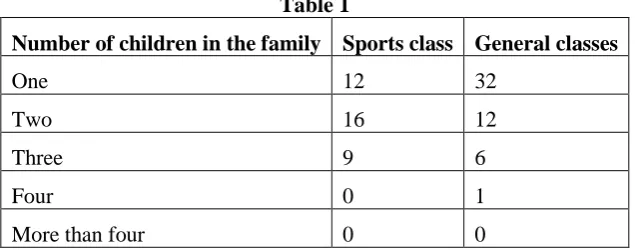
Table 1
Number of children in the family Sports class General classes
One 12 32
Two 16 12
Three 9 6
Four 0 1
More than four 0 0
Families in most cases have one (in the sports classes - 12, in the general classes - 32) or two children (in the sports classes - 16, in the general classes - 12). Three children are in 9 families of athletes and six in the control group, and three siblings have only one child in the general education class. One can assume that family conditions are similar.
Table 2
Sports class General classes Father Mother Father Mother
Basic education 4 1 3 3
Basic vocational education 2 3 4 3
General secondary education 2 3 2 1 Vocational secondary education 3 5 10 8
Page 162
Higher incomplete Education 2 2 3 4
Higher education 23 22 28 30
Parent education is similar in both populations.
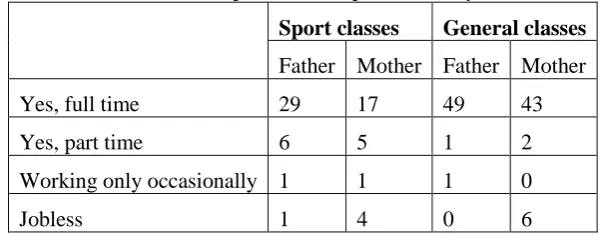
Table 3. Do parents work professionally?
Sport classes General classes Father Mother Father Mother
Yes, full time 29 17 49 43
Yes, part time 6 5 1 2
Working only occasionally 1 1 1 0
Jobless 1 4 0 6
Similarly, the structure of employment in both groups is similar.
Table 4. How do you rate your living conditions? Sport classes General classes
Very well 30 32
Well 7 12
Average 0 6
Poor 0 1
Table 5. Are you going out with your parents on vacation? Sport classes General classes
Yes 33 39
No 0 2
From time to time 4 10
Page 163 3.2 Ages and motives for starting sporting
The SP class 263 sports group is grouped by taekwondo, biathlon and football. SP No. 48 players are swimmers, gymnasts, figure skating, volleyball and football. Most of the adepts started training at the age of 6-8, two people earlier (already 3-4 years old) and 6 later (10-12 years).
Children attending classes with an increased physical education range come from a majority of families with traditional physical education (about 76%). Parents have a variety of sports, including swimming (4 people), bodybuilding, judo, athletics (5 people), basketball (2 people), volleyball, handball, football (4 people), fencing, sports fighting (2 people), boxing, artistic gymnastics, horse riding. It should be emphasized that in the general education classes this percentage is also very significant (nearly 50%). Here are the following disciplines: swimming (3 people), art gymnastics, sailing, figure skating, rowing, tennis, soccer, volleyball (5 people), handball (3 people), volleyball and recreation: Ski (2 persons), bicycle, jogging (4 people), fitness (2 persons), Nordic walking. Most children declare that they like the sport that they practice. Only seven of the thirty-seven children do not like their discipline. In a few cases, these people have already started practicing another sport. In most cases, they themselves decided to come to the sport class, and they made that choice at the age of seven. In six cases, the parents prompted them to join the school, the two were inspired by the coach and the two were interested in being friends or acquaintances.
3.3 Failure and expectation
Table 6. Have you ever wanted to retire from sports?
Primary school nr 263 Primary school nr 48
Yes 5 6
No 9 5
I used to think about it 7 5
Nearly half of the respondents thought about abandoning sports. At school number 263 five people had this intention, seven thought about it sometimes. In elementary school No. 48 similar proportions are formed - six people wanted to do it, five - sometimes.
Success in sport expects more people from the school at ul. Szegedinska (10, others do not know). At the School at ul. Sempolowska children are less optimistic. Only four people are certain of their abilities, four people are of the opinion that they have no chance, others do not know.
3.4 Sports class
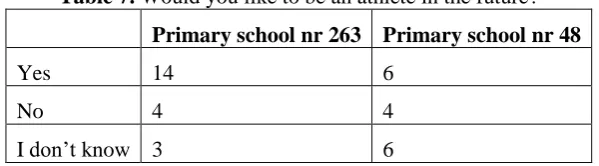
Table 7. Would you like to be an athlete in the future? Primary school nr 263 Primary school nr 48
Yes 14 6
No 4 4
Page 164
A significant proportion of sports class students (20 people, including 6 from SP No. 48, 14 from SP No. 263) plan to pursue a sports career in the future. Definitely other plans are 8 people (4 in both schools), the remaining 9 people have not yet specified plans.
Most of the students in the sports classes studied are from the first year of study. Two people have started since the second grade, four are in it three years, two have been in the last two years. This demonstrates the stability of the class team.
Science in sports classes has met expectations. Only one person gave a negative answer. Most of the respondents are also happy with attending a sports class. Only one person is against and two do not know. Less than half of respondents (14 people) feel honored by the fact that they practice sports. Probably they are people with more significant success in the field.
In sports classes almost half of children think teachers do not treat everyone equally. In the traditional classes, only 17 children are counted in 61. More than half of the students (20 participants) declare that the teachers do not give them any relief because of their sport. At the same time, 13 people are of the opinion that the pedagogical group treats sports success more gently. Seventeen athletes note that coaches do not treat everyone equally.
The vast majority of students feel good in their class. A similar percentage of children with negative grades (in sports classes - 4 people, in general - 8).
Most students - athletes fulfill their school duties and learn very well (19 people), very good (14 people), three are rated on average, one poorly. Classes in traditional grades are slightly lower. There are 10 students of very good, good - 28, 18 medium and 5 weak.
A large proportion of the respondents think that they would be better off if they did not train (10 people), 14 people thought that would not affect, and 13 did not think otherwise.
Only seven people from the sports classes wanted to give up their school. In the next question, as many as 10 people said that they were not doing it because of their colleagues, three had the opinion of their parents, and two were waiting for the end of the school year when they finished school. One person responded that she did not know what other things she could do.
3.5 Time budget for students of sports classes
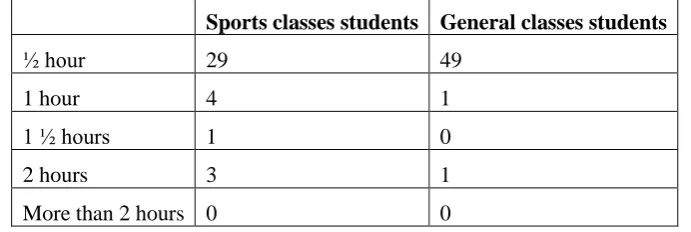
Table 8. How much time does it take you every day to go to school and workout? Sports classes students General classes students
½ hour 29 49
1 hour 4 1
1 ½ hours 1 0
2 hours 3 1
More than 2 hours 0 0
Page 165
Most children, even those who leave the house at about 7 am, return around 3pm in some but more demanding disciplines like skating and gymnastics often leave the house around 6am and return around 5pm. Some athletes declare that they leave the house At 5 am and it returns around 7pm. The number of workouts is different, depending on the sport and ranges from 3 to 14. The swimmers usually have 3 workouts after about 1 hour. The situation of skaters is different, they have classes even on weekends and the number of their training is even 14. Most of the disciplines are about 10-12 hours per week.
Table 9. How many hours a day do you sleep?
Sports classes students General classes students
6 hours 2 5
7 hours 12 11
8 hours 16 31
More than 8 hours 7 9
Most people sleep about eight hours, more than 8 hours a day sleeps 7 people, while 12 people sleeps 7 hours a day. However, the concern is that two people in the development period systematically sleep only 6 hours a day. But in the traditional classes up to 5 people sleep about 6 hours a day, 7 hours - 11 people, more than 8 hours - 12 people. About half of those surveyed in the general classes sleep about eight hours a day.
Table 10. How many hours a day do you study?
Sport classes students General classes students
½ hour 14 13
1 hour 8 8
1 ½ hour 8 16
2 hours 3 8
More than 2 hours 4 6
Most students (19 people) in sports classes spend up to an hour per day on learning. More than two hours are spend on learning by four people. More time is spent on learning from young people in traditional classes, but 12 people admit that they learn very little.
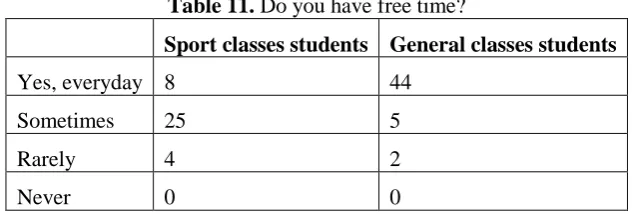
Table 11. Do you have free time?
Sport classes students General classes students
Yes, everyday 8 44
Sometimes 25 5
Rarely 4 2
Page 166
Children in general classes declare that they have free time everyday, sometimes - 5 people, rarely - 2. In sports classes, most respondents claim that only occasionally they have free time. This group included eight people who have daily hours at their disposal.
Athletes in leisure time mainly have tutorials, learn foreign languages, read, have extra activities, go on walks and meet with friends. Of course, a large part of the day they spend with their parents, who will be happy to help with domestic chores. At a much smaller size than the control group sit at the computer and watch TV. On average it takes them 30 - 60 minutes a day.
Young people in traditional classes repeatedly admitted that they spent the afternoon with friends, at the computer, or in front of the TV. Much less time is spent on other activities - cinema, tutoring, book reading, walking, language learning, and home support. They spend more time with their parents.
3.6 Fatigue and injuries
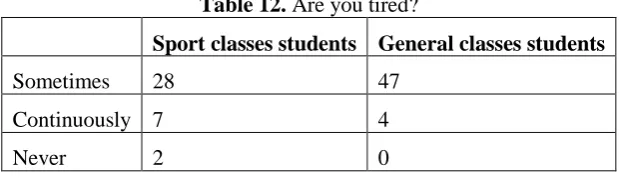
Table 12. Are you tired?
Sport classes students General classes students
Sometimes 28 47
Continuously 7 4
Never 2 0
Young athletes more than control groups feel tired. In the sports classes there is a greater proportion of people who have suffered injuries (16 out of 37 tested). These were mostly fractures, twists and strains. In many cases it was necessary to resign from training. A number of children with long-term health impairment came to my general education classes. Injuries and degenerations in knee joints were mentioned that prevented further sports development. The most sensitive was the training of athletics, especially the long run. But the number of injuries in the control classes is also disturbing. Nearly one in three children has suffered a traumatic event (19 in 51). Similarly, those were mostly fractures and twists.
3.7 Sports camps
An additional burden on youth from the sports classes is training camps. Most children from Primary School No. 48 spend 2 weeks (8 people), 4 people spend 3 weeks, 1 person more than 4 weeks, 3 people only 1 week.
Page 167 3.8 Cost of sporting
The costs of practicing sport in different disciplines are different. In most cases they range from 50 to 200 PLN. Some, however, disciplines attracting unimaginable expenses for the average family. The parents of children performing figure skating spend according to the declaration between 1000 and 2000 PLN, the gymnast also dedicates for this purpose about 1000zł. One more person playing football and swimming at the same time determines their spending at 1150 zł a month. I just add that all people who declare so high costs attend school in the city center. Most of them also commute, so the family has to count on the cost of gasoline and city cards (compulsory at this school, like dinners and several other contributions). The cost covers parents, only one child from Elementary School No. 263 has everything financed by the grandparents.
3.9 Dreams of children
Children's dreams show their rich inner world. It is difficult without prejudice to the respondents to evaluate their desires, so I will literally quote their statements. As a short comment I will just add that in my opinion children in sport classes are not afraid to dream of great things, their faith in their own possibilities and self-confidence are revealed. Probably they have been provided with all their needs. In the children of traditional classes there is sometimes a sad voice that they would simply like to live better, like their peers, have peace, more money for everyday life, a pet...
Dreams of children from sport classes: - move to Chicago;
- find a super boy for life; - create a family, build a house; - be a professional gymnast;
- become the most famous dancer in the world and singer;
- I would like to visit many countries, experience adventures, meet interesting people, start a family; - have a big house and be an athlete; I want to be a volleyball player;
- have dog farms;
- I am suffering from diabetes and I have to give up the sport that I cultivate. My dream is for the disease to pass or to invade the drug. And he wants to win the lottery because we have little money and we are going to earn money to move to Norway;
- win in Totka (2 times); - I want to be a school librarian;
- I want to be a naturalist and ride the world, speak many languages; - become a soccer player (4 times);
- become a famous athlete (4 times); - be a billionaire;
- to be rich;
- be an athlete and have a great and happy family; - to be happy;
Page 168 - be a wise man and become a football player; - win skating competitions;
- play handball (opinion of skaters); - be the best player in the world; - take part in the Olympics;
- get to a good junior high school and achieve great success in sports, go to America; - get to the best junior high school;
- be a dentist or interior designer;
- my dream is to succeed in learning, like my dad; - to have the same positive opinions and a good future;
- be famous, go to good studios; - to be rich;
- I have no dreams, I am satisfied.
Dreams of children in general classes:
- I want to be happy and become a famous writer; - become a dog trainer;
- I would like to lose weight and become a preschooler; - be famous, earn a lot and have many friends;
- have a dog, peace and be a reporter;
- have a sister and have a lot of material and filler for sewing mascots; - meet your idol;
- run professionally;
- I would like to recover and train again;
- become a professional dance dancer hip-hop dance hall;
- I would like to work in the future with computer graphics, architecture, or animation; - be happy;
- make a career in sport;
- to be a football player (4 times); - become a computer scientist; - I want to see the cosmos; - to get well in life;
- learn well, go on vacation;
- become a football player (2 times); - finish school with average 6.0;
- become an astronaut, study at a US university; - become a vet, or study at AWF;
Page 169 - learn the guitar;
- become a world-class dancer;
- travel to France, to Paris, and to America; - become a vet;
- get to junior high school, which is not my district, good high school and good study and have a good paid job;
- in the future I would like to have my own restaurant;
- live in the US, buy a Ferrari and a large house with a garage; - have a pet and be a celebrity in the future;
- learn to ride a horse, make a driver's license, pilot's license and travel the world; - catch a record big fish;
- I wish I had a good test after primary school;
- my dream is to have my own room, an angle where I could be alone.
CONCLUSIONS
Very often children in sport classes have good support in families. In terms of financial status, parents' education and social position are generally no different from other families. What is special about this is that big sports traditions. Children begin their adventure with sport very early, so they have to be prepared for it before they are required to attend compulsory physical education in all schools. Most children alone have decided that they will go to the sports class. After many years of attending such a school, they are still satisfied with their choice and declare that they feel good in their class. Most athletes still like their sport discipline. After graduating from primary school, probably half will retire from further sports career, but a large part declares that he expects success in sport. Many people feel honored because of the sport. The children feel very good in their group. The class team has a very stable composition, almost all the students are in it from the beginning. Only a few children admit that they are thinking of leaving this class, but do not do so mainly because of their colleagues.
It is worth noting that most students in sports classes fulfill their school duties well and very well. They achieve significantly better scores from the control class students despite the fact that they spend less time on learning. A lot of kids nonetheless think that if she did not train so much she would learn much better.
Daily multi-hour workouts are a big challenge for the young body, so athletes feel more tired than children in traditional classes. Very often their day plan is tightened to the limits of their endurance. Many of them additionally commute. This in some cases leaves the house at 5am and returns at 19. They often train on school holidays for their peers - holidays, holidays and weekends. Most of them leave for at least two weeks training camps.
Free time is used more effectively than peers. Many people are learning foreign languages at the moment, reading books and helping out at home. Their classmates have more time, but most of them spend watching TV, sitting in front of the computer, or meeting with friends. Children in sports classes have less time to study, but they use it optimally and thus achieve a better learning outcome than their peers. In the opinion of teachers, practicing sport does not absolve them from anything.
Athletes are actually more injured, but they do not produce more serious consequences. It turns out that children from traditional classes also suffer a lot of injuries.
Page 170
only changed the structure of financing the current expenses which are currently covered by the parents.
THE END
Youth sports training is a very important issue. It has to provide in the past a solid base of competitive sport. Durable seats in this system are occupied by the sports class. They have the burden, however, to reconcile two opposing tasks - to develop sports talent and, on the other hand, to educate them accordingly, so as to maintain patency between the various stages of teaching. Such a child can at any time go to another class or school. But even after giving up this path, he has specific knowledge and skills in the field of broadly understood physical culture. In addition, the child finishing school of this type is equipped with a number of useful skills, including first of all good time organization, responsibility for their own decisions, consequences, fairness based on the idea of fair play. Such experiences will shape their characters.
I find that a big problem to solve is to relieve parents of very high expenses. Because they are currently carrying virtually all financial responsibility for the future of Polish sport. It is not only the family that needs to cover enormous expenses, but also other costs, such as the need to resign from other plans and intentions, to develop perfectly coordinated logistics who, when and where the child carries. And how does a mother raise a child herself? Must not only arrange for timely transport, but also often to earn at the same time? Many such mothers, and this is a growing population nowadays, are starting to wonder whether maybe it is better not educate so children, then you will be able to work for one of three jobs less? With more than one child in the family, such education is absolutely unfeasible.
How in such a situation not to criticize for spending money de facto on the training of children talented athletes for the concert of a famous singer at the National Stadium? Many experts dealing with the theory of sports training argue that money is, but not where you need it. Increasing expenditures for the earliest years of sports training will allow for much better results in the future for much less money. It will enable the influx of talented children who cannot afford it at the moment. The memories I've shown show how softly sports training was when there were no such financial worries. Children trained for free, received nutrition and sportswear at school. Parents did not pay for sports camps and equipment, and athletes often received extra scholarships. As part of the reward for systematic workouts they were able to go to interesting places. It is known that it will not return, but parents should be supported by institutions called for the organization of sport for children and young people.
REFERENCES
1. Barański A. (1958) Dziecięce szkoły sportowe w ZSRR. Kultura Fizyczna 9: 654 – 662.
2. Bartusiak I. (1993) Sport szkolny – stan aktualny i kierunki działania szkoły. Zeszyty Naukowe AWF Wrocław t. 55: 187 – 195.
3. Blecharz J., Fiedor M. (1995) O trafności kryteriów doboru do tak zwanych sportów wczesnych. Trening 4: 5 – 9.
4. Chojnacki T., Mieczkowski T. (1971) Próba selekcji do klas ze zwiększoną ilością godzin wychowania fizycznego z ukierunkowaniem na gimnastykę sportową. Zeszyty Naukowe WSWF Wrocław z. 9: 141 - 150.
5. Chromiński Z. (1976) Miejsce sportu szkolnego w procesie pełnego rozwoju osobowości ucznia. Kultura Fizyczna 9: 405 – 408.
Page 171
7. Hajzik R. (1971) Kilka uwag lekarza na temat tzw. klas sportowych we Wrocławiu. Zeszyty Naukowe WSWF Wrocław z. 9: 263 – 266.
8. Jonkisz J., Słupik B. (1971) Ocena procesu dydaktyczno – wychowawczego klas sportowych na tle klas tradycyjnych. Zeszyty Naukowe WSWF Wrocław: z. 9: 319 – 331.
9. Królicki J., Nowocień J. (1995) Integracyjne funkcje aktywności sportowej dzieci i młodzieży. Roczniki Naukowe AWF Warszawa XXXV: 113 – 127.
10. Łubińska H. (1979) Sport dzieci i młodzieży. Cele, metody i środki pracy wychowawczej w szkołach sportowych ZSRR. Sport Wyczynowy 3-4: 47 – 52.
11. Nowocień J. (1980) System wartości społeczno – wychowawczych klas sportowych. Kultura Fizyczna 4: 17 – 19.
12. Nowocień J. (1982 – 1984) Klasy sportowe w systemie wartości wychowawczo-społecznych szkoły. Roczniki Naukowe AWF Warszawa XXVII : 155 – 184.
13. Nowocień J. (1978) Ocena poziomu wyników w nauce i stopnia uspołecznienia młodzieży z klas sportowych. Wyniki badań po 1. roku eksperymentu pedagogicznego. Kultura Fizyczna 9: 393 – 396.
14. Pac – Pomarnacki A. (1994) W liceum Batorego nie ma już klas sportowych. Sport Wyczynowy 3 – 4: 91 – 94.
15. Przewęda R. (1977) Klasy sportowe w polskich szkołach (I) Kultura Fizyczna 12: 542 – 548. 16. Puczyński W. (1971) Z doświadczeń nauczycieli w pracy z klasami sportowymi w woj.
koszalińskim. Zeszyty Naukowe WSWF Wrocław z. 9: 217 - 221.
17. Romanowska A. (2002) UKS – sport dzieci i młodzieży. Wychowanie Fizyczne i Zdrowotne 4: 38 – 42.
18. Srokosz W. (1976) Uprawianie sportu a pozycja i popularność ucznia w zespole klasowym. Wychowanie Fizyczne i Sport 4: 83 – 91.
19. Stępień J. (1972) „Klasy sportowe” na tle rozwoju sportu kwalifikowanego. Kultura Fizyczna 7: 301 – 307.
20. Sulisz S. (1985) Uwagi krytyczne o systemie kształcenia uczniów uzdolnionych sportowo. Wychowanie Fizyczne i Sport 3: 103 – 110.
21. Szopa J., Śrutowski A.(1986) Ocena skuteczności selekcji do klas sportowych w Szkole Podstawowej Nr 91 w Krakowie w roku 1983. Roczniki Naukowe AWF Kraków nr 45: 149 – 159. 22. Ulatowski Z.(1970) Wczesna specjalizacja sportowa. Sport Wyczynowy 7 – 8: 9 – 13.
23. Uzarowicz J., Zawada Z., Żak S. (1971) Wyniki działalności pedagogicznej i dydaktycznej w klasach sportowych miasta Krakowa. Zeszyty Naukowe WSWF Wrocław z. 9: 267 – 277.
24. Wohl A. (1973) Problem alienacji i identyfikacji człowieka w sporcie. Kultura Fizyczna 6: 247 – 250.
25. Wołoszyn S. (1973): Wychowanie fizyczne i sport jako czynnik wychowawczy. Kultura Fizyczna 7: 296 – 299.
26. Wojnarowska B., Garyński P., Palus – Szaniawska E., Dolota W.(1977) Wpływ wysiłku fizycznego na zdolność do pracy umysłowej uczniów szkół podstawowych o profilu sportowym. Wychowanie Fizyczne i Higiena Szkolna 3: 80 – 82.
27. Zuchora K. (1972) Eksperymentalne klasy sportowe w PRL. Kultura Fizyczna 2: 77 – 79. 28. Zuchora K. (1978) Sport jest szansą szkoły – szkoła jest szansą sportu. Kultura Fizyczna 1: 5 – 9.
Page 172
30. Żukowska Z. (1979): Aspekty pedagogiczne kształcenia uzdolnionej ruchowo młodzieży. Kultura Fizyczna 12: 6 – 7.