R E S E A R C H
Open Access
Low-complexity lattice reduction
algorithm for MIMO detectors with tree
searching
Hyunsub Kim
, Hyukyeon Lee, Jihye Koo and Jaeseok Kim
*Abstract
In this paper, we propose a low-complexity lattice reduction (LR) algorithm for multiple-input multiple-output (MIMO) detectors with tree searching. Whereas conventional approaches are based exclusively on channel characteristics, we focus on joint optimisation by employing an early termination criterion in the context of MIMO detection. In this regard, incremental LR (ILR) was previously proposed. However, the ILR is limited to LR-aided successive interference cancellation (SIC) detectors which have considerable bit-error-rate (BER) performance degradation compared to optimal detectors. Hence, in this paper, we extend the conventional ILR to be applicable to the LR-aided detectors with near-optimal performance. Furthermore, we perform the hypothetical analysis and several novel modifications to handle the obstacles for the application of the ILR to LR-aided detectors other than the LR-aided SIC detectors. The simulation results demonstrate that the computational complexity is considerably reduced, with BER performance degradation of 10−5.
Keywords: Lattice reduction, Multiple-input multiple-output, Early termination, Incremental lattice reduction
1 Introduction
In an effort to satisfy the demand for high-capacity wire-less communication systems, ample research is currently dedicated to multiple-input multiple-output (MIMO) techniques, owing to their ability to provide diversity and multiplexing gain within limited bandwidth and power resources. However, a major obstacle to the realization of an enhanced MIMO system is the high computational complexity of its receiver. The optimal MIMO receiver is the maximum-likelihood (ML) detector (MLD). However, its complexity increases exponentially with the number of transmit antennas, making it infeasible for actual systems. Hence, a low-complexity design for MIMO receivers is a challenging research topic.
The sphere detector (SD) was introduced to achieve an optimal performance with low complexity, by employing a tree-searching algorithm [1, 2]. However, the variable complexity of the SD is a major drawback for practical systems that require data to be processed at a constant
*Correspondence: [email protected]
Department of Electrical and Electronic Engineering, Yonsei University, Shinchon-dong, Seodaemun-gu, 120-749 Seoul, Republic of Korea
rate. To overcome this drawback, the fixed-complexity SD (FSD) [3, 4] and theK-best detector [5] have been devel-oped. These detectors have the advantage of constant throughput, because there is no feedback in the data flow. In particular, the FSD approaches optimal performance in a fixed number of operations. Nevertheless, the complex-ity of these algorithms remains high in MIMO systems with a large number of transmit antennas and higher order modulation.
Recently, lattice reduction (LR)-aided detection meth-ods have emerged as an efficient solution to the MIMO symbol-detection problem [6]. LR-aided linear and suc-cessive interference cancellation (SIC) detectors [7] pro-vide the same diversity order as the ML detector, by transforming the system model with near-orthogonal channel matrices [8, 9]. Furthermore, the LR-aided K -best detector employs the Schnorr–Euchner enumer-ation to find the next child during tree searching [10–12]. However, a considerable gap remains between the performance of the optimal detector and those of conventional LR-aided detectors as the number of trans-mit antennas increases. In this regard, an LR-aided FSD has been developed to achieve near-ML performance,
despite a large number of antennas and higher order modulation [13–15].
Given these desirable features, research into LR-aided detection has remained active. The majority of research on LR-aided detection has been directed at a low-complexity LR algorithm. In [16], the complex-valued extension of the Lenstra–Lenstra–Lovász (LLL) [17] algo-rithm was proposed to reduce by half the size of the real-valued channel matrix. In [18], an effective LLL was proposed to reduce the complexity of the size reduction by processing only pairs of consecutive basis vectors. More-over, some researchers focused on relaxing the Lovász condition to reduce complexity [19, 20]. Some effort in this field is devoted to fixing the complexity of the LLL algorithm. After the fixed-complexity LLL (fcLLL) algo-rithm was first proposed in [21], its complexity was fur-ther reduced by modifying the column traverse strategy [22–24].
Whereas these approaches focus exclusively on chan-nel characteristics, another approach is to jointly optimise LR processing and the detection process. The approach is referred to as incremental LR (ILR) [25]. ILR performs partial SIC detection at each iteration and employs an early termination (ET) criterion based on the reliability assessment (RA) [26] computed with the partial detec-tion result. However, ILR cannot be applied to LR-aided detectors other than the LR-aided SIC detector.
In this paper, we propose a low-complexity LR algorithm with ET that can be employed to high-performance LR-aided FSDs. In order to obtain the partial detection result in a simple manner, the proposed algorithm modifies the index of the column vectors for the channel matrix. Fur-thermore, in order to ensure that the characteristics of the lattice-reduced channel matrix remain the same, LR processing is performed only on the column vectors that involve LR-aided detection, and a modified QR decompo-sition (QRD) is proposed to generate the partially upper triangular matrix. The experimental results demonstrate that the proposed method achieves a significant reduction in complexity while maintaining a performance degrada-tion of less than 0.5 dB at a bit error rate (BER) of 10−5for a 8×8 MIMO system with 256 QAM.
Notations: Uppercase and lowercase boldface letters are used for matrices and vectors, respectively. The super-scripts(·)T and(·)H denote the transpose and the Her-mitage of a matrix, respectively.|a|denotes the absolute value of a scalara, or the cardinality ofaifais a set. · and·represent the 2-norm of a vector and the round-ing operation, respectively.IN denotes theN×Nidentity matrix, and0M×N denotes anM×Nmatrix of all zeros.
2 Preliminaries
In the following subsections, we briefly explain the MIMO system model and introduce the lattice-reduced MIMO
system model, whereby the channel matrix is transformed so that it has a favorable characteristic for MIMO detec-tion. Moreover, we introduce the FSD—and the LR-aided FSD—which achieves near-optimal performance with low complexity.
2.1 MIMO system model
Consider a flat fading MIMO system with NT trans-mit and NR receive antennas, where NT ≤ NR. When s=[s1,s2,. . .,sNT]T denotes the transmitted symbol vec-tor. TheNR×1 received symbol vector at one sample time can be expressed as follows:
y=Hs+n, (1)
wherendenotes theNR×1 additive white Gaussian noise (AWGN) vector with zero mean, the covariance matrix E[nnH]=σn2INR, andHrepresents anNR×NTchannel
matrix whose elements are independent and identically distributed (i.i.d.) complex Gaussian coefficients with zero mean and unit variance. We assume that the total power of every antenna is normalized to one, i.e.,E[sHs]=1. We further assume that the channel matrixHvaries at each sample time and is known by the receiver. Here,ˆsML, the MLD solution for (1), is given by
ˆ
sML= arg
s∈NT
miny−Hs2, (2)
where denotes the constellation points. Whereas this MLD is optimal, its search space is proportional to||NT. This exponential complexity renders the MLD infeasible for practical systems.
On the other hand, the zero-forcing (ZF) detector is the simplest linear detector, whose complexity is far lower than that of the MLD. The ZF detection can be formulated as follows:
where Q(·) denotes the slicing (quantisation to a con-stellation point) operation,n˜ := H†ndenotes the noise amplified after linear equalisation, andH†is the Moore– Penrose pseudo-inverse of the channel matrix, which can be written as follows:
H†=(HHH)−1HH. (5)
However, the noise amplification in (3) is the major cause of the degraded BER performance in linear detectors.
2.2 Lattice-reduced MIMO system model
received symbol to the consecutive complex integer lattice stellation points. The scaled and shifted received symbol vector can now be written as follows:
˙
Let H˜ = HT be the lattice-reduced channel matrix, whereH˜ spans the same lattice asHandTis a complex integer unimodular matrix. The lattice-reduced channel matrixH˜ can be obtained from the complex LLL (CLLL) algorithm, which is summarised in Table 1.
Table 1CLLL algorithm [16]
Input:H
Line 9 : Lovász condition
Line 10−13 : column swapping
Ifz = T−1x, the lattice-reduced system model can be represented as follows:
˙
y=HTT−1x+ ˙n= ˜Hz+ ˙n. (8)
Then, the LR-aided ZF detector can be formulated as follows:
zLR-ZF= ˜H†y˙=z+ ˜H†n˙ =z+w, (9)
ˆ
sLR-ZF=α (TzLR-ZF −1c). (10)
Note that w := ˜H†n˙ in (9) is the noise amplified by the lattice-reduced channel matrixH˜†. With the aid of the near-orthogonal nature of the lattice-reduced matrix, the noise amplification in (9) is much less than (3) so that the BER performance of LR-aided linear detectors has the same diversity order as the MLD.
2.3 FSD
Through the QRD on the channel matrix H, H can be decomposed asH=QR, whereQis anNR×NTunitary matrix, andRis anNT×NTupper-triangular matrix. By multiplying both sides of (1) byQH, the system model can be rewritten as follows:
q=Rs+v, (11)
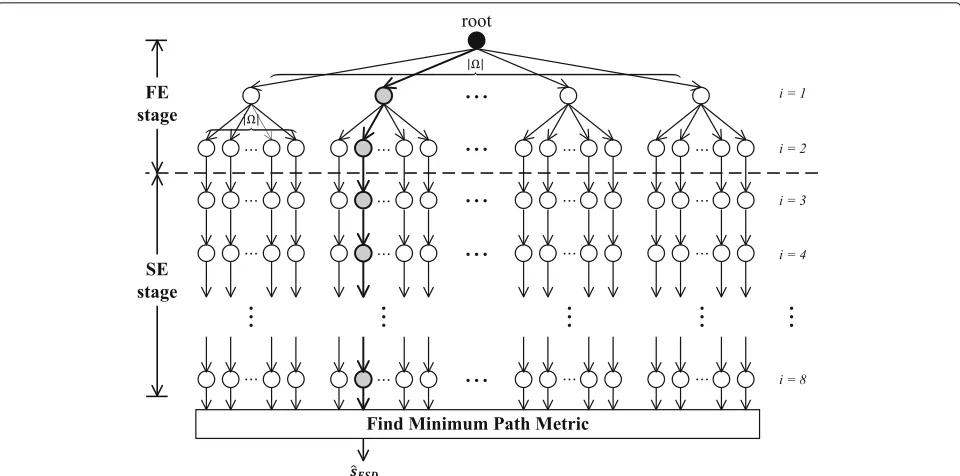
whereq = QHyandv = QHn. Figure 1 shows that the FSD performs constrained tree searching on (11), which consists of the full expansion (FE) and single expansion (SE) stages. For the firstNplevels, FE is performed, where all possible || branches are expanded. Then, for the remainingNT−Nplevels, SE is performed, where only one branch is expanded on each node in the manner of SIC. In other words, the FSD solution is given by
ˆ
sFSD= arg
s∈Lminq−Rs
2, (12)
whereLis the candidate list, which is generated as follows:
Fig. 1Tree structure of the FSD on an 8×8 MIMO system with||-QAM andNp=2. The gray-colored tree node contains the FSD solution
2.4 LR-aided FSD [15]
In order to reduce the complexity, the LR-aided FSD algo-rithm lowers the number of tree levels in the FE stage, in order to reduce the parent nodes generated at the FE stage. Nevertheless, the proposed algorithm maintains near-optimal BER performance by adopting LR-aided SIC at the SE stage. However, the application of the LR algo-rithm to the FSD is not straightforward. The bases of the channel matrix are modified in the lattice-reduced system model so that the child nodes cannot be expanded [10]. Hence, the LR-aided FSD generates the candidate signal in the FE stage, and cancel the FE signals in the original con-stellation domain before transforming the system model into a lattice-reduced one.
In other words, the FE candidate signals are cancelled and nulled as follows:
y(k)=y− NT
l=NT−Np+1
hlˆsl(k), (15)
wherey(k)denotes theNR×1 received signal in the revised system model,hl is thelth column vector of the channel matrixH, andˆsl(k)is thekth FE candidate signal transmit-ted from thelth transmit antenna. Then, the system model is transformed to a nulled system model as follows:
y(k)Hs(k)+n, (16)
whereH ands(k)respectively denote theNR×
NT−Np
channel matrix and theNT−Np× 1 transmitted sig-nal whoselthl=NT−Np+1,· · ·,NTcolumn vectors and elements are nulled. Then, LR-aided SIC is performed
on (16) to complete the candidate list, and the detection is completed by the ML test, where the symbol vector with the minimum Euclidean distance (ED) is detected as the solution.
3 Proposed algorithm
3.1 Motivation
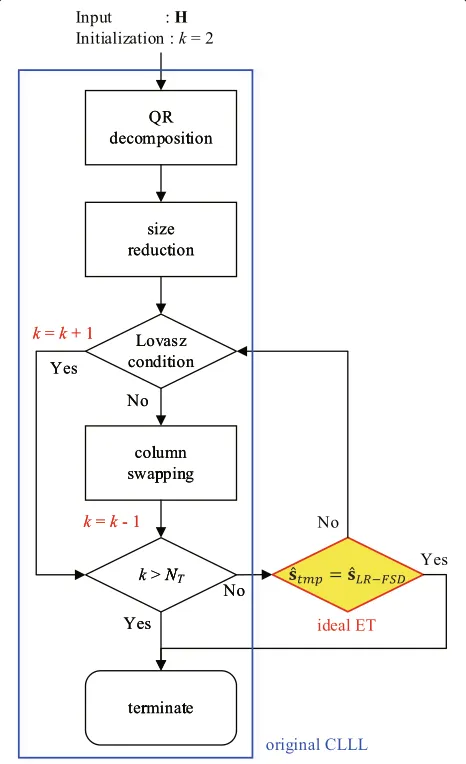
Motivated by the previous analysis in [25], we conducted a hypothetical experiment to determine whether it is fun-damentally possible to apply the ET scheme to LR-aided detectors other than the LR-aided SIC detector, as illus-trated in Fig. 2. First, the LR-aided FSD solutionsˆLR-FSD was obtained using the channel matrix that passed the basis-reduction process with the original CLLL. Then, at the end of each CLLL iteration, the temporary LR-aided FSD solution sˆtmp was obtained with the inter-mediate lattice-reduced channel condition. We compared ˆ
sLR-FSD andsˆtmp at each CLLL iteration, and terminated the reduction process when the two solutions were the same—referred to as the ideal ET.
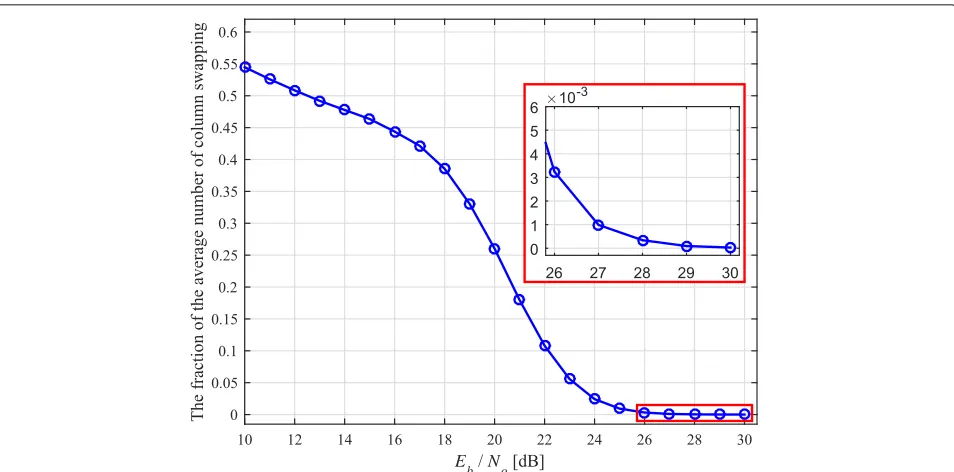
We performed this simulation on an 8×8 MIMO system with 256-QAM andNp=1. As shown in Fig. 3, a consid-erable portion of the CLLL process is unnecessary in the context of MIMO detection with the LR-aided FSD, espe-cially at high Eb/No values. Hence, it can be concluded that it is indeed fundamentally possible to employ the ET in the LR-aided FSD.
Fig. 2Flow chart for CLLL with ideal ET. Here,ˆsLR-FSDis the LR-aided FSD solution with the original CLLL, andsˆtmpis the LR-aided FSD solution obtained at each iteration
y−Hsˆtmp2≤Aσn2, (17)
where A is the positive parameter that determines the tradeoff between performance and computational com-plexity. However, there is a critical issue in the application of the ET to the LR-aided FSD. Whereas ILR obtained the practical ET criterion with RA by performing partial SIC detection during the intermediate LR process, all par-ent nodes should be considered as the candidate signal in the LR-aided FSD, making the overhead incurred by the partial detection too large. A novel way of handling this obstacle is proposed in the next subsection.
3.2 CLLL with ET for the LR-aided FSD
A problem arises when applying conventional ILR directly to the LR-aided FSD [15]: all the parent nodes in the FE stage should be considered for partial detection, making
the overhead incurred by the partial detection too large. In order to solve this problem, the proposed algorithm exchanges the column vectors of the channel matrix cor-responding to the FE stage and SE stage. LR is performed on column vectors during the SE stage exclusively, and not during the FE stage. In this way, as the LR-aided FSD performs LR-aided detection during the SE stage, the col-umn vectors that actually involve LR-aided detection are lattice-reduced. Furthermore, because the signals of the SE stage are switched to the upper level of the tree struc-ture, partial detection with SIC can be performed on the corresponding signals.
Let us explain in more detail the proposed algorithm with in a 4×4 MIMO system. The system model in (1) can be written in a 4×4 MIMO system as
y=Hs+n=h1s1+h2s2+h3s3+h4s4+n. (18)
Then, the LR-aided FSD with Np = 1 transforms the system model to a nulled system model as
y(k)Hs +nh1s1+h2s2+h3s3+n. (19)
In order to perform the LR-aided SIC detection on the SE stage, (19) is transformed to a lattice-reduced system model as
y(k)Hs +n=HTT −1s +nH˜ z +n, (20)
where H˜ HT and z T −1s. Also, T is the transformation matrix to assure the lattice-reduced char-acteristics ofH, which is obtained by performing the LLL toH. Here,T needs to assure the lattice-reduced char-acteristics between the column vectors {h1,h2,h3}, not
h4. Hence, the proposed algorithm obtainsT based on a different system model as
y= ¯Hs¯+n, H¯ =[h4,H] , ¯s=[s4,s]
(21)
where, the channel column vector and the transmit sig-nal corresponding to the FE sigsig-nal are moved to the front column and row, respectively. Then, whereas the con-ventional LLL starts from the first column, the proposed algorithm skips the first column and performs the LLL processing only onH. In other words, the initial value of the column indexkis changed from 2 to 3. The output of the proposed algorithm is a 4×4 transformation matrix
¯
Twhose right-lower submatrix is the same asT, which
means thatT¯ =
1 01×3
03×1 T
.
Fig. 3Fraction of the average number of column swaps, compared to the original CLLL. The simulation was conducted using the LR-aided FSD on an 8×8 MIMO system with 256-QAM andNp=1
(17). However, the proposed algorithm reduces the com-plexity considerably with little performance degradation, which is shown in the next Section.
The proposed algorithm is summarised in Table 2 and has the following main features.
3.2.1 Input channel matrix conversion (line 1 in Table 2) First, the column vectors of Hcorresponding to the FE stage and SE stage are exchanged, resulting in a converted channel matrix H¯. In this way, signals corresponding to the SE stage are displaced to the upper level in the tree structure so that partial SIC detection can be applied to the corresponding signals without considering the parent nodes during the FE stage.
3.2.2 Modification of the index for LR processing
The LR-aided FSD priorly eliminates FE signals and per-forms LR-aided SIC detection during the SE stage. This means that column vectors corresponding to the SE stage are those that actually require the basis-reduction process. Hence, as detailed in the initialization step and line 21 in Table 2, the column search index for LR processing,k, is modified from [2,· · ·,NT] to
2+Np,· · ·,NT
.
3.2.3 ET check (lines 4–17 in Table 2)
Prior to each LR iteration, an ET check is performed by adopting the RA criterion, which is computed by the symbol partially detected with the intermediate lattice-reduced channel. If the detected symbol is within the predetermined boundary, LR processing is terminated.
Note that this operation is performed only when col-umn swapping occurs so that the channel condition is modified. Furthermore, the symbol index where partial detection is performed is determined according to the column-swapping index, as shown in line 23 in Table 2.
3.2.4 Modified QRD (line 2 in Table 2)
The LR-aided FSD uses the nulled channel matrix,H in (16), which consists of the column vectors of the chan-nel matrix corresponding to the SE stage, as the input of the CLLL process. Meanwhile, the proposed algorithm uses the full channel matrixHafter converting toH¯. Let H = QR andH¯ = ¯QR¯, which are the results of the QRD. Then, the output matrices (Q,R) and (Q¯,R¯) differ from each other. This means that the proposed algorithm performs LR in an undesired manner, as LR processing is dependent on the QRD result.
To overcome this problem, we modified the QRD algo-rithm in the proposed algoalgo-rithm, which is based on the QRD with the Gram–Schmidt (GS) process. The pro-posed modification to the QRD algorithm is summarised in Table 3. Unlike the original QRD, the modified QRD performs the GS process for the column vectors of the channel matrix corresponding to the SE stage, generat-ing an orthonormalized basis. This orthonormal matrix results in a unitary matrix Q¯, which is equivalent toQ. Then, the Q¯H is multiplied by H¯, resulting in a par-tially upper-triangular matrixR¯, whose right-side column vectors are identical to R—i.e.R¯:,Np+1 :NT
Table 2Proposed CLLL algorithm with ET for the LR-aided FSD
Modified_QRD : in Table 3
Size_Reduction : Line 2–8 in Table 1
Column_Swapping : Line 10–13 in Table 1
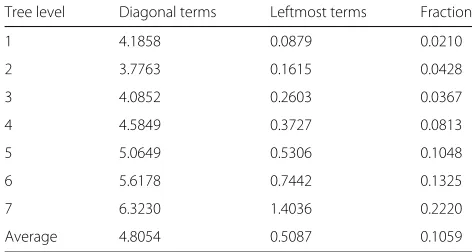
Although the leftmost column vector ofR¯ affects the par-tial SIC detection in the ET check as the interference, each element in the vector is statistically smaller than the diag-onal terms ofR. This is because the power of the leftmost terms ofR¯ are distributed normally, whereas the power ofR are converged to the diagonal terms due to the FSD
Table 3Modified QRD algorithm
Input:H¯,Np
ordering. Table 4 presents the average power of the diag-onal terms ofR, the leftmost terms ofR¯, and the fraction of the leftmost terms normalized by the diagonal terms on each tree level. Consequently, the interference of the leftmost column vector is nominal.
4 Simulation results
In this section, the BER performance and the computa-tional complexity of the convencomputa-tional CLLL is compared to that of the proposed CLLL with ET for LR-aided FSD through computer simulations. The simulation was con-ducted on an uncoded 8× 8 MIMO system with 256-QAM, withNp = 1 for LR-aided FSD. Here,Ebdenotes the average energy per information bit arriving at the receiver. Thus, the signal-to-noise-ratio (SNR) is given by Eb/No=NR/
log2(||)σn2.
Figure 4 shows the uncoded BER performance of the SD, FSD, and LR-aided FSD with different LR algorithms, as a function ofEb/No. Because the time consumption of
Table 4The average power of the diagonal terms ofR, the
leftmost terms ofR¯, and the fraction of the leftmost terms normalized by the diagonal terms on each tree level. The channel condition is given by the Rayleigh fading channel ordered by the FSD channel ordering
Tree level Diagonal terms Leftmost terms Fraction
Fig. 4Comparison of the uncoded BER performance of MIMO detectors. The simulation was conducted on an uncoded 8×8 MIMO system with 256-QAM, withNp=1 for the LR-aided FSD
the optimal ML simulation is too high, the optimal per-formance was obtained by performing the simulation with the SD. In order to achieve near-optimal performance, the FSD must satisfyNp≥√NT −1, ifNT =NRholds. This means thatNP ≥ 2 must hold whenNT = NR = 8 [27].
Therefore, there was considerable performance degrada-tion for the FSD with Np = 1, whereas the FSD with Np=2 achieved near-optimal performance.
By contrast, the LR-aided FSD with CLLL achieved near-optimal performance despite an insufficient number
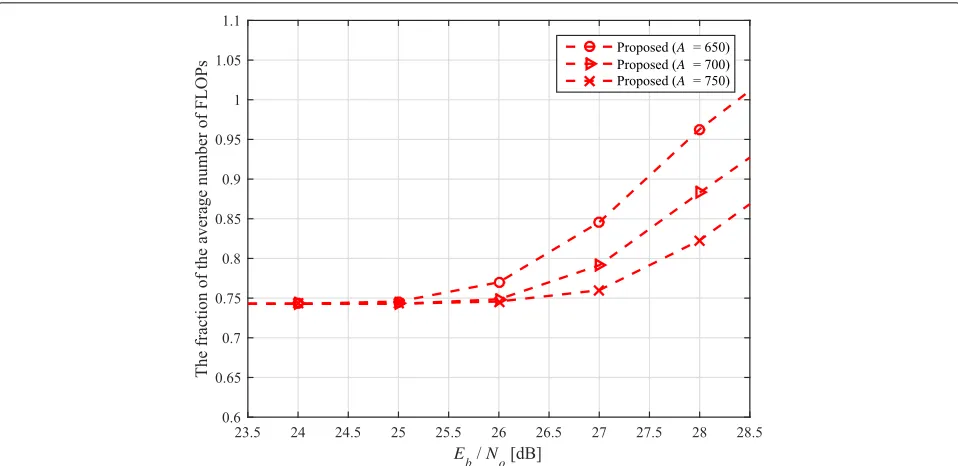
Fig. 6Fraction of the average number of FLOPs from the proposed LR algorithm normalized by the conventional CLLL as a function ofEb/No
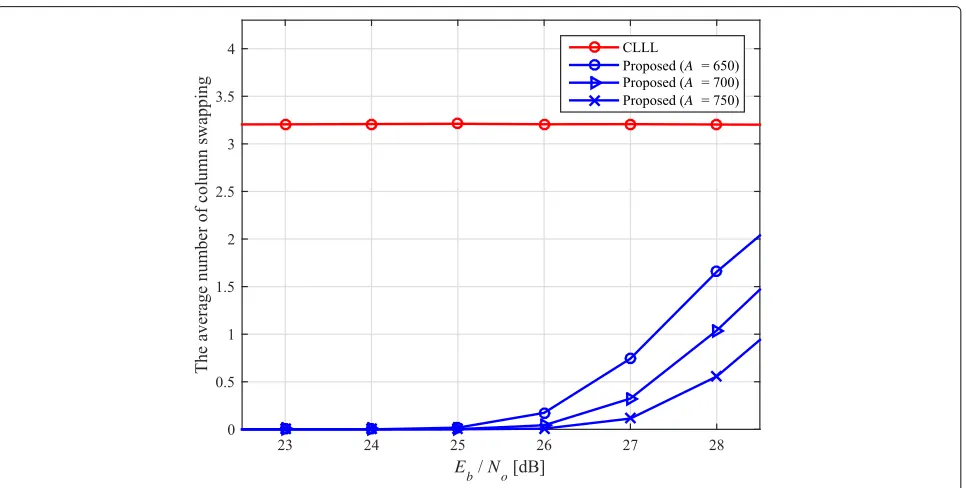
of FE stage. Moreover, when the proposed LR algorithm was applied, the performance degradation with the LR-aided FSD was less than 0.5 dB forA ≤ 700 at a BER of 10−5. Note that the performance of the conventional CLLL and the proposed algorithm for A = 0 was the same because no ET occurred. Meanwhile, Fig. 5 shows the reduction in the average number of column swaps
in the LR algorithms, which is the celebrated indicator of the computational complexity of the LR algorithm. Contrary to the result with the ideal ET which is shown in Fig. 3, the average number of column swaps increases for higher SNR. This is because the threshold of the RA gets tighter as the noise variance decreases. As the per-formance degradation is more sensitive to the channel
condition for higher SNR, it is inevitable to get the thresh-old tighter. Nevertheless, the average number of column swaps in the proposed algorithm with A = 700 was reduced to approximately 30 % of that of the CLLL at Eb/No≈28 dB where the BER is approximately 10−5.
For a more generalized comparison, the computational complexity was analysed in terms of the number of float-ing point operations (FLOPs), which we obtained accord-ing to the followaccord-ing rules [28]:
• The multiplication ofl×mandm×nreal (complex) matrices requires2lmn(8lmn) FLOPs.
• The Moore–Penrose pseudo-inverse of anm×nreal matrix requires2m3−2m2+m+16mnFLOPs.
Figure 6 illustrates the average number of FLOPs from the proposed LR algorithm normalized by the conven-tional CLLL. Although there was overhead owing to the ET check, the complexity of the proposed LR algorithm with A = 700 was reduced by approximately 40 % at Eb/No=28 dB where the BER is approximately 10−5.
In Fig. 7, the average number of FLOPs from the LR-aided FSD with the proposed LR algorithm normalized by the one with the conventional CLLL is illustrated. As the complexity of the FSD is not negligible, the reduc-tion rate of the FLOPs is decreased, compared to the results in Fig. 6. However, there still exists the decrease in the computational complexity which is approximately 18 % atEb/No = 28 dB where the BER is approximately 10−5. Note that this reduction rate can be increased, if the proposed algorithm adopts the low-complexity FSD algo-rithms such as simplified FSD [29] or FSD with pruning [30].
5 Conclusions
In this paper, we proposed a low-complexity LR algorithm with ET for detectors with tree searching. Whereas the ILR [25] is limited to LR-aided SIC detectors, the pro-posed algorithm is an extension of the conventional approach to LR for detectors with tree searching. We performed an additional hypothetical analysis and sev-eral novel modifications to the conventional algorithm in order to overcome its limitations.
We verified the performance of the proposed algorithm with a computer simulation, demonstrating that the aver-age number of column swaps was reduced, with negligible BER performance degradation. Furthermore, for a fair comparison, the computational complexity was analysed in terms of the number of FLOPs, indicating a significant reduction in computational complexity.
Acknowledgments
This work was supported by the National Research Foundation of Korea(NRF) grant funded by the Korea government(MSIP) (No. NRF-2015R1A2A2A0100 4883).
Competing interests
The authors declare that they have no competing interests.
Received: 22 May 2016 Accepted: 14 October 2016
References
1. E Viterbo, J Boutros, A univeral lattice code decoder for fading channels. IEEE Trans. Inform. Theory.45(5), 1639–1642 (1999)
2. MO Damen, HE Gamal, G Caire, On maximum-likelihood detection and the search for the lattice point. IEEE Trans. Inform. Theory.49(10), 2389–2402 (2003)
3. L Barbero, J Thompson, Fixing the complexity of the sphere decoder for MIMO detection. IEEE Trans. Wirel. Commun.7(6), 2131–2142 (2008) 4. C Xiong, X Zhang, K Wu, D Yang, A simplified fixed-complexity sphere
decoder for V-BLAST systems. IEEE Commun. Lett.13(8), 582–584 (2009) 5. KW Wong, CY Tsui, RK Cheng, WH Mow, A VLSI architecture of a K-Best
lattice decoding algorithm for MIMO channels. IEEE Int. Symp. Circuits Syst.3, 273–276 (2002)
6. H Yao, HW Wornell, Lattice-reduction-aided detectors for MIMO communications systems. IEEE Global Telecommun. Conf.1, 424–428 (2002)
7. D Wübben, R Böhnke, V Kühn, KD Kammeyer, Near-maximum-likelihood detection of MIMO systems using MMSE-based lattice reduction. IEEE Int. Conf. Commun.2, 798–802 (2004)
8. M Taherzadeh, A Mobasher, AK Khandani, LLL reduction achieves the receive diversity in MIMO decoding. IEEE Trans. Inform. Theory.53(12), 4801–4805 (2007)
9. J Jaldén, P Elia, DMT optimality of LR-aided linear decoders for a general class of channels, lattice designs, system models. IEEE Trans. inform. Theory.56(10), 4765–4780 (2010)
10. M Shabany, P Gulak, The application of lattice-reduction to the K-best algorithm for near-optimal MIMO detection. IEEE Int. Symp. Circuits Syst, 316–319 (2008)
11. M Shabany, P Gulak, A 675 Mbps,4×464-QAM K-best MIMO detector in 0.13μm CMOS. IEEE Trans. Very Large Scale Integr. (VLSI) Syst.20(1), 135–147 (2012)
12. S Aubert, Y Nasser, F Nouvel, Lattice-reduction-aided minimum mean square error K-best detection for MIMO systems. IEEE Int. Conf. Comput. Netw. Commun.2, 798–802 (2004)
13. H Kim, J Park, H Lee, J Kim, Near-ML MIMO detection algorithm with LR-aided fixed-complexity tree searching. IEEE Commun. Lett.18(12), 2221–2224 (2014)
14. J Liu, S Xing, L Shen, Lattice-reduction-aided sphere decoding for MIMO detection achieving ML performance. IEEE Commun. Lett.20(1), 125–128 (2016)
15. H Kim, J Kim, Near-optimal MIMO detection algorithm with low and fixed complexity. IEEE Int. Symp. Consumer Electron, 1–2 (2015)
16. YH Gan, C Ling, WH Mow, Complex lattice reduction algorithm for low-complexity full-diversity MIMO detection. IEEE Trans. Signal Prcoess. 57(7), 2701–2710 (2009)
17. AK Lenstra, HW Lenstra, L Lovász, Factoring polynomials with rational coefficients. Math. Ann.261, 515–534 (1982)
18. C Ling, N Howgrave-Graham, Effective LLL reduction for lattice decoding. IEEE Int. Symp. Inform. Theory, 196–200 (2007)
19. W Zhang, S Qiao, Y Wei, A diagonal lattice reduction algorithm for MIMO detection. IEEE Signal Process. Lett.19(5), 311–314 (2012)
20. K Zhao, S Du, Full-diversity approximated lattice reduction algorithm for low-complexity MIMO detction. IEEE Commun. Lett.18(6), 1079–1082 (2014)
21. H Vetter, V Ponnampalam, M Sandell, PA Hoeher, Fixed-complexity LLL algorithm. IEEE Trans. Signal Process.57(4), 1634–1637 (2009) 22. K Zhao, H Jiang, Y Li, S Du, Random selection LLL algorithm and its fixed
complexity variant for MIMO detection. Int. Symp. Wirel. Personal Multimed. Commun, 1–5 (2011)
23. C Ling, WH Mow, N Howgrave-Graham, Reduced and fixed-complexity variants of the LLL algorithm for communications. IEEE Trans. Commun. 61(3), 1040–1050 (2013)
25. B Gestner, X Ma, DV Anderson, Incremental lattice reduction: motivation, theory, and practical implementation. IEEE Trans. Wirel. Commun.11(1), 188–198 (2012)
26. F Wang, Y Xiong, X Yang, Reliability assessment for MIMO detection and its applications. Int. J. Electron. Commun.63(8), 678–684 (2009) 27. J Jaldén, LG Barbero, B Ottersten, JS Thompson, Full-diversity detection in
MIMO systems with a fixed-complexity sphere decoder. IEEE Int. Conf. Acoustics Speech Signal Process.3, 49–52 (2007)
28. GH Golub, CF Van Loan,Matrix computations. (The Johns Hopkins University Press, Baltimore, 2013)
29. C Xiong, X Zhang, K Wu, D Yang, A simplified fixed-complexity sphere decoder for V-BLAST Systems. IEEE Commun. Lett.13(8), 582–584 (2009) 30. S Lei, Q Tu, D Yang, J Chen, Probabilistic tree pruning for fixed-complexity
sphere decoder in MIMO systems. IEEE Int. Conf. Wirel. Commun. Signal Process, 1–6 (2010)
Submit your manuscript to a
journal and benefi t from:
7Convenient online submission
7Rigorous peer review
7Immediate publication on acceptance
7Open access: articles freely available online
7High visibility within the fi eld
7Retaining the copyright to your article
![Table 1 CLLL algorithm [16]](https://thumb-us.123doks.com/thumbv2/123dok_us/933007.1113403/3.595.56.293.339.727/table-clll-algorithm.webp)