USF Scholarship: a digital repository @ Gleeson Library | Geschke
USF Scholarship: a digital repository @ Gleeson Library | Geschke
Center
Center
Doctoral Dissertations Theses, Dissertations, Capstones and Projects
2019
ANTI-OPPRESSIVE EDUCATION WITH A “DIFFERENT KIND OF
ANTI-OPPRESSIVE EDUCATION WITH A “DIFFERENT KIND OF
RIGOR”: TEACHERS’ AND ADMINSTRATORS’ PERSPECTIVES OF A
RIGOR”: TEACHERS’ AND ADMINSTRATORS’ PERSPECTIVES OF A
SOCIAL JUSTICE EDUCATION PROGRAM AT AN AFFLUENT
SOCIAL JUSTICE EDUCATION PROGRAM AT AN AFFLUENT
PUBLIC HIGH SCHOOL
PUBLIC HIGH SCHOOL
Andrea Frances Struve
Follow this and additional works at: https://repository.usfca.edu/diss
ANTI-OPPRESSIVE EDUCATION WITH A “DIFFERENT KIND OF RIGOR”: TEACHERS’ AND ADMINSTRATORS’ PERSPECTIVES OF A SOCIAL JUSTICE
EDUCATION PROGRAM AT AN AFFLUENT PUBLIC HIGH SCHOOL
A Dissertation Presented To
The Faculty of the School of Education
International and Multicultural Education Department
In Partial Fulfillment Of the Requirements of the Degree
Doctor of Education
by Andrea Struve
THE UNIVERSITY OF SAN FRANCISCO
Dissertation Abstract
Anti-Oppressive Education with a “Different Kind of Rigor”: Teachers’ and
Administrators’ Perspectives of a Social Justice Education Program at an Affluent Public
High School
Affluent youth often experience intense pressure to succeed academically, while
conforming to narrow definitions of success that only serve to replicate the power and
privilege of their own communities. Therefore, students schooled in affluent settings need
to understand and problematize the roots and impact of their power and privilege, a
process requiring awareness of and empathy with the experiences of others less fortunate.
Social justice education is uniquely equipped to help students do exactly that.
Using a qualitative design, this case study of a social justice education program in
an affluent public high school explored how teachers committed to this program enact
anti-oppressive practices. Data collection included individual/focus group interviews with
the six program teachers alongside document analysis of student work and individual
interviews with administrators. Four major themes emerged. First, close teacher-student
relationships lie at the core of the social justice program; otherwise, the program could
not engage students in a transformative and democratic experience. Second, social justice
education must prepare students in an affluent school to challenge their position of
privilege. Third, teachers use critical pedagogy as a learning guide, enabling and
Fourth, to ensure program sustainability, more professional development is needed to
support learning how to teach for social justice.
Overall, the very existence of the program shows how the teachers at the school
counteract oppression through offering a challenge to the traditional approach to
schooling. The students in the social justice program have become empowered to move
This dissertation, written under the direction of the candidate’s dissertation committee
and approved by the members of the committee, has been presented to and accepted by
the Faculty of the School of Education in partial fulfillment of the requirements for the
degree of Doctor of Education. The content and research methodologies presented in this
work represent the work of the candidate alone.
Andrea Struve 7/24/19
____________________________________ ____________
Candidate Date
Dissertation Committee
Susan Katz 7/24/19
______________________________________ ____________ Chairperson
Rosa Jimenez 5/7/19
______________________________________ ____________
Ursula Aldana 5/7/19
DEDICATION
To my grandparents, present and past, new and old. Thank you for shaping me
into the person I am today. Helga’s fierce persistence, Helmut’s intense curiosity,
Marilyn’s unapologetic love of learning alongside the two Muriel’s passions for social
justice and grammar, I appreciate all you have given and inspired me to do. I love all of
you. You have all made the world a better place, and I hope this dissertation makes you
ACKNOWLEDGMENTS
The Greenship Academy community welcomed me three years ago as a teacher.
This dissertation cannot repay all of the lessons I have learned and support you have
given me, but I hope it can shed light on some of the amazing work completed within the
school itself. Coach and Jack your leadership is inspiring; Amy, Bruce, Matthew, Neil,
Robin, Steve, your dedication to teaching as a career and love for both your students and
social justice is profound. I am grateful to all of you for the thoughts and experiences you
shared and your part in making my ideas (and my study) a reality.
To Dr. Susan Katz, thank you for inspiring my entry into the doctoral program
and my passion for human rights, for your advising support across my years in the
program, and the countless hours you spent providing advice, assistance and
encouragement as my chair. I would not be where I am today without you. I am also
indebted to Dr. Ursula Aldana and Dr. Rosa Jimenez for serving on my dissertation
committee and sharing their invaluable expertise. To the professors who challenged and
encouraged me, especially Dr. Monisha Bajaj, Dr. Emma Fuentes, Dr. Emily Nusbaum,
Dr. Lance McCready, Dr. Betty Taylor, throughout this dissertation process: you gave me
the lens and the tools with which to conduct my research. More importantly, because of
your guidance, I learned to be a better educator, researcher and human.
My mentor and friend, Dr. Andrea McEvoy Spero, thank you for showing me
how to be a teacher and advocate for social justice. Your encouragement aided me at the
start and end of the doctoral program, helping me transition from master’s student to
doctoral student and providing me with meaningful advice in the dissertation writing
eternally understanding and giving, while making me laugh when I thought I might cry.
To my friends at USF, I appreciate the solidarity you all extended to me throughout this
journey. Ash Burciaga you taught me that I can have it all, Mauro Sifuentes you showed
me perseverance with the unexpected, and Jenni Bosco your writing encouragement and
accountability built my paper.
I will never be able to fully thank my family for their endless love and support. To
my mother, Dr. Octavia Struve, and to my father, Dr. Steven Struve, I appreciate all you
have given me. From financial to emotional support, you have been there for me since
day one. Your achievements are immense and I strive to follow in both of your footsteps,
becoming a revered and respected expert in my field. I appreciate your support in helping
me find my own goals and in creating opportunities for me to achieve them. To my sister,
Dr. Isabelle (Ishy) Struve, achieving your dreams through persistence and drive despite
the many barriers against you helped me to realize anything is possible when true grit is
shown. I am proud to say I used my big sister’s example to make it through this process.
Finally, to my fiancé, partner and friend, Brandon James, your unwavering
support made this dissertation possible. Our long-awaited spontaneous adventuring is
overdue, but I am so proud of how we both grew through this process. Thank you for
your love, hugs, and never-ending patience. I am grateful for your fierce confidence in
TABLE OF CONTENTS
DISSERTATION ABSTRACT ... II DEDICATION ... V ACKNOWLEDGMENTS ... VI
CHAPTER I: THE RESEARCH PROBLEM ... 1
Introduction... 1
Statement of the Problem ... 2
Background and Need ... 4
Purpose of the Study ... 5
Definition of Terms ... 6
Theoretical Rationale/ Conceptual Framework ... 7
Hegemony ... 8
Critical pedagogy ... 9
Counter-hegemony ... 10
Research Questions ... 11
Delimitations ... 12
Limitations ... 13
Educational Significance ... 13
CHAPTER II: LITERATURE REVIEW ... 14
Current State of Public Schooling in the United States ... 14
Current climate of affluent public high schools ... 18
Funding ... 18
Mental health ... 19
Anti-Oppression Education in Action ... 21
Studies in human rights and peace education ... 24
Studies in social justice education... 27
Summary ... 43
CHAPTER III: METHODOLOGY ... 45
Research Design ... 45
Research Questions ... 45
Research Setting ... 46
Community ... 46
School site ... 47
Physical space ... 47
School programs ... 48
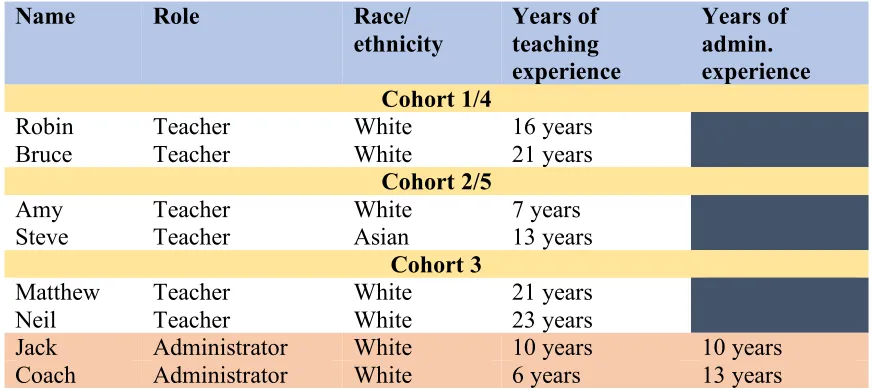
Participants ... 49
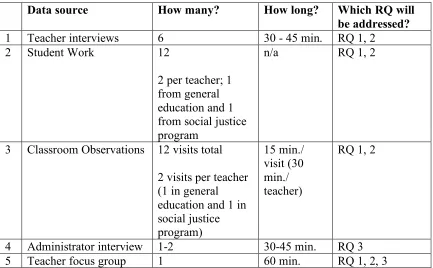
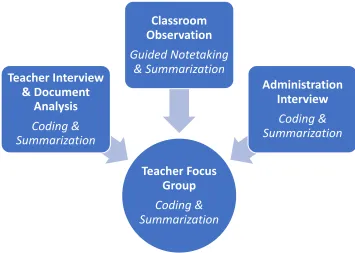
Data Collection ... 51
Teacher interviews and student work analysis... 52
Classroom observations ... 52
Administrator interviews ... 53
Teacher focus group ... 53
My positionality ... 57
Confidentiality ... 59
CHAPTER IV: FINDINGS ... 61
Introduction... 61
Program Profile ... 62
Research Question 1A: What Life Experiences Led to the Teachers’ Interest in Teaching and in Social Justice? ... 64
Robin ... 64
Bruce... 64
Amy ... 65
Steve ... 65
Matthew ... 66
Neil ... 66
Teaching as a career ... 66
Path to social justice ... 68
Social justice is about power ... 70
Summary of research question 1A ... 71
Research Question 1B: Why do the teachers choose to use social justice pedagogy in an affluent public school? ... 72
Challenging the system ... 73
Teachers joined program only after being asked ... 76
Building a relationship with students ... 78
Summary of research question 1B ... 79
Research Question 2A: How Do Social Justice Teachers in an Affluent Public School Describe their Pedagogical Approach and Curricular Practices for the Social Justice Program? ... 80
Reflective of teaching for student learning ... 81
Project focused ... 82
Iterative process ... 85
Summary of research question 2A ... 88
Research Question 2B: How Do Teachers in the Social Justice Program Understand and Plan for their Curriculum in Comparison with the General Education Program? . 88 Expert teacher v. learning guide ... 89
Not less, but different rigor ... 93
Summary of research question 2B ... 102
Research Question 3: What Are the Conditions Necessary for a Social Justice Program to Sustain Itself, According to Teachers and Administrators? ... 102
More clear expectations for students ... 103
Formalized new teacher onboarding ... 105
Ingrained support ... 107
Administrative awareness ... 110
Summary of research question 3 ... 113
Summary of Findings ... 114
Discussion ... 118
Relationships build access, depth, and interest ... 118
Social justice in affluent public schooling settings is about power and privilege .. 120
Critical pedagogy is teaching as a learning guide ... 123
Teacher support is necessary for program sustainability ... 125
Recommendations ... 127
For policy and practice ... 127
For further teacher support ... 127
For further research ... 128
Conclusion ... 128
REFERENCES ... 130
APPENDIX A: TEACHER PARTICIPANT CONSENT FORM ... 139
APPENDIX B: TEACHER PARTICIPANT INTERVIEW PROTOCOL... 142
APPENDIX C: TEACHER PARTICIPANT FOCUS GROUP PROTOCOL... 144
APPENDIX D: ADMINISTRATION PARTICIPANT CONSENT FORM ... 145
APPENDIX E: ADMINISTRATOR PARTICIPANT INTERVIEW PROTOCOL ... 148
CHAPTER I: THE RESEARCH PROBLEM
Introduction
Lecture, homework, test. Lecture, homework, test. Project. Next class. Next
semester. Next year. The curricular repetition of a school year is not hard to imagine. For
most, this type of learning is familiar as it is the traditional model of schooling. Now,
imagine this traditional model in an affluent, suburban and high achieving public high
school where teachers stand at the front of the classroom while students are in desks,
moving as the bell rings to their next class. The bell segments the day, and each bell
signifies a change in subject, an end to further thought and engagement. In this school,
students get to choose their courses, but their choice only gets them so far as not all
courses are accessible to everyone. Students are usually grouped by ability, which often
translates to race and class differences, as the students who can afford tutors enroll in
higher level courses. The course offerings are robust; however, with an emphasis on
weighted Grade Point Averages (GPA), honors and Advanced Placement (AP) courses
are seen as the norm and general education courses as the outlier. Furthermore,
innovation is encouraged and initiatives are highly sought after for both students and
teachers, but the strings and attachments that come with new programs, courses, and
ideas have so many requirements that the creations are usually not heavily supported
unless benefitting the majority. Since the ‘majority’ in the context of this school is the
socioeconomic elite, they are the ones who ultimately benefit from the competition and
standardization of curriculum.
This school, Greenship Academy (pseudonym), is one of the most well-funded
model of learning, with pressure to earn high grades through memorizing, taking tests,
and repetition. In contrast, critical thinking beyond a test and creativity outside of the arts
programs on campus are not heavily emphasized amongst all subjects, students, and
abilities. This style of learning is not questioned, as Greenship Academy has received
repeated nationwide recognition for achievement and academic excellence with this
traditional model. Therefore, the system and process of schooling becomes all about a
limited notion of success, not about pushing the student beyond their comfort zone or
beliefs about the world around them. The result is that the students’ world is one of
power and privilege, both widely unacknowledged at the school and in the larger
community.
The Social Justice Program, a teacher-initiated and teacher-run program at
Greenship Academy, attempts to change this narrative. It uses a democratized approach
to education with a focus on student-centered, project-based learning and critical thinking
over traditional schooling. In the process, the program attempts to challenge the status
quo and seeks curriculum that interrogates the intricacies of systemic oppression,
specifically the role of power and privilege in reproducing it, through having the students
engage in conversations and recognize their own role in continuing the system.
Statement of the Problem
Unless students are challenged to uncover their power and privilege, they may be
unaware of its true impact, an impact that can only be uncovered through understanding
the experiences of others (Adams, Bell & Griffith, 2007; Bell, 2010). Unfortunately,
members of an affluent community do not always seek out the experiences and needs of
progressivists and parents in the students’ lives tend to want what’s best for their own
child, a child who already has access to the best tutors, sports, and arts programs, and
ability to attend college without batting an eye (Swalwell, 2013). However, what happens
to be best for one student with power and privilege is most often not best for all students.
The Social Justice Program provides a sharp contrast to the potential narrative of
oppression that the powerful elite within the community have ability to replicate. It
moves students beyond their comfort zone, transforming the classroom from a general
education curriculum to one situated in narratives of the oppressed (i.e. people
marginalized for race, class, gender, sexual orientation), challenging students to question
the system and their own lives within it. The students engage in the program with the
understanding that it is entirely democratic; the students vote on the classes they will
take, and the majority wins for the collective. For instance, last year, students voted to
take California History instead of Foreign Policy and Sociology with the hope of
understanding the development of the Bay Area from the Indigenous Ohlone tribes to the
Gold Rush and the Gay Rights Movement.
This focus on the world outside of the small affluent suburban community where
Greenship Academy is centered allows for the students, the school, and the community as
a whole to be exposed to questions, perspectives, and ways of interpreting the world that
would otherwise go unchallenged. Throughout this dissertation, I explore how teachers’
implementation of democratic critical pedagogy through a social justice curriculum can
challenge a traditional model and approach to schooling and combat the replication of
Background and Need
While the use of critical pedagogy to overturn systems of power in schooling is a
common theme in educational literature, doing so in the context of an affluent school is
rare and less examined. Swalwell (2013) notes that social justice programs are usually
associated with low-income urban schools, but they are also essential in preparing
privileged children to become citizens and community members who engage within a
healthy democracy. Westheimer and Kahne (2004) further this claim as they conclude
that educators make pedagogical choices to support the vision of a healthy democracy
with community members who resemble responsible, participatory, and social
justice-oriented citizens.
Social justice is the complete and equal participation of all groups within society;
a society that is mutually shaped to meet all persons’ needs with an equal (or preferably
equitable) distribution of resources in which all members are independent with individual
agency and also interdependent, maintaining a sense of social responsibility within the
community (Adams, Bell & Griffith, 2007). To achieve social justice is not an easily
completed objective, as it is the ultimate goal to be reached in order to reform an
oppressive system.
This goal is aided through the guidance and support of social justice education as
it enables people to develop the skills necessary to “understand oppression and their own
socialization within oppressive systems” and to “develop a sense of agency to disrupt
oppressive patterns” (Adams, Bell & Griffith, 2007, p. 2). Social justice education
intends to combat the varying kinds of oppression that have withstood the test of time
subordination, and hegemony represent long-lasting forms of oppression seen in society,
and more importantly, reproduced through schooling. The identification of these forms of
oppression through schooling is essential in uncovering how social justice education
functions to rebuild perceptions, connections, and community.
The importance of comprehensive anti-oppression or social justice-based
education to dismantle oppression in affluent contexts has become clear in recent studies
conducted by Hagerman (2018) and Swalwell (2013) that explore the harm of
unchallenged privilege in communities of affluence. Both studies focus on the impact of
social justice-based curriculum on students’ understanding or oppression. Although prior
studies such as these have evaluated social justice curriculum in schools, few have
considered these issues within the context of affluent schools.
Purpose of the Study
The purpose of this qualitative study was to explore and evaluate the efforts of
social justice education in an affluent public high school setting, examining the dynamic
effects of the curriculum on the school community (i.e. learners and educators) from the
teachers and administrators’ perspectives. A small-scale case study approach was used,
focusing on one affluent public school, Greenship Academy, with an extant social justice
program. The program was in its fifth year with 120 students enrolled in this opt-in
program. Beginning sophomore year, students learn the humanities from a social justice
perspective with the same cohort of students for three years. The curriculum is created
and guided by the six teachers who began and currently run the entire program with
oversight and support from administration. Therefore, this study sought the stakeholders’
through individual and focus group interviews, document analysis of student work, and
observations.
Definition of Terms
Oppression. Teaching with a social justice lens requires an understanding of
oppression, marginalized people, privilege, schooling, and education. According to Bell,
Roberts, Irani and Murphy (2008), oppression is both a noun and a verb; it is pervasive,
restrictive, hierarchical, complex, internalized, and shared amongst marginalized groups.
It is the fusion of personal bias with institutional and systemic discrimination that plagues
most aspects of society. Kumashiro (2000) expands this definition, arguing oppression as
the creation and embodiment of the Other, causing privilege and marginalization within a
community; the Other is traditionally a group outside of the norm not given power by the
dominant group within society. The dominant group has primarily always been
considered to be people of Western European descent, but often is grouped with other
intersectional lenses, like affluence and gender (Powell, 2012).
Marginalized people are not just the racial Other or the non-white individuals; they are those who experience a perpetual denial of access to resources, opportunities,
and experiences who have embodied consequences of their status via class, race, gender,
amongst other identities (Adams, Bell & Griffith, 2007; Bell, Roberts, Irani & Murphy,
2008; Bell, 2010). As power and influence of the dominant group within society is
cyclical, self-promoted, and communal, it leads towards barriers in opportunity,
advancement, and achievement for the Other (Bell, 2010; Powell, 2012; Smith, 2006).
(2005), privilege refers to individuals who lack consciousness of and have been taught to
ignore their power within society, expecting all benefits from being of the dominant
group without earning it. Privilege becomes essential to maintain a sense of superiority or
entitlement that their needs are met, regardless of the cost to the Other and other members
of society. Parents with access to privilege internalize this ideology, and however liberal
or progressive they may be, end up making choices that maintain this privilege for their
children out of fear of taking risks that could jeopardize it (Hagerman, 2018). This aligns
with the discourse of privilege within social justice initiated by McIntosh (1990) who
explores and deconstructs the ways in which dominant groups of privilege maintain and
reproduce power at the expense of marginalized groups.
Schooling versus education. Kumashiro (2000) acknowledges that schools are
often spaces of silencing where marginalized youth are treated harmfully via others’
actions, assumptions and expectations; schools then become sites of this reproduction of
power through the process of schooling. Schooling, or the curriculum focused on conformity to the political and economic elite or privileged, is differentiated from all
forms of education, or the value of diversity and gain of knowledge to problem-solving
for the group (Shantz & Rideout, 2003). Both are set with the purpose of educating youth,
but only one has been built to reproduce harm. Therefore, education via schooling
becomes the ultimate cultivator of hegemony.
Theoretical Rationale/ Conceptual Framework
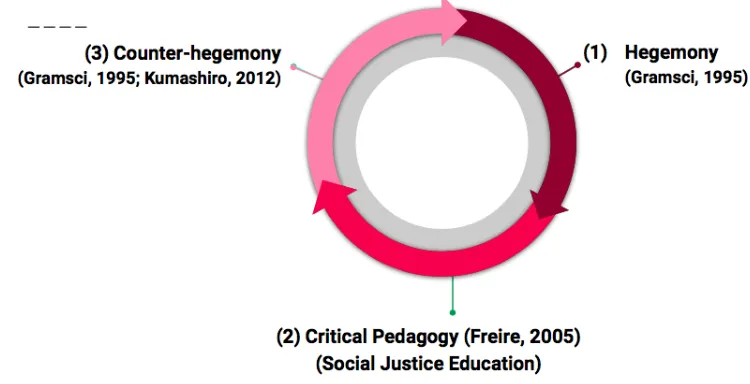
This paper integrates the concepts of hegemony, counter-hegemony, and critical
pedagogy into the theoretical rationale/conceptual framework for its research. Using
justice and anti-oppression education can move schooling towards counter-hegemony and
transformation for the students, teachers, and broader community (Figure 1).
Figure 1. As a visual representation of the conceptual framework used throughout the dissertation, critical pedagogy will work to counteract hegemony, working towards counter-hegemony in a cycle.
Hegemony
Defined as the “social, cultural, or economic influence exerted by a dominant
group over other groups,” current scholars have explored the concept of hegemony
through the writings of Antonio Gramsci, an Italian neo-Marxist theorist whose major
work on this topic was written in the 1920-1930s (Levinson, Gross, Hands, Dadds,
Kumasi & Link, 2012, p. 52). Gramsci (1995) used hegemony to define the bourgeoisie’s
rule over the proletariat, encompassing the entirety of culture and civil society. Gramsci
(1995) noted that in order to maintain consistent order and domination, the ruling class
must ensure that the working class either consents to or is coerced to accept its
hegemony. Most often, the dominant group uses coercion, impacting culture and society
Gramsci (1995) argued that schools, built with the purpose of producing a future
industrialized workforce, are sites of a racially-based political struggle as students each
day consent to instruction. Therefore, schools become industrial settings, replicating the
beliefs and the actions of those in power, giving them a complacent workforce for years
to come; therefore, the schooling system itself is oppressive for all students. Today, this
implicit hidden curriculum of capitalism and dominance shows up in everything from
class schedules to student assessments and grades. This task-orientated thinking provides
a reward for the job completed. While in the workforce this reward is a paycheck, in
school settings the currency is grades, not money. Student assessments emphasize getting
an “A” as the highest potential reward, thus fostering competition to be the best and
obtain the greatest possible currency for success (Levinson et al., 2012; Lipman, 2011).
When success is the name of the game and schools are the arena for where it is played,
whose success is valued?
Hegemony, therefore, is the ideal lens for this study as the focus of this research is
on affluent public schools, already situated in a culture of power based upon
socioeconomic wealth. Hegemony has the potential not only to reveal how privilege and
dominance interact with oppression in an affluent school, but also to show how students
in this context experience the pedagogy of oppression, and through the social justice
program, the pedagogy of liberation.
Critical pedagogy
Even though public schooling is rooted in and reproduces hegemony, action
against oppression can start inside the classroom through the tool of critical pedagogy.
between the oppressed and oppressor while looking at the dehumanization underlying the
“banking concept” of education (p. 72). The “banking” model sets up the teacher to
prepare the lesson and the student to then memorize the content; it is a one-way exchange
of knowledge without critical reflection or questioning. Within this traditional approach
to schooling, the student is oppressed as they cannot achieve knowledge, interact with
culture, or invoke change.
Therefore, the lens of critical pedagogy is essential to my research since
anti-oppression education involves “critical self-reflection of ideologies, power, and
privilege” (Berila, 2016, p. 13). Kumashiro (2000) firmly argues that anti-oppression
education is the model from which many others stem, including social justice education.
For the purpose of this study, anti-oppression is synonymous with social justice.
Education needs to be differentiated from pedagogy in the context of social justice.
Education isthe structures of schooling that incorporate social justice and the policies
that directly influence the ability of schools and teachers to apply social justice; whereas,
pedagogy is the practice and work of teachers with social justice within the classroom
context (Swalwell, 2013). Thus, social justice education through the application of social
justice pedagogy addresses internalized oppression and hegemonic structures, aiming to
achieve an emancipatory classroom that engages both students and teachers.
Counter-hegemony
Giroux (1988/2004) asserts that the achievement of maintaining an emancipatory
classroom through critical pedagogy allows the teacher to move beyond traditional forms
of academic success that hegemony created (i.e. grades, attendance, high stakes test
and act critically. Moving beyond what Freire (2005) called the “banking concept,” the
student in an emancipatory classroom receives knowledge about basic societal structures
(economy, state, work place, mass culture) to provide the tools necessary to transform
society (Giroux, 1988/2004). For transformation to be feasible, however, the teacher must
expose the four domains of power: structural, disciplinary, cultural, and interpersonal,
which Collins (2009) argues are the domains of power necessary for forms of oppression
to exist. Working in unison, these domains are the means by which hegemony and
oppression continue. Therefore, an educator must break, question, and/or engage one or
all domains of power to help guide their students toward a more inclusive classroom,
community and society- the ultimate purpose of social justice education (Bell, Roberts,
Irani & Murphy, 2008).
As students develop agency and a common language to expose hegemony and
create social justice, an emancipatory classroom begins; therefore, the emancipatory
classroom is also counter-hegemonic. The question underlying this study is: How do
teachers at an affluent public school engage in anti-oppressive education to work towards
social justice for all? Counter-hegemony, therefore, is essential in understanding the
intent behind social justice programs in affluent settings as well as teachers’ actions to
transform the classroom into a space where systemic inequalities and oppression are
addressed through awareness and action.
Research Questions
How do teachers committed to social justice education enact counter-hegemonic
and anti-oppressive practices in an affluent public school? This overarching question is
in social justice education? (2) What is each teacher’s approach to pedagogy and
curriculum? and (3) What are the teachers’ and administrators’ perspectives of the
sustainability of the social justice program? These research questions are detailed below:
1. What are the teachers’ prior experiences and current motivations for social justice
education?
a. Research question 1A: What life experiences led to the teachers’ interest
in teaching and in particular teaching social justice?
b. Research question 1B: Why do teachers choose to use social justice
pedagogy in an affluent public school?
2. What is each teacher’s approach to pedagogy and curriculum?
a. Research question 2A: How do social justice teachers in an affluent public
school describe their pedagogical approach and curricular practices for the
social justice program?
b. Research question 2B: How do teachers in the social justice program
understand and plan for their curriculum in comparison with the general
education program?
3. What are the teachers’ and administrators’ perspectives of the sustainability of the
social justice program?
a. Research question 3: What are the conditions necessary for a social justice
program to sustain itself, according to teachers and school administrators?
Delimitations
The focus of this study was on one school, Greenship Academy, an affluent
purpose of the study to uncover the specific effects of social justice curriculum at an
affluent public high school.
Limitations
The two main limitations to this study were that: (1) I was (and still am) a teacher
at the school site, and (2) the timeframe of the study was only one academic year. Time
constraints existed for me as the researcher as well as for the teachers and administrators
as participants in the study. Since multiple perspectives were essential to uncover the
needs, outlooks, and perceptions of the program, these time constraints were mitigated
inside the data collection.
Educational Significance
Many previous studies have focused on the implementation of social justice
curriculum and pedagogy within urban and predominantly low-income settings in
education. However, little research has examined the impact of social justice education in
an affluent public high school or considered the perspective of both teachers and
administrators. Through conducting this study, I hoped to expand the scope of research
literature on social justice education and to offer substantial conclusions that my
participants (teachers and administrators) could use to inform, validate, and strengthen
CHAPTER II: LITERATURE REVIEW
This chapter begins with a review of the scholarly literature on the current state of
public education across the nation with attention to neoliberalism and then specifically
focuses on affluent public schools. Affluent communities often face unique challenges
closely linked to mental health concerns caused by a culture of success and wealth. The
next section explores scholars’ views of the need for anti-oppression education, followed
by a discussion of how various types of anti-oppression educators (human rights, peace,
and social justice) implement critical pedagogy and impact students. Notably, social
justice education proponents, along with other equity reform advocates, aim to prove the
efficacy of these approaches in contrast to traditional educators who do not carry this
burden. Given this discrepancy, most published research related to anti-oppression
reform, action, education or pedagogy is intended to compare actions and/or approaches
with normative practices. For this reason, the conclusion of this chapter reviews empirical
studies regarding social justice education with this frame in mind.
Current State of Public Schooling in the United States
As established in Chapter 1, industrialization resulted in schools becoming sites of
preparation for future U.S. wage laborers, leading students to become dehumanized
through hegemonic influences (Freire, 2005; Hantzopoulos, 2016; Lipman, 2011). While
Hantzopoulos (2016) believes public schools are also sites of possibility, she thinks the
prevailing policies of reform rooted in neoliberalism do not incorporate holistic strategies
that truly benefit children. So then, what is neoliberalism? Lipman (2011) establishes that
neoliberalism first developed following World War II as the thrust of the economy
efficiency in the competitive capitalist market. Since then, the economic system has
benefitted large corporate interests, assuming that what works in the private sector will
work in the public sector and leading to the public sector subsidizing the private sector
(Lipman, 2011). Through this process, the free market of capitalism becomes
increasingly “free” for capitalists but less “free” for everyone else, as profits are moved
into the hands of the elite wealthy owners of the system (Lipman, 2011).
To continue the reproduction of wealth and power - hegemony, Giroux (2004)
argues that public pedagogy promotes devaluation of education and citizenship by
“defining higher education primarily as a financial investment and learning as a form of
training for the workforce” (p. 494). This public pedagogy reinforces the business
agenda, inside of public schooling, through the use of choice, free markets, and
deregulation of public schooling to fit capitalist interests (Giroux, 2004). Hantzopoulos
(2016) concludes that accountability reform based on this public pedagogy is inevitably
impossible to achieve, thereby leading to “failing” schools and paving the way for private
and charter schools to develop, managed by private entities outside the federal
government.
Klein (2015) notes how the No Child Left Behind Act (NCLB) of 2002
exemplifies these accountability reforms. NCLB came through the legacy of the
Elementary and Secondary Education Act (ESEA) of 1965, which created a clear role of
the federal government in public schools and provided federal money to help cover costs
of educating disadvantaged students. While reconfigured multiple times, the largest act
was NCLB (2002), which expanded the federal government’s role in monitoring the
elementary and secondary public schools, aiming for all schools to achieve proficiency
by 2013-14. By 2015, Klein (2015) acknowledged that no state had reached 100%
percent proficiency with NCLB. The United States Department of Education’s National
Center for Education Statistics (2018), however, claims that select schools and districts
have recently made progress, but this academic success is not evident in a majority of the
nation’s public schools.
Hantzopoulos (2016) acknowledges how all public schools, including high
performing ones, need to meet academic standards set through school reform (i.e. No
Child Left Behind, Race to the Top, Common Core State Standards) to benefit from
federal and state government funding. According to the United States Department of
Education (2017), the federal government contributes 8% of public schooling costs,
mostly relating to programs that focus on economically disadvantaged students; the other
92% of funding for public school districts derives from local and state governments.
Unfortunately, this gap causes many equity issues across public schooling, especially
because local government funds usually come from property taxes. In particular, Walker
(1984) establishes that in 1890, property taxes accounted for 67.9% of public-education
funding in the U.S., but with increased urbanization and industrialization, regional equity
grew as well, especially in public schooling. This pattern continues today with certain
areas of the nation having less valuable land and less industry having less money for
schools; conversely, areas of the nation with land in high demand and more industry have
more money for schools (Walker, 1984).
This inequity has implications for student success outside of schooling contexts.
(2016) study established that adequate funding of schools through reforms has a positive
direct impact on student achievement in academic achievement and future opportunities.
This study maintains that school funding has little impact on students from affluent
backgrounds, but a sizable impact on students from low-income or impoverished
backgrounds. Jackson, Johnson and Persico (2016) determined that a 20% increase in
per-pupil spending a year for poor children can lead to an additional year of completed
education, increased future earnings, and decreased poverty in adulthood. Therefore,
schools in affluent areas are shown to have higher performing students with increased
academic achievement regardless of funding.
In a review of the current climate of education, Klees (2017) found private
education to be a $100 billion business with education as a whole totaling $4 trillion; the
wealth opportunity is immense, especially as capital growth is estimated to increase to
$70 trillion by 2030 in both infrastructure and curriculum. In fact, any rationale to
support the continuation of privatization policies is used in order to deflect attention away
from the blame on changes to the institution itself. Brunn-Bevel and Byrd (2015) claim
that the success of all students depends on the level of support they receive in terms of
district size, teacher-student ratio, school funding, and parental involvement. While
affluent districts and school sites lobby for higher levels of support, this poses challenges
for low-income and working-class families.
Regardless of these supports, Malone (2017) concludes that social and economic
disadvantage impairs student performance, especially when students with these
disadvantages are concentrated within one school - a common pitfall of privatization.
with continued and positive supports provided; therefore, students without these supports
from the very start are usually grouped into the same under-funded schools. Rothstein
(2015) establishes that low expectations decrease student achievement and motivation,
inflamingthe divide between the haves and have-nots and causing a decline of
accessibility of equity in the education system.
Current climate of affluent public high schools
Despite having greater access to support through funding, communities of
privilege have their own issues, which are predominately due to success-driven funding
and wealth-catalyzed mental health concerns.
Funding
McKenna (2016) reports that certain organizations that exist specifically to
provide additional funding for public schools. These include: (1) local affiliates of the
Parent Teacher Association (PTA), (2) booster clubs, which provide supports for specific
programs or activities on campus, and/or (3) parent-run foundations that assist the school
but operate independently from the district, receiving individual tax benefits from
donations. These organizations are more common in affluent schools as parents need the
time and social capital to organize fundraisers and establish the foundations. Therefore,
fundraising “prowess” is seen within these wealthy community schools, earning the
nickname “public privates” due to the sheer amount of resources of the school
(McKenna, 2016). In their study, Nelson and Gazley (2014) found the number of
parent-led groups raising at least $25,000 annually jumped from 3,500 in 1995 to 11,500 in
In a more recent study on foundation and district leaders in California, Going
(2018) established that foundation funding has become an essential and expected
component of public education’s financial landscape; this is due to a mindset that has
developed at the state level that “the community will provide what the state cannot” (p.
55). However, this creates an equity divide as the community can only provide for certain
schools and districts, and many constituents have been monetarily tapped to the tipping
point. Reich (2013) illustrates this inequity in action with two examples of fundraising
alongside the district standard per-pupil allocation in Hillsborough and Oakland, both in
the San Francisco Bay Area. Hillsborough as a high affluent suburban area was able to
raise a total of $2,300 per student above the allocation; whereas, Oakland as a
predominately low socioeconomic urban center was only able to raise a total of $100 per
student above the allocation (Reich, 2013).
This fundraising does not just impact the student, but also the community itself as
all taxable donations go back into the community, enhancing student success while
simultaneously increasing the donor’s property value (Reich, 2013). Pinsker (2018) and
Hagerman (2018) note that parents in donating money are aiding their children in what
they think is best; however, Ledin (2014) asserts that these parent organizations often ask
for additional resources to insure their own children can achieve success prior to others.
Mental health
This emphasis on success contributes to mental health pressures. A nationwide
adolescent mental health survey completed by Merikangas et al. (2010) found one in five
kids in the United States have a mental health disorder, showing anxiety, depression,
mental health issues can lead to suicide, and the Center for Disease Control and
Prevention (2013) in a nationwide survey found that only 26.4% of teens who had
committed suicide were under treatment for a mental health disorder.
In working with suicide crisis counselors, Bailey et al. (2017) establishes the
inhibitors of youth suicide to be religiosity, social cohesion and intact families that spend
time together – all values of an affluent community. However, the very nature of
affluence and expectation to maintain success is a bigger contributor to suicide and
mental health issues amongst youth in wealthy areas. In fact, Wise (2008) points to
evidence that suggests affluent areas engage “disproportionately in a range of strange
pathologies, all of which are about control and domination either of others or even
oneself,” including higher rates of drug-induced deaths, binge drinking, and suicide (p.
154). This prevalence in privileged groups is recognized in study completed by Luthar
(2003) and Levine (2008) found that these individuals have lower levels of happiness in
comparison to their less affluent peers, becoming more prone to particular forms of
anxiety, depression, and drug use as well.
Similarly, Luthar and Barkin (2012) look at East Coast suburban youth at the end
of their senior year in high school and 11th and 12th graders in a Northwest suburb and
East Coast city. Focusing on the Northwest sample revolving around an upper
middle-class community with several suicide clusters, students showed a lack of coping abilities
and resiliency when faced with internal and external challenges. Many of these
challenges stemmed from the expectations of the community. Mueller and Abrutyn
(2016) further this claim in their work with a “highly integrated community,” showing
intense “emotional reactions to the prospect of failure among adolescents and an
unwillingness to seek psychological help for adolescents’ mental health problems among
both parents and youth” as the reactions are normalized to a social and cultural norm of
success (p. 877). Despite these troubles, educational research tends to frame the
education of privileged students as “successful,” which leads to an unstated and
dangerous norm that stays at an “unchanging and unproblematic location” (Bonnett,
1996, p. 146).
Affluent communities aspire to maintain this culture of success, but in doing so,
this culture is one where not all students succeed. Luthar and Barkin (2012) found that
teenagers faced intense pressure to succeed academically and conform to the very narrow
and well-defined standards of success. In fact, according to Koplewicz, Gurian, and
Williams (2009), this group of affluent youth is a “newly identified at-risk group” due to
the formation of a phenomenon known as affluenza, a metaphorical illness presenting
with a hyper-investment in material wealth among upper middle class and white-collar
families (p. 2). Children of these families show a need for preventative intervention to
allow for greater adjustment to challenges to which they are predisposed, like substance
abuse, depression, and anxiety (Koplewicz, Gurian, & Williams, 2009; Levine, 2008;
Luthar, 2003; Wise, 2008). To mitigate this tendency, Luthar and Barkin (2012) identify
the need to find ways of support for students to “thrive despite the relentless pressures of
upward mobility in the culture of affluence” (p. 17).
Anti-Oppression Education in Action
As Apple (2004) argues, since public schools have served to maintain power and
own knowledge by replicating achievement of a positive outcome and good test results
for themselves. Ladson-Billings (2006) claims that these good results or successes for
white and/or wealthy students are usually correlated with high standardized test scores,
enrollment in honors and advanced placement courses, and acceptance rates to college or
professional programs with high retention rates; however, in low-income settings, success
usually translates to high school graduation alone.
Regardless of wealth, the pressure for achievement is so great that many schools
alter their pedagogical model, in favor of a traditional approach to schooling to achieve
positive results. This pedagogical change in urban low-income settings is often referred
as Haberman’s (1991) pedagogy of poverty, a teacher-centric style of learning with four assumptions made inside the school and within the classroom:
(1) Teaching is what teachers do, learning is what students do. Therefore, students and teachers are engaged in different activities...
(2) Teachers are in charge and responsible. Students are those who still need to develop appropriate behavior...
(3) Students represent a wide range of individual differences... therefore ranking of some sort is inevitable.
(4) Basic skills are a prerequisite for learning and living and students are not necessarily interested in these basic skills. Therefore, directive pedagogy must be used. (p. 83)
The purpose of these assumptions and approach to schooling is to match the expectation
that students are not capable of achieving more, and instead, will become part of the
future workforce, perpetuating cyclical oppression through hegemonic dominance and
power (Haberman, 1991; Levinson et al., 2012).
This achievement narrative is also closely connected to teachers’ sense of their
own efficacy in promoting student learning. In one of the largest studies on teacher
nation, totaling nearly 12,000 student and 10,000 teacher participants. The study found a
statistically significant positive correlation between gains in student test scores
(achievement) and teachers’ sense of responsibility for students’ academic success or
failure in mathematics, reading, history and science. Additionally, race and
socioeconomic gaps in achievement lessened when teachers took responsibility for
student learning.
These conclusions are expanded in a study of 96 high schools from rural,
suburban, and urban environments. Goddard, LoGerfo, and Hoy (2004) concluded that
the collective efficacy – a group's belief in its capabilities to organize and execute courses
of action to meet specific goals - of a school’s faculty was the strongest predictor of
student achievement. Hoy, Tarter, and Hoy (2006) built upon this point, examining the
relationship between a school’s academic optimism and student achievement. Academic optimism is a construct composed of a school’s academic emphasis, collective faculty
efficacy, and the faculty’s trust in students’ and parents’ interest in learning.
Furthermore, teachers for anti-oppression education create learning communities
that encourage academic and social cooperation amongst students. Darder, Baltodano,
and Torres (2009) establish that when educators seek emancipatory ideals, they are
practicing critical pedagogy. From changing the physical space to promoting positive
student-teacher interactions and relationships, Breuning (2005) establishes that much can
be - and should be - done by teachers to implement critical pedagogical approaches.
Giroux (2004) adds that through the practice of critical pedagogy, schooling becomes
democratic and engaged while the students begin to transform into critical democratized
Next, the literature addressing the theme of anti-oppression education in action is
divided into three sections - human rights education, peace education, and social justice
education. All three types of anti-oppression education are closely aligned with and
integrate critical pedagogy into their overall purposes or goals. These goals have a
commonality: counteract oppressive structures to promote a society where everyone has
their rights given and maintained (human rights education) while violence ceases to exist
(peace education) and there is a deeper understanding of the experiences of the Other and
promotion of justice (social justice education). Additionally, all have been implemented
within public schools and affluent areas and fit with the nature of this research.
Studies in human rights and peace education
According to well-documented studies in education, a school curriculum focused
on critical analysis and personal growth offers students the best possible education.
However, due to neoliberal education policy, school curricula that provide these
components are often suppressed (Giroux, 2004; Lipman, 2011). Nevertheless, Katz and
McEvoy Spero (2015) note that many teachers, whether or not they identify as human
rights educators (HRE), contribute to HRE by engaging in models of teaching and
learning that carry out its vison and values. Social justice education aligns with HRE in
that it uses critical pedagogy to “engage students in critiquing economic, political, and
social inequalities and aim[s] to amplify the voices of underrepresented minorities” (Katz
& McEvoy Spero, 2015, p. 21). In fact, human rights and social justice are fundamentally
linked through their ultimate goal of transforming current conditions through collective
action and empowerment (Katz & McEvoy Spero, 2015). Grant and Gibson (2013) see a
rights. Each form of education has a method or model of teaching that allows for critical
analysis and growth. Tibbitts (2017) establishes the transformational model of human
rights education (HRE) as optimal for deepening the agency, experience, struggles, and
beliefs of learners. Through implementing this model, any school is able to engage in
critical pedagogy, moving both the teacher and the student to use their own lived
experience as a catalyst of transformation in their own lives and beyond.
For example, the transformational model can be seen in Hantzopoulos’ (2016)
case study of City Prep (or Prep) in New York City, which implements HRE through a
democratizing and humanizing lens in all aspects of space, curriculum, and philosophy.
The three main tenets of the school provide its foundation: (1) the operation of the HRE
framework to allow for guidance with communication, critical thinking, self-awareness,
and activism as a way of working through complex environments, (2), the application of
experiential knowledge to promote sustainable activism in unjust situations, and (3) using
HRE as a critical tool to allows for students to experience social realms with ease and
support life transitions with ease. HRE contributes to the culture of engagement that
brings critical consciousness, effecting broader social change. Overall, Hantzopoulos
(2016) shows how HRE realized in urban settings can serve as a counterpoint to current
educational policy and oppressive schooling, leading to a vibrant style of teaching and
learning that lasts long after the student leaves the classroom.
The impact of HRE can also be seen in other contexts. Covell, Howe and McNeil
(2010) completed a teacher-focused study of a human rights program implemented within
13 schools across ages in Hampshire County, England. Teachers reported an increased
students had increased participation and engagement, leading to discipline issues
decreasing in both instances of detention and expulsion across sites (Covell & Howe,
2008). The impact of the program was not just on the schools, but also on the broader
community started experiencing empowerment (Covell, Howe & McNeil, 2010).
Several case studies have focused on teachers’ use of critical pedagogy linked to
HRE (Arduini, 2015; Padilla, 2015) and/or specific approaches to human rights-based
curriculum (Sohcot, 2015) in the United States. Yet research on HRE is still in nascent
form and continually evolving. Focused on elementary school environments, Yamasaki
(2002) studied the influence of HRE programs on the student, while Wade (1992) looked
at students’ responses to the curriculum. By engaging with students through interviews,
pre- and post-surveys, and questionnaires, Yamasaki (2002) found the curriculum
influenced students’ understanding of content and ability to engage with their lives
outside of school. Similarly, Wade (1992) discovered that a focus on personal
experiences and cultural backgrounds influenced students’ ability to learn about human
rights.
Recent studies of HRE have focused on its effectiveness in engaging students in
urban high schools. Schiller (2013) discovered that HRE could actually provide
newcomer high school students with opportunities to master the English language while
developing the skills necessary to interrogate their lived experiences of oppression. Based
in a community impacted by police violence, McEvoy Spero’s (2012) study found that
the use of performance arts to teach about human rights allowed students to provide a
public testimony of their lived experiences that elevated their own as well as the
Along with HRE, peace education can also serve as a way to heighten students’
critical social consciousness and is similarly aligned with social justice teachings. In
reviewing current approaches toward peace education, Bajaj and Hantzopoulos (2016)
found that a range of educational settings have implemented peace education curriculum
to address violence against students of color, multilingual students, and those with special
needs. Critical peace education perspectives seek to “uncover subjugated knowledge,
challenge normalized truths and illuminate wisdom from individuals and groups
silenced” (Bajaj & Hantzopoulos, 2016, p. 7).
Furthermore, Dryden-Peterson and Sieborger (2006) show the positive
implications of critical pedagogy in under-funded schools. They studied 16 schools in
Cape Town, South Africa, using an ethnographic approach to uncover how testimony can
serve as a pedagogical tool to address the history of apartheid. The authors found that the
use of the teachers’ oral histories and narratives enabled the students to critically discuss
a very difficult and controversial topic. This democratic practice led to a new curriculum
that allowed teachers to portray the collective value of democracy, the tenacity of
humanity, and the atrocities of apartheid (Dryden-Peterson & Sieborger, 2006).
Studies in social justice education
As established earlier, affluent students’ “success” is attributed primarily to the
wealth of available resources and the larger community’s expectations. Unfortunately, a
critical understanding of class privilege and power in an affluent community is rarely
included in the curriculum. As a result, Swalwell (2011) asserts privileged students are
unlikely to enter classrooms with this kind of critical understanding of the world and
students. In agreement, Chubbuck and Zembylas (2008) call for educators and scholars to
think about ways in which:
All students, whether marginalized or from the dominant culture, need to learn and respond to the demands of both recognition and redistribution as expressions of justice… In socially just teaching, marginalized students who have been
positioned as objects of societal injustice… are to be empowered to act as subjects who challenge inequitable status quo and work to create a better society [while]… those students who are part of the dominant culture also can learn of injustice and embrace their own role as allies in the creation of a more just society. (pp. 282- 285)
Within a school engaged in social justice education, when some students are
“struggling to find food and shelter while others are debating the merits of this advanced
placement class over that one,” a singular approach cannot be used (North, 2009, p.
1200). Furthermore, students with privilege need to do more than just “learn about”
suffering, while marginalized students need more than test preparation to close the equity
divide (North, 2009, p. 1200). Affluent students need to develop the “skills, knowledge
and commitment required to tackle those injustices” (North, 2009, p. 1200); otherwise,
change will never occur (Allen & Rossatto, 2009). Curry-Stevens (2007) calls for
educators to act on five domains for the transformation of privileged students: spiritual,
ideological, psychological, behavioral, and intellectual or cognitive changes. All domains
work together towards reaching the goal of social justice education.
The ultimate goal of social justice education is creating democratic and engaged
individuals who acknowledge and respect the people and experiences around them. The
following section summarizes relevant research regarding the use of critical pedagogy to
teach for social justice. Since empirical studies of social justice methodologies in affluent
U.S. public high schools are scarce, this study intends to fill a gap in scholarly literature
Curriculum strategies: Incorporating critical pedagogy in urban settings
Freire (2005) concludes that the solution to traditional oppressive schooling is
problem-posing education, which builds a critical consciousness of the nature of society
and oppression. Through this process, both the teacher and the student learn from each
other and have a voice in the process; schooling becomes transformative and
anti-oppressive as “problem-posing education does not and cannot serve the interests of the
oppressor. No oppressive order could permit the oppressed to begin to question: why?”
(Freire, 2005, p. 86). This question of “why” sets the tone for critical pedagogy and its
emancipatory approach to go beyond the traditional “banking” method of schooling.
As schools have a role in “producing consensus and legitimizing knowledge,” a
hidden curriculum superimposes hegemony in the form of class schedules and classroom
layout, thereby establishing the interconnectedness of school and the capitalist system
(Levinson et al, 2012, p. 66). The liberation and overall disruptive discourse of social
justice education counteracts this through transformative pedagogy,
an activist pedagogy combining the elements of constructivist and critical pedagogy that empowers students to examine critically their beliefs, values, and knowledge with the goal of developing a reflective knowledge base, an
appreciation for multiple perspectives, and a sense of critical consciousness and agency. (Ukpokodu, 2009, p. 43)
Leonardo (2009) discusses how transformative pedagogies seek to deconstruct and
reconstruct ideas through questioning and focusing more on problem-posing than
answering and solving the problem. They are synonymous with the approach of critical
pedagogy, bringing awareness to the oppressed struggle, resisting oppression, and
working towards change. Transformative pedagogies do not limit educators to just one
oppression alongside the possibility of lessening oppressive conditions in the future must
use the language of transcendence or hope (Duncan-Andrade, 2009).
Miller (2010) found that teachers need to begin a student’s education with forging
a meaningful relationship within the classroom, within the community, and amongst the
students – all acts embedded in transformative pedagogies. As Banks (1995) states, “If
teachers are to increase learning opportunities for all students, they must be
knowledgeable about the social and cultural contexts of teaching and learning” (p. 4).
This knowledge builds a sense of community because it forms relationships that can
make or break the classroom space (Pratt-Johnson, 2006).
Banks (1995) outlines the five main sources of knowledge: personal/cultural,
popular, mainstream academic, transformative academic, school, showing that in having
all five working together, an acceptance of all peoples is possible within an educational
setting. Banks claims that education today has only framed curriculum using the
mainstream academic and school knowledge, thereby causing a constant positive
feedback loop where ideas are formed and created, as well as where and how students
receive knowledge. Using transformative pedagogies, teachers engage in a new mindset
and implement mindfulness and an arts-based curriculum, which disrupt that
“mainstream” or dominant perspective.
Transformative pedagogy should be used in the classroom as a quality education
involves questioning thought; therefore, it is the role of the teacher to critique the system.
This questioning can take place within the frames of transformative or critical pedagogy,
practice in the classroom, (3) collaborative grouping, (4) storytelling experiences, and (5)
integration of the arts through theatre.
Organic intellectual teacher mindset. Levinson et al. (2012) and Kumashiro
(2012) identify an important link to ending hegemony within the classroom - calling for
teachers to become organic intellectuals that challenge the system, unlike the traditional
“good teachers” who follow the dominant class and structure of society. Many different
organizations have already created curriculum to promote “bad teaching” that examines
hegemony from the experiences of the oppressed. For the social sciences, some of these
organizations, including Teaching Tolerance, Facing History and Ourselves, Equal
Justice Initiative, and the Upstander Project, focus on creating tangible classroom lessons
that move students and teachers towards a better understanding of the world outside the
confines of hegemonic thought.
Zinn’s (2003) authored A People’s History of the United States with the purpose
of disrupting the dominant approach towards learning history. The textbook itself was
written from a multiculturalist perspective, having people of different beliefs, ideals, and
appearances retell major historical events. As a result, the book contains an in-depth
account of each historical time period, using those primary source accounts to enrich the
historical narrative from the eyes of the people that experienced it. Zinn (2003) promotes
the unheard perspectives and voice of history, allowing for students to question their
beliefs and previous knowledge while creating a greater understanding of all peoples’
roles in the making of the nation.
mindful or self-reflective approach in classroom activities can help students decipher the
effects of the system of oppression and discern the face of the oppressor. Contemplating
one’s prior beliefs and experiences can result in deep emotional triggers. Ginwright
(2015) offers a way to acknowledge these emotional reactions, arguing that these triggers
may be necessary because they show a vulnerability and an opportunity for growth.
Acknowledging emotional reactions leads to lasting change and impacts the community
as a whole, mending and creating communal ties that will work to increase the strength of
its bond (Ginwright, 2015). If mindfulness were integrated in classroom activities, a
greater sense of community could engage and support the cohesion of its members,
regardless of experience.
Collaborative grouping. Cohesion of the classroom can also come in the form of
creating a cooperative learning environment through grouping strategies. In a
quasi-experimental study of jigsaw type cooperative learning in eight high school science
classes, Hanze and Berger (2007) found that although the grouping strategy did not
impact content knowledge, students within these groups developed significantly higher
“academic self-concepts,” or confidence in academic abilities. This was in direct
comparison to the control group receiving direct instruction. In contrast, Hanze and
Berger (2007) found students preferred working in groups, achieving a higher level of
intrinsic motivation, interest in the course, and self-confidence.
Storytelling experiences. Motivation and self-confidence correlate with addressing experiences that involve subjugation and oppression (Bell, 2010). For this reason,
engaging in activities in a diverse space can be intimidating, especially when addressing