Geschke Center
Doctoral Dissertations Theses, Dissertations, Capstones and Projects
Spring 2018
An Investigation into Full Range Leadership and
Leadership Development Methods in Public Parks
and Recreation Organizations in California
Heather Vilhauer
University of San Francisco, [email protected]
Follow this and additional works at:https://repository.usfca.edu/diss
Part of theLeadership Studies Commons,Public Affairs Commons, and theRecreation, Parks and Tourism Administration Commons
This Dissertation is brought to you for free and open access by the Theses, Dissertations, Capstones and Projects at USF Scholarship: a digital repository @ Gleeson Library | Geschke Center. It has been accepted for inclusion in Doctoral Dissertations by an authorized administrator of USF Scholarship: a digital repository @ Gleeson Library | Geschke Center. For more information, please [email protected].
Recommended Citation
Vilhauer, Heather, "An Investigation into Full Range Leadership and Leadership Development Methods in Public Parks and Recreation Organizations in California" (2018).Doctoral Dissertations. 421.
The University of San Francisco
AN INVESTIGATION INTO FULL RANGE LEADERSHIP AND LEADERSHIP DEVELOPMENT METHODS IN PUBLIC PARKS AND RECREATION
ORGANIZATIONS IN CALIFORNIA
A Dissertation Presented To
The Faculty of the School of Education Department of Leadership Studies Organization and Leadership Program
In Partial Fulfillment
Of the Requirements for the Degree Doctor of Education
By Heather Vilhauer
ii
Dissertation Abstract
An Investigation into Full Range Leadership and Leadership Development Methods in Public Parks and Recreation Organizations in California
As current public parks and recreation organizational leaders age and retire, it will
become important for qualified professionals to be prepared to fill these positions. A
study by Hurd and McLean (2004) examined the perceived competencies of CEOs in
public park and recreation organizations. Leadership and management were rated as the
most important competencies for CEOs. However, these perceived competencies are not
only for the CEOs; all professionals employed in parks and recreation, from
administrative leaders to direct service providers, must demonstrate leadership to succeed
in their positions (Russell, 2005). Thus, it is crucial for parks and recreation organizations
to understand the type of leadership needed in their field as well as appropriate leadership
development methods.
This survey study determined the self-perceived type of leadership used by
professionals in the public parks and recreation field and examined the relationship
between types of leadership development methods and transformational leadership.
Focusing on public parks and recreation professionals in California the sample included
the 4,063 members of California Parks and Recreation Society (CPRS) solicited through
emails and direct contact at a conference. Data were collected through self-reported
online surveys. A total of 372 surveys were completed over a two-month period in
Winter 2018.
Results of the study indicate that public parks and recreation professionals in
iii
development experiences and self-perceived use of transformational leadership. Findings
indicate moderate, positive relationships between developmental assignments,
self-development activities, and self-perceived use of transformational leadership. Weak,
positive relationships were found between formal programs, feedback processes, and
developmental relationships and self-perceived use of transformational leadership.
Results from this study can support CPRS, public parks and recreation
organizations, and universities in their efforts to provide leadership development to the
profession. These organizations should consider continuing or adding purposeful
developmental assignments as well as encouraging and supporting self-development
iv
and approved by the members of the committee, has been presented to and accepted by
the Faculty of the School of Education in partial fulfillment of the requirements for the
degree of Doctor of Education. The content and research methodologies presented in this
work represent the work of the candidate alone.
Heather Vilhauer 4/23/2018
Candidate
Dissertation Committee
Dr. Patricia Mitchell 4/23/2018
Chairperson
Dr. Walter Gmelch 4/23/2018
Dr. Richard Johnson, III 4/23/2018
v
Throughout my life, I have had incredible educators, mentors, family, and friends,
who instilled a love of learning in me. To each of them, I say thank you. You have helped
make me the person I am today, and I can only hope that I can instill that same love of
learning in my children and the students I teach.
It takes a village to complete a dissertation and a doctoral journey. I am incredibly
thankful for the village that I have. From my dissertation committee to family and
friends, to mentors, and professional colleagues, I could not have done this without each
of you.
I am especially grateful to the members of my doctoral committee: Dr. Patricia
Mitchell, without whose patience and support I could not have completed the program
(and this dissertation). Thank you for believing in me and what I could accomplish and
for pushing me forward when I needed it. Dr. Walter Gmelch and Dr. Richard Johnson,
thank you for your insight and guidance as I moved through my proposal and final
dissertation.
Thank you to my mentor, Dr. Chris Chamberlain, who empowered me to become
the academic I am today. From introducing me to teaching at California State University,
East Bay to sitting on my dissertation committee, the encouragement you have provided
me and the confidence you have instilled in me has been invaluable.
To my friends and colleagues at California State University, East Bay, thank you
for your encouragement, knowledge, and patience as I worked my way through my
vi
and State Boards and to those who work at CPRS headquarters, thank you for your
support. Your readiness to answer all of my questions, to send emails to members and
overall support has made this dissertation possible.
Of everyone, I owe the most thanks to my family. My husband, Conor Healy,
sacrificed the most over the past three years. From proofreading to statistics, he was there
to help. He spent much of the past three years taking care of me, our children, and our
household so that I could focus on my classes and research. His constant reminders that I
could do this and his unwavering support and belief in me made it all possible.
To my two beautiful children, Michael and Erin, thank you for your patience with
me while I worked to achieve my dream. As you learn and grow, I hope you understand
my decision to pursue this dream so that I can provide a better life for you and our
family. Know that I cannot wait to help you reach your dreams and pursue your passions.
To the rest of my incredible family and friends, thank you for the support. Thank
you for helping with dinners and school pickups. Thank you for checking in on me and
arranging to help when I needed it. Thank you for believing in me.
vii
ABSTRACT ... ii
SIGNATURE PAGE ... iv
ACKNOWLEDGMENTS ... v
LIST OF TABLES ... x
LIST OF FIGURES ... xi
CHAPTER I: THE RESEARCH PROBLEM ... 1
Statement of Problem ... 1
Background and Need for the Study ... 3
Purpose of the Study ... 5
Theoretical foundation ... 5
Laissez-faire ... 6
Management-by-exception (passive) and management-by-exception (active) ... 6
Contingent reward/transactional ... 6
4 I’s (Transformational) ... 6
Leader development model ... 8
Research Questions ... 9
Limitations ... 9
Significance... 10
Definition of Terms... 11
Summary ... 12
CHAPTER II: REVIEW OF LITERATURE ... 14
Restatement of Problem ... 14
Leadership ... 14
Transformational leadership and the full range leadership model ... 18
Four dimensions of transformational leaders ... 20
Components of transactional leadership ... 21
The full range leadership model ... 22
Multifactor Leadership Questionnaire ... 22
Transformational Leadership and Organizational Effectiveness ... 23
Leadership Development ... 24
Developmental Methods ... 26
Developmental relations ... 26
Yip and Wilson (2010) reported that: ... 26
Developmental assignments... 27
Feedback processes ... 28
Formal programs ... 29
Self-development activities ... 30
viii
Formal leadership development ... 35
Informal leadership development ... 37
Summary ... 40
CHAPTER III: METHODOLOGY ... 41
Restatement of the Purpose ... 41
Research Design... 41
Population and Sample ... 42
Instrumentation ... 43
Multifactor Leadership Questionnaire ... 43
Validity and reliability of the Multifactor Leadership Questionnaire ... 44
Leadership development methods... 45
Validity and reliability of the leadership development methods section ... 47
Demographics ... 47
Pilot test ... 47
Data Collection Procedures ... 48
Data Analysis ... 49
Researcher Background ... 52
Human Subjects and Ethical Considerations ... 52
CHAPTER IV: RESULTS ... 54
Introduction ... 54
Responses ... 54
Missing data ... 56
Demographics ... 56
Research Question 1 ... 57
Research Question 2 ... 61
Summary of Findings ... 73
CHAPTER 5: DISCUSSION, CONCLUSIONS, IMPLICATIONS, & RECOMMENDATIONS ... 75
Introduction ... 75
Study Overview ... 75
Discussion ... 76
Research question 1 ... 76
Research question 2 ... 78
Developmental assignments... 79
Self-development activities ... 80
Formal programs, feedback processes, developmental relationships ... 81
Additional findings ... 82
Conclusions ... 83
Implications... 84
Recommendations for the profession... 85
Recommendations for future research ... 86
ix
APPENDICES ... 98
Appendix A ... 99
Multifactor Leadership Questionnaire (MLQ-5x-Short) ... 99
Appendix B ... 100
Multifactor Leadership Questionnaire (MLQ-5x-Short) Permission ... 100
Approval for Remote Online Use ... 100
Appendix C ... 101
Leadership Development ... 101
Appendix D ... 103
Survey/Interview Validation Rubric for Expert Panels ... 103
Appendix E ... 105
Demographics ... 105
Appendix F... 108
Survey Invitation ... 108
Appendix G ... 109
Informed Consent Form ... 109
Appendix H ... 111
Survey Reminder 1 ... 111
Appendix I ... 112
Business Cards ... 112
Appendix J ... 113
x
Table 1: Response Data for Survey Requests ...55
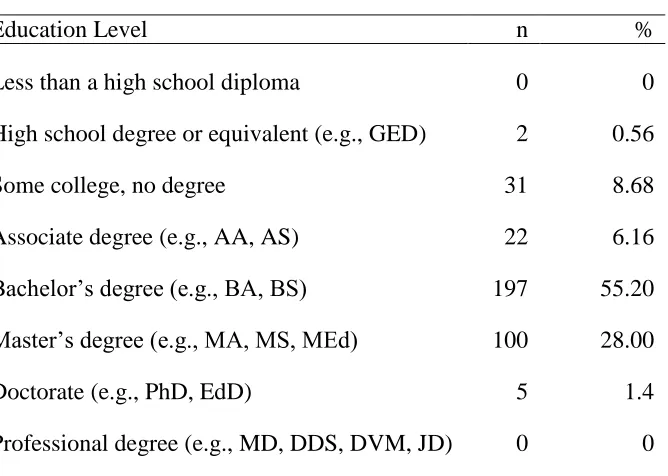
Table 2: Respondents’ Education Level ...57
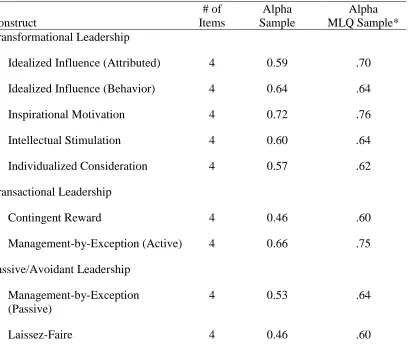
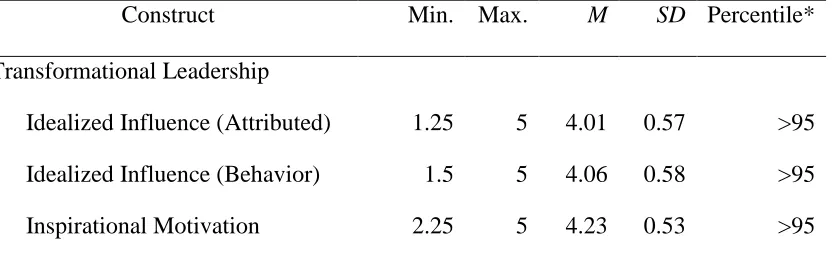
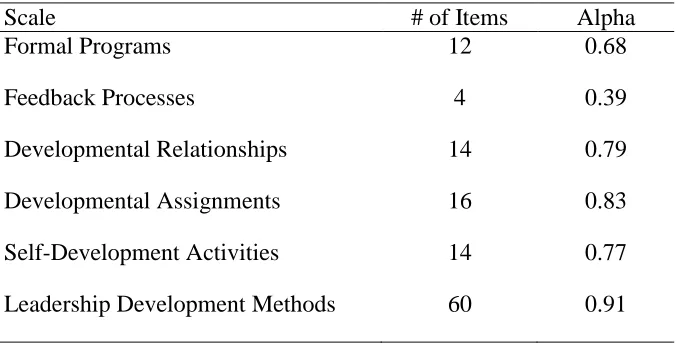
Table 3: Cronbach’s Alpha Reliability for Dimensions of Leadership ...58
Table 4: Descriptive Statistics for MLQ Variables ...59
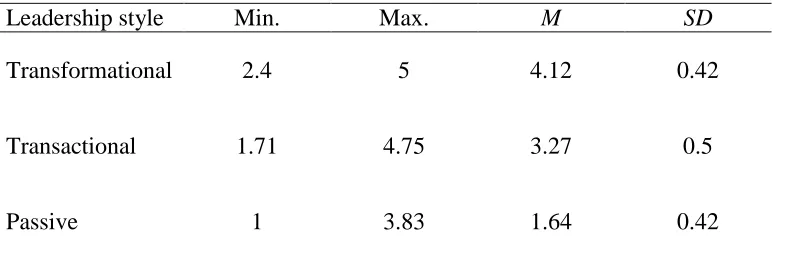
Table 5: Descriptive Statistics: Transformational, Transactional, & Passive Leadership .61 Table 6: Cronbach’s Alpha Reliability for Leadership Development Methods ...62
Table 7: Measures of Central Tendency for Leadership Development Variables ...63
Table 8: Shapiro-Wilk Test of Normality for Leadership Development Methods ...68
xi
Figure 1: Full range of leadership model ...5
Figure 2: Leader development model ...8
Figure 3: Recreation leadership functions according to leadership types ...34
Figure 4. Scatterplot of transformational leadership and formal programs ...64
Figure 5. Scatterplot of transformational leadership and feedback processes ...64
Figure 6. Scatterplot of transformational leadership and developmental relationships ....65
Figure 7. Scatterplot of transformational leadership and developmental assignments ...66
Figure 8. Scatterplot of transformational leadership and self-development activities ...66
Figure 9. Scatterplot of transformational leadership and all leadership development methods ...67
Figure 10. Q-Q plot of formal programs ...69
Figure 11. Q-Q plot of feedback processes ...69
Figure 12. Q-Q plot of developmental relationships ...70
Figure 13. Q-Q plot of developmental assignments ...70
Figure 14. Q-Q plot of self-development activities ...71
CHAPTER I
THE RESEARCH PROBLEM
Statement of Problem
Starting in 2011, 10,000 Baby Boomers a day began to turn 65. This amount of
aging is expected to continue until 2030 (Heimlich, 2010). As more and more Baby
Boomers approach and pass this age, more and more are closing in on retirement. Due to
these impending retirements, organizations face the prospect of filling some of their most
important leadership positions with new leaders. The public parks and recreation sector is
not immune from this, and the potential of finding qualified professionals to fill these
positions is critical to the success of the field. The California Parks and Recreation
Society (CPRS), the largest statewide organization for public parks and recreation
professionals in the nation, has identified leadership development as one of its top issues
to focus on for the next several years (California Park and Recreation Society, 2018a).
While already accounting for more than one million jobs throughout the
United States and 115,000 in California alone (National Recreation and Park
Association, 2018), the recreation industry is expected to continue growing
through the next decade. This growth comes as leisure becomes a more central
focus in our lives and as an increased importance is being placed on exercise and
health by society today (Edginton, Hudson, Scholl, & Lauzon, 2011):
Leisure has become a central focus in the lives of North Americans. We seek
leisure and increasingly see it as a central element contributing to the quality of our lives.
Not only do individuals seek to fulfill their lives through leisure, but they also are
become a major force in a contemporary society with powerful social, cultural, economic,
and environmental implications for how we live our lives. (p. 2)
Additionally, with the impending retirements of the Baby Boomers, more of the
population will be spending more time participating in leisure activities. The U.S. Bureau
of Labor Statistics (2015) reported that employment for recreation workers is expected to
grow faster than the average for other occupations, approximately 10 percent from 2014
to 2024. As the leisure sector grows, the need for leaders in the public parks and
recreation sector will also grow.
To effectively and efficiently serve the community, the public parks and
recreation sector relies on leaders at every level in an organization. A study completed by
Hurd and McLean (2004) examined the perceived competencies of CEOs in public park
and recreation organizations. Leadership and management were rated as the most
important for CEOs.
While many relevant textbooks exist on leadership in the parks and recreation
field, little empirical research has been conducted on the types of leadership that
professionals use in the field or on the leadership development methods that lead to
different styles of leadership. Recently, According to J. Wheeler, CPRS Board President
for 2017-2018, there has been much discussion among universities and professional
organizations about whether a college degree in parks and recreation is required for
becoming a leader in parks and recreation or if another degree will suffice if coupled with
professional development or on-the-job training (personal communication, March 31,
This study aimed to determine the type of leadership used by professionals in the
public parks and recreation field and to examine the relationship between leadership
development methods and the use of transformational leadership by those same leaders.
Research emerging from this study can help universities, professional organizations, and
public parks and recreation organizations as they work to achieve their goals of
developing leaders in the field.
Background and Need for the Study
All professionals employed in parks and recreation, from administrative leaders to
direct service providers, must demonstrate leadership to succeed in their positions. What
varies in each of these roles is the amount of time that a professional spends performing a
specific leadership function (Russell, 2005).
Twelve California State University campuses offer four-year degrees in parks and
recreation (“The California State University: Search CSU Degrees,” n.d.). While many
employed in the parks and recreation field have degrees in parks and recreation, a recent
informal study conducted by CPRS found that most parks and recreation organizations in
California are hiring people into recreation positions who lack degrees in the field. That
study found that this number may be as high as 70 percent of employees. There is
currently an effort through CPRS to offer training to these employees, to provide them
with the technical and conceptual knowledge that they lack (C. J. Chamberlain, Chair,
Department of Hospitality, Recreation and Tourism, California State University, East
Bay, personal communication, August 16, 2016).
In addition to college and university programs, many employed in parks and
those offered by their organizations, such as human resources management, sexual
harassment training, and child abuse training. National and state parks and recreation
organizations also host conferences each year that focus on professionally related topics
including leadership in parks and recreation. Nationally, these conferences have
thousands of participants and hundreds of educational sessions to choose from (National
Recreation and Park Association, n.d.).
While formal leadership development plays a significant role in developing
leaders in the parks and recreation field, research also demonstrates the importance of
on-the-job learning. According to McCauley and Brutus (1998), research shows that
approximately 70 percent of leadership development occurs through on-the-job
experience in comparison to the less than 10 percent of development that comes from
formal training.
As the field of parks and recreation grows to employ more people and as Baby
Boomers retire from leadership, it will be important for the field to develop leaders to
take on these newly available roles. Research from a variety of fields has shown that the
use of transformational leadership is effective at all levels of an organization and has a
positive impact on the organization (Avolio, 2011; Choudhary, Akhtar, & Zaheer, 2013;
Peus, Braun, & Schyns, 2013; Schein & Schein, 2017; Watts, 2017; Xenikou & Simosi,
2006). However, several gaps in the literature exist concerning leadership within the
parks and recreation sector. In fact, there are no available studies that examine which
style of leadership professionals within the field use or which leadership methods are
Purpose of the Study
The purpose of this survey study was to determine the self-perceived type of
leadership used by professionals in the public parks and recreation field and to examine
the relationship between types of leadership development methods and transformational
leadership. It focused on public parks and recreation professionals in California, and data
were collected through self-reported surveys.
Theoretical foundation
The theoretical foundation for this study was the full range leadership model, with
a particular focus on transformational leadership, and the leader development model. The
full range leadership model is one of the most researched and validated leadership models
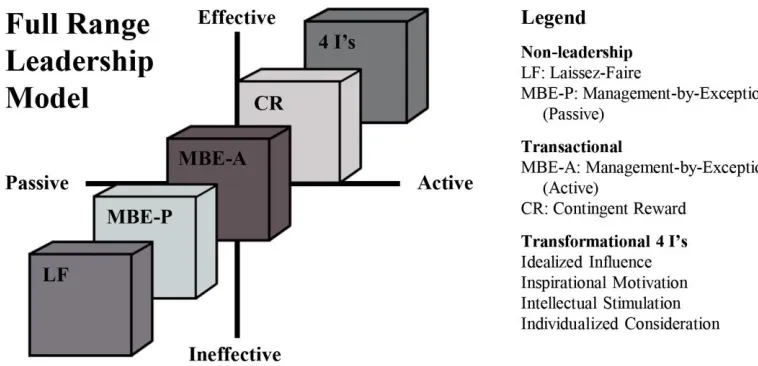
of the 21st century (Northouse, 2016). As seen in Figure 1, it provides a continuum of
leadership styles. A leader’s behavior, depending on the situation he or she is in, can be
found somewhere along the continuum from laissez-faire to transformational.
The model reflects both how effective or ineffective a leader is as well as whether
a leader is passive or active. A description of each of the components of the model is
provided below.
Laissez-faire
Research shows that leaders who use a laissez-faire style are the most passive and
least effective; it is, in essence, avoidance or absence of leadership. No transactions take
place. It is considered a form of non-leadership (Bass & Avolio, 1994).
Management-by-exception (passive) and management-by-exception (active)
Management-by-exception is also viewed as a generally ineffective leadership
style. When using management-by-exception (passive), leaders wait for followers to
make mistakes or errors, then work with the followers to correct them. When using
management-by-exception (active), leaders proactively monitor their followers to look
for mistakes and errors and then work with the followers to correct the mistakes (Bass &
Avolio, 1994).
Contingent reward/transactional
Contingent reward is considered one of the two effective methods of leadership
according to the full range leadership model. Leaders and followers in this model agree
upon both an assignment and a reward for carrying out the assignment (Bass & Avolio,
1994).
4 I’s (Transformational)
Transformational leadership is a process of leadership that “changes and
transforms people” (Northouse, 2016, p. 161). The concept of transformational leadership
between revolutionary, rebellious, reform, and ordinary leaders (Avolio & Bass, 2004).
However, it was not until Burns’ Leadership (1978) that the concept became a recognized
leadership theory. In his research on political leaders, Burns distinguished between
transactional and transformational leadership by defining transactional leadership as an
exchange between leaders and followers. In thus defining transformational leadership,
Burns focused on the exchange between leaders and followers as engagement and
connection, helping each reach a higher level of motivation, rather than the traditional
give and take of a transactional relationship.
In 1985 Bass expanded Burns’ definition. He suggested that transformational
leadership belongs on a continuum that includes transformational at one end,
transactional in the middle, and laissez-faire leadership at the opposing end. Where one’s
leadership style falls on the continuum is dependent upon the leader’s focus on the
follower’s needs. Transactional leaders tend to reward contingently and manage by
exception. Transformational leaders tend to utilize the following: idealized influence
(behaviors and attributes), inspirational motivation, intellectual stimulation, and
individualized consideration. When utilizing idealized influence (behaviors and
attributes), leaders act as role models for their followers. Followers grow a connection
with the leader and want to emulate them. Leaders using these methods also are
consistent, put others’ needs above their own, and employ high ethical standards. When
utilizing inspirational motivation, leaders attempt to motivate followers. They do this
through demonstrating enthusiasm while providing meaningful work for their followers.
When utilizing intellectual stimulation, leaders attempt to create curiosity among their
things, even if it leads to mistakes. When utilizing individualized consideration, leaders
consider each follower’s needs. Leaders attempt to address these by providing coaching
and mentoring as necessary.
Leader development model
In addition to the full range leadership model, this study made use of the leader
development model, proposed in the Center for Creative Leadership’s Handbook of
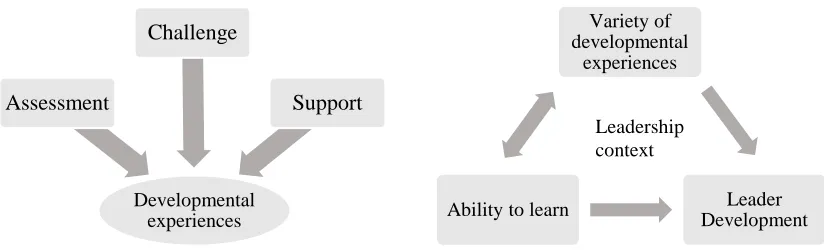
Leadership Development (Van Velsor, McCauley, & Ruderman, 2010). This two-part
model, as shown in Figure 2, encompasses both developmental experiences and the
developmental process.
Figure 2. Leader development model. Adapted from Handbook of Leadership
Development (p. 4)by E. Van Velsor, C. McCauley, and M. M. Ruderman, 2010, San Francisco, CA: Jossey-Bass. Copyright 2010 by John Wiley & Sons. Reprinted with permission.
Leaders learn through a variety of experiences, but not all experiences are equal.
These experiences can include everything from training programs to job assignments to
relationships. Any of these experiences can assist with leadership development, but each
experience will be more developmental if it has elements of assessment, challenge, and
support. As illustrated on the right side of Figure 2, leader development requires both a
variety of developmental experiences and the ability to learn from an experience. It Developmental experiences Assessment Challenge Support Developmental Experiences Variety of developmental experiences Leader Development Ability to learn
should also be noted that the development process is affected by the context in which it
takes place. The context could include the external environment, organizational culture,
and the person looking to develop as a leader.
Using both the full range leadership model and the leader development model as
foundations, this study explored the self-perceived leadership levels of parks and
recreation professionals as well as the relationship between types of leadership
development methods and self-perceived use of transformational leadership.
Research Questions
The following research questions guided this study:
1. What self-perceived level of full range leadership (laissez-faire, transactional, or
transformational) do professionals in the public parks and recreation field in
California use?
2. To what extent is there a relationship between types of leadership development
methods and self-perceived use of transformational leadership?
Limitations
There are several limitations to this study related to generalizability,
self-reporting, and sample size. First, this study was conducted with a sample of members
from the California Park and Recreation Society. Experiences of members of this
organization likely differ from those of public parks and recreation professionals who are
not members of the organization. While the sample size (n=372) is large enough to
generalize to the membership of CPRS, using a confidence level of 95 percent and a
confidence interval of 5, it is 11 respondents shy of the criteria for generalization to the
Additionally, this study was specific to those who are currently working or who have
worked in the field of public parks and recreation; thus, it would not be appropriate to
generalize to those who are not or have not worked in the field.
Second, the survey required participants to not only self-report on their leadership
style but also to remember their experiences as they related to leadership development.
As Holbrook (2017) found, this can result in inaccuracies as people’s memories are not
always accurate and because people have an interest in being viewed favorably by the
researcher, especially if they are familiar with the researcher.
Third, it can be difficult to achieve an appropriate response rate when sending
mass emails. It was necessary to use a variety of methods to ensure an acceptable
response rate, which might further impact the generalizability or accuracy of the results
(Couper, 2008).
Fourth, the portion of the survey developed to examine leadership development
methods was limited to content and face validity. These limitations make it difficult for
the findings to be broadly applied.
Significance
This study contributes to a greater understanding of the leadership styles used by
leaders in public parks and recreation organizations. Additionally, this study provides an
understanding of methods of leadership development for professionals in the field.
Currently, little empirical research has been completed in this area that is specific to the
public parks and recreation field. This study provides the field with the information
This study can be useful to professional organizations, such as the California Park
and Recreation Society and the National Recreation and Park Association, as they plan
future educational and networking opportunities for professionals. Specifically, it can
assist such organizations in their quest to understand what methods are the most effective
for providing professional development opportunities to their members. It can also be
useful to colleges and universities that offer parks and recreation degrees. Such degree
programs are continuously working to remain relevant in a constantly changing world
and they could benefit from insight into successful leadership development methods.
Finally, public parks and recreation organizations can use the results as they develop
career pathing and allocate leadership development funds.
Definition of Terms
The following terms have been identified and defined in this study:
California Park and Recreation Society (CPRS): The nation’s largest statewide
professional organization, dedicated to “advancing the park and recreation profession
through education, networking, resources and advocacy” (California Park and Recreation
Society, 2017).
Full range leadership model: Illustrates a continuum of leadership styles.
Leader’s behavior, depending on the situation he or she is in, can be found somewhere
along the continuum from laissez-faire to transformational leadership (Bass & Avolio,
1994).
Laissez-faire: Meaning “let do,” in the full range leadership model, it is
considered to be the most inactive and ineffective type of leadership. There is little to no
Leader: Anyone who leads one or more staff persons/volunteers OR one or more
program areas (aquatics, youth, sports, seniors, etc.).
Leader Development Model: A two-part model that encompasses both
developmental experiences and the developmental process required for leadership
development (Van Velsor, McCauley, & Ruderman, 2010).
Leadership: “A process whereby an individual influences a group of individuals
to achieve a common goal” (Northouse, 2016, p. 6).
Leadership development: “The expansion of a person’s capacity to be effective in
leadership roles and processes” (Van Velsor, McCauley, & Ruderman, 2010, p. 2).
Public parks and recreation organizations: Governmental departments or special
districts that are tasked with providing the community they serve with parks, recreation,
and community service activities.
Transactional leadership: A leadership style that encompasses many other
leadership models. It focuses on the exchange between the leader and follower
(Northouse, 2016).
Transformational leadership: A leadership style that focuses on the links between
leaders and followers. Leaders motivate followers to achieve their full potential so that
leaders and followers can achieve their goals (Northouse, 2016).
Summary
Chapter I provided a statement of the problem, an overview of the background
and need for this study, the purpose, the theoretical foundation, and the primary research
questions of the study, discussion of known limitations and expected significance of the
study is broken up into four chapters. Chapter II, Literature Review, introduces relevant
literature including a background to public parks and recreation, leadership,
transformational leadership, leadership within the parks and recreation field, and
leadership development. Chapter III, Methodology, provides details of the research
design, setting, population, and sample. Information on the instrument, including
reliability and validity data, is provided. Data collection and analysis procedures are also
specified. Chapter IV, Results, introduces the findings of the study. Chapter V provides
an overview of the study, a discussion of the findings and related conclusions as well as
CHAPTER II
REVIEW OF LITERATURE
Restatement of Problem
As Baby Boomers retire, many sectors will face a shortage of qualified leaders to
replace them. The public parks and recreation field is not immune to this problem. As the
field works to replace these leaders, it is important for those doing the succession
planning to understand the types of leadership used within organizations and the
relationship between leadership development methods and types of leadership used.
This chapter provides a review of the literature on leadership and leadership
development methods, both generally and in the parks and recreation field specifically. It
provides background information as well as context for this study. The first section is an
examination of the evolution of leadership theories from the past 70 years, including a
detailed examination of the full range leadership model. The second section provides an
overview of leadership development. The final section focuses on the leadership in
today’s parks and recreation organizations and leadership development within parks and
recreation.
Leadership
The last 70 years have seen a wealth of research examining leadership in
organizational settings. While many different definitions of leadership exist, most involve
the concept of an individual influencing a group to achieve a goal (Northouse, 2016).
Kotter (1990) described the differences between management and leadership thus: “The
overriding function of management is to provide order and consistency to organizations,
Management is about seeking order and stability; leadership is about seeking adaptive
and constructive change” (p. 13).
Through the last 70 years, many theories of leadership have been developed. The
following is a brief introduction to some of the significant leadership theories of the 20th
and 21st centuries. It includes discussion of the trait, skills, behavioral, and situational
approaches to early research, and four more modern leadership theories: authentic
leadership, servant leadership, adaptive leadership, and transformational leadership. It
also provides details on transactional and laissez-faire leadership.
Early leadership theories focused on the trait approach. These approaches also
called the “great man” theories, focused on what characteristics make a person a great
leader. The focus is also on the innate characteristics that individuals have or do not have.
More recent researchers are critical of this theory, as continued research has not
demonstrated a select set of traits that define a leader (Northouse, 2016).
Like the trait approach is the skills approach. In this approach, leadership depends
on the leader having three types of skills: technical, human, and conceptual. The skill
level of the leader in each of these areas will depend on the management level that a
leader performs. While not as well studied outside of the military, it has been used in the
field of recreation to explain the leadership skills needed by various levels of employees
(Northouse, 2016; Russell, 2005).
In the 1960s and 1970s, contrasting views to the trait and skills approaches to
leadership were presented. Bennis (1997), considered by many to be the father of modern
leadership, said, “The most dangerous leadership myth is that leaders are born – that there
charismatic qualities or not. That’s nonsense; in fact, the opposite is true. Leaders are
made rather than born” (p. 163).
Developed by researchers in the 1960s and 1970s, the behavioral approach was
one of the first approaches that focused on the leader’s behavior rather than who he or she
is. The approach assumes that leaders have two focuses: tasks and relationships. It is the
intersection of these two behaviors that explain how a leader acts. Through their task
behaviors, leaders facilitate the achievement of goals. Through their relationship
behaviors, leaders help followers understand themselves, each other, and the situation.
The behavioral approach signifies a change in leadership research with a movement from
traits to behaviors (Northouse, 2016).
In the late 1960s, Hersey and Blanchard developed the situational approach to
leadership. Since that time, it has been refined multiple times by them as well as by other
researchers. This approach to leadership focuses on how leaders behave in different
situations. In this approach, both the leader’s leadership style and the followers’
developmental level are accounted for. A leader’s style can then be classified into one of
four styles that may be used at different points in time and different situations: high
directive-low supportive (directing approach), high directive-high supportive (coaching
approach), high supportive-low directive (supporting approach), and low supportive-low
directive (delegating approach). The second piece of this approach is the follower’s
developmental level. The developmental level is defined as the level to which followers
have the competence and commitment necessary to achieve the goal. Followers are
classified into one of four categories from developing to developed. This approach, while
The path-goal theory, developed during the 1970s, focuses on the leader’s ability
to establish the best method of motivation for his or her followers. “It is a contingency
approach to leadership because effectiveness depends on the fit between the leader’s
behavior and the characteristics of followers and the task” (Northouse, 2016, p. 135). The
leader is charged with helping the followers reach their goals. To do this, he or she can
help remove obstacles, provide support, and motivate the followers in a way that is
effective for them. This theory is also considered a variant of transactional leadership,
which is described later.
The theories above have focused on either the leader, the follower, or the context
of the situation. The leader-member exchange theory, developed in the mid-1970s,
focuses on the interactions between the leader and the follower. This theory focuses on
in-group and out-group members and how they are used to accomplish goals. This theory
is one of the more well-researched theories as several studies link good leader-member
exchanges with high outcomes for organizations (Northouse, 2016).
The next four leadership theories have been developed more recently. Authentic
leadership focuses on the authenticity of leaders. While identified initially as part of
transformational leadership, it is now identified as a stand-alone theory. There is no one
definition of authentic leadership, but it is understood to be “transparent, morally
grounded, and responsive to people’s needs and values” (Northouse, 2016, p. 220).
Initially developed in the 1970s by Greenleaf, servant leadership is now coming
of age in related research. In his original work on the theory Servant as Leader, Greenleaf
[Servant leadership] begins with the natural feeling that one wants to serve, to
serve first. Then conscious choice brings one to aspire to lead. . .The difference
manifests itself in the care taken by the servant—first to make sure that other
people’s highest priority needs are being served. The best test . . . is: do those
served grow as persons; do they, while being served, become healthier, wiser,
freer, more autonomous, more likely themselves to become servants? And, what is
the effect on the least privileged in society; will they benefit, or, at least, will they
not be further deprived? (p. 15)
Multiple efforts have been made to conceptualize servant leadership, leading to
multiple descriptions, but most commonly the ten characteristics of servant leadership are
considered to be listening, empathy, healing, awareness, persuasion, conceptualization,
foresight, stewardship, commitment to the growth of people, and building community
(Spears, 2001).
The most well-researched and referenced leadership theory is transformational
leadership (Northouse, 2016). The focus of transformational leadership is how “leaders
motivate others to do more than they originally intended and often more than they
thought possible” (Avolio & Bass, 2002, p. 1). This approach stresses that leaders need to
understand and adapt to the needs and motives of the followers.
Transformational leadership and the full range leadership model
As mentioned previously, transformational leadership is one of the most popular
theories of the last 30 years. It is a process of leadership that “changes and transforms
people” (Northouse, 2016, p. 161). Downton first proposed the concept in the early 1970s
leaders (Avolio & Bass, 2004). Several years later, Burns’ seminal book, Leadership
(1978), helped popularize transformational leadership. He further refined Downton’s
concept as he distinguished between transformational and transactional leaders. Based on
his research on political leaders, Burns found that by expanding the traditional give and
take of transactional leadership, transformational leaders worked to engage their
followers to help them reach a higher level of motivation. Burns cited leaders such as
Gandhi, Martin Luther King, Jr., and John F. Kennedy as contemporary leaders utilizing
transformational leadership.
Much as Burns’ extended Downton’s theory, Bass (1985) expanded upon Burns’
theory. Rather than examining transactional leadership and transformational leadership as
two separate independent leadership styles, Bass’ theory viewed them as belonging on a
continuum. Bass suggested that different leaders use transactional and transformation
leadership in differing amounts and differing intensities. As examples of this, he pointed
to Charles de Gaulle, Franklin D. Roosevelt, and Lyndon Johnson (Northouse, 2016).
Bass also utilized House’s 1976 work on charismatic leadership in his expansion of the
theory. House postulated that charismatic leaders not only demonstrated specific
personality characteristics, but they also demonstrated specific behaviors that affect the
follower’s behavior. As part of his original work, Bass noted that transformational leaders
(namely political) could also transform through coercive means. He observed that leaders
like Alexander the Great and Ivan the Terrible used coercion to change the social and
physical environment, destroying one way of life and making a new one. Outside of
politics, Bass suggested that industrialists like Henry Ford used similar means to
Based on empirical research conducted by Bass and other researchers, the full
range leadership model was developed by Bass and Avolio. This model includes
laissez-faire, transactional leadership, and transformational leadership (Bass, 1985). The
transformational leadership piece of the model includes four dimensions of
transformational leaders: idealized influence (called initially charisma), inspirational
motivation, intellectual stimulation, and individualized consideration (also called
individualized attention).
Four dimensions of transformational leaders
The fullrange leadership model includes four dimensions of transformational
leaders. Transformational leaders demonstrate idealized influence. They are role models
and act in a way that their followers want to emulate. They have high moral standards
and expect their followers to have the same. They are consistent with their actions over
time and take risks with their followers, rather than expecting followers to do it on their
own. They are the reason a group moves forward. Over time, followers will identify with
the leader’s vision and work to attain that (Avolio, 2011; Bass, 1985; Northouse, 2016).
Transformational leaders also demonstrate inspirational motivation. They
encourage and motivate their followers by setting high expectations and creating meaning
within their followers’ work. They demonstrate enthusiasm and optimism. They
encourage followers to think about the future and to think outside of the box. Using this
method followers are encouraged to become more engaged within the organization
(Avolio, 2011; Bass, 1985; Northouse, 2016).
Transformational leaders encourage intellectual stimulation among their
beyond the way things have always been done. Leaders inspire their followers to question
everything and to think of new solutions to age-old problems (Avolio, 2011; Bass, 1985;
Northouse, 2016).
Transformational leaders focus on each of their followers as individuals,
understanding each one’s needs for achievement and growth. They are often considered
coaches and mentors. They work to provide learning opportunities for their followers in a
supportive learning environment. Management by engagement is encouraged, and
two-way communication is the norm. Followers feel engaged, rather than checked on, because
they trust their leader (Avolio, 2011; Bass, 1985; Northouse, 2016).
Components of transactional leadership
The full range leadership model also includes two components of transformational
leadership: contingent reward and management-by-exception. Contingent reward is the
exchange between a leader and a follower. The leader and follower negotiate the
assignment to be carried out and the reward following the successful completion of the
assignment. When management-by-exception (active) is in use, a leader actively watches
his followers for signs of mistakes or rules broken, then takes corrective action. This
corrective action can include criticism, negative feedback, or negative reinforcement.
When management-by-exception (passive) is in use, a leader waits until a problem arises
or until standards are not met, then provides corrective action. Both
management-by-exception methods use negative reinforcement when compared to the contingent reward
method (Bass, 1985; Northouse, 2016).
Laissez-faire leadership. Laissez-faire is a French phrase that means “let things
inactive and ineffective type of leadership to use. There is little to no interaction, good or
bad, between leaders and followers in this style (Avolio, 2011).
The full range leadership model
As shown in Chapter I, Figure 1 illustrates the optimal full range leadership
model. In the development of this model, Bass and Avolio (1994) noted that every leader
uses each style of leadership to some degree. There are three dimensions to this model.
The first dimension is how frequently the style is used. The second is the effectiveness of
the style. The third is how active or passive each style is. When examined together,
transformational leadership is seen to be the most effective, while laissez-faire is seen to
be the least effective. After years of research using this model, Avolio (2011) found that
leaders who use all three methods in the right situations are the most effective (Avolio,
2011).
Multifactor Leadership Questionnaire
Many questionnaires exist that can be used to assess transformational and
transactional leadership. However, the most validated and researched is the Multifactor
Leadership Questionnaire (MLQ-5X Short). There are two forms of the questionnaire: the
self-rating form, wherein the supervisor rates himself or herself as a leader, and the rater
form, where followers rate their leaders. Followers can represent four different levels of
the organization including above, below, or at the same level as the person being rated or
another relationship, for instance, a customer (Avolio & Bass, 2004).
Avolio and Bass (2004) discuss several advantages to using the MLQ. One is that
it is based on the full range leadership model, which is easy to understand and explain.
followers. It also can be used in a 360-degree evaluation of leaders and followers within
an organization.
The MLQ (5X-Short), the current version of the instrument, includes 45 items
validated by both discriminatory and confirmatory factor analysis. It is designed to
measure leadership and effectiveness behaviors that have been previously linked to
success in both individuals and organizations. It measures nine leadership dimensions, by
using four highly intercorrelated items for each component. Each of the items for the
components has low correlations with the other eight components. The dimensions are
associated with the full range leadership model. They include idealized influence
(attributed charisma), idealized influence (behaviors), inspirational motivation,
intellectual stimulation, individualized consideration, contingent reward,
management-by-exception (active), management-management-by-exception (passive), and laissez-faire. In addition
to the 36 items measuring the nine dimensions, three leadership outcomes are measured
by the remaining nine items: extra effort, effectiveness, and satisfaction (Avolio & Bass,
2004).
Transformational Leadership and Organizational Effectiveness
Bass (1998) noted that a leader can impact the outcome of an organization in
ways that many other internal and external factors do not. In a meta-analysis of
transformational and transactional leadership, Dumdum, Lowe, and Avolio (2002) found
that transformational leadership has a stronger relationship to the effectiveness of an
organization and satisfaction of employees within that organization. Results from these
correlated with work performance than other leadership styles within the full range
leadership model. Avolio (2011) reported the following:
Research has supported the idea that on average transformational leadership is far
more effective than transactional leadership in generating the higher levels of
extra effort, commitment, performance, and satisfaction of those led. This has
been true almost regardless of level of leadership position, the type of
organization, and the culture in which both are embedded. (p. 57)
Multiple other researchers have found the positive relationship that transformational
leadership has to organizational effectiveness (Bass & Avolio, 2000; Bommer, Rubin, &
Baldwin, 2004; Dvir, Eden, Avolio, & Shamir, 2002; Kelloway, Barling, & Helleur,
2000; Lowe, Kroeck, & Sivasubramaniam, 1996; Phifer, 2009; Schein & Schein, 2017;
Young, 1994). These positive relationships have been observed at public, private, and
governmental organizations.
Leadership Development
In their 2012 Leadership Development Factbook, Lowe and O’Leonard indicated
that US companies spend close to 14 billion dollars each year on leadership development.
In their 2016 State of the Industry report, American Talent Development found that on
average organizations spend more than $1,200 per employee on direct learning
expenditures. These expenditures include the cost to design and administer these
programs. The high number should not be surprising as a study completed by the
Conference Board and McKinsey (2012) reported that close to 500 executives from a
variety of industries noted that leadership development was their number one priority
(Avolio, 2011). This is likely because strong leadership is reported to be one of the most
critical keys to organizational growth and change. Leadership has also been reported as
being in short supply (Conger & Benjamin, 1999).
Van Velsor, McCauley, and Ruderman (2010) defined leader development “as the
expansion of a person’s capacity to be effective in leadership roles and processes” (p. 2).
While past research focused on the traits and skills that a leader has (Northouse, 2016),
newer research has focused on the idea that everyone has the opportunity to become a
better leader through leadership development (Avolio & Bass, 2002; Bass & Riggio,
2006; Kouzes & Posner, 2017; McCauley & Douglas, 2004).
Organizations have two options when it comes to fulfilling their need for effective
leaders. Either they can work to develop current employees, or they can recruit and hire
new employees (McCauley, Kanaga, & Lafferty, 2010). There are three main purposes of
leader development within an organization: performance improvement, or individual
preparation; succession management; and organizational change, also called a strategic
intervention (Conger & Benjamin, 1999; McCauley et al., 2010).
There are many ways in which leaders are developed. The leader development
model, proposed in the Center for Creative Leadership’s Handbook of Leadership
Development (Van Velsor et al., 2010) provides a place to start when describing
leadership development. This two-part model (see Figure 2 in Chapter I) encompasses
both developmental experiences and the developmental process.
The experiences through which leaders learn are not all created equal.
Experiences can include training programs, job assignments, relationships, and more.
more developmental if it has elements of assessment, challenge, and support. As
illustrated on the right side of Figure 4, leader development requires both a variety of
developmental experiences and ability to learn from experience. It should also be noted
that the development process is affected by the context in which it takes place. The
context could include the external environment, organizational culture, and the person
looking to develop as a leader (McCauley et al., 2010).
Developmental Methods
In a study of global organizations, Howard and Wellins (2008) found that
organizations who had the most effective leadership development programs used a higher
number of methods than those that were less effective. They observed that it is not just
the number of methods but the right mix of methods. For instance, a program that not
only teaches skills but provides opportunities to use those skills will be more effective
than one that teaches a variety of skills.
Current research has identified multiple methods currently used for leadership
development. McCauley et al. (2010) organized these methods into five broad categories:
developmental relationships, developmental assignments, feedback processes, formal
programs, and self-development activities.
Developmental relations
Yip and Wilson (2010) reported that:
Across cultures, developmental relationships are consistently the second-most
cited cluster of learning experiences. This squares with findings from other
coaching, one-on-one mentoring, and peer and group mentoring are identified as
best practices for leader development. (p. 73)
Developmental relations are defined as either natural or intentional relationships
that happen in the workplace or other places in life. In the workplace, intentional
relationships can be developed to help support learning in a particular area (McCauley et
al., 2010). McCauley and Douglas (2004) noted that relationships can be a source of
assessment, challenge, and support, which in turn can lead to learning and development.
While many developmental relationships are informal, formal relationships both in and
out of the workplace are becoming more popular. Communities of practice are an
example of this. Groups of people, typically those who have similar expertise or job
responsibilities but who do not work in the same department or units, will come together
to learn from one another and share best practices and challenges. These groups happen
both within an organization and outside of organizations between companies (McCauley
et al., 2010).
Developmental assignments
In Flow: The Psychology of Optimal Experience, author Mihaly Csikszentmihalyi
(1990) discussed the importance of achieving flow as that is where people are happiest.
Flow is a focus on the activity at hand and the situation. In this state, nothing else seems
to matter. It is a state of intrinsic motivation. There are nine components to flow, but the
most applicable to developmental assignments is the challenge-skill balance – the
concept that the challenge of the task must be balanced with that of the skill of the
participant. This research applies to leadership development as well, mainly when
challenging for the skill level of each (Yip & Wilson, 2010). Additionally, appropriate
amounts of support and assessment must be provided to the individual working on the
assignments (McCauley et al., 2010).
They also reported that feedback on performance assisted in leadership
development. In a study completed by McCall, Lombardo, and Morrison (1988), job
assignments were observed to have helped people learn strategic thinking, develop
leadership and persuasion skills, and team building. In the same study, the authors
reported that hardships or difficult situations also helped people understand how to act on
people problems and handle difficult relationships.
A variety of developmental assignments can be used, from taking on informal
leadership opportunities in a workplace to more formal developmental assignments of
participating in an action learning team or special project committee within an
organization. In this situation, a cross-functional team is created to help solve an
organizational issue. Members work together, bringing individual expertise to propose a
solution (McCauley et al., 2010).
Several studies on what methods are most effective have shown that
developmental assignments and relationships are the most essential methods for
leadership development (Howard & Wellins, 2008; McCall et al., 1988; Yip & Wilson,
2010).
Feedback processes
Feedback processes are another method of leadership development. Many view
feedback as something that occurs regularly and naturally within an organization;
Formal feedback can vary from basic annual employee evaluation forms to something
more structured like a 360-degree evaluation (McCauley et al., 2010). The Multifactor
Leadership Questionnaire, used in its 360-degree method, is considered a very formal
feedback structure, as it often comprises not only the questionnaire but formalized
training and coaching once the questionnaire has been completed (Avolio & Bass, 2004).
Formal programs
Formal leadership development programs are structured events that bring people together
for learning and development. McCauley et al. (2010) noted that these formal programs
“vary widely in their content, pedagogical techniques, purposes, and targeted outcomes”
(p. 48). Conger (1992) identified four types of leader development programs:
knowledge-based (conceptual understanding), skills training, feedback intensive, and personal
growth. He found that each has a place in leadership development and serves a different
purpose. Knowledge-based leader development programs are theory- and concept-driven
and focus on understanding the why. These programs are not designed to develop skills
but to give participants information so that they can be more effective in their positions.
Skills training focuses on taking knowledge and translating it into skills; for instance,
participants may learn communication or decision-making skills that they can
immediately use upon their return to work. In informal, feedback intensive programs,
participants learn about themselves. They then use what they have learned about
themselves to reflect on how they can improve their leadership effectiveness. Personal
growth programs focus on the concept that those who are more in touch with themselves,
their abilities, and their talents, are better leaders. The goal of these programs is to help
These formal leadership trainings can be identified by their structured curriculum
and include classroom training, formal education programs (undergraduate or graduate),
continuing education courses, and workshops (Young, 1994). Avolio (2011) observed
that even a few hours of leadership training could impact one’s leadership development,
demonstrating that these opportunities need not be long in duration to have an impact.
Self-development activities
With the advent of the Internet, a new dimension of leadership development has
emerged. Self-development activities are becoming more and more accessible to those
looking to increase their leadership skills. Self-development activities can either be
self-initiated or suggested by human resources. These activities include books, articles,
reports, and online resources, invited speakers and colloquia, conferences and trade
shows, fireside chats, town hall meetings, and all-staff meetings. Books, articles, and
reports provide leaders knowledge, while speakers and colloquia provide opportunities
for leaders to think outside of their organizations. Attending conferences provides an
opportunity to network with others as well as learn from others (McCauley et al., 2010).
Today’s Parks and Recreation Organizations
To the general public, the words recreation and leisure are interchangeable,
something that people do during their free time. In the field of parks and recreation,
however, each refers to a different action or condition. Although experts within the field
of parks and recreation offer different definitions of the words, there are many similarities
(O’Sullivan, 2013). Leisure is typically defined as unobligated time during which people
voluntarily engage in non-work activities. Recreation refers to an activity or program,
are used interchangeably to describe recreation or leisure service organizations. For this
reason, the terms are used interchangeably here.
While leisure activities have long existed, formal recreation organizations only
came into existence in the United States in the late 1800s. In the beginning, the focus of
the recreation movement was to provide places for people to recreate, typically in parks,
recreation centers, and playgrounds. Around the turn of the 20th century, specific
recreation programs became more prevalent. According to Jordan, Degraaf, and Degraaf
(2005):
These programs are where people and parks, recreation, and leisure service
organizations meet…recreation programs are purposeful interventions
deliberately designed and constructed to produce certain behavioral outcomes
(e.g., having fun with family and friends, meeting new friends, learning new
skills, increasing fitness levels) in an individual and/or group. (p. 5)
Recreation organizations have come a long way since the start of the formal
recreation movement. The 2016 National Recreation and Park Association Field Report
found that local and regional park and recreation organizations throughout the United
States account for one million full- and part-time jobs and approximately 140 billion
dollars in annual economic activity (National Recreation and Park Association, 2016a).
Recreation organizations can be found in a variety of sectors including municipal and
county governments (local), state and federal governments (including the armed forces),
nonprofit organizations, therapeutic recreation settings, commercial organizations,
corporate recreation, membership recreation, and human services organizations (medical
A typical park and recreation organization operated by a local government has
approximately 33 full-time equivalents (FTEs). This includes a mix of full- and part-time
staff in a variety of positions (National Recreation and Park Association, 2016a). As the
size of the jurisdiction grows, so does the number of staff within the organization. There
are typically three types of employees within a parks and recreation organization: direct
service, supervisory, and administrative. Direct service employees are the front-line
contacts with customers and include those that maintain parks and facilities as well as
those who provide recreation programming (activities) in areas ranging from camps and
aquatics to sports and seniors. Many of these employees serve in either part-time,
seasonal positions or entry-level, full-time positions. Titles for these positions include
camp counselor, lifeguard, or facility attendant. Middle managers, typically referred to as
supervisory leaders in the recreation field, are responsible for supervising and
coordinating direct service staff and volunteers. These managers oversee several areas of
expertise, for instance, aquatics and sports or teens and seniors. Depending on the size of
the organization, titles include recreation coordinator or supervisor, program director, or
center director. Administrative leaders hold the executive positions in most
organizations. Their focus is on planning, developing, controlling, and evaluating. Titles
of such leaders include CEO or director (Russell, 2005).
Types of leaders needed in parks and recreation organizations
As Van Velsor et al. (2010) noted, at some point, most people will be in a
leadership role. The role can vary from a formal position to an informal position. Those
in formal positions have the option to make decisions and then act on the decisions. In an
for those employed in the parks and recreation field. To succeed in their positions, all
professionals employed in parks and recreation, from administrative leaders to direct
service providers, must demonstrate leadership. What varies in each of these roles is the
amount of time that a professional spends performing a specific leadership function.
According to Hersey and Blanchard (1982), there are three types of leadership functions:
technical, human relations, and conceptual. In the recreation field, technical functions
include those such as planning and implementing programs, organizing classes and sports
activities, evaluating programs, and performing general office tasks. Human relations
leadership functions include knowing and understanding the demographics (including
special needs) of those that one is serving in a way that one can develop appropriate
programs to meet the outcomes they need, appropriately using group dynamic theories to
work with groups, and having the ability to relate with customers as well as other
professionals and organizations, including boards and councils. Conceptual human
relations functions include having a comprehensive understanding of parks, recreation,
and leisure philosophies and theories, having a sound professional philosophy, and being
willing to work to improve the field and society as a whole.
Each type of parks and recreation professional (administrative, supervisory, and
direct service) spends varying amounts of time using each of these leadership functions.
Figure 3 provides an overview of how much time each type of leader will spend using
each leadership function.
In addition to utilizing various leadership functions in their work, recreation
professionals also serve a number of different roles, as they work to serve their