Geschke Center
Doctoral Dissertations Theses, Dissertations, Capstones and Projects
Winter 2017
Epistemology, Wisdom, and Social
Transformation: Strategies at the Forefront of the
Contemplative Movement in Higher Education
Nicola Smith
University of San Francisco, [email protected]
Follow this and additional works at:https://repository.usfca.edu/diss
Part of theEducational Leadership Commons, and theHigher Education Commons
This Dissertation is brought to you for free and open access by the Theses, Dissertations, Capstones and Projects at USF Scholarship: a digital repository @ Gleeson Library | Geschke Center. It has been accepted for inclusion in Doctoral Dissertations by an authorized administrator of USF Scholarship: a digital repository @ Gleeson Library | Geschke Center. For more information, please [email protected].
Recommended Citation
Smith, Nicola, "Epistemology, Wisdom, and Social Transformation: Strategies at the Forefront of the Contemplative Movement in Higher Education" (2017).Doctoral Dissertations. 409.
EPISTEMOLOGY, WISDOM, AND SOCIAL TRANSFORMATION: STRATEGIES AT THE FOREFRONT OF THE CONTEMPLATIVE MOVEMENT IN HIGHER
EDUCATION
A Dissertation Presented To
The Faculty of the School of Education Department of Leadership Studies Organization and Leadership Program
In Partial Fulfillment
of the Requirements for the Degree Doctor of Education
by Nicola Smith San Francisco
ii
DISSERTATION ABSTRACT
Epistemology, Wisdom, and Social Transformation: Strategies at the Forefront of the Contemplative Movement in Higher Education
American society is currently experiencing a surging interest in contemplative
practices. The secularization and professionalization of contemplative practices can be
seen in the adoption of mindfulness-based approaches in sectors as wide-ranging as
technology, nonprofit, and higher education. Amongst all these fields, institutions of
higher education play a unique role within the contemplative movement in that the
academy lays claim to the powerful social roles of producing and disseminating
knowledge and, subsequently, of shaping societal values and behaviors.
In conducting this qualitative study, the researcher analyzed 1) what the
academics in the contemplative movement expressed through their speech regarding the
activities that forward their work within the context of an epistemological shift in the
academy; 2) the extent to which these academics articulated a connection between
activities aimed toward the epistemological shift within the academy, the cultivation of
wisdom, and activities directed toward social transformation; 3) which methods
contemplative scholars, scientists, and administrators employ through curricular
innovation, study designs, the securing of project funding, and networks of support in
order to act as agents of institutional change and social transformation. This research
paired activity theory (AT) and critical discourse analysis (CDA).
Fifteen participants representing a spectrum of academics engaged in
contemplative practice or research on contemplative practice were interviewed. With the
exception of three participants, all others indicated that they conceived of a positive
iii
practice and social transformation, or a more complex connection between all three.
Non-profits were found to be central to the movement’s unfolding. The construction and
production of knowledge occurred around strategic discourse for a number of academics.
Rich texts for the analysis of word meaning came overwhelmingly from those academics
who experienced contradiction in their activity setting. The first eight participants
represented contrast sharply with the last seven in terms of the social status they have
within their university settings. With the exception of five participants, all others
discussed some form of delegitimization, isolation, and scarcity of resources, even though
they may also have experienced legitimization, integration, and support.
Suggestions for future research and practice are discussed. The researcher advises
that studies that pair approaches from contextualized Theology or Religious Studies,
Social Psychology, and educational theory should be conducted to examine the
adaptation of contemplative practices for the spaces of socially marginalized people.
Additionally, non-profit organizations and centers conducting research on contemplative
practices should create opportunities for research assistantships, internships, and
fellowships for undergraduate and graduate students that foster interdisciplinary inquiry
iv
SIGNATURE PAGE
This dissertation, written under the direction of the candidate’s dissertation committee
and approved by the members of the committee, has been presented to and accepted by
the Faculty of the School of Education in partial fulfillment of the requirement for the
degree of Doctor of Education. The content and research methodologies presented in this
work represent the work of the candidate alone.
Nicola Smith August 15, 2017
___________________ ________________
Candidate Date
Dissertation Committee
Dr. Patricia Mitchell August 15, 2017
___________________ ________________
Chairperson Date
Dr. Betty Taylor August 15, 2017
___________________ ________________
Date
Dr. Darrick Smith August 15, 2017
___________________ ________________
v
ACKNOWLEDGEMENTS
Embarking on the journey to undertake a doctoral program, I was not in the least
bit sure of what I might find along the way. I knew that the degree, in and of itself, was
not the exclusive motivating force for me, however. I knew that this would be a process
of becoming and, no matter how much I wanted to pin down precisely who I would be by
the end of this labor, I found myself submitting over and over again to the mystery
inherent in the unfolding. It is strange how much we can fight cultivating the greatest
gifts planted inside of us, ones that are not meant to be buried, but to be shared with the
world. The study that follows is the result of the commitment to cultivate and share that
which is most authentic to who I am. This work could not have been possible without the
support of others who have trod this path before me and those closest to me who have not
gone down this road, but went along on the journey with me anyways.
With the utmost gratitude, I thank all of the participants of my study. Because
contemplative studies is an emerging field it can be exciting as well as contentious
territory. I am incredibly fortunate to have had the level of generosity I did from my
participants. It was truly inspiring to listen to and, in some instances, meet with people
who are passionate, innovative, and willing to take risks because of what they believe in.
Special thanks goes to Cliff Saron for the interest he took in my study and the time he
spent sharing with me the evolution of his research in neuroscience. It was especially
meaningful to connect with those whose work in contemplative studies is dedicated to
transforming unjust and inequitable structures within higher education institutions and the
vi
such trailblazing programs like those established by Harold Roth and Ed Sarath had been
fought for many years in advance of this moment.
In addition to my participants, I am indebted to and so thankful for the members
of my dissertation committee. Dr. Patricia Mitchell was a constant source of both
academic and personal support, encouragement, and nurturance throughout the whole
experience. She is the definition of a student-centered educator. I cannot imagine making
it through the program without her. Dr. Betty Taylor was also a tremendous source of
support and encouragement. Her Women of Color in Higher Education course was a
defining moment in the program for me. It was an oasis within academia, a place where I
could feel completely understood. She reminded me of the unique social, emotional, and
spiritual gifts I have to offer that stem from my complex positionality. Dr. Darrick Smith
always provided me with engaged and constructive feedback on my study. His ongoing
support of my professional endeavors is greatly appreciated by me.
Finally, I have loved ones to thank. Thank you to Roger and Hope Forsyth for
your grounding and welcoming presence and support as I transitioned back to Los
Angeles. Thank you to Tracy Trahan for your friendship and preservation of extended
family. Thank you to Sheri and Kandee Forbes—the closest I will have to siblings—for
your love and consistency even throughout unbearable times of loss and grief. Thank you
to Martina Melendez for unconditional, life-long sisterhood. Last, but not least, this study
is dedicated to the memory of my grandmother, Ruth Forsyth. Her love and strength
vii
LIST OF FIGURES
FIGURE 1
viii
TABLE OF CONTENTS
DISSERTATION ABSTRACT ... ii
SIGNATURE PAGE ... iv
ACKNOWLEDGEMENTS ... v
LIST OF FIGURES ... vii
CHAPTER I THE RESEARCH PROBLEM ... 1
Statement of the Problem ... 1
Background and Need for the Study ... 2
Purpose of the Study ... 4
Theoretical Rationale ... 5
Conceptual Rationale ... 10
Research Questions ... 11
Delimitations and Limitations ... 12
Significance ... 14
Definition of Terms ... 15
Terminological Background ... 17
Epistemology ... 17
Wisdom ... 20
Mindfulness ... 21
Meditation and Contemplation ... 23
CHAPTER II REVIEW OF LITERATURE ... 31
Restatement of the Problem ... 31
Overview ... 31
Review of Literature ... 32
Philosophy of Contemplative Studies ... 32
Contemplative Practice in Teaching ... 48
Research on Contemplative Practice Among University Students ... 59
Contemplative Studies at University Research Centers ... 71
Contemplative Practice for Individual and Social Transformation ... 85
CHAPTER III METHODOLOGY ... 99
Restatement of the Purpose of the Study ... 99
Research Design ... 99
Population and Sample ... 103
Interviews ... 104
Data Collection Procedures ... 106
Data Analysis ... 109
CHAPTER IV RESULTS ... 111
Introduction ... 111
Findings ... 112
Summary ... 219
CHAPTER V ... 221
CONCLUSIONS, IMPLICATIONS, AND RECOMMENDATIONS ... 221
ix
Conclusions ... 223
Recommendations ... 228
Recommendations for Future Research ... 228
Recommendations for Future Practice ... 229
Closing Remarks ... 230
REFERENCES ... 232
APPENDIX A INTERVIEW QUESTIONS ... 243
CHAPTER I
THE RESEARCH PROBLEM
Statement of the Problem
The privileging of empirical evidence and the scientific method in academia to the
exclusion of epistemological diversity presents an obstacle to innovation in teaching and
scholarship. Objective, third person forms and modes of knowledge have dominated the
disciplines since the time of the European Enlightenment and continue to be regarded as
the standard for intellectual rigor and legitimacy (Magee, 2011; Roth, 2008; Sarath, 2006;
Zajonc, 2006). However, as Roth (2008) notes, such cognitive models can lead to
intellectually fatal consequences that include ethnocentrism and bad science. The
contemplative movement in higher education problematizes these limiting parameters
and calls for an epistemological renewal in the academy.
Transdisciplinary and interdisciplinary in nature, the contemplative movement
consists of scholars representing the full spectrum of thought in the sciences, social
sciences, humanities, and law. The academics in the movement maintain the veridicality
of subjective, first person experience without undermining the values of empirical
evidence or scientific inquiry. As professors, they rely upon contemplative pedagogy to
teach their students and, as researchers, they investigate the neuroscience of
contemplative practices, the impact of contemplative practice on clinical and subclinical
populations, and speculate about the role of contemplative practices in social change.
In addition to the problem of intellectual ideologies that relegate first person,
subjective epistemologies to the margins of knowledge and discourse about knowledge,
of the contemplative movement. Contemplative studies is still fleshing out it contours and
has yet to substantiate a philosophy of its existence as an interdisciplinary domain.
Background and Need for the Study
American society is currently experiencing a surging interest in contemplative
practices and its institutions of higher education are becoming the matrices out of which
the rationality and empiricism of scientific inquiry are being integrated with the direct
experience of other, embodied ways of knowing. What was once the domain of relatively
small groups of religious from Buddhist, Catholic, mystical Jewish, and Islamic sects has
become a gentle but penetrating influence within the lives of lay people, the organizations
in which they work, and the institutions in which they are educated. In order to
understanding the nature of this paradigm shift, a definition of contemplative practice is
in order. According to Callanan (2011):
[c]ontemplative practice is defined broadly as that cluster of spiritual practices of
all faiths that quiet the mind and bring body mind and heart into alignment
producing greater calm, insight, openness, receptivity, and connection to oneself,
others, nature and the divine. Examples include forms of meditation, yoga,
prayer, contemplative arts, contemplative movement and ritual. (p. 399)
However, the engagement with contemplative practices need not be as formal and
ritualized as they were traditionally conceived. Personal, professional, and societal
embrace of contemplative practice can and is being adapted to fit the contours of
individual lives, organizational cultures, and public policy as well as teaching and
The secularization and professionalization of contemplative practices can be seen
in the adoption of mindfulness-based approaches in sectors as wide-ranging as
technology, nonprofit, and higher education. Wisdom 2.0, a conference that aims to bring
into conversation professionals from the technology industry and practitioners of
mindfulness, made its groundbreaking debut in the Silicon Valley in 2010. Companies
such as Apple, Google, and Twitter have launched innovative employee programs,
smartphone applications, and web design developed to bring individuals into the direct
experience of present moment awareness. Non-profit organizations such as The Center
for the Contemplative Mind in Society and Spirit Rock Meditation Center are committed,
respectively, to cultivating contemplative practices within higher education and offering
spiritual teachings such as insight mediation as a means of bringing about personal and
social transformation.
Higher education institutions have established research institutes and centers
dedicated to advancing scholarship, teaching, and public discourse on compassion,
insight, and wisdom, the generative fruits of mindfulness practices. Stanford University’s
Center for Compassion and Altruism Research and Education, Brown University’s
Contemplative Studies Initiative, the University of Oxford’s Mindfulness Centre, and the
Greater Good Science Center at UC Berkeley are only a few that are on the vanguard of
this movement within higher education. Additionally, Professors of Law at the University
of San Francisco are at the forefront of teaching contemplative lawyering, drawing upon
the modality of mindfulness-based stress reduction (MBSR) advanced by Jon
Amongst all these fields, institutions of higher education play a unique role within
the contemplative movement in that the academy lays claim to the powerful social roles
of producing and disseminating knowledge and, subsequently, of shaping societal values
and behaviors. As a significant epistemological shift within the landscape of higher
education is evident in the growing presence of teaching and research grounded in
contemplative inquiry, it is imperative that scholarship within the domain of
contemplative studies acts in a self-reflective manner. Specifically, as leadership from the
ranks of the professoriate emerges and academics act as agents in the transformation of
the production and dissemination of knowledge, an understanding of the complex
interacting activity systems through which they accomplish this is needed. Thus far, the
literature has not addressed this.
Precisely because it is in a germinal stage, there is a strong need for this study as
it takes an original approach to exploring the contours of this movement in academia.
Specifically, this research will employ a novel conceptual framework that draws upon an
innovative pairing of activity theory (AT) (Engeström, 1996; Engeström, 1999;
Engeström, 2001) and critical discourse analysis (CDA) (Fairclough, 1993).
Purpose of the Study
Primarily, this study aimed to analyze discourse strategically employed by
academics as a means of forwarding the contemplative movement within higher
education. With regard to the emerging, interdisciplinary field of contemplative studies, it
sought to direct its focus on language referencing institutional
legitimization/delegitimization, integration/isolation, and support/scarcity of resources.
regarding the activities that forward their work within the context of the epistemological
shift. Second, the researcher was interested in the extent to which these academics
articulated a connection between activities aimed toward the epistemological shift within
the academy, the cultivation of wisdom, and activities directed toward social
transformation. Additionally, the purpose of this qualitative study was to determine
which methods contemplative scholars, scientists, and administrators employ through
curricular innovation, study designs, the securing of project funding, and networks of
support in order to act as agents of institutional change and social transformation.
Theoretical Rationale
The theoretical rationale for this study is Activity Theory (AT). Many scholars
echo that “in activity theory, the method of inquiry cannot be separated form the
theoretical approach” (Guy, 2005, p. 48). According to Hashim and Jones (2007),
“Activity theory is a theoretical framework for the analysis and understanding of human
interaction through their use of tools and artefacts. Activity theory offers a holistic and
contextual method of discovery that can be used to support qualitative and interpretive
research” (p. 2). Yamagata-Lynch (2010) posits that AT is a methodology, and Ruckriem
(2012) argues that, while AT is a methodology it is also a “quest for a method of theory
formation” (p. 2).
For Engeström (1999), the relationship between theory and method could have
socially innovative consequences. He envisions the following as necessary for the
difficulties inherent in both the process of acculturation and the process of creating a new
In order to understand such transformations going on in human activity systems,
we need a methodology for studying expansive cycles. Such a methodology does
not easily fit into the boundaries of psychology or sociology or any other
particular discipline . . . . I want to suggest that such a methodology is best
developed when researchers enter actual activity systems undergoing such
transformations . . . . the type of methodology I have in mind requires that general
ideas of activity theory be put to the acid test of practical validity and relevance in
interventions that aim at the construction of new models of activity jointly with
the local participants . . . . Key findings and outcomes of such research are novel
activity-specific, intermediate-level theoretical concepts and methods—
intellectual tools for reflective mastery of practice. (pp. 35-36)
Engeström’s interventionist approach weds theory and method as it seeks perpetually to
refine AT. This way of doing research acknowledges local actors within an activity
system as co-creators in the development of a culturally and historically relevant AT.
Additionally, AT has the advantage of focusing its attention on human activity
that it recognizes as affected by community and culture. In this way, it is inherently a
hybridization of theory and practice as it looks at the ways in which everyday activities
are enacted by individuals in collectively and culturally influenced systems (Nardi, 1996,
p. 7).
Engeström (1996, 2001) identifies three discrete stages in the conceptual growth
of AT. Cultural-historical activity theory (CHAT), birthed by Vygotsky, ushered in the
mediated actions between a subject and object that Vygotsky represented visually in his
classical triadic model.
The second generation of AT was launched by Leont’ev who made the conceptual
distinction between an individual action and a collective activity. He structured these two
concepts within a hierarchy containing a third concept, operation. Within this schema,
object-related, collective activity supersedes goal-directed, individual action and
individual action supersedes operation. In the development of the primary distinction
between action and activity, Leont’ev articulated a means of understanding individual
relationship to community within an activity system, something that was not accounted
for in Vygotsky’s model.
Critiques of the second generation of AT have abounded and still have not been
worked through thoroughly. One of the central oversights that persists in AT is the
absence of culturally diverse lenses represented concomitantly within a depiction of an
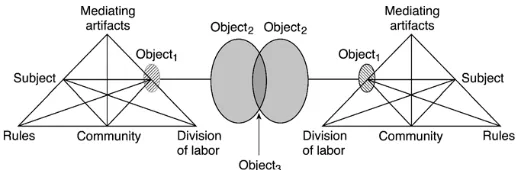
activity system. In envisioning interacting activity systems that leave the space for the
possibility of a “jointly constructed object,” (2001, p. 136) Engeström has formulated the
cornerstone of the third generation of AT, imagining the agency of actors who are not
Figure 1. Two interacting activity systems as minimal model for the third generation of
activity theory.
Note. From “Expansive learning at work: Toward an activity theoretical
reconceptualization” by Y. Engeström, 2001, Journal of Education and Work, 14(1), p.
136.
The Scandinavian school of AT, founded and developed most influentially by
Engeström, identifies six elements as constitutive of an activity system and analyzes the
relationships between those six elements within a particular activity system and between
interacting activity systems. These elements include the following: object, subject,
mediating artifact, community, rules, and division of labor. This articulation of AT rejects
the notion of human actions taking place in or having relevance within the vacuum of the
classical triadic model of only subject, object, and mediating artifact. Instead, it sees all
six of the elements as a more full representation of individual actions within collective
activity. Within this more complex model, the object or the goal of the activity system is
what links individual actions to community activity (Engeström, 1999).
Engeström (2001) argues that AT, in its current evolutionary stage, is undergirded
by five principles. The first principle holds “that a collective, artifact-mediated and
object-oriented activity system, seen in its network relations to other activity systems, is
taken as the prime unit of analysis.” The second principle maintains “the
“historicity.” The fourth principle asserts “the central role of contradictions as sources of
change and development.” Finally, the fifth principle “proclaims the possibility of
expansive transformations in activity systems.” Taken together, these five current
principles represent the values of third generation AT in light of more recent criticisms
and attempts to resolve its previous exclusion of multiple voices, perspectives, and
experiences within socially and historically meaningful contexts.
As this dissertation will contend with epistemology and the social construction of
knowledge, it is imperative that AT can be shown to be practically relevant to such
historically influenced investigation. Daniels and Warmington (2007) offer an innovative
application of AT and use it to make claims about the social production of labor-power
and the knowledge economy drawing upon Marxian theories of capital. The authors’
study examined interacting activity systems—a characteristic of third generation AT—
with regard to professional learning that takes place within a number of different service
organizations in England. Through their application of third generation AT to these
settings, the researchers demonstrate that labor-power in contemporary work
environments can be understood, increasingly, as a collectivist effort. A redefinition of
organizational rules and divisions of labor must accompany such reconfiguration.
Amongst scholars, the construction and production of knowledge has become a
collaborative endeavor to a large extent as well. This fact is essential to the study that will
be presented in this dissertation as an epistemological shift within the various activity
systems of academia must be conceived of as a community effort. Specifically, actions
engaged by scholars who have the objective of instantiating and legitimizing
object-oriented activity systems referred to as the contemplative movement in higher education.
This type of reorganization envisioned by the contemplative movement in higher
education requires, as Daniels and Warmington (2007) suggest, the rescripting of rules
and the renegotiation of the divisions of labor. This may highlight contradictions or
“historically accumulating structural tensions” (Engeström, 2001, p. 137) within
academia’s activity systems.
As a means of developing a coherent and systematic approach to AT analysis,
Yamagata-Lynch (2010) advocates the use of a “boundary identification framework” (p.
24). Because third generation AT focuses on interacting activity systems, constructing
and interpreting models for these systems with their numerous subjects and activities
could become an unwieldy endeavor for researchers. The author proposes that studies
rely upon two concepts beyond the standard AT boundaries to guide the researcher in her
articulation of human activity and social systems: activity settings and the three planes of
sociocultural analysis (p. 24). These terms are discussed in the conceptual framework
section.
Conceptual Rationale
The first conceptual pairing that serves as rationale for this study is activity
settings and the three planes of socio-cultural analysis. Since third generation activity
theory (AT) requires the interpretation of complex interacting activity systems,
employing conceptual frameworks that can manage the intricacies of human activities
and their contexts is necessary. Yamagata-Lynch (2010) offers two concepts that have
aided in the systematic analysis of her own research in which she engages the activity
Drawing upon the works of Gallimore and Tharp (1990, 1998) and Rogoff (1990), she
provides multiple definitions of activity settings. In summation, a researcher can
understand activity settings to operate as contextually bounded social systems in which
human cognition and human activity exert a reciprocal influence upon on one another (p.
24). Yamagata-Lynch (2010) goes on to explain that “activity settings allow investigators
to interpret how participant activities are influencing and are being influenced by the
social context (Rogoff, 1990; Werthsch et al., 1995)” and “[i]n this process, investigators
will find out how activity settings, object-oriented activity, and goal-directed actions are
fluid, intertwined, and changing from moment to moment (Lave 1993)” (p. 24).
According to Yamagata-Lynch (2010), although AT takes object-oriented activity
to be the unit of analysis, a researcher may focus on different subjects when using the
three planes of sociocultural analysis as a framework. In this framework, the personal, the
interpersonal, and the institutional/community constitute the three planes. When
analyzing a bounded system of activity the investigator takes as her discrete subject, one
at a time, an individual, a group, or an organization. In this way, a researcher is able to
handle a potentially overwhelming analytical process (p. 25).
Research Questions
As a means of addressing the purpose of this study, the researcher has composed a central
question and four sub-questions to guide her inquiry:
Central Question
1. What is the process by which the contemplative movement in higher education is
unfolding?
1. What discourses can one identify with regard to knowledge construction, knowledge
production, and the knowledge economy as they are espoused inside and outside of the
disciplines?
2. What word meaning and movement of meaning can one identify within the academics’
talk about epistemological shift and social change?
3. What evidence exists of social hierarchies and power relations within the academics’
talk about personal, interpersonal, and institutional/community forms of support for
activities geared toward epistemological shift and social change?
4. What words convey personal, interpersonal, and institutional/community
legitimization/delegitimization, integration/isolation, and support/scarcity of
resources?
Delimitations and Limitations
A couple of delimitations constrain this study. The first delimitation has to do
with the two terms central to the title of this dissertation. Lest this study be guilty of
perpetuating a misnomer, it is crucial to understand that it seeks to investigate neither
epistemology per se nor wisdom per se. Rather, it attempts, in part, to explore a
speculative relationship between the two that has been identified by advocates of
contemplative practices both inside and outside the academy. Integral to the working
definition of wisdom proposed in this study is an exemplary personal conduct that is
characterized by a caring responsiveness to the needs of others (Baltes & Staudinger,
2000). The wisdom attribute responsible for this compassion in action may be, in some
instances, what motivates one’s engagement in social justice or work toward social
between contemplative practice, personal transformation, and the wise action of social
justice work.
Another delimitation of this study exists in the sample. This study will collect data
in the form of interviews from professors, administrative directors, a dean, and a research
scientist. It will not interview other professionals within the context of higher education
such as staff or counselors.
Additionally, this study has a number of limitations one must take into account.
First, the sample size is relative small. While the total count of professors and directors of
research institutes is adequate, each group, separately, contains a small number of
interviewees. When conceiving of future directions for research as well as replicating this
project, one should note the number of participants interviewed. Second, the researcher
has bias with regard to the adaptation of contemplative practices for people from socially
marginalized groups. For the past twelve years, the researcher has taught within the
context of higher education predominantly lower-income, first generation, ethnic
minority students. Within this setting, she has integrated contemplative pedagogy into her
courses that address social justice issues. Additionally, she has taught contemplative
practices to extremely socially marginalized clients at a religiously affiliated,
community-based non-profit organization. While she has maintained contemplative disciplines for the
past nineteen years, she does not take a purist approach to contemplative practice. She
has adapted these practices for people who would otherwise not have access to them as a
resource for learning and individual transformation. Finally, participant bias may exist.
All the academics interviewed claim to have a contemplative practice outside of their
Significance
This study has educational significance at both the organizational and the social
levels. Firstly, the cross-disciplinary integration of contemplative inquiry into pedagogy
and research on contemplative practices signals the evolutionary advancement of human
consciousness. Without the respect that the empiricism of the hard sciences has
commanded, subjective experience has historically been relegated to the humanities and
soft science disciplines. Study of embodied, direct experience has remained at the fringes
of science at best. Additionally, the advent of contemplative studies within higher
education is a testament to the fact that spiritual practices are gaining influence in
contemporary Western secular societies, specifically the U.S. This broader social
receptivity has created an opportunity for scholars to investigate links between
contemplative practices and the greater social good. Consequently, this study also
explored the possibility that the wedding of science and spiritual practice legitimized by
centers of knowledge production could have profound moral and ethical repercussions in
society.
Secondly, this research is significant in that it explored a recent phenomenon
regarding the social construction of knowledge that relatively few rigorous scholarly
works have endeavored to understand as it furthers the understanding of discursive
dynamics within the complex interacting activity systems of higher education institutions.
Here, the question of legitimation arises again as academics must rely upon
communication as a tool for garnering organizational/community buy in. Specifically, the
analysis of word meaning and word movement help researchers and practitioners develop
collectively orchestrated outcome. The competition for resources is an obstacle that
academics face in the founding and sustaining of research institutes. Beyond capturing
support for individual projects and research institutes, the institutionalization of
contemplative studies is a collaborative endeavor. Identifying and interpreting the forms
of discourse employed by different kinds of academics at different institutional levels
made explicit the discursive strategies most effectively employed within higher education
activity systems.
Definition of Terms
The following terms have been operationalized for this study: epistemology,
wisdom, mindfulness, meditation, and contemplation.
Epistemology-an area of philosophy that inquires into how knowledge is constituted and
what the range and limitations of knowledge are.
Wisdom-entails both acquired knowledge as well as the ability to employ discernment in
order to direct that knowledge toward the attainment of understanding the meaning of
life. That understanding informs behaviors motivated toward a superlative existence
fulfilled, in part, by extending care to self and others.
Mindfulness-inclining one’s mind in a non-judgmental, accepting fashion toward
awareness of what arises in the present moment.
Meditation-in Buddhism, for example, meditation is engaged, generally speaking, to
penetrate the ultimate reality, while in Christianity, it is a step in the progression toward
deeper knowledge of and intimacy with the Person of God. In secular contexts, such
variety of ends such as stress-reduction, emotional regulation, increased concentration,
and deepened self-awareness.
Contemplation-in Christianity, typically, the final, culminating step in the process of
ascent toward God. However, in Ignatian spirituality, contemplation consists of active
imagination, not an emptying of the mind of thoughts and images. In a secular context,
this term may refer to the adoption of critical, focused attentiveness to subjective
experience.
The Contemplative Movement-describes, collectively, the sustained efforts of both
individuals and groups of people who engage in what could be termed either
contemplative or meditative practices and who support the wider cultural embrace of
these practices. The collective objective of engagement with these practices is somewhat
amorphous, but it is generally aimed toward a better quality of life.
The Contemplative Movement in Higher Education-refers to the sustained efforts of
researchers, faculty, and administrators who work to integrate contemplative practices
into the institutional culture of their higher education settings. This takes shape in the
following ways: conducting research on contemplative practices from a variety of
disciplinary lenses, directing an academic program in contemplative studies or center for
contemplative sciences, integrating contemplation into course content and curriculum,
and leading groups in contemplative activities within the frameworks of professional
development, student support services, and spiritual retreats. The collective objective,
while not firmly delineated, can be understood as the attempts to examine the evidence
contemplation within various academic, professional, social, and spiritual dimensions of
the higher education context.
Contemplative Studies-an emerging, interdisciplinary field of inquiry that is undergirded
by epistemologies that legitimize embodied, first person, subjective experience in concert
with the more traditional, critical, objective methods for arriving at truth. Contemplative
studies spans a broad array of fields including neuroscience, cognitive and behavioral
science, religious studies, architecture and design, education, law and social work.
Academics-for the purpose of this study, the term is used to refer comprehensively to
researchers, faculty, and administrators working for higher education institutions. This
term is employed to highlight their roles as educators involved in teaching and learning
about contemplative practices.
Terminological Background
Epistemology
Epistemology is an area of philosophy that inquires into how knowledge is
constituted and what the range and limitations of knowledge are. It investigates and
debates the legitimacy of forms of knowledge acquisition and the parameters around the
acquisition of knowledge relevant to a particular field of inquiry. As the scientific
revolution in 17th century Europe ushered in modern science, the Enlightenment and its
prime value of reason was soon to follow. An epistemology grounded in empiricism—the
theory that privileges evidence and sense perception as veridical sources by which to
obtain knowledge—was born.
Camps of contention against empiricism’s valorization of sensory data have
century discourse on historical epistemology, observes that, on the whole, knowledge
domains have taken sense perception to be something biological and universal to the
human being. As such, sense perception has been thought to be ahistorical. Wartofsky
(1973) explains that:
[t]he view, in various epistemological theories, is that though knowledge may
grow and change, and evidence (and what counts as evidence) may also change,
the empirical base for such knowledge, or its test in our perception of the world
remains anchored in an unchanging and universal human perceptual capacity. (p.
188)
In other words, theorists have asserted that history has no influence over human
perceptual faculties. However, Wartofsky problematizes this conception as he argues that
human capacity for perceiving changes in correspondence to historical changes in human
action. Furthermore, he claims that perceptual changes and changes in action have a
reciprocal impact on one another.
More recent scholarship has aimed to elucidate this relationship between
epistemology and history (Feest & Sturm, 2011; Kitcher, 2011; Stroud, 2011; Sturm,
2011). For example, Kitcher calls for the renewal of philosophy and invokes the
suggestion of John Dewey that, “the task of philosophy is to help people make sense of
their lives” (p. 506). Kitcher continues:
but a common error in the history of philosophy is to suppose that certain issues
are timeless, that the “core problems” of some special philosophical discipline—
philosophical inquiry in each generation. Philosophical traditions fossilize. . . . (p.
506)
Here, we arrive at discourse that addresses one of the major obstacles identified by the
contemplative movement in higher education, namely, that an epistemology that is
incapable of speaking to people’s lived, embodied experiences runs the risk of becoming
obsolete. A traditional philosophical agenda that clings rigidly to scientism or radical
empiricism will not be able to address the evolutionary advancements of human
perception and action.
Personal epistemology, as imagined by Falmagne, Iselin, Todorova, and Welsh
(2013) is an area of inquiry that has the possibility to attend to the theory of knowledge in
a way that “problematize[s] the normative discourse of rationalism and the cultural
politics underlying its development” (p. 617). Generally speaking, personal epistemology
can be defined as “the study of people’s thinking about knowledge and how people
know” (Barzilai & Zohar, 2014, p. 14). However, the reconstructionist position
forwarded by Falmagne et al., acknowledges that social and cultural systems shape
discourses of knowledge and ways of knowing, privileging some, while dismissing or
diminishing others. The authors submit that gender, race, and socioeconomic class are
inextricably linked to epistemologies. The revision to a theory of personal epistemology
that they offer is one in which “reasoners are social agents, ‘mind’ is continuous with the
whole person, and the person is continuous with the social world in its discursive and
structural complexity” (p. 617).
The previous statement is of particular relevance to the study at hand. First,
contemplative movement in higher education. Second, cultivating a sense of personal and
social agency in contemplative practitioners who must navigate systemic oppression is a
hallmark of the nascent body of scholarship that seeks to conceptualize contemplative
practice as a vehicle for personal and social transformation.
Wisdom
While the perennial philosophy maintains that, at the heart of the doctrines of the
major world religions, there is a higher truth common to all of them, definitions of this
wisdom are said to be ineffable. Still, many have dared to conceive of that for which
concepts do no justice. It could be argued that the resurgent interest in wisdom in the
western world has come about due to the influx of spiritual practices from the east. This
possible influence may have contributed to the proliferation of scholarly publications on
the theoretical nature of wisdom as well as its discernable characteristics as evidenced in
the behaviors of individuals.
According to Walsh (2015), wisdom is transdisciplinary and transcultural. Recent
publications have attempted to categorize wisdom according to general, varietal,
personal, practical, cross-cultural, philosophical, gender, integral, aged,
psychotherapeutic, and educational (p. 278). He contends that wisdom is closely
associated with other virtues (pp. 286-289) and that, “in Buddhism, compassion and all
virtues are said to flower fully only when informed by prajna (transconceptual wisdom
that sees deeply into the nature of reality; Ray, 2000)” (p. 287). Walsh posits that wisdom
both facilitates and is facilitated by emotional-regulation (pp. 289-290).
In addition to the Buddhist tradition, a number of scholars have sought to revive
from a particular tradition (Moltmann-Wendel, 2012; Bennema, 2001) while others
advocate making connections between different wisdom traditions (McLaughlin &
McMinn, 2015). While mysticism as a source of wisdom has usually been associated
with Christianity or Judaism, recent literature explores Islamic mysticism as a conduit for
the acquisition of wisdom (Thomas, 2006).
For the purpose of this study, the definition forwarded by Baltes and Staudinger
(2000) is most suitable. The authors posit that wisdom entails both acquired knowledge
as well as the ability to employ discernment in order to direct that knowledge toward the
attainment of understanding the meaning of life. That understanding informs behaviors
motivated toward a superlative existence fulfilled, in part, by extending care to self and
others. Although the author’s delineation is a pragmatic one, it is capacious enough to
hold within it the spiritual and conduct dimensions emphasized by all the major world
religions as well as the secular conceptions of wisdom associated with mindfulness.
Mindfulness
Mindfulness is one of the most commonly used terms associated with
contemplative practice and is employed throughout scholarship in all fields of
contemplative inquiry. Scholars and practitioners in fields ranging from neuroscience,
medicine, psychology, healthcare, education, and business leadership have both scientific
evidence as well as direct experience that testifies to the fact that inclining one’s mind
toward awareness of subjective inner experiences has positive impacts. While
mindfulness derives specifically from the Buddhist meditation traditions in which there is
able to account for the variety of expressions within popular, secularized modalities has
yet to be achieved.
Nevertheless, a number of scholars have proposed secularized conceptualizations
of mindfulness. Bishop et al. (2004) have presented a two-component model consisting of
attentional self-regulation and a disposition towards the present moment which is
characterized by curiosity, openness, and acceptance. Additionally, Shapiro, Carlson,
Astin, and Freedman (2006) have identified three aspects of mindfulness consisting of
intention, attention, and attitude. Most recently, Dorjee (2010) has forwarded mindfulness
as a five dimensional construct consisting of intention and context, bare attention,
attentional control, wholesome emotions, and ethical discernment. Stratton (2015) notes
that Zen Buddhist monk, Thich Nhat Hahn, associates both the self-regulation of
attention and an open, observing engagement with the present moment to be
representative of both traditional and contemporary Buddhism (p. 102).
Across disciplinary domains and professional fields, recognition, acceptance,
investigation and non-judgment are tools used to relate to the self and subjective
experience within broadly conceptualized approaches to mindfulness practice.
Receptivity to and not aversion from present moment experience such as sensing into the
body, focus on activity or stillness, acceptance of thoughts and feelings, non-reactivity to
and curiosity or interest in what is arising internally from moment to moment exemplify
the content of items appearing on mindfulness questionnaires (Baer, 2011). Of particular
relevance to the study at hand, these elements have also been documented as approaches
to integrating mindfulness practice into higher education curriculum (Barbezat & Bush,
Bai, 2014; Palmer & Zajonc, 2010; Sanders, 2013; Williams & Kabat-Zinn, 2013) and
are the subject of examination at university research institutes. Levels of stress,
decision-making capabilities, deep listening and compassion as well as the alleviation of negative
emotions and mental states such as anger and depression have been shown to result from
mindfulness practices and mindfulness based interventions (MBI) (Fennell & Segal,
2011; Feldman & Kuyken, 2011; Batchelor, 2011).
Meditation and Contemplation
Meditation and contemplation present themselves as categorically elusive terms
not merely as one ventures to interpret and synthesize their definitional parameters across
religious traditions, but also as one attempts to comprehend their meaning within a
particular religion. This is neither a problem which emanates entirely from the study at
hand nor is it a contemporary difficulty; rather, it points to historical tensions within the
development of discrete religious systems that have been debated by theologians,
philosophers, and religious leaders throughout the centuries. As the current study situates
itself within institutional paradigms that rely almost exclusively upon Buddhist or
Buddhist-inspired forms of meditation, it will be necessary to contrast Buddhist
conceptions of these terms with the underrepresented forms of meditative and
contemplative practices from the Abrahamic religions.
The chief factor distinguishing any discussion of meditation or contemplation
within Buddhism as opposed to the Abrahamic religions has not as much to do with the
method or means, but the end. While Buddhism does not maintain the existence of a
personal God, the Abrahamic religions do. Therefore, in Buddhism, meditation is
being and pure awareness. . . [understood as] “mind” (Merton, 1999, p. 24), not as a step
in the progression toward deeper knowledge of and intimacy with the Person of God.
Thomas Merton (1999), Catholic monk and mystic, articulates the following challenge
implicit in discourse on contemplation across religions:
Can one tentatively say what these traditions have in common? Here we
immediately encounter difficulties, for it cannot be said that they all culminate in
union with a “personal God.” For the Moslem there is no question that God is a
Person, but He is so completely and totally transcendent that the idea of union
with Him poses doctrinal problems (which, however, the Sufis, in the main,
ignore). For the Hindu, union with God on an “I-Thou” level is admitted in
bhakti, which is, however, considered an inferior form of union. In Buddhism the
impersonality of “God” is pushed to the point of anatta, in which not even the
Atman or supreme Self of Hinduism is admitted. (p. 210)
One can see that amongst religions that have a shared belief in one God, there is
discrepancy about the existence and nature of that God. How the human person might
come to acquire knowledge of God, how God might reveal Himself to the human person,
and the limits of knowledge of and communion with God are circumscribed by the
contours of each tradition’s doctrinal cannon. For the Buddhist religion, methods by
which the ultimate reality can be illuminated differ amongst various sects and schools. As
a result, meditation, koans, or devotional practices may be emphasized or abandoned
depending upon the lineage and historical time period. These inconsistencies, necessarily,
Within Buddhist discourse, contemplation has been used synonymously with
meditation while, at the same time, meditation has been referred to as a type of
contemplative practice. Grumbach (2005) demonstrates the conflation of contemplation
and meditation in Buddhist scholarship as she defines the terms from Jōdo Shinshū as
follows: “nenbutsu and meditation, or devotion and contemplation” (p. 91). However, she
subsequently goes on to categorize meditation as a form of contemplative practice as she
explains that “[f]or most of the history of Buddhism, ‘devotional’ practices like prayer,
invocation, and offerings have not been at odds or even very distinctly separated from
‘contemplative’ practices such as meditation, sutra copying, and sutra recitation” (p. 91).
Although these two statements are logically at odds with one another, they are
representative of the tendency to eschew differentiation between the two concepts while
making one a subtype of the other.
Eppert, Vokey, Nguyen, and Bai (2015) impart the latter conceptualization as
well. The authors convey that, within Shambala Buddhism, the ultimate reality is
conceived of as the nondual ground of basic goodness (pp. 276-277) and, although this
tradition posits that human nature is intrinsically good, it also contends this goodness
must be cultivated over time. One must engage in contemplative practices such as
meditation, calligraphy, and art as a means to condition one’s thinking, speech, and
conduct toward that abiding, inherent goodness (p. 279). Such practices train a person to
work constructively with difficult emotions (p. 281) and prepare her to engage effectively
with the world (p. 282). One can infer from this rendering that meditation is, once more,
Scholarship from the Christian tradition has also sought to refine an
understanding of the relationship between contemplation and meditation. McWhorter
(2014) provides clarification of these terms in the works of Hugh of St. Victor. In Hugh’s
early theological text, De tribus diebus, contemplation and meditation are crudely
fashioned or even used interchangeably. However, by his later work, In Salomonis
Ecclesiasten, Hugh employs a more sophisticated execution of these concepts (p. 117).
He elucidates meditation as both a means of perfecting learning as well as a spiritual
practice. With regard to the perfection of learning, meditation is a kind of inquiry with
which one engages after reading a theological text. With regard to spiritual practice, this
form of mediation as inquiry is unencumbered by the rubric of scriptural exegesis and,
therefore, allows one to advance toward contemplation (p.112). Hugh considers this
endeavor as one of four preparatory activities that are central to the spiritual life and
which culminate in contemplation—study, meditation, prayer, and performance.
Therefore, the contemplative life can be understood as being constituted largely by a
“search for the divine” (p. 112).
According to Hugh’s teaching, meditation consists of numerous elements. It is a
“silent scrutiny,” a “habituating spiritual discipline,” “consideration,” “attentiveness,” (p.
113) and “inquiry into obscurity” (p. 115). It also has an “integrative psychological
function” (p. 114) that is “inherently religious” (p. 115). In this way, meditation serves to
gather the parts of the psyche that have been scattered as a result of human alienation
from relationship with God and to bring the whole person into a life that converges on
Hugh also distinguishes between meditation and contemplation in a number of
ways. First, meditation has a “focused precision” whereas contemplation is characterized
by “broad comprehension.” Second, meditation contains an “intellectual tension” while
contemplation is a “release” from it. Third, meditation enacts a “searching,” but
contemplation is evidence of “attainment” (p. 116). In summation, meditation is but one
category of activity engaged in the process of ascent toward God for which
contemplation is the final, culminating step and through which “one has a foretaste, even
in this life, of what the future reward of good work is” (p. 112).
The Islamic tradition contends with contemplation in manners philosophical and
mystical. As explicated by Fakhry (1976), Avicenna (Ibn Sīna), the Muslim
Neo-Platonist, conceives of a metaphysical order headed by what he calls “the Necessary
Being.” One of the manifestations of this unified reality is a constellation of diverse
intelligences the last of which Avicenna refers to as the “active intellect” and which has
three roles: it acts as a cosmic principle, an ontological principle, and an epistemological
principle. In its epistemological function it makes knowledge accessible to the human
intellect. Avicenna proposes that “[t]he whole process of human cognition thus becomes .
. . the apprehension of those intelligibles stored away in the active intellect.” This concept
of progression toward “the Necessary Being” differed from that of union with or vision of
the Divine. Rather, Avicenna termed it “conjunction with the active intellect” (p. 139).
This ascent by way of the intellect expressed the domain of contemplation, reserved
exclusively for philosophers (p. 140). However, this doctrine diverges radically from
which all activities of the contemplative life, including meditative practices, culminate (p.
142).
Finally, a more contemporary vein of Jewish mysticsm is advanced by the
neo-orthodox Habad-Lubavitch movement. Lefcoe (2005) describes Habad Hasidism as “an
intellectual approach to Jewish mysticism that uses in-depth contemplative meditation as
a way to cultivate awareness of, connection to, and ultimately yihud (bonding or union)
with G-d” (p. 75). While it conceives of contemplation as distinct from Hugh and
Avicenna, the intellectual disposition is something it has in common with them.
However, as opposed to the ascent or progression towards the Person of God or the
Necessary Being conceived of, respectively, by Hugh and Avicenna, hitbonenut or
contemplative meditation:
begin[s] with the placing of one’s attention onto G-d; thinking, for example,
of how G-d is brining oneself and one’s surroundings into existence every
moment. Once G-d has become the ‘object’ of contemplation in this way, one
begins to develop an ‘understanding’ by which we mean, in this context, an inner
sense or representation of G-d and the creative processes initiated and maintained
by G-d. (p. 76)
The emphasis that this Hasidic philosophy places on union is shared with the
contemplation of the Sufis and, ultimately, it can be seen in other mystical traditions as
well. Merton (1999) refers to the work of R. C. Zaehner to argue that mysticism has
evolved:
from contemplation that seeks to discover and rest in the spiritual essence of the
the individual self in God together with other men in the Mystical Christ. In its
highest form, then, this convergence of all with all in the personal center which is
Christ demands a dying to the individualist essence. (pp. 5-6)
He also sees the potential of “dying to the individualist essence” in Buddhist meditation,
Zen, in particular (p. 37).
At last, working definitions of meditation and contemplation must be forged.
Drawing upon the work of Kristeller (2010) and Wallace (2009), Stratton (2015)
identifies a number of shared characteristics between mindfulness meditation from the
Buddhist tradition and centering prayer from the Catholic tradition. These commonalities
inform a distinctive understanding of meditation as a silent practice in which embodied
awareness is cultivated through a commitment to centering one’s attention on an object
(e.g. breath, bodily sensations, thoughts, feelings, or perceptions) that one regards with an
observing attitude. It is a learned technique for dispensing with habitual, discriminating
mental tendencies in favor of leading oneself into a particular mode of consciousness.
Wandering attention is not responded to with a forceful recalibrating of focus, but with a
disposition of gentleness and kindness. One can see from this definition that meditation is
a practice that can be engaged by those who have a personal relationship with God and
those who do not. For those who have a personal relationship with God, meditation is
often the foundation one lays to move into contemplation.
Contemplation for the Abrahamic religions, Hinduism, or any other religion that
acknowledges relationship with the Divine must, ultimatley, be conceptualized
differently from contemplation for Buddhism or any other religion that does not engage
a manner capable of both encompassing and respecting the uniqueness of the Abrahamic
religions, Hinduism, and Buddhism, even Zen. He explains that:
[c]ontemplation is the highest expression of man’s intellectual and spiritual life. It
is that life itself, fully awake, fully active, fully aware that it is alive . . . . It is a
vivid realization of the fact that life and being in us proceed from an invisible,
transcendent and infinitely abundant Source. Contemplation is, above all,
awareness of the reality of that Source . . . . It can be suggested by words, by
symbols, but in the very moment of trying to indicate what it knows the
contemplative mind takes back what it has said, and denies what it has affirmed.
For in contemplation, we know by “unknowing.” Or better, we know beyond all
knowing or “unknowing.” (pp. 1-2)
Here, one can see that a transrational, transconceptual awareness is fundamental. While
this is cultivated in meditation, contemplation can be delineated at the point at which one
enters into an embodied awareness of the Source of all life and being which may be
understood as God or the Ground of Being.
One must take into consideration, however, that within both the literature review
and the interviews, scholars may use the terms meditation and contemplation
interchangeably on some occasions, while, at other times, they may refer to meditation as
a type of contemplative practice. The researcher would like to stress once again that these
conceptual problems are as old as religions themselves and, although this is a matter that
the contemplative movement in higher education should endeavor to address, it is not a
CHAPTER II
REVIEW OF LITERATURE
Restatement of the Problem
The increasing number of academics engaged in contemplative studies signals a
profound movement concerning the construction, production, and dissemination of
knowledge. As an epistemological shift within higher education institutions emerges, it is
crucial for stakeholders to recognize the transformation and the complex, dynamic ways
in which it is unfolding. Academics occupy different roles in the contribution to this
movement and there is scholarship that acknowledges this fact. However, the literature
thus far has addressed neither the activity systems in which these endeavors are taking
shape nor the discourse employed to strategically forward the advent of this new
epistemic that transcends disciplinary boundaries and establishes subjective, embodied,
direct experience as a legitimate object of inquiry and means of knowing.
Overview
The following review of literature represents contemplative studies scholarship in
its current embryonic stage. In order, the subsections consist of Philosophy of
Contemplative Studies, Contemplative Practice in Teaching, Research on Contemplative
Practice Among University Students, Contemplative Studies at University Research
Centers, and Contemplative Practice for Individual and Social Transformation. First,
academics engaged in imagining the nature, concerns, and boundaries of the fledging
domain of inquiry is presented. Second, scholarship on contemplative pedagogy is
forwarded. Third, research on the effects of contemplative practice interventions on
centers devoted to investigating the impact of contemplative practices on clinical
populations is advanced. Fifth, scholarship that conjectures contemplative practice as a
catalyst for individual and social transformation is offered.
Review of Literature
Philosophy of Contemplative Studies
To begin, the architects of the emerging field of contemplative studies must
embrace a philosophy of the variety of processes by which one arrives at wisdom. Such a
philosophy is necessary to undergird a contemplative epistemology that legitimates first
person, subjective experience. Although wisdom traditions do not hail exclusively from
the East, the foundational discourse of contemplative studies refers largely to
contemplative practices that derive from the Buddhist and Hindu religions. As the
following review of literature will reveal, there are also a diversity of canonical, religious,
and practical perspectives from the major Western and Abrahamic religions regarding the
nature of contemplative experiences and the engagement with exercises that aim
intentionally at the cultivation of a higher order human consciousness. Additionally, the
sciences have contributed to empirically based understandings of human cognition and
development that cannot be excluded from discussions of contemplation and the
refinement of human consciousness. As the contemplative movement in higher education
is being advanced by academics working across disciplines and in both teaching and
research capacities, an underlying philosophy guiding this movement must be capacious
enough to attend to and support the range of contemplative studies endeavors from the
study of mystical experience to the incorporation of mindfulness practices into course
thought within the contemplative movement which will later be synthesized as a means
of articulating the constituent elements required for a unified philosophy of
contemplative studies.
A significant concern for the rising domain of contemplative studies is the
historical rejection by western scientific knowledge paradigms of epistemologies
grounded in first person experience. Harold Roth (2008), Professor of Religious Studies
and Director of the Contemplative Studies Initiative at Brown University, calls attention
to the problematic assumption reified both inside and outside of the academy that truth
can only be substantiated through objective, value free measurements. He posits that the
influence of the European Enlightenment has persisted in a pernicious fashion within the
scientific community in that it has shaped disciplinary thought to be exclusionary and
ethnocentric. Specifically, the study of religion has been approached through the lenses of
social science researchers who have remained purportedly neutral, outside observers of
other’s rituals and their corresponding functions within cultures and societies. Not only
has this served to devalue implicitly the subjective experiences of participants, but it has
neglected to challenge the idea that one is capable excising one’s value system from
one’s way of seeing, interpreting, and applying scientific method.
Additionally, the privileging of Abrahamic religions as authentically religious
because they maintain the existence of a supernatural entity has relegated eastern
traditions to merely metaphysics. Roth claims that there is an intimate connection
between Enlightenment values of rationality and objectivity embedded within the
scientific method that denude the worth of eastern religious traditions and first person